Close Menu
TechCentralTechCentral

    Subscribe to the newsletter

    Get the best South African technology news and analysis delivered to your e-mail inbox every morning.

    Facebook X (Twitter) YouTube LinkedIn
    WhatsApp Facebook X (Twitter) LinkedIn YouTube
    TechCentralTechCentral
    • News
      South Africa targets 2030 for its first satellite launch from home soil

      South Africa targets 2030 for its first satellite launch from home soil

      13 August 2026
      New poll undermines the case against a Starlink deal

      New poll undermines the case against a Starlink deal

      13 August 2026
      Meet the CIO | Discovery's Derek Wilcocks on AI, guardrails and growth

      Meet the CIO | Derek Wilcocks on how AI personalised Vitality

      13 August 2026
      AI spreads at Standard Bank, but the tech bill barely budges

      AI spreads at Standard Bank, but the tech bill barely budges

      13 August 2026
      Inside Google's frantic push to close the AI gap

      Inside Google’s frantic push to close the AI gap

      13 August 2026
    • World
      Russia building its own Starlink - and faster than expected - Vadym Skibitskyi

      Russia building its own Starlink – and faster than expected

      11 August 2026
      Meta AI will now tell parents if their teen is in crisis

      Meta AI will now tell parents if their teen is in crisis

      17 July 2026
      IBM shares crash 25% as AI upends software spending - Arvind Krishna

      IBM shares crash 25% as AI upends software spending

      15 July 2026
      Jony Ive's first OpenAI device: an AI smart speaker - Jony Ive and Sam Altman

      Jony Ive’s first OpenAI device: an AI smart speaker

      15 July 2026
      Stripe, Advent in talks to buy PayPal for $53-billion

      Stripe, Advent in talks to buy PayPal for $53-billion

      15 July 2026
    • In-depth
      Google DeepMind CEO Demis Hassabis. Image: John Sears

      The plan to stop AI from breaking the world

      16 July 2026
      The internet has a Strait of Hormuz problem

      The internet has a Strait of Hormuz problem

      15 July 2026
      AI boom sparks rally, frenzy and fear

      AI boom sparks rally, frenzy and fear

      11 June 2026
      Every plug-in hybrid on sale in South Africa, ranked by price - Lamborghini Temerario

      Every plug-in hybrid on sale in South Africa, ranked by price

      7 June 2026
      What Wi-Fi 8 will mean for wireless networks

      What Wi-Fi 8 will mean for wireless networks

      1 June 2026
    • TCS
      TCS+ | Specops' Darren James on continuous trust in an AI world

      TCS+ | Specops’ Darren James on continuous trust in an AI world

      7 August 2026
      TCS+ | How AI is turning hardware into a subscription service - Shane van der Merwe Merchant West

      TCS+ | How AI is turning hardware into a subscription service

      6 August 2026
      TCS+ | Why South African workers must become supervisors of digital labour - Accelera Digital Group Cliff de Wit

      TCS+ | Why South African workers must become supervisors of digital labour

      31 July 2026
      TCS | Rapid deployment rules can't work without municipalities: ACT - Nomvuyiso Batyi

      TCS | Icasa’s rules skip the real bottleneck: ACT

      30 July 2026
      TCS+ | iStore Business on why Apple makes sense for SMEs - Sudesh Pillay and Tamia Nontsikelelo

      TCS+ | iStore Business on why Apple makes sense for SMEs

      30 July 2026
    • Opinion
      The author, Jannie van Zyl

      Selling vapour is corporate suicide in slow motion

      16 July 2026
      Brazil's online gambling crackdown is a lesson for South Africa

      How Amazon outmanoeuvred Starlink in South Africa

      15 July 2026
      The Popia problem with agentic AI - Herman Haasbroek

      The Popia problem with agentic AI

      14 July 2026
      The author, Fanie van Rooyen

      South Africa can still catch the AI wave – here’s how

      7 July 2026
      The author, Fanie van Rooyen

      The AI utopia South Africa can’t afford

      1 July 2026
    • Company Hubs
      • 1Stream
      • Africa Data Centres
      • AfriGIS
      • Altron Digital Business
      • Altron Document Solutions
      • Altron Group
      • Arctic Wolf
      • Ascent Technology
      • AvertITD
      • BBD
      • Braintree
      • CallMiner
      • CambriLearn
      • CM Telecom
      • Contactable
      • CYBER1 Solutions
      • Digicloud Africa
      • Digimune
      • Domains.co.za
      • ESET
      • Euphoria Telecom
      • HOSTAFRICA
      • Incredible Business
      • iONLINE
      • IQbusiness
      • Iris Network Systems
      • Kaspersky
      • LSD Open
      • Mitel
      • NEC XON
      • Netstar
      • Network Platforms
      • Next DLP
      • Ovations
      • Paracon
      • Paratus
      • Q-KON
      • SevenC
      • SkyWire
      • Solid8 Technologies
      • Telit Cinterion
      • Telviva
      • Tenable
      • Vertiv
      • Videri Digital
      • Vodacom Business
      • Vox
      • Wipro
      • Workday
      • XLink
    • Sections
      • AI and machine learning
      • Banking
      • Broadcasting and Media
      • Cloud services
      • Contact centres and CX
      • Cryptocurrencies
      • Education and skills
      • Electronics and hardware
      • Energy and sustainability
      • Enterprise software
      • Financial services
      • HealthTech
      • Information security
      • Internet and connectivity
      • Internet of Things
      • Investment
      • IT services
      • Lifestyle
      • Policy and regulation
      • Public sector
      • Retail and e-commerce
      • Satellite communications
      • Science
      • SMEs and start-ups
      • Social media
      • Talent and leadership
      • Telecoms
      • Watts & Wheels
    • Events
    • Advertise
    TechCentralTechCentral
    Home » Sections » Science » South Africa targets 2030 for its first satellite launch from home soil
    South Africa targets 2030 for its first satellite launch from home soil

    South Africa targets 2030 for its first satellite launch from home soil

    By Fanie van Rooyen13 August 2026

    South Africa could put a satellite into orbit on a locally built rocket by 2030 – if someone finds R3-billion and the team building it grows sixfold.

    That is the ambition of the University of KwaZulu-Natal’s Aerospace Systems Research Institute (ASRI), which is developing the liquid-fuelled Saffire engine and the two-stage commercial launch vehicle (CLV) it is meant to power. Before that, the institute wants to fly a suborbital sounding rocket capable of reaching space in 2028.

    Both dates come with conditions. “Timelines and funding are highly related; we hope to launch the suborbital rocket in 2028 if the funding and regulatory obstacles are overcome,” ASRI’s Prof Glen Snedden told TechCentral. “For an orbital launch, we have 2030 as a target.”

    We hope to launch the suborbital rocket in 2028 if the funding and regulatory obstacles are overcome

    The gap between those targets and where ASRI is today is mostly a gap in money and people. Getting a CLV onto the pad would cost in “the order of R3-billion for the total programme”, Snedden said, though the figure dates from 2023. “Obviously that estimate is a little dated and we need to update the numbers.” At current exchange rates of about R16.16/US$, that is roughly US$186-million, which he called cheap in dollar terms.

    ASRI is working with a fraction of that money for now. “We have significant funding from DSTI – we received R100-million for the 2026 and 2027 financial years,” Snedden said, referring to the department of science, technology and innovation. “And everything we have achieved to date has cost less than that.”

    Commercialisation

    The staffing gap is arguably the bigger challenge. “Again, opinions vary, but I believe we need to grow from the 20-odd staff we have now to at least 120, and that does not include the jobs that will be created in suppliers and ancillary industry,” he said. Of that complement, ASRI counted 16 engineers in late 2024.

    A sixfold increase in headcount, and a programme cost 30 times the current two-year allocation, are not things a university research institute absorbs easily, which is why ASRI wants out of the university.

    Full ASRI documentary released in 2024

    Working inside a university brings advantages and restrictions, Snedden said, and ASRI is now working with its board, UKZN structures and the DSTI on a path to commercialise at least part of its activities. “We are very serious about reaching our goal of launching satellites from South African soil and to do that we have to see significant growth in staff and the scale of our facilities and that cannot be achieved purely within the university,” he said.

    That turn has already started. In October 2025, ASRI signed an exclusive agreement with local company Mura Space to commercialise the sounding rocket launch facility at the Denel Overberg Test Range near Arniston. Mura has announced a pipeline of suborbital campaigns for 2026, some targeting the 100km Kármán line – but those are flights by international teams using ASRI’s gantry, not ASRI vehicles. The institute’s own space-capable rocket remains a 2028 target. Neither party has yet reported a flight under the agreement.

    Read: Why Stellenbosch keeps churning out successful start-ups

    ASRI is also in exploratory discussions with the developers of the Cape Winelands Airport, which confirmed in July that it was engaging the institute. Those talks cover the option of an assembly facility, “from whence rockets would be dispatched to their launch site for final integration and launch, but these are early-stage discussions”, Snedden said. Prof Corné Schutte, vice-dean for research and industry liaison at Stellenbosch University’s engineering faculty, cautioned in July that the airport’s aerospace plans amount to “intent rather than a prospectus”.

    From Phoenix to Saffire

    UKZN/ASRI’s Phoenix-1B sounding rockets break African record in 2021

    ASRI grew out of the Aerospace Systems Research Group, which has done propulsion research at UKZN since 2009. Snedden dates the institute’s formation as a research centre to 2023; UKZN publicly launched it in April 2024.

    Its first vehicle, the Phoenix hybrid rocket, has flown eight times across five campaigns from Overberg, according to Snedden. The altitude record remains the Phoenix-1B Mk IIr flight of 8 March 2021, which reached 17.9km and broke the African hybrid rocket record of 10.3km. “The team was delighted to see all of their hard work come to fruition with a picture-perfect flight, which exceeded our expectations,” Jean Pitot, who led the group at the time, said then.

    Two flights from the new launch gantry in December 2024 went lower, reaching 16.6km and 11.9km. That was by design rather than regression, Snedden said. “The focus shifted from setting a record in 2021, to concentrating on payload launches and attempts at recovery of the data with smaller propellant load … and hence the lower altitudes.”

    There are currently no rocket launch skills available for hire in the South African market

    The rocket’s real value is people. “There are currently no rocket launch skills available for hire in the South African market, and as a result we have to develop these skills,” Snedden said. Phoenix is safe for students because its fuel is inert.

    The December flights also brought the permanent launch gantry at Overberg into service. Commissioned in October 2024, funded by the science department and built with local firm TF Design, it stands about as tall as a six-storey building when vertical. Unveiling it between the two launches, deputy science minister Nomalungelo Gina called it “a national asset that will be used to launch suborbital rockets built by ASRI”, TechCentral reported at the time. It was deliberately over-sized, built for what comes next.

    The 200kg question

    ASRI was formed around a conceptual design for a CLV able to put 200kg into a 500km sun-synchronous orbit from the Overberg, in a two-stage, nine-plus-one engine configuration burning liquid oxygen and kerosene through electrically driven pumps. Snedden describes it as similar in size to Rocket Lab’s Electron, which uses the same architecture and also lifts 200kg to sun-synchronous orbit.

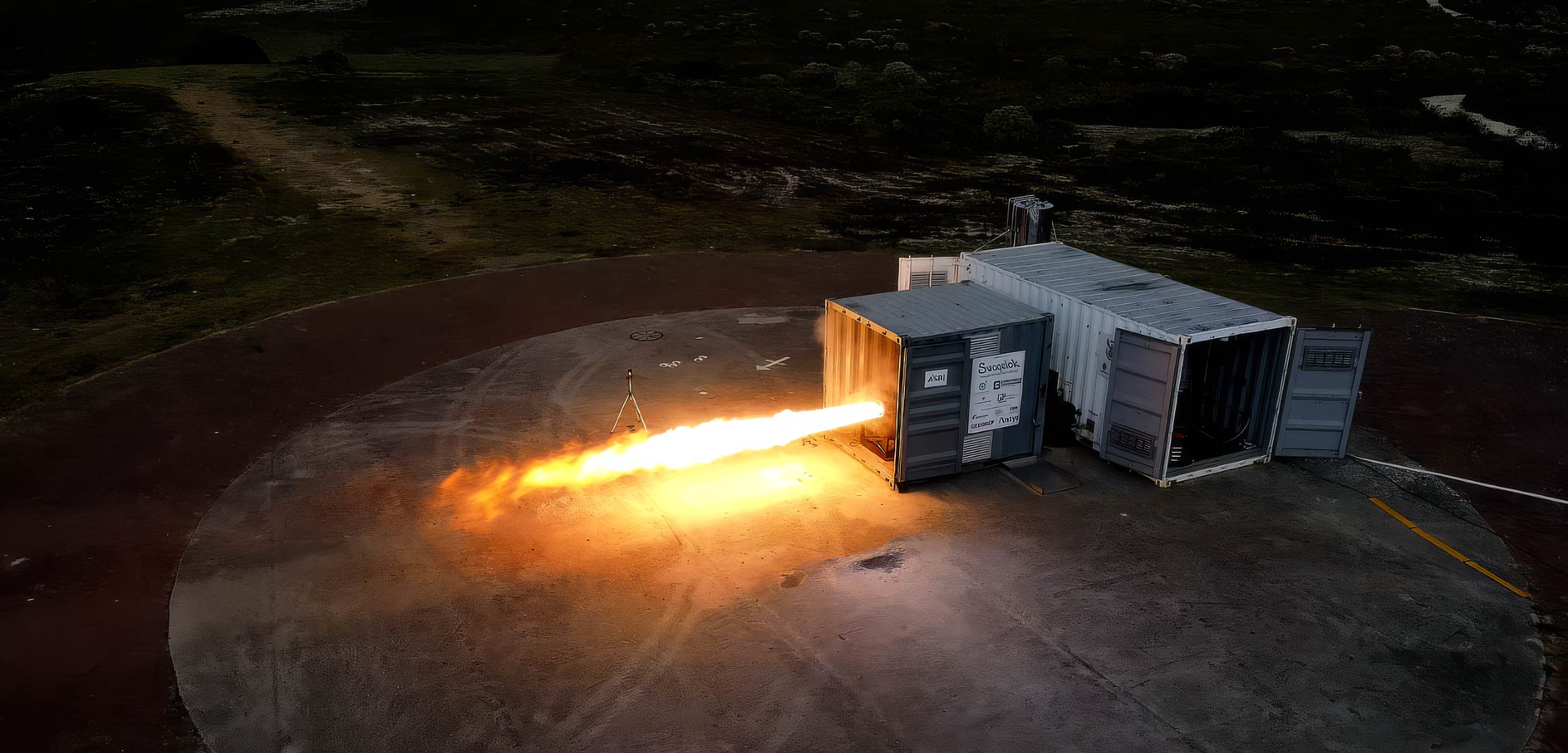
    The engine that has to make that work is Saffire, short for South African First Integrated Rocket Engine, designed for 27.6kN of thrust. An ablatively cooled, pressure-fed demonstrator known as Able, producing 18kN on liquid oxygen and Jet A-1 fuel, has been hot-fired at the Overberg site across three campaigns and was billed by UKZN as one of the most powerful student-built liquid rocket engines ever produced.

    “We are currently in the preliminary stages of testing of our first full-scale electro-pump and the regeneratively cooled chamber is currently being 3D printed at various vendors for assembly and test later this year,” Snedden said. “Once we have that we have the key to unlock the entire system.”

    Saffire rocket engine – June 2024 test campaign footage

    Phoenix is not being retired. Snedden said ASRI has helped international entities test their hybrid systems and “we might soon be launching Phoenix internationally”. The 2028 suborbital vehicle is central to a strategy of proving flight termination, recovery and telemetry on cheap rockets “before leaping into the much more costly CLV system”.

    ASRI also researches green monopropellant fuels and an in-space chemical thruster, and in November 2025 it opened an advanced manufacturing facility that Snedden said is already letting it machine high-tolerance parts in-house.

    ASRI collaborates with Stellenbosch University on turbopump development and with its Electronic Systems Laboratory on telemetry, downlinks and control. Snedden said the two are upgrading their memorandum of understanding to a memorandum of agreement, and he sees a bigger prize in the Stellenbosch-Somerset West corridor, home to firms including CubeSpace, Dragonfly Aerospace and Simera Sense and the subject of earlier TechCentral reporting on South Africa’s satellite cluster. “I believe there is a great opportunity to develop a broader aerospace institute to cater for more than just the sum of our parts,” he said.

    …article continues below…
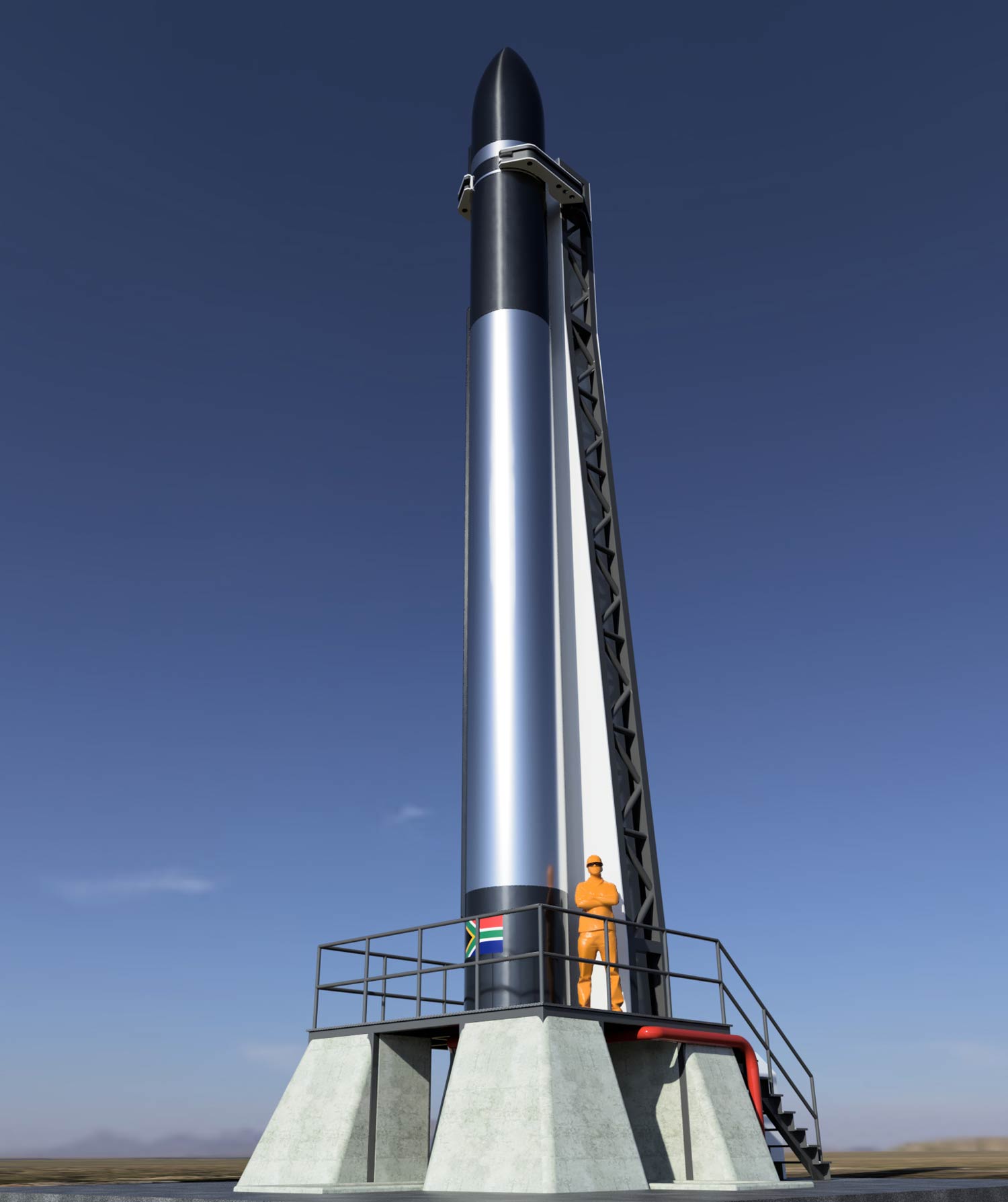
    Concept art for the proposed Saffire-powered South African Commercial Launch Vehicle (CLV) capable of lifting 200kg into polar orbit from the Overberg Test Range
    Concept art for the proposed Saffire-powered South African Commercial Launch Vehicle (CLV) capable of lifting 200kg into polar orbit from the Overberg Test Range

    In June 2025, Daily Maverick reported that Elon Musk wanted to launch SpaceX rockets from Overberg, in the context of White House discussions involving President Cyril Ramaphosa. The claim was not sourced to a named party, and neither Musk nor SpaceX has said so publicly.

    Snedden is not opposed in principle. The gantry was sized to accept European systems such as the German aerospace centre’s Red Kite motor, he said, and there have been exploratory talks about bringing international vehicles here for scientific missions, “not that they have led to much”. “We clearly support the idea as an opportunity to learn.”

    Denel is ready to support a sovereign launch capability but do not see it as an international opportunity

    The more difficult problem is that launch technology is tightly controlled and dual-use. “Moving launch systems from one country to another and potentially ‘sharing’ this knowledge would have to come with credible assurances between governments and at the moment this is a challenging requirement given the lack of trust on all sides,” Snedden said. Anything short of equitable co-development, he added, would cost more in technology transfer than building the capability locally and “lock South Africa into dated design philosophies”.

    Denel, he said, is “standing ready to support the creation of a sovereign launch capability but do not see it as an international marketing opportunity, which is unfortunate given the opportunities which exist in the market today”.

    ASRI sees “hopeful signs” in the re-establishment of the South African Council for Space Affairs, which licenses launch activity under the Space Affairs Act of 1993. The site question is more awkward. The Overberg’s southern latitude suits polar and sun-synchronous launches – precisely what the 200kg CLV is designed for – but rules it out for customers wanting equatorial orbits.

    Read: Prominent South African investor joins the board of SpaceX

    Progress, Snedden said, is measured in tests rather than triumphs. “We are in a spiral development process … so success and failure frequently coexist in a bittersweet arrangement. We do everything we can to mitigate against the risk and ensure that we fail forwards. That is something Elon Musk has taught us.”  – © 2026 NewsCentral Media

    • Main image: Full scale, full throttle testing of the Saffire engine, pressure fed from the containerised system built by ASRI and deployed to the test site at Overberg
    • Subscribe to TechCentral’s daily newsletter
    • Get breaking news alerts on WhatsApp

    Follow TechCentral on Google News Add TechCentral as your preferred source on Google


    Asri Corné Schutte Denel Elon Musk Glen Snedden Jean Pitot Mura Space Nomalungelo Gina Rocket Lab SpaceX Stellenbosch University University of KwaZulu-Natal
    WhatsApp YouTube
    Share. Facebook Twitter LinkedIn WhatsApp Telegram Email Copy Link
    Previous ArticleNew poll undermines the case against a Starlink deal

    Related Posts

    New poll undermines the case against a Starlink deal

    New poll undermines the case against a Starlink deal

    13 August 2026
    Meet the CIO | Discovery's Derek Wilcocks on AI, guardrails and growth

    Meet the CIO | Derek Wilcocks on how AI personalised Vitality

    13 August 2026
    How much Amazon Leo will cost in South Africa - Van Zyl Botha

    How much Amazon Leo will cost in South Africa

    11 August 2026
    Company News
    Kaspersky on how to secure a supply chain you do not control

    Kaspersky on how to secure a supply chain you do not control

    13 August 2026
    Build or buy software? AI is rewriting the answer - BBD Software

    Build or buy software? AI is rewriting the answer

    12 August 2026
    Max zoom meets max speed with the new 5G Huawei Pura 90s series

    Max Zoom meets Max Speed with the 5G Huawei Pura 90s series

    11 August 2026
    Opinion
    The author, Jannie van Zyl

    Selling vapour is corporate suicide in slow motion

    16 July 2026
    Brazil's online gambling crackdown is a lesson for South Africa

    How Amazon outmanoeuvred Starlink in South Africa

    15 July 2026
    The Popia problem with agentic AI - Herman Haasbroek

    The Popia problem with agentic AI

    14 July 2026

    Subscribe to Updates

    Get the best South African technology news and analysis delivered to your e-mail inbox every morning.

    Latest Posts
    South Africa targets 2030 for its first satellite launch from home soil

    South Africa targets 2030 for its first satellite launch from home soil

    13 August 2026
    New poll undermines the case against a Starlink deal

    New poll undermines the case against a Starlink deal

    13 August 2026
    Kaspersky on how to secure a supply chain you do not control

    Kaspersky on how to secure a supply chain you do not control

    13 August 2026
    Meet the CIO | Discovery's Derek Wilcocks on AI, guardrails and growth

    Meet the CIO | Derek Wilcocks on how AI personalised Vitality

    13 August 2026
    © 2009 - 2026 NewsCentral Media
    Built and maintained by Chronon
    • Cookie policy (ZA)
    • TechCentral – privacy and Popia

    Type above and press Enter to search. Press Esc to cancel.

    Manage consent

    TechCentral uses cookies to enhance its offerings. Consenting to these technologies allows us to serve you better. Not consenting or withdrawing consent may adversely affect certain features and functions of the website.

    Functional Always active
    The technical storage or access is strictly necessary for the legitimate purpose of enabling the use of a specific service explicitly requested by the subscriber or user, or for the sole purpose of carrying out the transmission of a communication over an electronic communications network.
    Preferences
    The technical storage or access is necessary for the legitimate purpose of storing preferences that are not requested by the subscriber or user.
    Statistics
    The technical storage or access that is used exclusively for statistical purposes. The technical storage or access that is used exclusively for anonymous statistical purposes. Without a subpoena, voluntary compliance on the part of your Internet Service Provider, or additional records from a third party, information stored or retrieved for this purpose alone cannot usually be used to identify you.
    Marketing
    The technical storage or access is required to create user profiles to send advertising, or to track the user on a website or across several websites for similar marketing purposes.
    • Manage options
    • Manage services
    • Manage {vendor_count} vendors
    • Read more about these purposes
    View preferences
    • {title}
    • {title}
    • {title}