Close Menu
TechCentralTechCentral

    Subscribe to the newsletter

    Get the best South African technology news and analysis delivered to your e-mail inbox every morning.

    Facebook X (Twitter) YouTube LinkedIn
    WhatsApp Facebook X (Twitter) LinkedIn YouTube
    TechCentralTechCentral
    • News
      Big Microsoft 365 price increases coming next year

      Big Microsoft price increases coming next year

      5 December 2025
      Vodacom to take control of Safaricom in R36-billion deal - Shameel Joosub

      Vodacom to take control of Safaricom in R36-billion deal

      4 December 2025
      Black Friday goes digital in South Africa as online spending surges to record high

      Black Friday goes digital in South Africa as online spending surges to record high

      4 December 2025
      BYD takes direct aim at Toyota with launch of sub-R500 000 Sealion 5 PHEV

      BYD takes direct aim at Toyota with launch of sub-R500 000 Sealion 5 PHEV

      4 December 2025
      'Get it now': Takealot in new instant deliveries pilot

      ‘Get it now’: Takealot in new instant deliveries pilot

      4 December 2025
    • World
      Amazon and Google launch multi-cloud service for faster connectivity

      Amazon and Google launch multi-cloud service for faster connectivity

      1 December 2025
      Google makes final court plea to stop US breakup

      Google makes final court plea to stop US breakup

      21 November 2025
      Bezos unveils monster rocket: New Glenn 9x4 set to dwarf Saturn V

      Bezos unveils monster rocket: New Glenn 9×4 set to dwarf Saturn V

      21 November 2025
      Tech shares turbocharged by Nvidia's stellar earnings

      Tech shares turbocharged by stellar Nvidia earnings

      20 November 2025
      Config file blamed for Cloudflare meltdown that disrupted the web

      Config file blamed for Cloudflare meltdown that disrupted the web

      19 November 2025
    • In-depth
      Jensen Huang Nvidia

      So, will China really win the AI race?

      14 November 2025
      Valve's Linux console takes aim at Microsoft's gaming empire

      Valve’s Linux console takes aim at Microsoft’s gaming empire

      13 November 2025
      iOCO's extraordinary comeback plan - Rhys Summerton

      iOCO’s extraordinary comeback plan

      28 October 2025
      Why smart glasses keep failing - no, it's not the tech - Mark Zuckerberg

      Why smart glasses keep failing – it’s not the tech

      19 October 2025
      BYD to blanket South Africa with megawatt-scale EV charging network - Stella Li

      BYD to blanket South Africa with megawatt-scale EV charging network

      16 October 2025
    • TCS
      TCS+ | How Cloud on Demand helps partners thrive in the AWS ecosystem - Odwa Ndyaluvane and Xenia Rhode

      TCS+ | How Cloud On Demand helps partners thrive in the AWS ecosystem

      4 December 2025
      TCS | MTN Group CEO Ralph Mupita on competition, AI and the future of mobile

      TCS | Ralph Mupita on competition, AI and the future of mobile

      28 November 2025
      TCS | Dominic Cull on fixing South Africa's ICT policy bottlenecks

      TCS | Dominic Cull on fixing South Africa’s ICT policy bottlenecks

      21 November 2025
      TCS | BMW CEO Peter van Binsbergen on the future of South Africa's automotive industry

      TCS | BMW CEO Peter van Binsbergen on the future of South Africa’s automotive industry

      6 November 2025
      TCS | Why Altron is building an AI factory - Bongani Andy Mabaso

      TCS | Why Altron is building an AI factory in Johannesburg

      28 October 2025
    • Opinion
      Your data, your hardware: the DIY AI revolution is coming - Duncan McLeod

      Your data, your hardware: the DIY AI revolution is coming

      20 November 2025
      Zero Carbon Charge founder Joubert Roux

      The energy revolution South Africa can’t afford to miss

      20 November 2025
      It's time for a new approach to government IT spend in South Africa - Richard Firth

      It’s time for a new approach to government IT spend in South Africa

      19 November 2025
      How South Africa's broken Rica system fuels murder and mayhem - Farhad Khan

      How South Africa’s broken Rica system fuels murder and mayhem

      10 November 2025
      South Africa's AI data centre boom risks overloading a fragile grid - Paul Colmer

      South Africa’s AI data centre boom risks overloading a fragile grid

      30 October 2025
    • Company Hubs
      • Africa Data Centres
      • AfriGIS
      • Altron Digital Business
      • Altron Document Solutions
      • Altron Group
      • Arctic Wolf
      • AvertITD
      • Braintree
      • CallMiner
      • CambriLearn
      • CYBER1 Solutions
      • Digicloud Africa
      • Digimune
      • Domains.co.za
      • ESET
      • Euphoria Telecom
      • Incredible Business
      • iONLINE
      • IQbusiness
      • Iris Network Systems
      • LSD Open
      • NEC XON
      • Netstar
      • Network Platforms
      • Next DLP
      • Ovations
      • Paracon
      • Paratus
      • Q-KON
      • SevenC
      • SkyWire
      • Solid8 Technologies
      • Telit Cinterion
      • Tenable
      • Vertiv
      • Videri Digital
      • Vodacom Business
      • Wipro
      • Workday
      • XLink
    • Sections
      • AI and machine learning
      • Banking
      • Broadcasting and Media
      • Cloud services
      • Contact centres and CX
      • Cryptocurrencies
      • Education and skills
      • Electronics and hardware
      • Energy and sustainability
      • Enterprise software
      • Financial services
      • Information security
      • Internet and connectivity
      • Internet of Things
      • Investment
      • IT services
      • Lifestyle
      • Motoring
      • Public sector
      • Retail and e-commerce
      • Satellite communications
      • Science
      • SMEs and start-ups
      • Social media
      • Talent and leadership
      • Telecoms
    • Events
    • Advertise
    TechCentralTechCentral
    Home » News » Space Station set to fall back to Earth in a fiery blaze

    Space Station set to fall back to Earth in a fiery blaze

    By Fabian Zander15 February 2022
    Twitter LinkedIn Facebook WhatsApp Email Telegram Copy Link
    News Alerts
    WhatsApp
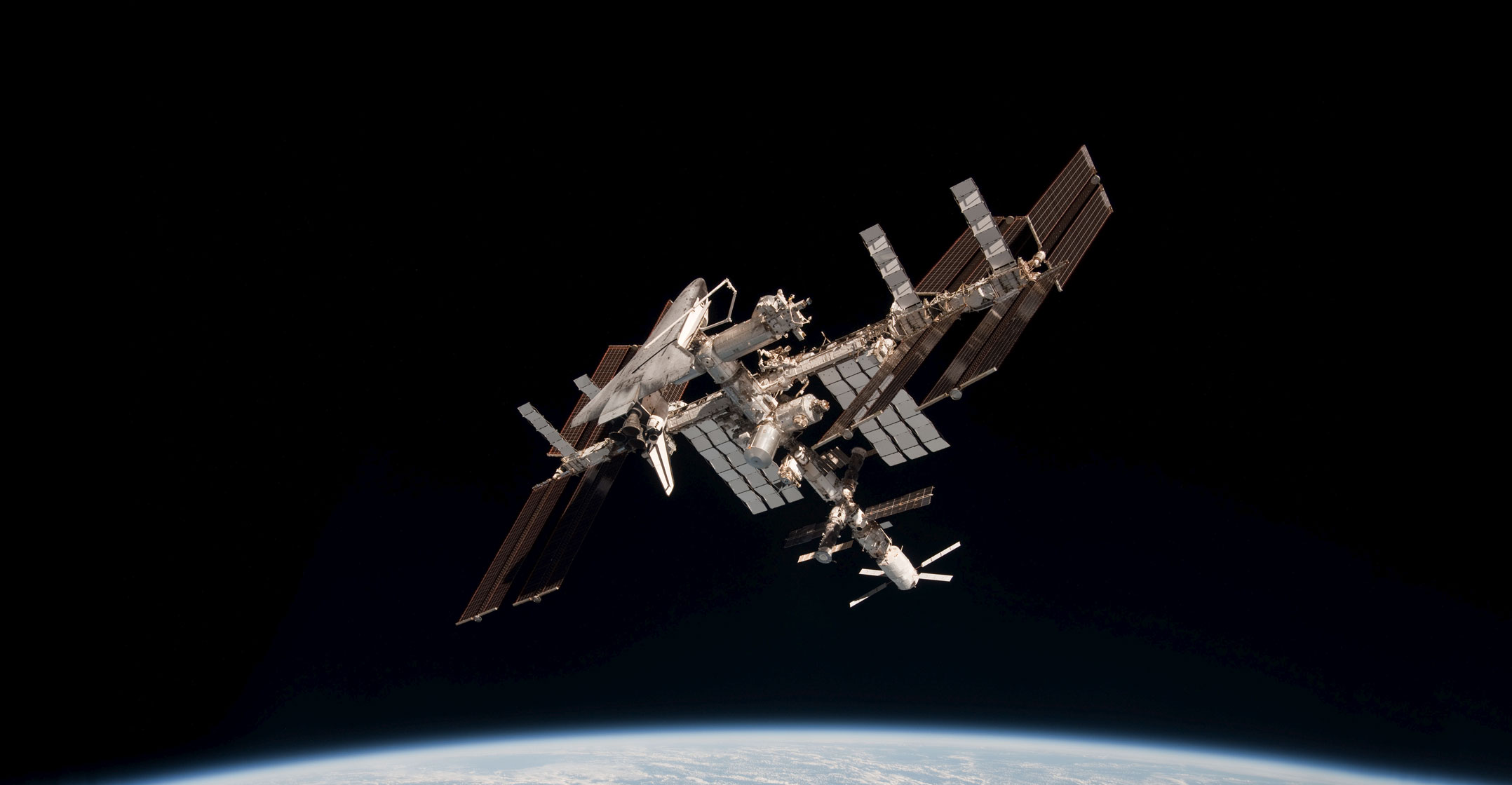
    The International Space Station

    For more than two decades, the International Space Station (ISS) has been the mainstay of human presence and research in space. More than 100m long, it’s the largest object ever placed in space, and its construction brought together the space agencies from the US, Europe, Russia, Japan and Canada.

    The ISS has hosted research that could not have been done anywhere else, in the fields of microgravity, space biology, human physiology and fundamental physics. It also provides a base for deep space exploration.

    Now, the end of its life has been planned. According to Nasa, the station is expected to be de-orbited by 2031 (an extension from the original plan to de-orbit by 2020). But if the ISS is so important, why is there an end-of-life plan at all?

    There comes a time when the costs and risks of maintaining the ISS become too high

    The first components of the ISS were launched in the 1990s. And although many parts have been updated and replaced, it’s not feasible to replace everything.

    In particular, the main structural components can’t be replaced. While they are checked, monitored and repaired, there are limits to this. The ISS was not designed to last forever.

    It survives in a harsh environment, travelling at 27 500km/h, with a day/night cycle every 90 minutes (the time it takes the ISS to orbit Earth).

    The temperature differences experienced during each cycle put a small fatiguing load on the structure. Over a few years, this is not significant. But over the course of decades this can cause fatigue failures in the metal structure.

    So, there comes a time when the costs and risks of maintaining the ISS become too high, and this has been determined to be in 2030.

    Gravity

    As with all objects under the influence of gravity, given time the ISS would simply fall down to Earth. This is because, even at the orbital altitude of 400km, there is some drag due to small particles. In fact, the ISS currently requires a regular boost to lift its orbital altitude, which is slowly – but constantly – decreasing.

    A natural re-entry would be a completely uncontrolled process, and there would be no way of predicting where this would take place. The responsible (and planned) approach is to use thrusters to slow the ISS down, causing the de-orbit to happen much faster and in a specific location decided in advance.

    The slowing down will initially be done using thrusters on the station, and on support vehicles docked to the station. This process may take a few months and will slowly reduce the orbital altitude of the ISS, preparing it for the final re-entry phase.

    In the final phase, the deceleration will be much more rapid, and will determine the ISS’s final re-entry trajectory. Although it hasn’t been decided exactly how the ISS will reach its final deceleration, the favoured option is to use three modified Russian Progress spacecraft.

    The spacecraft will be docked to the ISS and fire their propulsion systems to achieve the required deceleration – controlling the trajectory of the re-entry and the re-entry location.
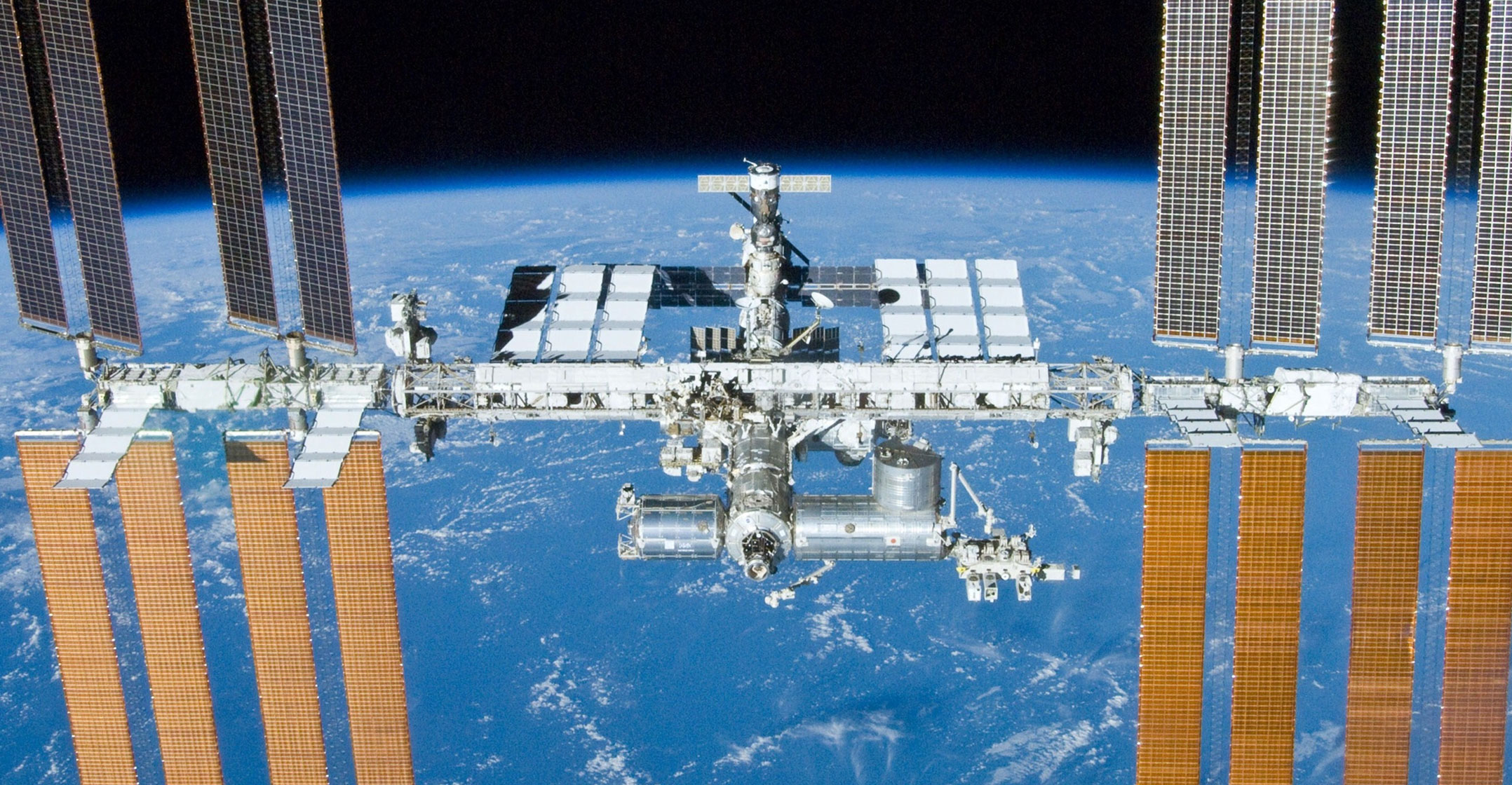
    The Space Station has about a decade of useful life left in it

    It will take a couple of minutes for the ISS to pass through the atmosphere. It’s likely the higher-altitude phase of this will take place near or above Australia.

    The re-entry will be a visually spectacular event, resembling multiple large shooting stars. An increasing number of space debris breakup events have been observed and videoed over the last few years.

    But these re-entries have been small objects, sized in the order of metres, such as the ATV-1 and Cygnus spacecraft. Meanwhile, the ISS is about the size of a football field, and will be correspondingly more spectacular.

    Due to the danger of components reaching the surface, it will be important to make sure they fall where there is minimal risk to people or property. Even a controlled re-entry will potentially spread pieces of debris over an area of hundreds, if not thousands, of kilometres.

    This is why the ISS re-entry (and most space debris de-orbits) will target an area known as the South Pacific Ocean Uninhabited Area (Spoua), the centre of which is known as Point Nemo, or the “Spacecraft Cemetery”.

    Dumping ground

    The Spoua is used as Earth’s dumping ground for space debris. It’s the largest uninhabited area on Earth, and hence has the lowest risk associated with debris from re-entry.

    The ISS will be travelling at something like 6km/s when it hits the atmosphere. This high speed will cause the air in front of the structure to heat up significantly, reaching temperatures in excess of 10 000℃.

    This will cause the structure to break into smaller pieces. Most of it will burn up as it falls, but it’s very likely some small pieces will survive – especially some of the heavier and denser internal components.

    Any surviving debris will eventually sink into the ocean and disappear.The Conversation

    • Written by Fabian Zander, senior research fellow in aerospace engineering, University of Southern Queensland
    • This article is republished from The Conversation under a Creative Commons licence


    International Space Station ISS Nasa
    Subscribe to TechCentral Subscribe to TechCentral
    Share. Facebook Twitter LinkedIn WhatsApp Telegram Email Copy Link
    Previous ArticleBuffett bought $1-billion in Activision shares before Microsoft deal
    Next Article Cape Town fintech Stitch raises R315-million in series-A round

    Related Posts

    Nasa astronauts head home on SpaceX capsule

    Nasa astronauts head home on SpaceX capsule

    18 March 2025
    Low-Earth orbit satellites - the way forward for Africa

    Why car companies like Toyota are turning to space

    14 February 2025

    Bookmarks | The number of new mobile internet users is stalling

    25 November 2024
    Company News
    AI is not a technology problem - iqbusiness

    AI is not a technology problem – iqbusiness

    5 December 2025
    Telcos are sitting on a data gold mine - but few know what do with it - Phillip du Plessis

    Telcos are sitting on a data gold mine – but few know what do with it

    4 December 2025
    Unlock smarter computing with your surface Copilot+ PC

    Unlock smarter computing with your Surface Copilot+ PC

    4 December 2025
    Opinion
    Your data, your hardware: the DIY AI revolution is coming - Duncan McLeod

    Your data, your hardware: the DIY AI revolution is coming

    20 November 2025
    Zero Carbon Charge founder Joubert Roux

    The energy revolution South Africa can’t afford to miss

    20 November 2025
    It's time for a new approach to government IT spend in South Africa - Richard Firth

    It’s time for a new approach to government IT spend in South Africa

    19 November 2025

    Subscribe to Updates

    Get the best South African technology news and analysis delivered to your e-mail inbox every morning.

    Latest Posts
    Big Microsoft 365 price increases coming next year

    Big Microsoft price increases coming next year

    5 December 2025
    AI is not a technology problem - iqbusiness

    AI is not a technology problem – iqbusiness

    5 December 2025
    Vodacom to take control of Safaricom in R36-billion deal - Shameel Joosub

    Vodacom to take control of Safaricom in R36-billion deal

    4 December 2025
    Black Friday goes digital in South Africa as online spending surges to record high

    Black Friday goes digital in South Africa as online spending surges to record high

    4 December 2025
    © 2009 - 2025 NewsCentral Media
    • Cookie policy (ZA)
    • TechCentral – privacy and Popia

    Type above and press Enter to search. Press Esc to cancel.

    Manage consent

    TechCentral uses cookies to enhance its offerings. Consenting to these technologies allows us to serve you better. Not consenting or withdrawing consent may adversely affect certain features and functions of the website.

    Functional Always active
    The technical storage or access is strictly necessary for the legitimate purpose of enabling the use of a specific service explicitly requested by the subscriber or user, or for the sole purpose of carrying out the transmission of a communication over an electronic communications network.
    Preferences
    The technical storage or access is necessary for the legitimate purpose of storing preferences that are not requested by the subscriber or user.
    Statistics
    The technical storage or access that is used exclusively for statistical purposes. The technical storage or access that is used exclusively for anonymous statistical purposes. Without a subpoena, voluntary compliance on the part of your Internet Service Provider, or additional records from a third party, information stored or retrieved for this purpose alone cannot usually be used to identify you.
    Marketing
    The technical storage or access is required to create user profiles to send advertising, or to track the user on a website or across several websites for similar marketing purposes.
    • Manage options
    • Manage services
    • Manage {vendor_count} vendors
    • Read more about these purposes
    View preferences
    • {title}
    • {title}
    • {title}