Close Menu
TechCentralTechCentral

    Subscribe to the newsletter

    Get the best South African technology news and analysis delivered to your e-mail inbox every morning.

    Facebook X (Twitter) YouTube LinkedIn
    WhatsApp Facebook X (Twitter) LinkedIn YouTube
    TechCentralTechCentral
    • News
      Vodacom taps UJ, AWS to build its AI talent pipeline - Vodacom Group CEO Shameel Joosub

      Vodacom taps UJ, AWS to build its AI talent pipeline

      24 July 2026
      Africa's most popular phones have a tracking problem

      Africa’s most popular phones have a tracking problem

      24 July 2026
      Intel is back in the game - Intel CEO Lip-Bu Tan. Laure Andrillon/Reuters

      Intel is back in the game

      24 July 2026
      Fat bonuses at Telkom despite group missing own targets - Serame Taukobong

      Fat bonuses at Telkom despite group missing own targets

      23 July 2026
      Massive changes coming to Amazon Prime Video - Jeff Bezos

      Massive changes coming to Amazon Prime Video

      23 July 2026
    • World
      Meta AI will now tell parents if their teen is in crisis

      Meta AI will now tell parents if their teen is in crisis

      17 July 2026
      IBM shares crash 25% as AI upends software spending - Arvind Krishna

      IBM shares crash 25% as AI upends software spending

      15 July 2026
      Jony Ive's first OpenAI device: an AI smart speaker - Jony Ive and Sam Altman

      Jony Ive’s first OpenAI device: an AI smart speaker

      15 July 2026
      Stripe, Advent in talks to buy PayPal for $53-billion

      Stripe, Advent in talks to buy PayPal for $53-billion

      15 July 2026
      Memory crisis sends smartphone market into steep decline

      Memory crisis sends smartphone market into steep decline

      13 July 2026
    • In-depth
      The plan to stop AI from breaking the world - Google DeepMind CEO Demis Hassabis. Image: John Sears

      The plan to stop AI from breaking the world

      16 July 2026
      The internet has a Strait of Hormuz problem

      The internet has a Strait of Hormuz problem

      15 July 2026
      AI boom sparks rally, frenzy and fear

      AI boom sparks rally, frenzy and fear

      11 June 2026
      Every plug-in hybrid on sale in South Africa, ranked by price - Lamborghini Temerario

      Every plug-in hybrid on sale in South Africa, ranked by price

      7 June 2026
      What Wi-Fi 8 will mean for wireless networks

      What Wi-Fi 8 will mean for wireless networks

      1 June 2026
    • TCS
      TCS | How Optasia lends billions to people banks can't see - Salvador Anglada

      TCS | How Optasia lends billions to people banks can’t see

      23 July 2026
      The rands-and-cents case for electric trucks - William Kelly Watts & Wheels with Wills

      The rands-and-cents case for electric trucks

      20 July 2026
      Watts & Wheels S1E7: 'Ferrari's EV breaks the internet'

      Watts & Wheels S1E7: ‘Ferrari’s EV breaks the internet’

      8 July 2026
      TCS | Pick n Pay's Enrico Ferigolli on Penny, the AI that shops for you

      TCS | Pick n Pay’s Enrico Ferigolli on Penny, the AI that shops for you

      2 July 2026
      TCS+ | How Tracker is turning vehicle data into business strategy - Silvia Schollenberger

      TCS+ | How Tracker is turning vehicle data into business strategy

      1 July 2026
    • Opinion
      Selling vapour is corporate suicide in slow motion - Jannie van Zyl

      Selling vapour is corporate suicide in slow motion

      16 July 2026
      Brazil's online gambling crackdown is a lesson for South Africa

      How Amazon outmanoeuvred Starlink in South Africa

      15 July 2026
      The Popia problem with agentic AI - Herman Haasbroek

      The Popia problem with agentic AI

      14 July 2026
      The author, Fanie van Rooyen

      South Africa can still catch the AI wave – here’s how

      7 July 2026
      The author, Fanie van Rooyen

      The AI utopia South Africa can’t afford

      1 July 2026
    • Company Hubs
      • 1Stream
      • Africa Data Centres
      • AfriGIS
      • Altron Digital Business
      • Altron Document Solutions
      • Altron Group
      • Arctic Wolf
      • Ascent Technology
      • AvertITD
      • BBD
      • Braintree
      • CallMiner
      • CambriLearn
      • CM Telecom
      • Contactable
      • CYBER1 Solutions
      • Digicloud Africa
      • Digimune
      • Domains.co.za
      • ESET
      • Euphoria Telecom
      • HOSTAFRICA
      • Incredible Business
      • iONLINE
      • IQbusiness
      • Iris Network Systems
      • Kaspersky
      • LSD Open
      • Mitel
      • NEC XON
      • Netstar
      • Network Platforms
      • Next DLP
      • Ovations
      • Paracon
      • Paratus
      • Q-KON
      • SevenC
      • SkyWire
      • Solid8 Technologies
      • Telit Cinterion
      • Telviva
      • Tenable
      • Vertiv
      • Videri Digital
      • Vodacom Business
      • Vox
      • Wipro
      • Workday
      • XLink
    • Sections
      • AI and machine learning
      • Banking
      • Broadcasting and Media
      • Cloud services
      • Contact centres and CX
      • Cryptocurrencies
      • Education and skills
      • Electronics and hardware
      • Energy and sustainability
      • Enterprise software
      • Financial services
      • HealthTech
      • Information security
      • Internet and connectivity
      • Internet of Things
      • Investment
      • IT services
      • Lifestyle
      • Policy and regulation
      • Public sector
      • Retail and e-commerce
      • Satellite communications
      • Science
      • SMEs and start-ups
      • Social media
      • Talent and leadership
      • Telecoms
      • Watts & Wheels
    • Events
    • Advertise
    TechCentralTechCentral
    Home » Sections » Science » SpaceX reaches for a milestone in spaceflight

    SpaceX reaches for a milestone in spaceflight

    By The Conversation25 May 2020
    Twitter LinkedIn Facebook WhatsApp Email Telegram Copy Link
    News Alerts
    WhatsApp
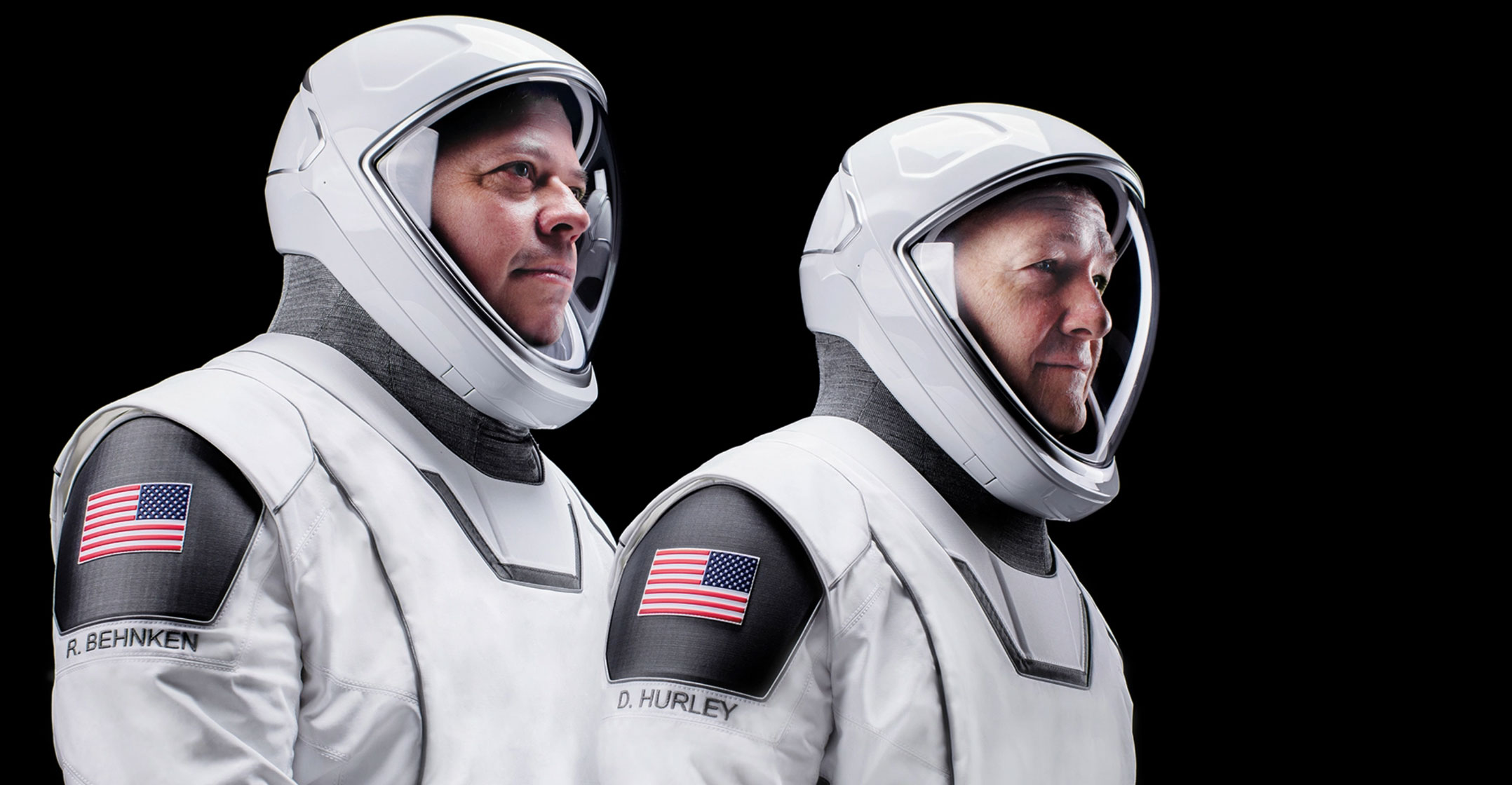
    US astronauts Robert Behnken and Douglas Hurley. Image: SpaceX

    On 27 May, two US astronauts, Robert Behnken and Douglas Hurley, are planning to launch from the Kennedy Space Centre on a mission to the International Space Station. If successful, this will mark the first time in nine years that American astronauts will launch into space from US soil. What’s even more remarkable is they will not be launched by Nasa but by a private company, SpaceX.

    Human spaceflight is incredibly difficult and expensive; the rockets must be reliable and the vehicle must be built with expensive life support systems and a certain level of redundancy. To date, only three countries – Russia, the US and China – have achieved this feat.

    As a space policy expert, I find it hard to overstate the significance for both SpaceX and spaceflight in general. For SpaceX, it’s another step on its road to Mars, but more generally, it demonstrates that spaceflight need not be reserved for only the most powerful of states.

    In many ways, SpaceX’s achievement is due not only to technological advances, but opportunity brought about by disaster

    In many ways, SpaceX’s achievement is due not only to technological advances, but opportunity brought about by disaster. The breakup of the space shuttle Columbia in 2003 led the George W Bush administration to decide to end the shuttle programme by 2010. They directed Nasa to develop a replacement, Project Constellation, but due to budget cuts and other problems, Nasa failed to make significant progress. As a result, in 2010, the Barack Obama administration directed Nasa to refocus its efforts on deep-space missions and rely on private companies to provide access to the ISS and low-earth orbit.

    Enter SpaceX. Dreaming of colonisation of Mars but frustrated with the slow pace at which it was coming, Elon Musk founded SpaceX in 2002. To get to Mars, he decided that spaceflight would first need to be made cheaper. His philosophy was to devise a rocket system that could be used again and again with minimal refurbishment between flights. Over the next decade, SpaceX designed, built and tested its Falcon series of rockets. It signed contracts with Nasa to provide cargo services to the ISS and with other companies and the US military to provide general launch services. Perhaps most importantly, SpaceX has demonstrated that its rockets can be reused, with the core stages flying their way back to Earth to land themselves.

    Shift

    The 2010 shift in American space policy gave SpaceX an opportunity to build on its early successes. By 2014, both SpaceX and Boeing were given contracts from Nasa to provide commercial crew launch services. And it appears, so far, that SpaceX has made good on its promise of reducing the cost of human spaceflight. Compared to an average space shuttle mission that cost US$1.6-billion, Nasa is paying only $55-million per seat for SpaceX’s upcoming ISS flights.

    This massive reduction in cost made possible through reusable rockets is contributing to several developments in spaceflight. First, it provides Nasa a means of access to the ISS without relying on the Russian Soyuz. Since 2011, the US has been paying Russia upwards of $86-million per seat for flights to the space station.

    Second, with SpaceX and Boeing providing access to the ISS, Nasa can concentrate on Project Artemis, which intends to return humans to the Moon by 2024. They are also leveraging new commercial capabilities from SpaceX, Blue Origin and others to further reduce costs to get there.
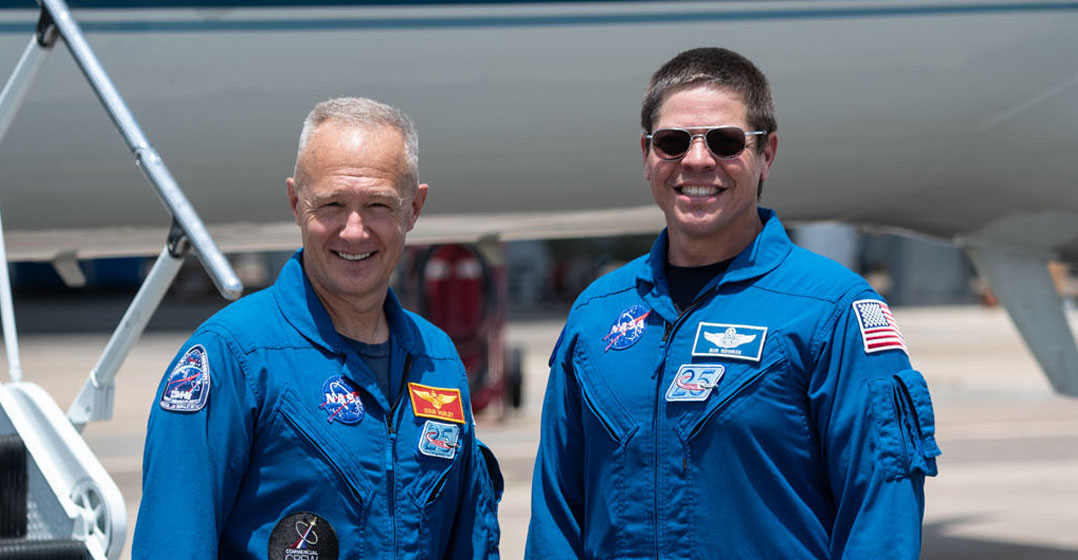
    Astronauts Douglas Hurley, left, and Robert Behnken before boarding the Gulfstream jet that will carry them to Kennedy Space Centre in Florida. Image: James Blair/Nasa

    If SpaceX is successful, it could also mean the opening of space to tourism. Blue Origin and Virgin Galactic are planning to offer brief suborbital launches that don’t enter Earth orbit. SpaceX, on the other hand, is already signing up passengers for several-day trips to space at $35-million a seat. Even Tom Cruise is looking to fly on SpaceX and film a movie aboard the ISS. While space companies have long predicted opportunities for space tourism, SpaceX’s Dragon brings that possibility closer to reality.

    More broadly, adding tourists to the mix in low-earth orbit may even help make space safer. Debris in orbit is a growing problem, along with increasing tensions between the US, China and Russia in space. Both of those things make operating in space more difficult, dangerous and costlier.

    For the space economy to really take off, countries will need to put in place regulations that ensure safety and reliability in several areas, including vehicle safety and debris mitigation. And, as I suggest in my new book, having more humans in space might force countries to think twice before taking potentially dangerous actions in space. While orbital space tourism might still be far off for the average American, SpaceX’s crew launch brings us closer to the day when an extraordinary event is a normal occurrence.The Conversation

    • Written by Wendy Whitman Cobb, professor of strategy and security studies, US Air Force School of Advanced Air and Space Studies
    • This article is republished from The Conversation under a Creative Commons licence

    Follow TechCentral on Google News Add TechCentral as your preferred source on Google


    Douglas Hurley Nasa Robert Behnken SpaceX top
    WhatsApp YouTube
    Share. Facebook Twitter LinkedIn WhatsApp Telegram Email Copy Link
    Previous ArticleChina’s trillions toward tech won’t buy dominance
    Next Article MTN unveils 1GB daily bundles for R29

    Related Posts

    Intel is back in the game - Intel CEO Lip-Bu Tan. Laure Andrillon/Reuters

    Intel is back in the game

    24 July 2026
    SpaceX

    SpaceX shares slide below listing price

    16 July 2026
    Brazil's online gambling crackdown is a lesson for South Africa

    How Amazon outmanoeuvred Starlink in South Africa

    15 July 2026
    Company News
    Green dashboards, stalled change: the CIO's blind spot - Change Logic Marchant van den Heever

    Green dashboards, stalled change: the CIO’s blind spot

    24 July 2026
    Why Africa's cloud needs more than one path - Africa Data Centres

    Why Africa’s cloud needs more than one path

    23 July 2026
    Samsung's new Galaxy Z series: foldables, perfected

    Samsung’s new Galaxy Z series: foldables, perfected

    22 July 2026
    Opinion
    Selling vapour is corporate suicide in slow motion - Jannie van Zyl

    Selling vapour is corporate suicide in slow motion

    16 July 2026
    Brazil's online gambling crackdown is a lesson for South Africa

    How Amazon outmanoeuvred Starlink in South Africa

    15 July 2026
    The Popia problem with agentic AI - Herman Haasbroek

    The Popia problem with agentic AI

    14 July 2026

    Subscribe to Updates

    Get the best South African technology news and analysis delivered to your e-mail inbox every morning.

    Latest Posts
    Vodacom taps UJ, AWS to build its AI talent pipeline - Vodacom Group CEO Shameel Joosub

    Vodacom taps UJ, AWS to build its AI talent pipeline

    24 July 2026
    Green dashboards, stalled change: the CIO's blind spot - Change Logic Marchant van den Heever

    Green dashboards, stalled change: the CIO’s blind spot

    24 July 2026
    Africa's most popular phones have a tracking problem

    Africa’s most popular phones have a tracking problem

    24 July 2026
    Intel is back in the game - Intel CEO Lip-Bu Tan. Laure Andrillon/Reuters

    Intel is back in the game

    24 July 2026
    © 2009 - 2026 NewsCentral Media
    Built and maintained by Chronon
    • Cookie policy (ZA)
    • TechCentral – privacy and Popia

    Type above and press Enter to search. Press Esc to cancel.

    Manage consent

    TechCentral uses cookies to enhance its offerings. Consenting to these technologies allows us to serve you better. Not consenting or withdrawing consent may adversely affect certain features and functions of the website.

    Functional Always active
    The technical storage or access is strictly necessary for the legitimate purpose of enabling the use of a specific service explicitly requested by the subscriber or user, or for the sole purpose of carrying out the transmission of a communication over an electronic communications network.
    Preferences
    The technical storage or access is necessary for the legitimate purpose of storing preferences that are not requested by the subscriber or user.
    Statistics
    The technical storage or access that is used exclusively for statistical purposes. The technical storage or access that is used exclusively for anonymous statistical purposes. Without a subpoena, voluntary compliance on the part of your Internet Service Provider, or additional records from a third party, information stored or retrieved for this purpose alone cannot usually be used to identify you.
    Marketing
    The technical storage or access is required to create user profiles to send advertising, or to track the user on a website or across several websites for similar marketing purposes.
    • Manage options
    • Manage services
    • Manage {vendor_count} vendors
    • Read more about these purposes
    View preferences
    • {title}
    • {title}
    • {title}