Close Menu
TechCentralTechCentral

    Subscribe to the newsletter

    Get the best South African technology news and analysis delivered to your e-mail inbox every morning.

    Facebook X (Twitter) YouTube LinkedIn
    WhatsApp Facebook X (Twitter) LinkedIn YouTube
    TechCentralTechCentral
    • News
      How Comsol turned 60MHz into a national 5G bet - Iain Stevenson

      How Comsol turned 60MHz into a national 5G bet

      20 August 2026
      Humanoid robots poised for their 'ChatGPT moment'

      Humanoid robots poised for their ‘ChatGPT moment’

      20 August 2026
      SpaceX breaks cover at Icasa satellite spectrum hearings

      SpaceX breaks cover at Icasa satellite spectrum hearings

      20 August 2026
      South Africa to get a new national 5G broadband network - Iain Stevenson

      South Africa to get a new national 5G broadband network

      20 August 2026
      WhatsApp's free lunch ends on 1 October

      WhatsApp’s free lunch ends on 1 October

      19 August 2026
    • World
      Russia building its own Starlink - and faster than expected - Vadym Skibitskyi

      Russia building its own Starlink – and faster than expected

      11 August 2026
      Meta AI will now tell parents if their teen is in crisis

      Meta AI will now tell parents if their teen is in crisis

      17 July 2026
      IBM shares crash 25% as AI upends software spending - Arvind Krishna

      IBM shares crash 25% as AI upends software spending

      15 July 2026
      Jony Ive's first OpenAI device: an AI smart speaker - Jony Ive and Sam Altman

      Jony Ive’s first OpenAI device: an AI smart speaker

      15 July 2026
      Stripe, Advent in talks to buy PayPal for $53-billion

      Stripe, Advent in talks to buy PayPal for $53-billion

      15 July 2026
    • In-depth
      Google DeepMind CEO Demis Hassabis. Image: John Sears

      The plan to stop AI from breaking the world

      16 July 2026
      The internet has a Strait of Hormuz problem

      The internet has a Strait of Hormuz problem

      15 July 2026
      AI boom sparks rally, frenzy and fear

      AI boom sparks rally, frenzy and fear

      11 June 2026
      Every plug-in hybrid on sale in South Africa, ranked by price - Lamborghini Temerario

      Every plug-in hybrid on sale in South Africa, ranked by price

      7 June 2026
      What Wi-Fi 8 will mean for wireless networks

      What Wi-Fi 8 will mean for wireless networks

      1 June 2026
    • TCS
      Meet the CIO | Discovery's Derek Wilcocks on AI, guardrails and growth

      Meet the CIO | Derek Wilcocks on how AI personalised Vitality

      13 August 2026
      TCS | Money just became native to the internet - Steven Boykey Sidley

      TCS | Money just became native to the internet – Steven Boykey Sidley

      12 August 2026
      TCS+ | Specops' Darren James on continuous trust in an AI world

      TCS+ | Specops’ Darren James on continuous trust in an AI world

      7 August 2026
      TCS+ | How AI is turning hardware into a subscription service - Shane van der Merwe Merchant West

      TCS+ | How AI is turning hardware into a subscription service

      6 August 2026
      TCS+ | Why South African workers must become supervisors of digital labour - Accelera Digital Group Cliff de Wit

      TCS+ | Why South African workers must become supervisors of digital labour

      31 July 2026
    • Opinion
      The author, Jannie van Zyl

      Selling vapour is corporate suicide in slow motion

      16 July 2026
      Brazil's online gambling crackdown is a lesson for South Africa

      How Amazon outmanoeuvred Starlink in South Africa

      15 July 2026
      The Popia problem with agentic AI - Herman Haasbroek

      The Popia problem with agentic AI

      14 July 2026
      The author, Fanie van Rooyen

      South Africa can still catch the AI wave – here’s how

      7 July 2026
      The author, Fanie van Rooyen

      The AI utopia South Africa can’t afford

      1 July 2026
    • Company Hubs
      • 1Stream
      • Africa Data Centres
      • AfriGIS
      • Altron Digital Business
      • Altron Document Solutions
      • Altron Group
      • Arctic Wolf
      • Ascent Technology
      • AvertITD
      • BBD
      • Braintree
      • CallMiner
      • CambriLearn
      • CM Telecom
      • Contactable
      • CYBER1 Solutions
      • Digicloud Africa
      • Digimune
      • Domains.co.za
      • ESET
      • Euphoria Telecom
      • HOSTAFRICA
      • Incredible Business
      • iONLINE
      • IQbusiness
      • Iris Network Systems
      • Kaspersky
      • LSD Open
      • Mitel
      • NEC XON
      • Netstar
      • Network Platforms
      • Next DLP
      • Ovations
      • Paracon
      • Paratus
      • Q-KON
      • SevenC
      • SkyWire
      • Solid8 Technologies
      • Telit Cinterion
      • Telviva
      • Tenable
      • Vertiv
      • Videri Digital
      • Vodacom Business
      • Vox
      • Wipro
      • Workday
      • XLink
    • Sections
      • AI and machine learning
      • Banking
      • Broadcasting and Media
      • Cloud services
      • Contact centres and CX
      • Cryptocurrencies
      • Education and skills
      • Electronics and hardware
      • Energy and sustainability
      • Enterprise software
      • Financial services
      • HealthTech
      • Information security
      • Internet and connectivity
      • Internet of Things
      • Investment
      • IT services
      • Lifestyle
      • Policy and regulation
      • Public sector
      • Retail and e-commerce
      • Satellite communications
      • Science
      • SMEs and start-ups
      • Social media
      • Talent and leadership
      • Telecoms
      • Watts & Wheels
    • Events
    • Advertise
    TechCentralTechCentral
    Home » Sections » Internet and connectivity » Starlink profits are more elusive than investors think

    Starlink profits are more elusive than investors think

    SpaceX’s prized Starlink satellite business is still burning through more cash than it brings in.
    By Agency Staff10 April 2024
    Twitter LinkedIn Facebook WhatsApp Email Telegram Copy Link
    News Alerts
    WhatsApp

    SpaceX’s prized Starlink satellite business is still burning through more cash than it brings in.

    People familiar with the finances of one of the world’s most valuable private companies say Starlink has — at times — lost hundreds of dollars on each of the millions of ground terminals it ships, casting doubt on claims by CEO Elon Musk and the company’s top brass that the business is in “profitable territory”.

    Starlink, which provides space-based internet service to more than 2.6 million customers, often strips out the hefty cost of sending its satellites into space to make the non-public numbers look better to investors, these people said, asking not to be identified discussing private information. They describe the company’s accounting as “more of an art than a science” and say it’s not actually profitable based on an operational and ongoing basis.

    As SpaceX tells it, there’s a limit to how much money rocket launches can make

    Closely held companies don’t have to publicly release their financials and often massage their numbers while fund-raising. Many operate for years by subsisting on financing while burning through cash. But people with knowledge of Starlink’s balance sheet say money-making quarters have been less consistent than Musk suggested to investors when he celebrated having achieved “breakeven cash flow” in a post last year on his social media platform, X.

    When pressed further about Musk’s comments at a Washington conference last month, SpaceX chief financial officer Bret Johnsen said: “I don’t know that I want to quantify those numbers, but we are in positive cash flow and profitable territory for our satellite business now.”

    Much as Musk’s electric car manufacturer, Tesla, upended the global motoring industry, SpaceX is remaking the market for rockets and satellites. It has slashed rocket launch costs with its reusable boosters — largely made in-house. And with Starlink now accounting for a majority of all active satellites around the world, the company’s global profile is rising.

    Integral

    SpaceX in December was valued near US$180-billion, putting it on par with corporate behemoths like Verizon Communications and General Electric. It’s now integral to the US government space programme and has become a major player in national security. But the company is relying, in part, on Starlink to pay the bills.

    As SpaceX tells it, there’s a limit to how much money rocket launches can make. Musk is counting on the rapidly growing satellite business to bankroll the billionaire’s lifelong ambition to reach Mars. According to some investors, Starlink accounts for more than half of SpaceX’s 2024 revenue.

    “There are probably 150 rocket customers on this planet, but there’s eight billion potential customers for Starlink,” SpaceX president Gwynne Shotwell said in an interview with Goldman Sachs partner Susie Scher posted last month on the bank’s website. SpaceX didn’t respond to requests for further comment.

    Read: Starlink terminals are falling into the wrong hands

    To reach those customers, Starlink is building a larger network of powerful satellites that zip around Earth at relatively low altitudes to reduce latency, the time it takes for data to travel from satellites to terminals.

    Right now, Starlink has 5 600 active satellites deployed, but plans to add tens of thousands more to reduce transmission times and boost its internet capabilities around the world. Once fully deployed, the network aims to rival telecommunications providers that use larger and higher orbit satellites that hover over one location.
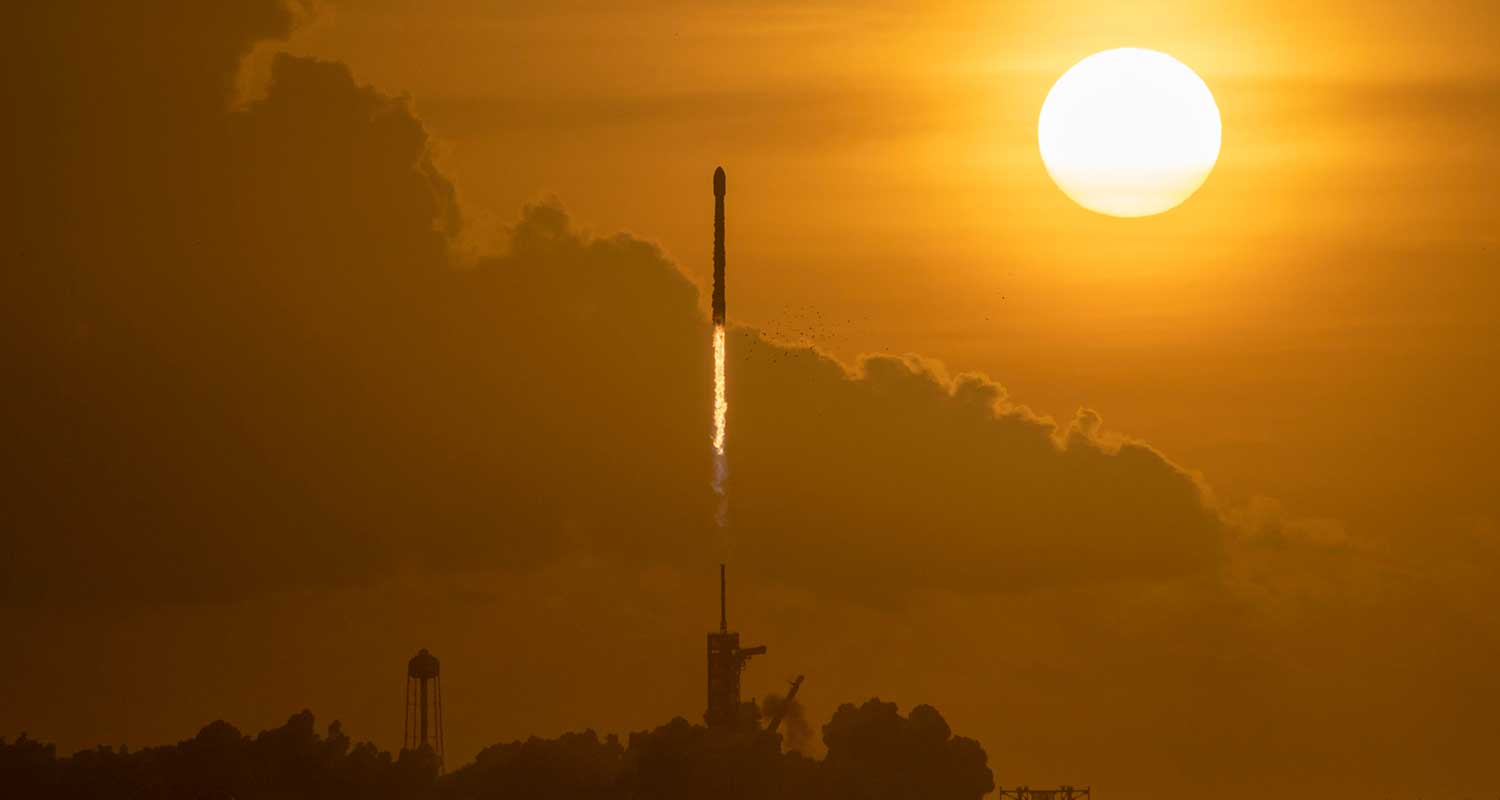
    Starlink satellites being blasted into space aboard a SpaceX Falcon 9 rocket

    Unlike with cell service providers, Starlink can’t strategically pinpoint areas that need greater capacity by adding static towers. It has to keep adding more satellites to its system, said space researcher Caleb Henry of Quilty Analytics.

    “It’s like trying to raise the sea level. It’s spread all over and the only way to increase the amount is to spread it out everywhere,” Henry said.

    Too many people tapping into a satellite at one time can overwhelm the system and cause disruptions for people on the ground. The increase in users in urban and suburban locations has been “dragging down the performance”, said Mark Giles, a lead analyst at Ookla, which tracks Starlink speeds and analyses internet performance.

    Starlink speeds began to decrease in 2022, coinciding with an increase in users, Ookla found

    Starlink speeds began to decrease in 2022, coinciding with an increase in users, Ookla found. Speeds have trended upward again, particularly in less-populated regions, as SpaceX started launching upgraded satellites aimed at boosting capacity.

    The company says it hopes to ramp up even faster later this year when it starts commercial launches of Starship, a larger rocket than the Falcon 9 currently in use. The costly spacecraft is still undergoing testing and aims to allow SpaceX to launch larger satellites.

    “Starlink should accelerate the deployment of its satellites per launch and focus on the reliability of its existing satellites and internet service,” said Andrea Lamari, a managing partner at Cuatro Capital, and a transitioning general partner at Manhattan Venture Partners, a venture firm that has invested in SpaceX across multiple funds under their management.

    “Starlink has always been able to prominently expand coverage where traditional internet options are limited or non-existent. They must also continue to increase bandwidth capacity and reduce latency at every chance possible,” she said.

    Capacity issues

    Capacity issues may be one reason why Starlink is struggling to woo some lucrative corporate contracts.

    All the major airlines — Delta, Southwest Airlines, American and United — have spurned the Musk-led service in favour of sticking with established Wi-Fi providers like Viasat. Analysts say SpaceX doesn’t provide the long-term contracts and exclusivity that corporate clients often want and that it’s cost-prohibitive to rip out existing Wi-Fi for a service that doesn’t yet stand out from competitors.

    Viasat, for example, has a sales staff that numbers in the hundreds, compared to the dozens that Starlink has, people familiar with the business say. Viasat declined to comment.

    Read: Zimbabwe threatens to arrest Starlink users

    Starlink has had more success signing up corporate clients in rural and maritime areas where capacity issues don’t overwhelm the system. They’ve signed up clients like Carnival Cruise Lines, Deere & Co and shipper Anglo-Eastern Ship Management.

    At Anglo-Eastern, CIO Torbjorn Dimblad said Starlink access has become a necessity and has drastically reduced costs. “It’s like suddenly getting running water,” he said.

    Paratus Zambia: a seamless Starlink experience
    A Starlink terminal at Victoria Falls in Zambia. Image: Paratus Zambia

    Anglo-Eastern, which already has the service on about 300 of the 650 ships it fully manages, spends about $2,700 per vessel for Starlink hardware and $1 000/month for internet service. That compares with $20 000 for equipment and $2 000/month in subscription fees the company pays per ship for slower download speeds from incumbent satellite providers like Eutelsat and Viasat’s Inmarsat Global.

    To be sure, profitability is increasing as Starlink reduces the money it spends on manufacturing satellites and ground terminals. One person familiar with the company’s financials said Starlink’s cash generation improved towards the end of 2023 and that its now more consistently profitable.

    SpaceX has met or exceeded revenue projections over the past three years, other people familiar with the company’s balance sheet say. The company forecasts sales to grow to $15-billion this year from $4.7-billion a year ago, these people said.

    Investors say they expect SpaceX to have to raise more money or get a cash infusion from Musk himself

    To keep up with that growth, investors say they expect SpaceX to have to raise more money or get a cash infusion from Musk himself.

    SpaceX has weighed a Starlink spinoff and potential listing, which would allow the standalone entity to raise debt or equity separately from the parent company, Bloomberg News has reported. SpaceX has already hived off Starlink’s data, storing it on dedicated servers, people familiar with the plans said.

    At the moment, the company says it isn’t in a rush to list. “It’d be more in the years to come,” Johnsen, the chief financial officer, said last month.  — Kiel Porter, Loren Grush and Edward Ludlow, with Eric Johnson, Gillian Tan and Bruce Einhorn, (c) 2024 Reuters

    Get breaking news alerts from TechCentral on WhatsApp

    Follow TechCentral on Google News Add TechCentral as your preferred source on Google


    Elon Musk SpaceX Starlink
    WhatsApp YouTube
    Share. Facebook Twitter LinkedIn WhatsApp Telegram Email Copy Link
    Previous ArticleEther surges on US ETF speculation
    Next Article South African outage highlights high-stakes cloud risks

    Related Posts

    SpaceX breaks cover at Icasa satellite spectrum hearings

    SpaceX breaks cover at Icasa satellite spectrum hearings

    20 August 2026
    China can now land rocket boosters, just like SpaceX

    China can now land rocket boosters, just like SpaceX

    19 August 2026
    Paratus Rwanda marks first year with AfPIF opening reception

    Paratus Rwanda marks first year with AfPIF opening reception

    18 August 2026
    Company News
    Smarter operations take centre stage at Electra Mining Africa 2026

    Smarter operations take centre stage at Electra Mining Africa 2026

    20 August 2026
    Fidelity turns to Sigfox to spot fires before they start

    Fidelity turns to Sigfox to spot fires before they start

    19 August 2026
    Paratus Rwanda marks first year with AfPIF opening reception

    Paratus Rwanda marks first year with AfPIF opening reception

    18 August 2026
    Opinion
    The author, Jannie van Zyl

    Selling vapour is corporate suicide in slow motion

    16 July 2026
    Brazil's online gambling crackdown is a lesson for South Africa

    How Amazon outmanoeuvred Starlink in South Africa

    15 July 2026
    The Popia problem with agentic AI - Herman Haasbroek

    The Popia problem with agentic AI

    14 July 2026

    Subscribe to Updates

    Get the best South African technology news and analysis delivered to your e-mail inbox every morning.

    Latest Posts
    How Comsol turned 60MHz into a national 5G bet - Iain Stevenson

    How Comsol turned 60MHz into a national 5G bet

    20 August 2026
    Humanoid robots poised for their 'ChatGPT moment'

    Humanoid robots poised for their ‘ChatGPT moment’

    20 August 2026
    Smarter operations take centre stage at Electra Mining Africa 2026

    Smarter operations take centre stage at Electra Mining Africa 2026

    20 August 2026
    SpaceX breaks cover at Icasa satellite spectrum hearings

    SpaceX breaks cover at Icasa satellite spectrum hearings

    20 August 2026
    © 2009 - 2026 NewsCentral Media
    Built and maintained by Chronon
    • Cookie policy (ZA)
    • TechCentral – privacy and Popia

    Type above and press Enter to search. Press Esc to cancel.

    Manage consent

    TechCentral uses cookies to enhance its offerings. Consenting to these technologies allows us to serve you better. Not consenting or withdrawing consent may adversely affect certain features and functions of the website.

    Functional Always active
    The technical storage or access is strictly necessary for the legitimate purpose of enabling the use of a specific service explicitly requested by the subscriber or user, or for the sole purpose of carrying out the transmission of a communication over an electronic communications network.
    Preferences
    The technical storage or access is necessary for the legitimate purpose of storing preferences that are not requested by the subscriber or user.
    Statistics
    The technical storage or access that is used exclusively for statistical purposes. The technical storage or access that is used exclusively for anonymous statistical purposes. Without a subpoena, voluntary compliance on the part of your Internet Service Provider, or additional records from a third party, information stored or retrieved for this purpose alone cannot usually be used to identify you.
    Marketing
    The technical storage or access is required to create user profiles to send advertising, or to track the user on a website or across several websites for similar marketing purposes.
    • Manage options
    • Manage services
    • Manage {vendor_count} vendors
    • Read more about these purposes
    View preferences
    • {title}
    • {title}
    • {title}