Close Menu
TechCentralTechCentral

    Subscribe to the newsletter

    Get the best South African technology news and analysis delivered to your e-mail inbox every morning.

    Facebook X (Twitter) YouTube LinkedIn
    WhatsApp Facebook X (Twitter) LinkedIn YouTube
    TechCentralTechCentral
    • News
      Watts & Wheels: S1E1 - 'William, Prince of Wheels'

      Watts & Wheels: S1E1 – ‘William, Prince of Wheels’

      8 January 2026
      Safety recall hits Volvo's best-selling EV in South Africa

      Safety recall hits Volvo’s best-selling EV in South Africa

      8 January 2026
      South Africa's giant SKA telescope clears major technical hurdle

      South Africa’s giant SKA telescope clears major technical hurdle

      8 January 2026
      'The robot will see you now': OpenAI launches ChatGPT Health

      ‘The robot will see you now’: OpenAI launches ChatGPT Health

      8 January 2026
      Court ruling marks major turning point in driving licence card saga - Barbara Creecy

      Court ruling marks major turning point in driving licence card saga

      7 January 2026
    • World
      Samsung forecasts record operating profit as AI demand sends memory chip prices sharply higher worldwide - TM Roh

      Samsung cashes in on AI data centre boom as memory prices soar

      8 January 2026
      EU pressure mounts on Musk's X over AI 'undressing' images - Wolfram Weimer

      EU pressure mounts on Musk’s X over AI ‘undressing’ images

      7 January 2026
      Intel launches Panther Lake, its next-gen PC chip

      Intel launches Panther Lake, its next-gen PC chip

      6 January 2026
      Starlink plans to lower satellite orbit to enhance safety

      Starlink plans to lower satellite orbit to enhance safety

      4 January 2026
      Lou Gerstner, the man who saved IBM, dies at 83

      Lou Gerstner, the man who saved IBM, dies at 83

      29 December 2025
    • In-depth
      Digital authoritarianism grows as African states normalise internet blackouts

      Digital authoritarianism grows as African states normalise internet blackouts

      19 December 2025
      TechCentral's South African Newsmakers of 2025

      TechCentral’s South African Newsmakers of 2025

      18 December 2025
      Black Friday goes digital in South Africa as online spending surges to record high

      Black Friday goes digital in South Africa as online spending surges to record high

      4 December 2025
      DStv dodges channel blackout in last-minute deal with Warner Bros

      Canal+ plays hardball – and DStv viewers feel the pain

      3 December 2025
      Jensen Huang Nvidia

      So, will China really win the AI race?

      14 November 2025
    • TCS
      TCS+ | Africa's digital transformation - unlocking AI through cloud and culture - Cliff de Wit Accelera Digital Group

      TCS+ | Cloud without culture won’t deliver AI: Accelera’s Cliff de Wit

      12 December 2025
      TCS+ | How Cloud on Demand helps partners thrive in the AWS ecosystem - Odwa Ndyaluvane and Xenia Rhode

      TCS+ | How Cloud On Demand helps partners thrive in the AWS ecosystem

      4 December 2025
      TCS | MTN Group CEO Ralph Mupita on competition, AI and the future of mobile

      TCS | Ralph Mupita on competition, AI and the future of mobile

      28 November 2025
      TCS | Dominic Cull on fixing South Africa's ICT policy bottlenecks

      TCS | Dominic Cull on fixing South Africa’s ICT policy bottlenecks

      21 November 2025
      TCS | BMW CEO Peter van Binsbergen on the future of South Africa's automotive industry

      TCS | BMW CEO Peter van Binsbergen on the future of South Africa’s automotive industry

      6 November 2025
    • Opinion
      ANC's attack on Solly Malatsi shows how BEE dogma trumps economic reality - Duncan McLeod

      ANC’s attack on Solly Malatsi shows how BEE dogma trumps economic reality

      14 December 2025
      Netflix, Warner Bros deal raises fresh headaches for MultiChoice - Duncan McLeod

      Netflix, Warner Bros deal raises fresh headaches for MultiChoice

      5 December 2025
      BIN scans, DDoS and the next cybercrime wave hitting South Africa's banks - Entersekt Gerhard Oosthuizen

      BIN scans, DDoS and the next cybercrime wave hitting South Africa’s banks

      3 December 2025
      ANC's attack on Solly Malatsi shows how BEE dogma trumps economic reality - Duncan McLeod

      Your data, your hardware: the DIY AI revolution is coming

      20 November 2025
      Zero Carbon Charge founder Joubert Roux

      The energy revolution South Africa can’t afford to miss

      20 November 2025
    • Company Hubs
      • Africa Data Centres
      • AfriGIS
      • Altron Digital Business
      • Altron Document Solutions
      • Altron Group
      • Arctic Wolf
      • AvertITD
      • Braintree
      • CallMiner
      • CambriLearn
      • CYBER1 Solutions
      • Digicloud Africa
      • Digimune
      • Domains.co.za
      • ESET
      • Euphoria Telecom
      • Incredible Business
      • iONLINE
      • IQbusiness
      • Iris Network Systems
      • LSD Open
      • NEC XON
      • Netstar
      • Network Platforms
      • Next DLP
      • Ovations
      • Paracon
      • Paratus
      • Q-KON
      • SevenC
      • SkyWire
      • Solid8 Technologies
      • Telit Cinterion
      • Tenable
      • Vertiv
      • Videri Digital
      • Vodacom Business
      • Wipro
      • Workday
      • XLink
    • Sections
      • AI and machine learning
      • Banking
      • Broadcasting and Media
      • Cloud services
      • Contact centres and CX
      • Cryptocurrencies
      • Education and skills
      • Electronics and hardware
      • Energy and sustainability
      • Enterprise software
      • Financial services
      • Information security
      • Internet and connectivity
      • Internet of Things
      • Investment
      • IT services
      • Lifestyle
      • Motoring
      • Public sector
      • Retail and e-commerce
      • Satellite communications
      • Science
      • SMEs and start-ups
      • Social media
      • Talent and leadership
      • Telecoms
    • Events
    • Advertise
    TechCentralTechCentral
    Home » Sections » Broadcasting and Media » Television at 50 | Power, propaganda and the battle for the airwaves
    Television at 50 | Power, propaganda and the battle for the airwaves - Jock Anderson and Koos Bekker
    Jock Anderson, Koos Bekker

    Television at 50 | Power, propaganda and the battle for the airwaves

    By Nkosinathi Ndlovu7 January 2026

    It is impossible to tell the story of how the business of broadcasting has evolved in South Africa without examining the industry’s political aspects.

    Political influence played a role in the South African broadcasting landscape even prior to the first broadcast going live on 5 January 1976. The conservative government of the time saw the “devil’s box” as a threat to its value system, leading to South Africa being a relatively latecomer to broadcasting by international standards.

    This is the fourth in a series of articles TechCentral is publishing this week to mark the anniversary of the launch of television broadcasting in South Africa on 5 January 1976. Visit our homepage for more.

    Consequently, when the industry finally took off in 1976, state control and censorship were the name of the game. This put big limitations on the type of content that would end up in people’s homes.

    All television content, including news, sports and entertainment, was limited to the SABC. Though the broadcaster built infrastructure, including in-house studios and filming equipment, along with the necessary skills, internally, viewers were not treated to much variety.

    All television content, including news, sports and entertainment, was limited to the SABC

    There was one antidote to the monotony, but only in a relatively small part of the country. Residents of the what is now North West could enjoy a more liberal line-up of local and international TV shows on Bophuthatswana’s Bop TV. Some residents on the western outskirts of what is now Gauteng could access Bop TV signals spilling over from Bophuthatswana.

    The first real gamechanger for South African broadcasting came with the introduction of M-Net in 1986. It was the first time that South African viewers outside of the Bantustans had an alternative to state broadcasting. Most significant was M-Net’s business model, which relied on user subscriptions and advertising revenue instead of the national fiscus.

    With competition came innovation, with M-Net pioneering South Africa’s first daily soap opera, Egoli: Place of Gold. Carte Blanche, launched in 1988, introduced a standard for investigative journalism not seen on state programming at the time. A small segment named SuperSport would eventually grow into one of the largest broadcasters of live sports in the world.

    Liberalisation

    M-Net’s entrance into the market led to some market liberalisation, but most South Africans still relied on the SABC for their programming – and M-Net was precluded from offering its own news service. However, a transformation was brewing at the SABC, too. Brand Fourie, who had led the broadcaster from 1985, was replaced by Christo Viljoen, an academic and electronics engineer.

    Viljoen brought in a strongly commercialised team that included the likes of Quentin Green, Gert Klaasens and Wynand Harmse. The trio would form the Viljoen Task Group on Broadcasting, leading to a 1991 report recommending the deregulation of the airwaves and the introduction of community radio, among other radical changes.

    Read: Television at 50 | The broadcast that changed everything

    “That is an often-overlooked but important turning point, especially from a business point of view, because what that team did was shift the focus of the broadcaster from simply being a state propagandist to being a more organised commercial and entertainment provider,” said Ruth Teer-Tomaselli, a renowned telecommunications author and emeritus professor of culture, communications and media studies at the University of KwaZulu-Natal.

    The next major change would come in 1993 with the formation of the Independent Broadcasting Authority (IBA). According to Teer-Tomaselli, the IBA was formed prior to South Africa’s first democratic election in 1994, partly because preparing the SABC for the election was one of IBA’s first major tasks.
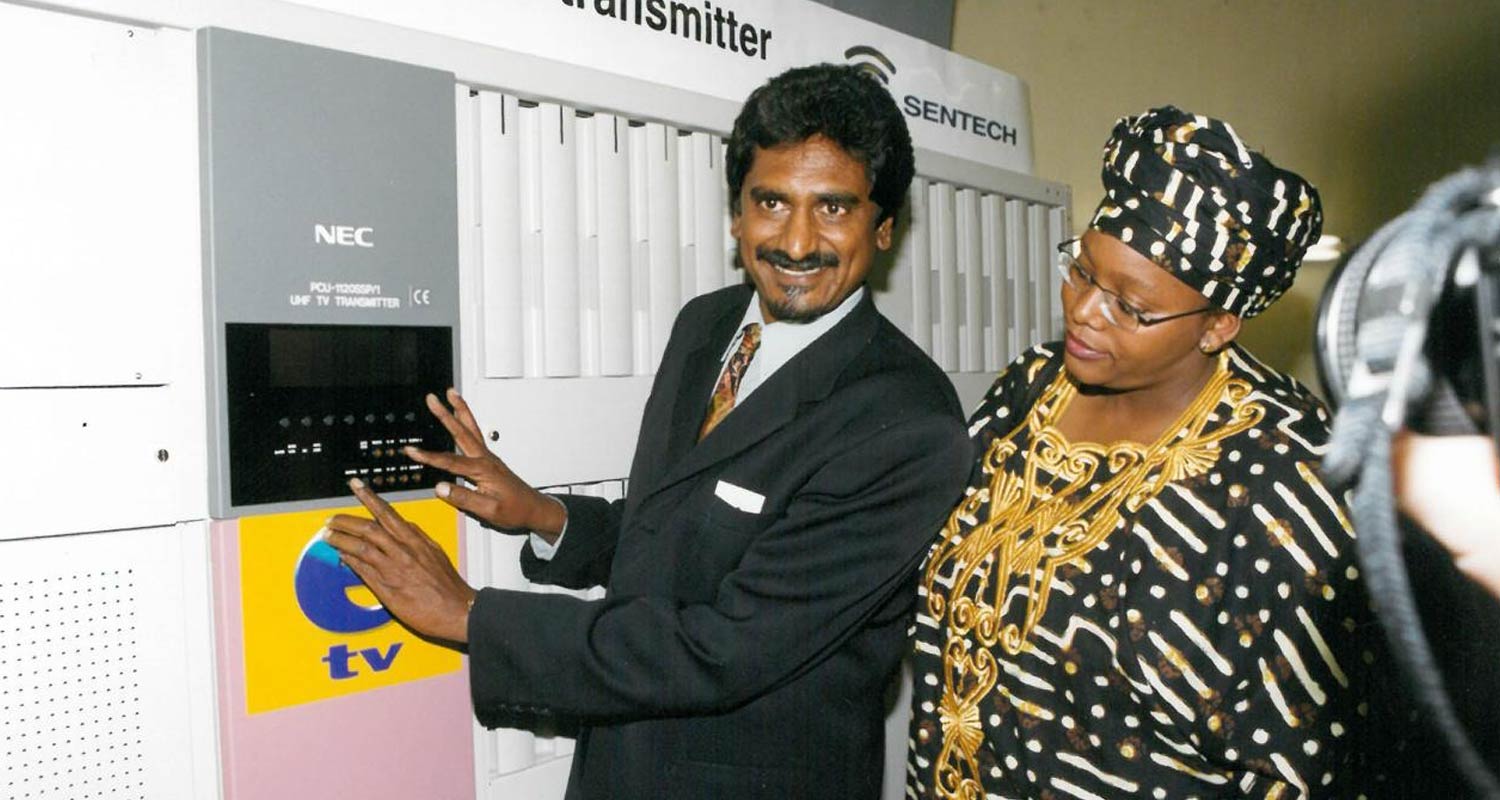
    Jay Naidoo, the minister of posts & telecommunications, in the Mandela administration at the launch of e.tv's transmissions
    Jay Naidoo, the minister of posts & telecommunications in the Mandela administration, at the launch of e.tv’s transmission in 1998. He is pictured with ICT industry veteran Felleng Sekha

    The IBA delineated broadcasting licences according to public (SABC), commercial (M-Net) and community categories. By 1997, regulations on quotas for local television and music content on South African radio and TV were introduced. Teer-Tomaselli said these regulations had a tremendous impact on the development of independent production houses in South Africa because they also stipulated that some of the content must be produced external to the broadcasting houses.

    “By the early 2000s, the SABC had practically shut down all of their internal production, except for sport, a little bit of education and news production. They don’t make dramas anymore because that is all commissioned,” said Teer-Tomaselli.

    Another major development would further impose radical changes to South Africa’s broadcasting landscape before the turn of the century. Following a fiercely competitive bidding process in the years prior, the Midi TV consortium was granted a broadcasting licence by IBA, leading to the launch of e.tv in October 1998.

    The launch of social media platforms, such as Facebook in 2004, pointed to a new era of media consumption

    E.tv further liberalised the market by introducing a completely new broadcasting model that encompassed elements of the incumbents at the time. Like the public broadcaster, e.tv was free to air, but it was also privately owned, like M-Net. Its launch introduced new competitive dynamics into the broadcasting landscape, even forcing the SABC to rebrand shortly prior to its launch in an effort to defend advertising market share.

    E.tv also came with independent news and current affairs shows like 3rd Degree, along with a slew of newly minted soap operas such as Backstage, Rhythm City and Scandal. The boom in local content production led to flourishing production houses such as Quizzical Pictures, Ochre Moving Pictures and Urban Brew Studios.

    With the new millennium came new technology, and the decade between 2000 and 2010 would see the internet rise in prominence as the cornerstone technology facilitating world commerce.

    Rise of streaming

    The launch of social media platforms, such as Facebook in 2004 and YouTube in 2005, pointed to a new era of media consumption. By 2007, Netflix launched with only a thousand titles available for streaming – that number has grown to around 14 000.

    South Africa’s broadcasting industry has lagged behind on digitisation. Although M-Net evolved into DStv as far back as 1995, effectively introducing satellite-based digital television to South Africa, parent company MultiChoice’s streaming service Showmax is struggling to garner market share against larger international rivals.

    The SABC’s digitisation journey has been hampered by perennial delays to the broadcast digital migration project. Many in the industry, including Teer-Tomaselli, believe government’s decision to adopt digital terrestrial television in 2010 was short-sighted. The SABC has launched its own streaming service, SABC Plus, and e.tv has the eVOD streaming service to compete with the streamers.

    Read: Television at 50 | How the SABC lost its way – and what it must become

    “DTT only made sense at the time because it was based on short-term economic thinking instead of long-term vision. Government really didn’t believe that the internet would be so powerful so soon,” said Teer-Tomaselli.  – © 2026 NewsCentral Media

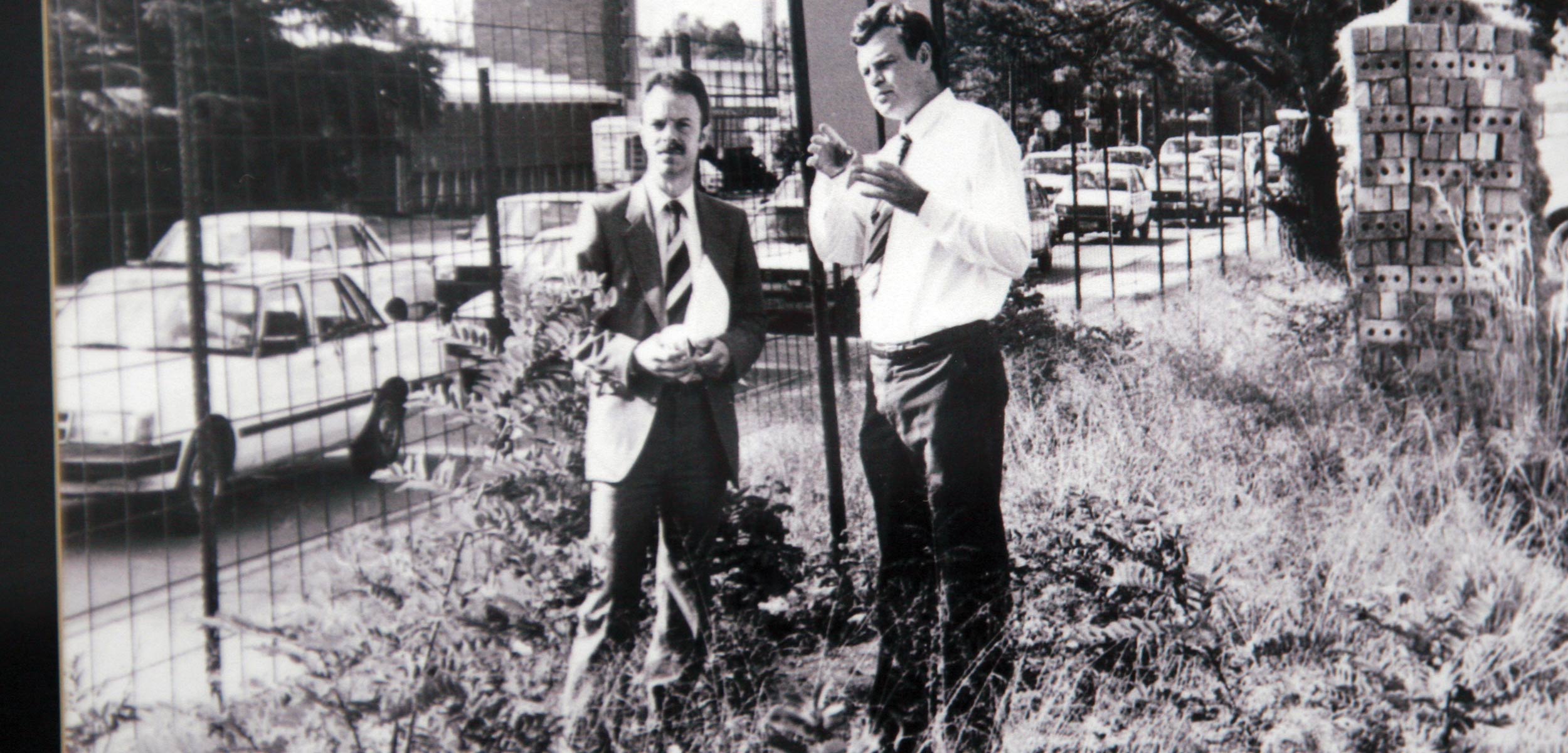
    • Main image: M-Net’s first chief technology officer, Jock Anderson (left), with co-founder Koos Bekker at the site in Randburg, Johannesburg where MultiChoice Group’s head office is located today. Image courtesy of MultiChoice.

    Get breaking news from TechCentral on WhatsApp. Sign up here.



    Carte Blance e.tv Jock Anderson Koos Bekker M-Net Midi TV MultiChoice Ruth Teer-Tomaselli Wynand Harmse
    Subscribe to TechCentral Subscribe to TechCentral
    Share. Facebook Twitter LinkedIn WhatsApp Telegram Email Copy Link
    Previous ArticleEU pressure mounts on Musk’s X over AI ‘undressing’ images
    Next Article Why South Africa should extend the e-hailing compliance deadline

    Related Posts

    Television at 50 | A timeline of events that shaped an industry

    Television at 50 | A timeline of events that shaped an industry

    6 January 2026
    Television turns 50 in South Africa

    Television turns 50 in South Africa

    4 January 2026
    Koos Bekker sells R2.5-billion in Naspers and Prosus shares

    Koos Bekker sells R2.5-billion in Naspers and Prosus shares

    23 December 2025
    Company News
    Why trust is the real currency in modern media

    Why trust is the real currency in modern media

    6 January 2026
    Why banks and insurers need a single decisioning brain as pressures collide - SAS

    Why banks and insurers need a single decisioning brain as pressures collide

    29 December 2025
    First Technology Western Cape delivers the tools - and intelligence - behind modern business - Dell Technologies

    First Technology Western Cape delivers the tools – and intelligence – behind modern business

    29 December 2025
    Opinion
    ANC's attack on Solly Malatsi shows how BEE dogma trumps economic reality - Duncan McLeod

    ANC’s attack on Solly Malatsi shows how BEE dogma trumps economic reality

    14 December 2025
    Netflix, Warner Bros deal raises fresh headaches for MultiChoice - Duncan McLeod

    Netflix, Warner Bros deal raises fresh headaches for MultiChoice

    5 December 2025
    BIN scans, DDoS and the next cybercrime wave hitting South Africa's banks - Entersekt Gerhard Oosthuizen

    BIN scans, DDoS and the next cybercrime wave hitting South Africa’s banks

    3 December 2025

    Subscribe to Updates

    Get the best South African technology news and analysis delivered to your e-mail inbox every morning.

    Latest Posts
    Watts & Wheels: S1E1 - 'William, Prince of Wheels'

    Watts & Wheels: S1E1 – ‘William, Prince of Wheels’

    8 January 2026
    Safety recall hits Volvo's best-selling EV in South Africa

    Safety recall hits Volvo’s best-selling EV in South Africa

    8 January 2026
    Samsung forecasts record operating profit as AI demand sends memory chip prices sharply higher worldwide - TM Roh

    Samsung cashes in on AI data centre boom as memory prices soar

    8 January 2026
    South Africa's giant SKA telescope clears major technical hurdle

    South Africa’s giant SKA telescope clears major technical hurdle

    8 January 2026
    © 2009 - 2026 NewsCentral Media
    • Cookie policy (ZA)
    • TechCentral – privacy and Popia

    Type above and press Enter to search. Press Esc to cancel.

    Manage consent

    TechCentral uses cookies to enhance its offerings. Consenting to these technologies allows us to serve you better. Not consenting or withdrawing consent may adversely affect certain features and functions of the website.

    Functional Always active
    The technical storage or access is strictly necessary for the legitimate purpose of enabling the use of a specific service explicitly requested by the subscriber or user, or for the sole purpose of carrying out the transmission of a communication over an electronic communications network.
    Preferences
    The technical storage or access is necessary for the legitimate purpose of storing preferences that are not requested by the subscriber or user.
    Statistics
    The technical storage or access that is used exclusively for statistical purposes. The technical storage or access that is used exclusively for anonymous statistical purposes. Without a subpoena, voluntary compliance on the part of your Internet Service Provider, or additional records from a third party, information stored or retrieved for this purpose alone cannot usually be used to identify you.
    Marketing
    The technical storage or access is required to create user profiles to send advertising, or to track the user on a website or across several websites for similar marketing purposes.
    • Manage options
    • Manage services
    • Manage {vendor_count} vendors
    • Read more about these purposes
    View preferences
    • {title}
    • {title}
    • {title}