

Close Menu
TechCentralTechCentral

    Subscribe to the newsletter

    Get the best South African technology news and analysis delivered to your e-mail inbox every morning.

    Facebook X (Twitter) YouTube LinkedIn
    WhatsApp Facebook X (Twitter) LinkedIn YouTube
    TechCentralTechCentral
    • News
      Big Microsoft 365 price increases coming next year

      Big Microsoft price increases coming next year

      5 December 2025
      Vodacom to take control of Safaricom in R36-billion deal - Shameel Joosub

      Vodacom to take control of Safaricom in R36-billion deal

      4 December 2025
      Black Friday goes digital in South Africa as online spending surges to record high

      Black Friday goes digital in South Africa as online spending surges to record high

      4 December 2025
      BYD takes direct aim at Toyota with launch of sub-R500 000 Sealion 5 PHEV

      BYD takes direct aim at Toyota with launch of sub-R500 000 Sealion 5 PHEV

      4 December 2025
      'Get it now': Takealot in new instant deliveries pilot

      ‘Get it now’: Takealot in new instant deliveries pilot

      4 December 2025
    • World
      Amazon and Google launch multi-cloud service for faster connectivity

      Amazon and Google launch multi-cloud service for faster connectivity

      1 December 2025
      Google makes final court plea to stop US breakup

      Google makes final court plea to stop US breakup

      21 November 2025
      Bezos unveils monster rocket: New Glenn 9x4 set to dwarf Saturn V

      Bezos unveils monster rocket: New Glenn 9×4 set to dwarf Saturn V

      21 November 2025
      Tech shares turbocharged by Nvidia's stellar earnings

      Tech shares turbocharged by stellar Nvidia earnings

      20 November 2025
      Config file blamed for Cloudflare meltdown that disrupted the web

      Config file blamed for Cloudflare meltdown that disrupted the web

      19 November 2025
    • In-depth
      Jensen Huang Nvidia

      So, will China really win the AI race?

      14 November 2025
      Valve's Linux console takes aim at Microsoft's gaming empire

      Valve’s Linux console takes aim at Microsoft’s gaming empire

      13 November 2025
      iOCO's extraordinary comeback plan - Rhys Summerton

      iOCO’s extraordinary comeback plan

      28 October 2025
      Why smart glasses keep failing - no, it's not the tech - Mark Zuckerberg

      Why smart glasses keep failing – it’s not the tech

      19 October 2025
      BYD to blanket South Africa with megawatt-scale EV charging network - Stella Li

      BYD to blanket South Africa with megawatt-scale EV charging network

      16 October 2025
    • TCS
      TCS+ | How Cloud on Demand helps partners thrive in the AWS ecosystem - Odwa Ndyaluvane and Xenia Rhode

      TCS+ | How Cloud On Demand helps partners thrive in the AWS ecosystem

      4 December 2025
      TCS | MTN Group CEO Ralph Mupita on competition, AI and the future of mobile

      TCS | Ralph Mupita on competition, AI and the future of mobile

      28 November 2025
      TCS | Dominic Cull on fixing South Africa's ICT policy bottlenecks

      TCS | Dominic Cull on fixing South Africa’s ICT policy bottlenecks

      21 November 2025
      TCS | BMW CEO Peter van Binsbergen on the future of South Africa's automotive industry

      TCS | BMW CEO Peter van Binsbergen on the future of South Africa’s automotive industry

      6 November 2025
      TCS | Why Altron is building an AI factory - Bongani Andy Mabaso

      TCS | Why Altron is building an AI factory in Johannesburg

      28 October 2025
    • Opinion
      Your data, your hardware: the DIY AI revolution is coming - Duncan McLeod

      Your data, your hardware: the DIY AI revolution is coming

      20 November 2025
      Zero Carbon Charge founder Joubert Roux

      The energy revolution South Africa can’t afford to miss

      20 November 2025
      It's time for a new approach to government IT spend in South Africa - Richard Firth

      It’s time for a new approach to government IT spend in South Africa

      19 November 2025
      How South Africa's broken Rica system fuels murder and mayhem - Farhad Khan

      How South Africa’s broken Rica system fuels murder and mayhem

      10 November 2025
      South Africa's AI data centre boom risks overloading a fragile grid - Paul Colmer

      South Africa’s AI data centre boom risks overloading a fragile grid

      30 October 2025
    • Company Hubs
      • Africa Data Centres
      • AfriGIS
      • Altron Digital Business
      • Altron Document Solutions
      • Altron Group
      • Arctic Wolf
      • AvertITD
      • Braintree
      • CallMiner
      • CambriLearn
      • CYBER1 Solutions
      • Digicloud Africa
      • Digimune
      • Domains.co.za
      • ESET
      • Euphoria Telecom
      • Incredible Business
      • iONLINE
      • IQbusiness
      • Iris Network Systems
      • LSD Open
      • NEC XON
      • Netstar
      • Network Platforms
      • Next DLP
      • Ovations
      • Paracon
      • Paratus
      • Q-KON
      • SevenC
      • SkyWire
      • Solid8 Technologies
      • Telit Cinterion
      • Tenable
      • Vertiv
      • Videri Digital
      • Vodacom Business
      • Wipro
      • Workday
      • XLink
    • Sections
      • AI and machine learning
      • Banking
      • Broadcasting and Media
      • Cloud services
      • Contact centres and CX
      • Cryptocurrencies
      • Education and skills
      • Electronics and hardware
      • Energy and sustainability
      • Enterprise software
      • Financial services
      • Information security
      • Internet and connectivity
      • Internet of Things
      • Investment
      • IT services
      • Lifestyle
      • Motoring
      • Public sector
      • Retail and e-commerce
      • Satellite communications
      • Science
      • SMEs and start-ups
      • Social media
      • Talent and leadership
      • Telecoms
    • Events
    • Advertise
    TechCentralTechCentral
    Home » Sections » Financial services » The barcode at 50: how it changed the world

    The barcode at 50: how it changed the world

    Barcodes have changed the world in ways many people don't fully appreciate.
    By Mark Thomson29 May 2023
    Twitter LinkedIn Facebook WhatsApp Email Telegram Copy Link
    News Alerts
    WhatsApp

    Read every day, everywhere, the seemingly simple barcode is not your basic “beep”. There’s more to the barcode than meets the eye — or ear — with the familiar, expected “beep” when scanned. It revolutionised business across industries from retail and hospitality to health care, logistics and more, making transactions and tracking faster, easier and even safer.

    And it’s opened the door to more innovation, including the next generation of solutions such as the QR code, radio frequency identification (RFID), fixed industrial scanning and machine vision.

    Like any great invention, the barcode seems like a natural part of everyday life, as if the black and white “zebra” pattern appearing on just about everything that is bought, sold or tracked has always existed. But it was decades in the making, born by the grocery sector’s need to bust long checkout queues. Retailers and brands needed a solution to automatically capture product information, reduce human error and manage the explosive growth of post WWII baby boomer shoppers.

    The modern zebra barcode was selected in 1973 and made its public debut in 1974

    Enter George J Laurer, an IBM engineer who created the barcode when he reimagined a bulls-eye concept drawn in the sand by Joe Woodland in the 1940s, transforming it into the uniform product code (UPC) today known as GS1 (Global Trade Item Numbers) – aka the barcode. It’s now estimated that the barcode is used 10 billion times a day globally. The barcode’s impact cannot be underestimated.

    The modern zebra barcode was selected by the symbol selection committee in 1973 and made its public debut in 1974 when Marsh’s Supermarket, an Ohio grocer, installed the first UPC scanner to help reduce customers’ checkout time for a better experience, and improve associate productivity. Barcodes have been delivering ever since that first scan—of a pack of Wrigley’s chewing gum—making a permanent mark on the world: transforming retail, how we shop and more.

    Whether the information in a barcode is read via a multi-plane, fixed or handheld mobile scanner, the barcode boosts efficiency, flexibility and convenience, helping customers get in-and-out of stores as quickly as possible, as most say they prefer. It also enables the blended “buy online pick-up in store” shopping experience consumers lean toward.

    3D barcodes

    The simple one-dimensional barcode has helped evolve how we shop as it continues to evolve dimensionally. If you’ve taken a photo of a QR code with your smartphone for a menu, ticket or other item, you’ve scanned a 2D barcode which holds codes in squares rather than the original one-dimensional lines of the traditional barcode. Manufacturers often use 3D barcodes, which hold even more information and are engraved into machinery, reading information and scanning for anomalies via fixed industrial scanning and computer vision.

    Schnucks, one of the largest privately held, family-owned US supermarket chains, is transitioning from the traditional 1D barcode made up of lines and spaces and moving to 2D barcodes. And of course, there’s the “Amazon Go” option where you simply walk in, grab items and walk out without scanning or physically paying for items. But you do need to scan a QR code to enter as artificial intelligence, computer vision and data pulled from multiple sensors ensure you’re only charged for what you walk out with.

    RFID takes barcodes to the next level where line of sight is not easy, accurately and efficiently tracking inventory in retail, the warehouse, transportation and logistics, and equipment, medication – even patients – in health care.

    In fact, barcodes and scanners are used daily to match patients accurately and quickly to their records, medication and treatments, ensuring errors are kept to a minimum, while patients receive the right care. And this is just one example of its many benefits in patient care. And to think it all started with a simple barcode in a grocery checkout.

    The author, Mark Thomson

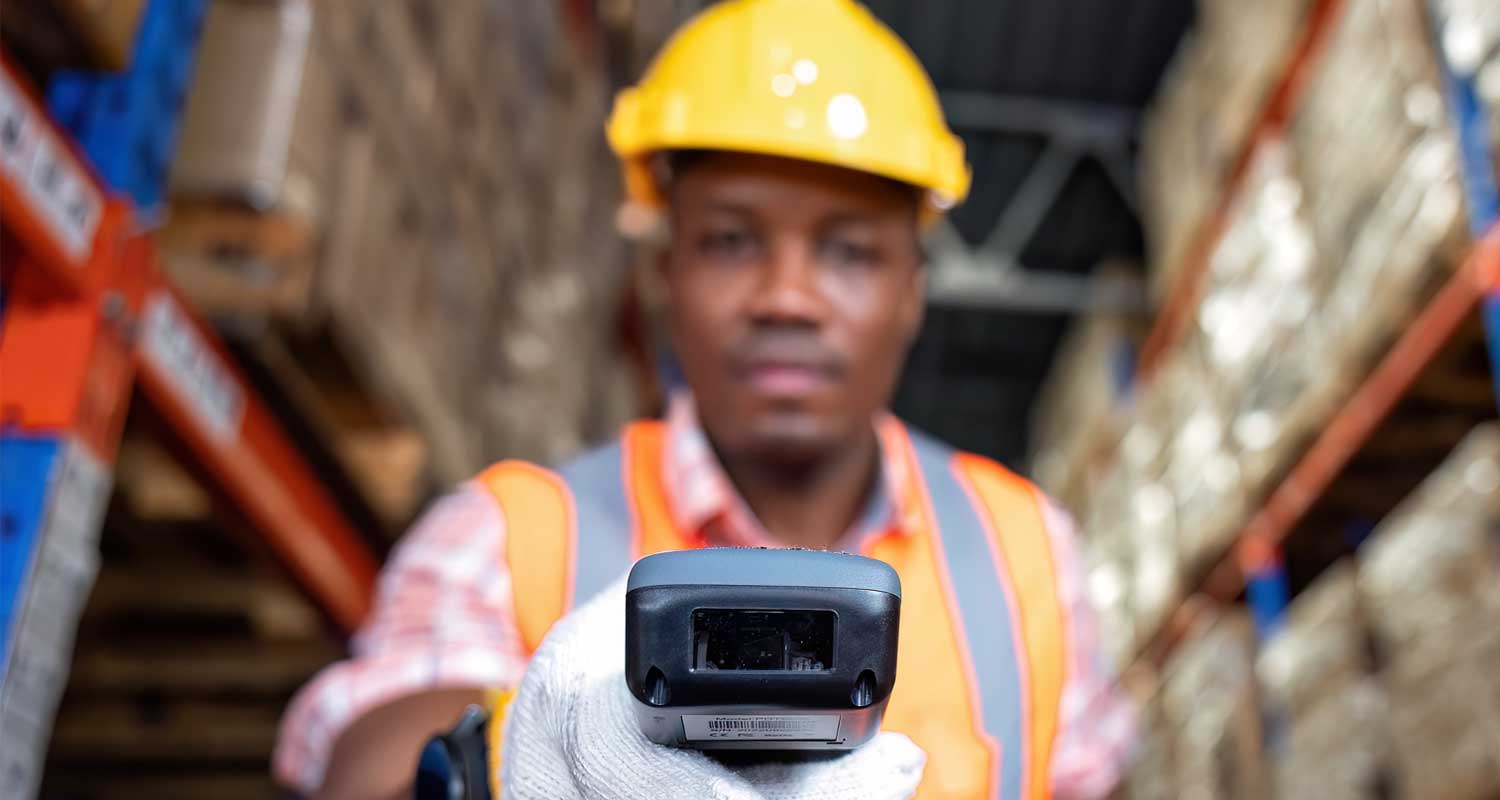
    Fixed industrial scanning, one of the hottest industrial automation trends today, reads barcodes on items moving along conveyor belts or order fulfillment lines in distribution centres and warehouses, providing a status update to logistics managers or possibly even customers.

    In addition to verifying that an item has passed by a checkpoint, which is the tracking component, these scanners might be set up to verify the accuracy of product or package labels, automatically confirming items in an order have been picked and passed along for packing, or even facilitate shipment routing.

    If configured for machine vision, these scanners could be used to identify items that aren’t acceptable for return per quality standards defined in the system. The machine vision system – meaning the smart cameras or sensors – positioned either overhead or in line with the conveyor belt can learn to recognise when a part is mislabelled or there is a discrepancy in the design when compared to the blueprints.

    As for the future, the barcode is here to stay. Its journey is not even a century old, and we have seen such innovative and life-saving developments that its value will only increase, since it’s critical to the success of global industries and rewriting the future in lines, small squares and radio frequencies.

    • The author, Mark Thomson, is retail director at Zebra Technologies

    Get TechCentral’s daily newsletter


    Mark Thomson Zebra Technologies
    Subscribe to TechCentral Subscribe to TechCentral
    Share. Facebook Twitter LinkedIn WhatsApp Telegram Email Copy Link
    Previous ArticleARM rolls out new smartphone tech
    Next Article AI is transformative – but ethics must come first
    Company News
    AI is not a technology problem - iqbusiness

    AI is not a technology problem – iqbusiness

    5 December 2025
    Telcos are sitting on a data gold mine - but few know what do with it - Phillip du Plessis

    Telcos are sitting on a data gold mine – but few know what do with it

    4 December 2025
    Unlock smarter computing with your surface Copilot+ PC

    Unlock smarter computing with your Surface Copilot+ PC

    4 December 2025
    Opinion
    Your data, your hardware: the DIY AI revolution is coming - Duncan McLeod

    Your data, your hardware: the DIY AI revolution is coming

    20 November 2025
    Zero Carbon Charge founder Joubert Roux

    The energy revolution South Africa can’t afford to miss

    20 November 2025
    It's time for a new approach to government IT spend in South Africa - Richard Firth

    It’s time for a new approach to government IT spend in South Africa

    19 November 2025

    Subscribe to Updates

    Get the best South African technology news and analysis delivered to your e-mail inbox every morning.

    Latest Posts
    Big Microsoft 365 price increases coming next year

    Big Microsoft price increases coming next year

    5 December 2025
    AI is not a technology problem - iqbusiness

    AI is not a technology problem – iqbusiness

    5 December 2025
    Vodacom to take control of Safaricom in R36-billion deal - Shameel Joosub

    Vodacom to take control of Safaricom in R36-billion deal

    4 December 2025
    Black Friday goes digital in South Africa as online spending surges to record high

    Black Friday goes digital in South Africa as online spending surges to record high

    4 December 2025
    © 2009 - 2025 NewsCentral Media
    • Cookie policy (ZA)
    • TechCentral – privacy and Popia

    Type above and press Enter to search. Press Esc to cancel.

    Manage consent

    TechCentral uses cookies to enhance its offerings. Consenting to these technologies allows us to serve you better. Not consenting or withdrawing consent may adversely affect certain features and functions of the website.

    Functional Always active
    The technical storage or access is strictly necessary for the legitimate purpose of enabling the use of a specific service explicitly requested by the subscriber or user, or for the sole purpose of carrying out the transmission of a communication over an electronic communications network.
    Preferences
    The technical storage or access is necessary for the legitimate purpose of storing preferences that are not requested by the subscriber or user.
    Statistics
    The technical storage or access that is used exclusively for statistical purposes. The technical storage or access that is used exclusively for anonymous statistical purposes. Without a subpoena, voluntary compliance on the part of your Internet Service Provider, or additional records from a third party, information stored or retrieved for this purpose alone cannot usually be used to identify you.
    Marketing
    The technical storage or access is required to create user profiles to send advertising, or to track the user on a website or across several websites for similar marketing purposes.
    • Manage options
    • Manage services
    • Manage {vendor_count} vendors
    • Read more about these purposes
    View preferences
    • {title}
    • {title}
    • {title}