Close Menu
TechCentralTechCentral

    Subscribe to the newsletter

    Get the best South African technology news and analysis delivered to your e-mail inbox every morning.

    Facebook X (Twitter) YouTube LinkedIn
    WhatsApp Facebook X (Twitter) LinkedIn YouTube
    TechCentralTechCentral
    • News
      The AI policy that AI broke

      The AI policy that AI broke

      28 April 2026
      New DStv owner Canal+ confirms JSE listing date

      New DStv owner Canal+ confirms JSE listing date

      28 April 2026
      Pivotal week for US tech stocks

      Pivotal week for US tech stocks

      28 April 2026
      State broadband merger limps into a second decade - Solly Malatsi

      State broadband merger limps into a second decade

      28 April 2026
      WhatsApp becomes the doctor's office in Turn.io's voice AI play

      WhatsApp becomes the doctor’s office in Turn.io’s voice AI play

      28 April 2026
    • World
      Taylor Swift trademarks her voice to fight AI fakes

      Taylor Swift trademarks her voice to fight AI fakes

      28 April 2026
      DeepSeek's long-awaited V4 model enters preview

      DeepSeek’s long-awaited V4 model enters preview

      24 April 2026
      More organic compounds detected on Mars - Nasa Curiosity rover

      More organic compounds detected on Mars

      21 April 2026
      Adobe bets on AI agents to fend off cheaper rivals

      Adobe bets on AI agents to fend off cheaper rivals

      16 April 2026
      Google poised to lose ad crown to Meta

      Google poised to lose ad crown to Meta

      14 April 2026
    • In-depth
      Africa switches on as Europe dims the lights

      Africa switches on as Europe dims the lights

      9 April 2026
      The biggest untapped EV market on Earth is hiding in plain sight

      The biggest untapped EV market on Earth is hiding in plain sight

      1 April 2026
      The R18-billion tech giant hiding in plain sight - Jens Montanana

      The R16-billion tech giant hiding in plain sight

      26 March 2026
      The last generation of coders

      The last generation of coders

      18 February 2026
      Sentech is in dire straits

      Sentech is in dire straits

      10 February 2026
    • TCS

      TCS+ | ‘The ISP for ISPs’: Vox’s shift to wholesale aggregator

      20 April 2026
      TCS | Werner Lindemann on how AI is rewriting the infosec rulebook

      TCS | Werner Lindemann on how AI is rewriting the infosec rulebook

      15 April 2026
      TCS | Donovan Marsh on AI and the future of filmmaking

      TCS | Donovan Marsh on AI and the future of filmmaking

      7 April 2026
      TCS+ | Vodacom Business moves to crack the SME tech gap - Andrew Fulton, Sannesh Beharie

      TCS+ | Vodacom Business moves to crack the SME tech gap

      7 April 2026
      TCS | MTN's Divysh Joshi on the strategy behind Pi - Divyesh Joshi

      TCS | MTN’s Divyesh Joshi on the strategy behind Pi

      1 April 2026
    • Opinion
      Free calls, dead voice and Shameel Joosub's Spanish ghost - Duncan McLeod

      Free calls, dead voice and Shameel Joosub’s Spanish ghost

      22 April 2026
      The conflict of interest at the heart of PayShap's slow adoption - Cheslyn Jacobs

      The conflict of interest at the heart of PayShap’s slow adoption

      26 March 2026
      South Africa's energy future hinges on getting wheeling right - Aishah Gire

      South Africa’s energy future hinges on getting wheeling right

      10 March 2026
      Free calls, dead voice and Shameel Joosub's Spanish ghost - Duncan McLeod

      Apple just dropped a bomb on the Windows world

      5 March 2026
      R230-million in the bag for Endeavor's third Harvest Fund - Alison Collier

      VC’s centre of gravity is shifting – and South Africa is in the frame

      3 March 2026
    • Company Hubs
      • 1Stream
      • Africa Data Centres
      • AfriGIS
      • Altron Digital Business
      • Altron Document Solutions
      • Altron Group
      • Arctic Wolf
      • Ascent Technology
      • AvertITD
      • BBD
      • Braintree
      • CallMiner
      • CambriLearn
      • Contactable
      • CYBER1 Solutions
      • Digicloud Africa
      • Digimune
      • Domains.co.za
      • ESET
      • Euphoria Telecom
      • HOSTAFRICA
      • Incredible Business
      • iONLINE
      • IQbusiness
      • Iris Network Systems
      • Kaspersky
      • LSD Open
      • Mitel
      • NEC XON
      • Netstar
      • Network Platforms
      • Next DLP
      • Ovations
      • Paracon
      • Paratus
      • Q-KON
      • SevenC
      • SkyWire
      • Solid8 Technologies
      • Telit Cinterion
      • Telviva
      • Tenable
      • Vertiv
      • Videri Digital
      • Vodacom Business
      • Wipro
      • Workday
      • XLink
    • Sections
      • AI and machine learning
      • Banking
      • Broadcasting and Media
      • Cloud services
      • Contact centres and CX
      • Cryptocurrencies
      • Education and skills
      • Electronics and hardware
      • Energy and sustainability
      • Enterprise software
      • Financial services
      • HealthTech
      • Information security
      • Internet and connectivity
      • Internet of Things
      • Investment
      • IT services
      • Lifestyle
      • Motoring
      • Policy and regulation
      • Public sector
      • Retail and e-commerce
      • Satellite communications
      • Science
      • SMEs and start-ups
      • Social media
      • Talent and leadership
      • Telecoms
    • Events
    • Advertise
    TechCentralTechCentral
    Home » Top » The Godfather is still the king of the mob, 40 years on

    The Godfather is still the king of the mob, 40 years on

    By Editor3 April 2012
    Twitter LinkedIn Facebook WhatsApp Email Telegram Copy Link
    News Alerts
    WhatsApp
    Forty years after it made its bones, The Godfather retains its power

    Is any other film ageing as gracefully as The Godfather, which celebrated its 40th anniversary in March this year? Francis Ford Coppola’s mafia saga is as compelling now as it was then, a film that perfectly fuses a director’s personal vision with epic themes and that effortlessly reconciles artistic flair with cracking entertainment.

    The Godfather is one of the greatest achievements of the new Hollywood — a movement of the late 1960s and 1970s that saw young directors such as Martin Scorsese, William Friedkin and Robert Altman wrestle creative control of their movies away from the studios. It was born out of the tension between the old studio system that treated directors as hired hands and the new pack of auteur-brats.

    That the film exists in the form it does is a miracle. Made by a green director with only some work for trash merchant Roger Corman on his CV and based on a best-selling potboiler by Mario Puzo, there was no reason to imagine at the outset of production that The Godfather would become one of the best films of all time.

    Paramount turned to Coppola to direct The Godfather after a number of name directors rejected its overtures. The studio initially wanted spaghetti Western maestro Sergio Leone or Peter Bogdanovich, at that time hot from his success withThe Last Picture Show, to direct the film.

    Coppola, just in his early 30s, eventually got the job partly on the strength of his Sicilian and Italian heritage. Robert Evans, head of Paramount, said that he “wanted to smell the spaghetti” in the movie. Studio bosses also thought that Coppola’s youth and inexperience would make him pliable.

    How wrong they were. Coppola’s frictional relationship with Paramount and Evans especially would become the stuff of Hollywood legend. The director spent most weeks of the six-month shoot waiting to be fired after fighting Paramount honchos on everything from budget and casting to the underlit look of the interiors and the setting in the 1940s.

    Nearly every element of The Godfather that has become iconic represents a battle that Coppola won against Evans and other Paramount heads. Rather than Al Pacino, Paramount fancied Robert Redford, Warren Beatty, Alain Delon or Ryan O Neal for the part of criminal empire heir Michael Corleone.

    As laughable as it may sound, Paramount wanted Ernest Borgnine rather than the notoriously chaotic Marlon Brando for the role of the ageing mob patriarch Vito Corleone. The studio wanted to update the action to the 1970s; Coppola insisted on staying in the era of the novel, despite the added costs period detail would add to the production.
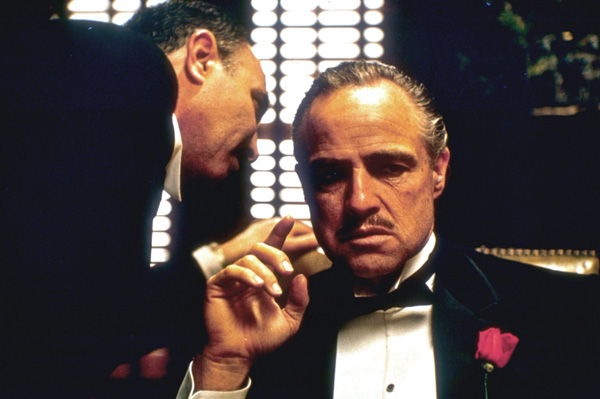
    A word in your ear, Godfather

    As Peter Biskind recounts in Easy Riders, Raging Bulls — his definitive account of the rise and fall of the new Hollywood — Paramount suits hated the “dailies” they saw from the film. Executives complained that they couldn’t make out what was going in the dark interior scenes and moaned that they would need subtitles to understand Brando’s mumbled dialogue.

    Somehow, despite the reservations that Paramount had about the film, it escaped into the wild as the animal that Coppola had given birth to. The reception from critics was ecstatic. They raved about the performances, the script and the weighty themes with which the film grappled. But The Godfather was not only an artistic triumph, but also a smash hit at the box office.

    Though Jaws is usually regarded as the milestone that marks the start of the blockbuster era, The Godfather paved the way. In an unusual move for a time when films were rolled out in theatres over months, The Godfather opened in around 350 cinemas across the US simultaneously. The film revived an ailing Paramount with an immediate transfusion of cash, pumping an unprecedented US$86m into its cash flow by the end of its first run.

    So what explains The Godfather‘s enduring appeal? Perhaps it’s the fact that it is as classically elegant in its storytelling as it was innovative and revolutionary in some of its casting and technical choices. At its heart, The Godfather is a timeless American story of wealth, power and family that has been described as Shakespearian in its character arcs.

    There is also little doubt that despite the grand themes — the corruption of the powerful and the betrayal of the American dream — this was also an intensely personal film for Coppola. A middle child with a fraught relationship with his family, Coppola connected with the sibling rivalries and the stifling patriarchy of the Corleone family. There’s a hint, perhaps, of the relationship between the new Hollywood directors and the studio bosses in the conflicts with Vito.

    Nearly every scene is a master class in filmmaking. In just two minutes, starting with the sting of the ironic words “I believe in America”, Coppola tells us everything we need to know about poor Italian migrants in New York and their status as undertaker Bonasera begs the Godfather for justice for his badly assaulted daughter.
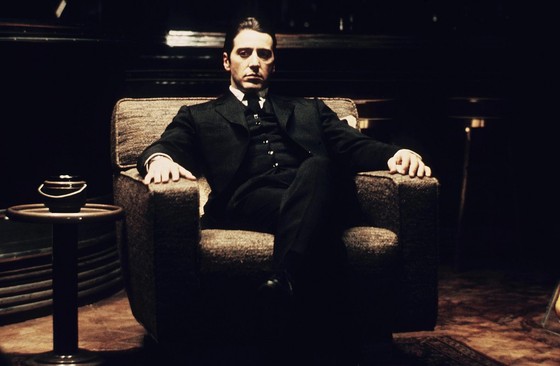
    Michael Corleone ascends to the throne of power

    Every scene that follows is as pithy and pacey, so that The Godfather never feels overlong despite its spacious three-hour running time. Scenes like the nail-biter where Michael moves his badly wounded father to a different room in a hospital as gunmen descend, and the one showing Sonny’s operatic death, still thrill, despite the many times they have been copied. The period setting is meticulous but understated. The Godfather is a film that seldom feels the need to belabour a point.

    And although its dialogue has seeped into popular culture — “It’s strictly business”; “Luca Brasi sleeps with the fishes”; “Make him an offer he can’t refuse” — it is still so sharp and caustic in context that it retains its bite. No film before or since illustrates Balzac’s axiom as vividly: “Behind every great fortune there is a crime.”

    Despite the fact that so many of the scenes are shrouded in dark at a time most Hollywood films were flooded with light, the composition of most shots in The Godfather is fairly conventional. Where Coppola uses tight zooms — as in the opening shot of the undertaker’s face — or overhead shots, like the god’s eye view of Vito’s shooting, it is done with intelligence and purpose.

    Of course, there’s the acting. The Godfather not only netted a best actor Oscar for Brando (who ungraciously declined it), but best supporting actor nominations for Pacino, Robert Duval, and James Caan. The godfather Don Vito is the lead character of the book, but in Coppola’s treatment it is Michael Corleone who is arguably the protagonist. The young Pacino carries the film on his shoulders, colouring it with the sort of nuance and understatement that has become rarer in the actor’s performances as he has grown older.

    At first, he is deeply convincing as the idealistic war hero who has stayed out of the family racketeering business. But in the pivotal scene, where he decides to go to war on his father’s behalf, the ruthlessness he inherited from Vito bursts to the surface. Pacino makes you realise that the mercilessness was always there, but you just didn’t see it before.

    Behind the scenes (via YouTube):

    http://www.youtube.com/watch?v=VQFrnnueZ2c&feature=player_embedded

    He gives no speeches about the inner turmoil as the two sides of his nature battle each other, but the scars of the struggle write themselves on his face. The moment where Michael Corleone orders the death of his brother in law is chilling. The vacuum in Pacino’s eyes makes it clear that Michael has lost his soul.

    Brando’s Don Vito is barely corporeal, often little more than a voice rasping from a face barely visible through darkness as thick as pea soup. He is a shade, a man hollowed out by his pursuit of wealth, a pure will to power. It is only his family that that keeps him tethered to the world of humanity. His ominous presence casts a shadow on every scene in the film. Caan as the hot-headed son Sonny and Duval as the quiet, outsider adoptive son Tom also turn in career-best performances.

    In The Godfather‘s success were also the seeds of the new Hollywood’s destruction. Coppola, flush from success with The Godfather and The Godfather 2, became increasingly megalomaniacal and puffed with hubris. Like many his fellow new Hollywood directors, he made increasingly extravagant demands on both his audience and the studios in the films he made.

    The famous Godfather theme by Nino Rota (via YouTube):

    Coppola started principle photography for Apocalypse Now in 1976, a shambolic shoot that dramatically overshot its budget and schedule after the director insisted on heading to the Philippines during monsoon season. His next major film — One from the Heart — was a self-indulgent mess that made only $390 000 in its first weekend on a budget of $26m. It bookended the new Hollywood and marked the start of the next studio blockbuster era.

    But the legacy of The Godfather lives on everywhere in popular culture. It is credited with “The Godfather Effect“, clearing the way for proudly ethnic films from Italian Americans and other cultural groups.

    It has inspired every gangster film since, but only Coppola’s Godfather 2, Scorsese’s Good Fellas and Leone’s Once Upon a Time in America rival it in stature. The American Film Institute ranks it only behind Citizen Kane andCasablanca in its pantheon of the all-time greats of American cinema.

    Read more:
    Time magazine: 40 things you didn’t know about The Godfather
    Pauline Kael’s review of The Godfather in The New Yorker (1972)

    Follow TechCentral on Google News Add TechCentral as your preferred source on Google


    Francis Ford Coppola Lance Harris Martin Scorcese The Godfather
    WhatsApp YouTube
    Share. Facebook Twitter LinkedIn WhatsApp Telegram Email Copy Link
    Previous ArticleStart me up: the Cape of cool kids
    Next Article Lower broadband prices as soon as this week

    Related Posts

    Apple secures new Scorsese film starring DiCaprio, De Niro

    28 May 2020

    TechCentral’s top 10 movies of 2019

    31 December 2019

    TechCentral’s top 10 games of 2019

    23 December 2019
    Company News
    AI governance: the key to growth for SA's financial institutions - Fenergo

    AI governance: the key to growth for SA’s financial institutions

    28 April 2026
    Turn passion into presence with a .digital domain name - Domains.co.za

    Turn passion into presence with a .digital domain name

    28 April 2026
    Cybersecurity in the age of AI: why speed and trust now define resilience - iqbusiness

    Cybersecurity in the AI age: speed and trust define resilience

    24 April 2026
    Opinion
    Free calls, dead voice and Shameel Joosub's Spanish ghost - Duncan McLeod

    Free calls, dead voice and Shameel Joosub’s Spanish ghost

    22 April 2026
    The conflict of interest at the heart of PayShap's slow adoption - Cheslyn Jacobs

    The conflict of interest at the heart of PayShap’s slow adoption

    26 March 2026
    South Africa's energy future hinges on getting wheeling right - Aishah Gire

    South Africa’s energy future hinges on getting wheeling right

    10 March 2026

    Subscribe to Updates

    Get the best South African technology news and analysis delivered to your e-mail inbox every morning.

    Latest Posts
    The AI policy that AI broke

    The AI policy that AI broke

    28 April 2026
    New DStv owner Canal+ confirms JSE listing date

    New DStv owner Canal+ confirms JSE listing date

    28 April 2026
    Pivotal week for US tech stocks

    Pivotal week for US tech stocks

    28 April 2026
    State broadband merger limps into a second decade - Solly Malatsi

    State broadband merger limps into a second decade

    28 April 2026
    © 2009 - 2026 NewsCentral Media
    • Cookie policy (ZA)
    • TechCentral – privacy and Popia

    Type above and press Enter to search. Press Esc to cancel.

    Manage consent

    TechCentral uses cookies to enhance its offerings. Consenting to these technologies allows us to serve you better. Not consenting or withdrawing consent may adversely affect certain features and functions of the website.

    Functional Always active
    The technical storage or access is strictly necessary for the legitimate purpose of enabling the use of a specific service explicitly requested by the subscriber or user, or for the sole purpose of carrying out the transmission of a communication over an electronic communications network.
    Preferences
    The technical storage or access is necessary for the legitimate purpose of storing preferences that are not requested by the subscriber or user.
    Statistics
    The technical storage or access that is used exclusively for statistical purposes. The technical storage or access that is used exclusively for anonymous statistical purposes. Without a subpoena, voluntary compliance on the part of your Internet Service Provider, or additional records from a third party, information stored or retrieved for this purpose alone cannot usually be used to identify you.
    Marketing
    The technical storage or access is required to create user profiles to send advertising, or to track the user on a website or across several websites for similar marketing purposes.
    • Manage options
    • Manage services
    • Manage {vendor_count} vendors
    • Read more about these purposes
    View preferences
    • {title}
    • {title}
    • {title}