Close Menu
TechCentralTechCentral

    Subscribe to the newsletter

    Get the best South African technology news and analysis delivered to your e-mail inbox every morning.

    Facebook X (Twitter) YouTube LinkedIn
    WhatsApp Facebook X (Twitter) LinkedIn YouTube
    TechCentralTechCentral
    • News
      Eskom lifts load reduction for 140 000 customers

      Eskom lifts load reduction for 140 000 customers

      8 February 2026
      AI chatbots are coming to Apple CarPlay

      AI chatbots are coming to Apple CarPlay

      8 February 2026
      South Africa's stablecoin silence is becoming a policy failure

      South Africa’s stablecoin silence is becoming a policy failure

      6 February 2026
      Every electric car you can buy in South Africa in early 2026, ranked by price

      Every electric car you can buy in South Africa in early 2026, ranked by price

      6 February 2026
      From stocks to crypto, markets reel as AI doubts grow

      From stocks to crypto, markets reel as AI doubts grow

      6 February 2026
    • World
      Crypto firm accidentally sends R700-billion in bitcoin to its users

      Crypto firm accidentally sends R700-billion in bitcoin to its users

      8 February 2026
      AI won't replace software, says Nvidia CEO amid market rout - Jensen Huang

      AI won’t replace software, says Nvidia CEO amid market rout

      4 February 2026
      Apple acquires audio AI start-up Q.ai

      Apple acquires audio AI start-up Q.ai

      30 January 2026
      SpaceX IPO may be largest in history

      SpaceX IPO may be largest in history

      28 January 2026
      Nvidia throws AI at the weather

      Nvidia throws AI at weather forecasting

      27 January 2026
    • In-depth
      How liberalisation is rewiring South Africa's power sector

      How liberalisation is rewiring South Africa’s power sector

      21 January 2026
      The top-performing South African tech shares of 2025

      The top-performing South African tech shares of 2025

      12 January 2026
      Digital authoritarianism grows as African states normalise internet blackouts

      Digital authoritarianism grows as African states normalise internet blackouts

      19 December 2025
      TechCentral's South African Newsmakers of 2025

      TechCentral’s South African Newsmakers of 2025

      18 December 2025
      Black Friday goes digital in South Africa as online spending surges to record high

      Black Friday goes digital in South Africa as online spending surges to record high

      4 December 2025
    • TCS
      TCS+ | How Cloud On Demand is helping SA businesses succeed in the cloud - Xhenia Rhode, Dion Kalicharan

      TCS+ | Cloud On Demand and Consnet: inside a real-world AWS partner success story

      30 January 2026
      Watts & Wheels S1E3: 'BYD's Corolla Cross challenger'

      Watts & Wheels S1E3: ‘BYD’s Corolla Cross challenger’

      30 January 2026
      Watts & Wheels S1E3: 'BYD's Corolla Cross challenger'

      Watts & Wheels S1E2: ‘China attacks, BMW digs in, Toyota’s sublime supercar’

      23 January 2026

      TCS+ | Why cybersecurity is becoming a competitive advantage for SA businesses

      20 January 2026
      Watts & Wheels S1E3: 'BYD's Corolla Cross challenger'

      Watts & Wheels: S1E1 – ‘William, Prince of Wheels’

      8 January 2026
    • Opinion
      South Africa's skills advantage is being overlooked at home - Richard Firth

      South Africa’s skills advantage is being overlooked at home

      29 January 2026
      Why Elon Musk's Starlink is a 'hard no' for me - Songezo Zibi

      Why Elon Musk’s Starlink is a ‘hard no’ for me

      26 January 2026
      South Africa's new fibre broadband battle - Duncan McLeod

      South Africa’s new fibre broadband battle

      20 January 2026
      AI moves from pilots to production in South African companies - Nazia Pillay SAP

      AI moves from pilots to production in South African companies

      20 January 2026
      South Africa's new fibre broadband battle - Duncan McLeod

      ANC’s attack on Solly Malatsi shows how BEE dogma trumps economic reality

      14 December 2025
    • Company Hubs
      • Africa Data Centres
      • AfriGIS
      • Altron Digital Business
      • Altron Document Solutions
      • Altron Group
      • Arctic Wolf
      • AvertITD
      • Braintree
      • CallMiner
      • CambriLearn
      • CYBER1 Solutions
      • Digicloud Africa
      • Digimune
      • Domains.co.za
      • ESET
      • Euphoria Telecom
      • Incredible Business
      • iONLINE
      • IQbusiness
      • Iris Network Systems
      • LSD Open
      • NEC XON
      • Netstar
      • Network Platforms
      • Next DLP
      • Ovations
      • Paracon
      • Paratus
      • Q-KON
      • SevenC
      • SkyWire
      • Solid8 Technologies
      • Telit Cinterion
      • Tenable
      • Vertiv
      • Videri Digital
      • Vodacom Business
      • Wipro
      • Workday
      • XLink
    • Sections
      • AI and machine learning
      • Banking
      • Broadcasting and Media
      • Cloud services
      • Contact centres and CX
      • Cryptocurrencies
      • Education and skills
      • Electronics and hardware
      • Energy and sustainability
      • Enterprise software
      • Financial services
      • Information security
      • Internet and connectivity
      • Internet of Things
      • Investment
      • IT services
      • Lifestyle
      • Motoring
      • Public sector
      • Retail and e-commerce
      • Satellite communications
      • Science
      • SMEs and start-ups
      • Social media
      • Talent and leadership
      • Telecoms
    • Events
    • Advertise
    TechCentralTechCentral
    Home » Top » The Hateful Eight review: high octane

    The Hateful Eight review: high octane

    By The Conversation5 February 2016
    Twitter LinkedIn Facebook WhatsApp Email Telegram Copy Link
    News Alerts
    WhatsApp

    hateful-eight-640

    This review contains some mild spoilers for The Hateful Eight.

    Quentin Tarantino has secured his place in popular culture by reaching into neglected corners of cinema for genres that are ready for reinvention and rediscovery.

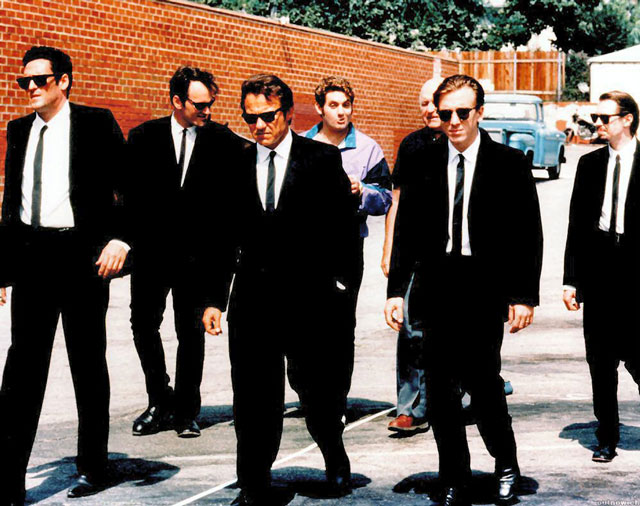
    This approach saw the motor-mouth filmmaker bring postmodern panache to the gangster film with Reservoir Dogs (1992) and Pulp Fiction (1994), mythologise martial arts movies in Kill Bill (2003), and imagine a Hollywood ending for World War II in Inglourious Basterds (2009).

    This fruitful trail now brings us to the remote mountainside lodge of Minnie’s Haberdashery — the setting for Tarantino’s eighth film, appropriately titled The Hateful Eight (2015). Across his films Tarantino has built up a loyal company of actors willing to brave these uncertain cinematic detours.

    With The Hateful Eight bustling into theatres, I sat down with two of Tarantino’s favourite stars, Samuel L Jackson and Kurt Russell, to discuss the filmmaker, the movie’s political parallels, and why the Western may never again be a Hollywood mainstay.

    A high-octane cast comes together

    In post-Civil War Wyoming, an unlikely group of bounty hunters, bandits, and lawmen take shelter from a merciless blizzard in the isolated stagecoach lodge of Minnie’s Haberdashery. The strangers each harbour dark secrets and deadly intentions.

    Among the lodge’s reluctant occupants is Samuel L Jackson’s Union soldier-turned-bounty hunter Major Marquis Warren.

    Jackson said the Tarantino set was unusually close and collaborative:

    I think it’s unique to this particular film, mainly because we rehearsed it for so long and we spent so much time together… Once we got to [primary location] Telluride [Colorado], Quentin still found unique ways of bringing us all together, cast and crew … you form a bond that’s very unique and different on his sets.

    Kurt Russell plays John “The Hangman” Ruth, a bounty hunter determined to bring prisoner Daisy Domergue to the town of Red Rock. Impenetrable snow forces them to stay at the lodge, with Ruth increasingly suspicious of the other travellers already there.

    Russell, a Hollywood veteran who previously worked with Tarantino on Death Proof (2007), said of the on-set atmosphere:

    There was a real high level of appreciation of each other’s talent on this, so it was fun to be there and watch somebody else do what they were doing … the crew and cast were very close.

    Jackson, who has contributed to six of Tarantino’s films, describes the filmmaker as a “masterful storyteller [who] creates characters that are complete and honest and entertaining, and memorable”.

    The film’s eponymous gunslingers are impeccably cast, with Jackson relishing a further opportunity to spit out Tarantino’s dialogue and Russell bringing old school bluster to the bear-like John Ruth.

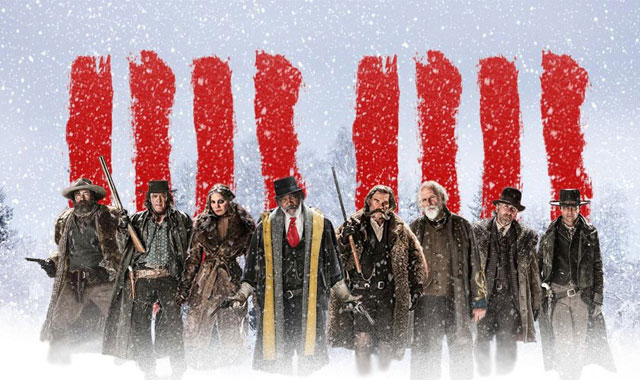
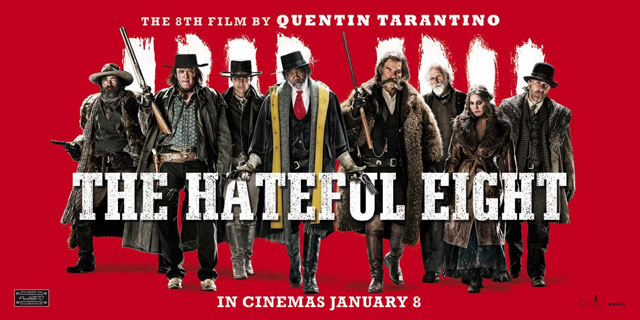
    Russell spends much of the film tethered to his bounty, viper-like Daisy Domergue, played by a revelatory Jennifer Jason Leigh. Rounding out the octet are Demián Bichir’s unlikely lodge proprietor Bob The Mexican, Reservoir Dogs alumni Tim Roth and Michael Madsen, while Bruce Dern and Walton Goggins play Confederate lost causers.

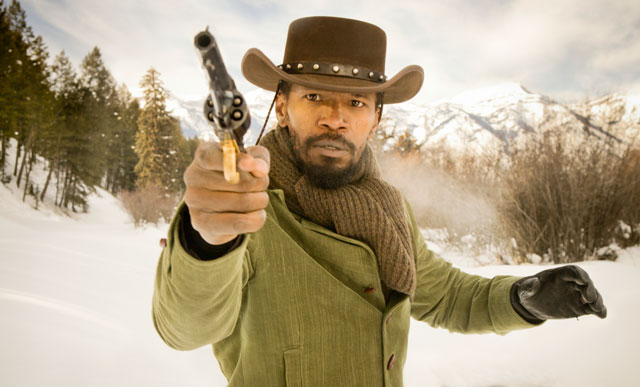
    Like the writer/director’s 2012 movie Django Unchained, The Hateful Eight is a Western, a genre which has enjoyed only limited success since its heyday in the 1950s.

    Russell, whose first starring role came at the age of 12 in the 1963 Western TV series The Travels of Jaimie McPheeters, attributes this decline to genre fatigue:

    There were a lot of Westerns on TV [in the 1960s]. In those days you did 26 shows as a series. So you had 26 new shows being written for nine different Westerns. At some point you’ve worn out your welcome.

    Jackson disagreed with this take, countering: “I don’t think that about courtroom shows or hospital shows. There’s a whole bunch of PC crap going on too.” Jackson suggests that even if contemporary social attitudes do not allow for the black and white morality of classical Westerns:

    They do it in another way now, it’s cop shows and all the other stuff — the alphabet soup of spy shows. People are still shooting themselves all over TV.

    Placing The Hateful Eight in the director’s larger filmography, Jackson believes the new film, “fits right in there like the rest of them” with the only difference being that Tarantino “tells bigger stories now, and the scope of them seems to be larger”.

    While the film’s first act does feature some impressive snowbound vistas, The Hateful Eight is mainly set in a single location. It invites inevitable comparisons with Tarantino’s first film, the warehouse-set crime drama Reservoir Dogs.

    The Hateful Eight engages in some of the same non-linear storytelling synonymous with Tarantino’s catalogue, but it is also one of his most measured film since his breakout success. Commenting on Tarantino’s command of the form, Russell reflects:

    He was in his prime here; that is one of the things that I take away from this experience and that I feel very fortunate about. Sometimes you get to work with great directors but unfortunately they weren’t in their prime. [Jackson lets out a knowing chuckle.] We can honestly say that it was one thing to work with them perhaps before or after, but when you get to work with Orson Welles absolutely in his prime or you get to work with Quentin Tarantino absolutely in his prime, that’s one to hold on to.

    Evoking Reservoir Dogs is not the director’s only nostalgic impulse. The notoriously digital-shy filmmaker has avoided industry standard techniques to shoot and process the Western on actual 70mm film.

    It’s also the first film since 1966’s Khartoum to be shot in Ultra Panavision 70, which gives The Hateful Eight an impossibly wide aspect ratio.

    To showcase this old-school format, the film is being distributed in a 1950s-style roadshow release with a longer cut (complete with an intermission and musical overture) shown in select theatres first, before the “shorter” 167-minute version is exhibited widely.
    hateful-eight-640-2

    In doing so, Tarantino is hoping to combat the loss of cinema audiences to television and streaming services by “eventising” the release. This strategy may work for cinephiles but it’s unlikely to tempt home viewers increasingly accustomed to binge watching Netflix in their pyjamas.

    Another incentive for film buffs is The Hateful Eight’s score. Tarantino’s soundtracks are almost as popular as the films they serve. In his first seven releases, the director eschewed a traditional score in favour of cherry-picking obscure film music and retro pop rock.

    Here the director breaks with this practice by enlisting Ennio Morricone, whose iconic music gave Sergio Leone’s Westerns their operatic grandeur, to provide the film’s score. While the haunting themes cannot match Morricone’s work on classics like Once Upon A Time In The West (1968) they maintain and reinforce the film’s sense of ever-present danger.

    Morricone’s score is essential to bring texture to a film that runs the risk of becoming wearisome across its three-hour running time. Tarantino “the writer” has given Tarantino “the director” an incredibly difficult task by setting the lion’s share of The Hateful Eight in a single location.

    Rather than resist the theatricality of this setup, Tarantino has wisely leaned into it. Snowflakes drop from spotlight-like shafts of light that peak through the lodge’s rafters and the 70mm aspect ratio provides a wider stage for the actors to perform, while the director himself reads off-camera stage directions at a crucial juncture. This is assured filmmaking from a director with the conviction to allow the camera to rest on a blood-stained tableaux.
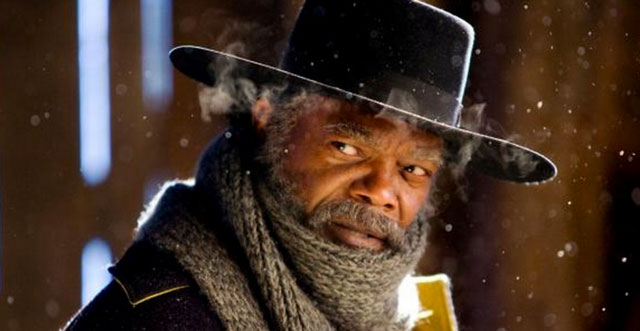
    Samuel L Jackson as XXX in The Hateful Eight
    Samuel L Jackson as Union soldier-turned-bounty hunter Major Marquis Warren in The Hateful Eight

    Jackson said that this larger canvas did not affect his performance, but notes that for the audience the characters have “lives outside of the main focus of what was going on… If you watch the movie a second or third time and follow somebody other than the person who was the major focus of the shot you’ll see all kinds of stuff happening in it.”

    The lens of the past examines the future

    After Tarantino’s more detached earlier work, the director’s confidence is also evident by the film’s greater political engagement. Before the release of The Hateful Eight, Tarantino made a number of comments about the divisiveness that pervades modern America.

    The film includes many moments that evoke contemporary discussion around US liberal media bias, the removal of the confederate flag from the South Carolina capitol, and more recently the Oregon militia’s occupation of a wildlife refuge.

    Russell believes that as it is an election year, the film’s post-Civil War setting might find particular relevance:

    That’s when [divisiveness] is talked about most… And they are not afraid to say something about it… Because maybe there’s a group out there that they want to appeal to, or a group out there that wants someone to appeal to them. And then it dies down for a while — you vote and that’s it.

    These days, few Westerns can be found roaming the multiplexes. Russell summarises the genre’s decline by observing:

    I think the Western will be something that you get in piecemeal now. You get it in little fits and spurts, but I don’t think it’ll ever be a mainstay again. It’s really hard to come up with a new take.

    While The Hateful Eight may not offer a wholly new spin on the Western genre, Tarantino is successful at creating a slow-burn chamber piece that ratchets up the tension with the introduction of each gun-toting character.

    By providing eight protagonists with uncertain pasts and nebulous morality, Tarantino also affords the spectator a measure of autonomy absent in many modern films. This effect is reinforced by the carefully staged and layered 70mm tableaux that allows the viewer to decide where to look, and ultimately where to rest their allegiance once the bullets start flying and the film races towards a blood-soaked third act.The Conversation

    • Liam Burke is senior media studies lecturer, Swinburne University of Technology
    • This article was originally published on The Conversation

    Liam Burke Quentin Tarantino The Hateful Eight The Hateful Eight review
    WhatsApp YouTube Follow on Google News Add as preferred source on Google
    Share. Facebook Twitter LinkedIn WhatsApp Telegram Email Copy Link
    Previous ArticleMTN caught up in music royalties furore
    Next Article Showdown at the VOD corral

    Related Posts

    Hollywood faces Internet piracy nightmare

    30 December 2015

    Django Unchained: southern fried spaghetti

    19 January 2013

    Reservoir Dogs: cinema’s most successful heist ever

    8 October 2012
    Company News
    The skills gap is a thinking gap: why South African employers can't find problem solvers

    The skills gap is a thinking gap: why SA employers can’t find problem solvers

    6 February 2026
    Vox Kiwi Wireless: fibre-like broadband for South African homes

    Vox Kiwi Wireless: fibre-like broadband for South African homes

    5 February 2026
    NEC XON achieves an African first with full Fortinet accreditation - Ian Kruger

    NEC XON achieves an African first with full Fortinet accreditation

    5 February 2026
    Opinion
    South Africa's skills advantage is being overlooked at home - Richard Firth

    South Africa’s skills advantage is being overlooked at home

    29 January 2026
    Why Elon Musk's Starlink is a 'hard no' for me - Songezo Zibi

    Why Elon Musk’s Starlink is a ‘hard no’ for me

    26 January 2026
    South Africa's new fibre broadband battle - Duncan McLeod

    South Africa’s new fibre broadband battle

    20 January 2026

    Subscribe to Updates

    Get the best South African technology news and analysis delivered to your e-mail inbox every morning.

    Latest Posts
    Eskom lifts load reduction for 140 000 customers

    Eskom lifts load reduction for 140 000 customers

    8 February 2026
    Crypto firm accidentally sends R700-billion in bitcoin to its users

    Crypto firm accidentally sends R700-billion in bitcoin to its users

    8 February 2026
    AI chatbots are coming to Apple CarPlay

    AI chatbots are coming to Apple CarPlay

    8 February 2026
    South Africa's stablecoin silence is becoming a policy failure

    South Africa’s stablecoin silence is becoming a policy failure

    6 February 2026
    © 2009 - 2026 NewsCentral Media
    • Cookie policy (ZA)
    • TechCentral – privacy and Popia

    Type above and press Enter to search. Press Esc to cancel.

    Manage consent

    TechCentral uses cookies to enhance its offerings. Consenting to these technologies allows us to serve you better. Not consenting or withdrawing consent may adversely affect certain features and functions of the website.

    Functional Always active
    The technical storage or access is strictly necessary for the legitimate purpose of enabling the use of a specific service explicitly requested by the subscriber or user, or for the sole purpose of carrying out the transmission of a communication over an electronic communications network.
    Preferences
    The technical storage or access is necessary for the legitimate purpose of storing preferences that are not requested by the subscriber or user.
    Statistics
    The technical storage or access that is used exclusively for statistical purposes. The technical storage or access that is used exclusively for anonymous statistical purposes. Without a subpoena, voluntary compliance on the part of your Internet Service Provider, or additional records from a third party, information stored or retrieved for this purpose alone cannot usually be used to identify you.
    Marketing
    The technical storage or access is required to create user profiles to send advertising, or to track the user on a website or across several websites for similar marketing purposes.
    • Manage options
    • Manage services
    • Manage {vendor_count} vendors
    • Read more about these purposes
    View preferences
    • {title}
    • {title}
    • {title}