Close Menu
TechCentralTechCentral

    Subscribe to the newsletter

    Get the best South African technology news and analysis delivered to your e-mail inbox every morning.

    Facebook X (Twitter) YouTube LinkedIn
    WhatsApp Facebook X (Twitter) LinkedIn YouTube
    TechCentralTechCentral
    • News
      Acsa is adding AI and augmented reality to its airport app

      Acsa is adding AI and augmented reality to its airport app

      23 July 2026
      TCS | How Optasia lends billions to people banks can't see - Salvador Anglada

      TCS | How Optasia lends billions to people banks can’t see

      23 July 2026
      Massive changes coming to Amazon Prime Video - Jeff Bezos

      Massive changes coming to Amazon Prime Video

      23 July 2026
      Load shedding is over - and that's exposing a new energy crisis

      Load shedding is over – and that’s exposing a new energy crisis

      23 July 2026
      Fat bonuses at Telkom despite group missing own targets - Serame Taukobong

      Fat bonuses at Telkom despite group missing own targets

      23 July 2026
    • World
      Meta AI will now tell parents if their teen is in crisis

      Meta AI will now tell parents if their teen is in crisis

      17 July 2026
      IBM shares crash 25% as AI upends software spending - Arvind Krishna

      IBM shares crash 25% as AI upends software spending

      15 July 2026
      Jony Ive's first OpenAI device: an AI smart speaker - Jony Ive and Sam Altman

      Jony Ive’s first OpenAI device: an AI smart speaker

      15 July 2026
      Stripe, Advent in talks to buy PayPal for $53-billion

      Stripe, Advent in talks to buy PayPal for $53-billion

      15 July 2026
      Memory crisis sends smartphone market into steep decline

      Memory crisis sends smartphone market into steep decline

      13 July 2026
    • In-depth
      The plan to stop AI from breaking the world - Google DeepMind CEO Demis Hassabis. Image: John Sears

      The plan to stop AI from breaking the world

      16 July 2026
      The internet has a Strait of Hormuz problem

      The internet has a Strait of Hormuz problem

      15 July 2026
      AI boom sparks rally, frenzy and fear

      AI boom sparks rally, frenzy and fear

      11 June 2026
      Every plug-in hybrid on sale in South Africa, ranked by price - Lamborghini Temerario

      Every plug-in hybrid on sale in South Africa, ranked by price

      7 June 2026
      What Wi-Fi 8 will mean for wireless networks

      What Wi-Fi 8 will mean for wireless networks

      1 June 2026
    • TCS
      The rands-and-cents case for electric trucks - William Kelly Watts & Wheels with Wills

      The rands-and-cents case for electric trucks

      20 July 2026
      Watts & Wheels S1E7: 'Ferrari's EV breaks the internet'

      Watts & Wheels S1E7: ‘Ferrari’s EV breaks the internet’

      8 July 2026
      TCS | Pick n Pay's Enrico Ferigolli on Penny, the AI that shops for you

      TCS | Pick n Pay’s Enrico Ferigolli on Penny, the AI that shops for you

      2 July 2026
      TCS+ | How Tracker is turning vehicle data into business strategy - Silvia Schollenberger

      TCS+ | How Tracker is turning vehicle data into business strategy

      1 July 2026
      TCS+ | IBM Bob: an AI-powered 'development partner' for the enterprise - David Spurway

      TCS+ | IBM Bob: an AI-powered development partner for the enterprise

      30 June 2026
    • Opinion
      Selling vapour is corporate suicide in slow motion - Jannie van Zyl

      Selling vapour is corporate suicide in slow motion

      16 July 2026
      Brazil's online gambling crackdown is a lesson for South Africa

      How Amazon outmanoeuvred Starlink in South Africa

      15 July 2026
      The Popia problem with agentic AI - Herman Haasbroek

      The Popia problem with agentic AI

      14 July 2026
      The author, Fanie van Rooyen

      South Africa can still catch the AI wave – here’s how

      7 July 2026
      The author, Fanie van Rooyen

      The AI utopia South Africa can’t afford

      1 July 2026
    • Company Hubs
      • 1Stream
      • Africa Data Centres
      • AfriGIS
      • Altron Digital Business
      • Altron Document Solutions
      • Altron Group
      • Arctic Wolf
      • Ascent Technology
      • AvertITD
      • BBD
      • Braintree
      • CallMiner
      • CambriLearn
      • CM Telecom
      • Contactable
      • CYBER1 Solutions
      • Digicloud Africa
      • Digimune
      • Domains.co.za
      • ESET
      • Euphoria Telecom
      • HOSTAFRICA
      • Incredible Business
      • iONLINE
      • IQbusiness
      • Iris Network Systems
      • Kaspersky
      • LSD Open
      • Mitel
      • NEC XON
      • Netstar
      • Network Platforms
      • Next DLP
      • Ovations
      • Paracon
      • Paratus
      • Q-KON
      • SevenC
      • SkyWire
      • Solid8 Technologies
      • Telit Cinterion
      • Telviva
      • Tenable
      • Vertiv
      • Videri Digital
      • Vodacom Business
      • Vox
      • Wipro
      • Workday
      • XLink
    • Sections
      • AI and machine learning
      • Banking
      • Broadcasting and Media
      • Cloud services
      • Contact centres and CX
      • Cryptocurrencies
      • Education and skills
      • Electronics and hardware
      • Energy and sustainability
      • Enterprise software
      • Financial services
      • HealthTech
      • Information security
      • Internet and connectivity
      • Internet of Things
      • Investment
      • IT services
      • Lifestyle
      • Policy and regulation
      • Public sector
      • Retail and e-commerce
      • Satellite communications
      • Science
      • SMEs and start-ups
      • Social media
      • Talent and leadership
      • Telecoms
      • Watts & Wheels
    • Events
    • Advertise
    TechCentralTechCentral
    Home » Editor's pick » Reservoir Dogs: cinema’s most successful heist ever

    Reservoir Dogs: cinema’s most successful heist ever

    By Lance Harris8 October 2012
    Twitter LinkedIn Facebook WhatsApp Email Telegram Copy Link
    News Alerts
    WhatsApp

    Reservoir Dogs, released 20 years ago in the US this month, blindsided almost everyone who saw it when it first came out with its fragmented storytelling, its juxtaposition of jaunty pop music and bracing violence, and its rat-tat-tat dialogue. That it feels almost conventional today is just a reflection of how influential Quentin Tarantino’s debut would be for the next two decades.

    Kinetic, politically incorrect, brutal and darkly funny — all gleefully so — Reservoir Dogs was a stark contrast to the right-on, inert and mannered fare favoured by the curators of Sundance, the film festival that was (and still is) the touchstone for American independent moviemaking.

    Those that were not shocked by the film’s vulgarity and carnage when it was shown at Sundance in 1992 were invigorated by its inventiveness and playfulness. Though it lost the festival’s main prize to the charming In the Soup, Dogs was the most exciting thing to hit Sundance since Joel and Ethan Coen’s Blood Simple in 1985.

    Dogs dropped the unsuspecting audience into the midst of a group of gangsters codenamed for colours, camera swirling between them as they sit in a diner discussing the meaning of Madonna’s Like a Virgin and the morality of tipping waitresses. In the next scene, Mr Orange (Tim Roth) is bleeding from a gut wound as Mr White (Harvey Keitel) rushes him to a rendezvous with the rest of the crew.

    From there, things just get more screwed up as the film zigzags between past and present to show how the gang members are recruited for a diamond heist and what happens to each of them when it all goes wrong. The most talked-about part — a grinning Mr Blonde (Michael Madsen) jiving to Stealers Wheel’s Stuck in the Middle With You while carving off a cop’s ear with a straight razor — distilled the Tarantino aesthetic into a single scene.

    “People seldom died in Sundance films, lest of Aids, old age or boredom, and in [Reservoir] Dogs, they not only died, they died slowly, painfully, bloodily with feeling,” writes Peter Biskind in Down and Dirty Pictures, his authoritative overview of the American independent cinema in the 1990s. And the film’s outspoken, enthusiastic director — a bit like Popeye on amphetamines — was born to be a star.

    Asked to justify the violence, Tarantino goaded his critics: “I don’t know about you, but I love violent movies. What I find offensive is that Merchant-Ivory shit.” Welcome to what Biskind calls the new brutalism — at that time, a welcome counterpoint to the dull worthiness of the American independent scene.

    Tarantino initially planned to fund the film from US$30 000 he raised from selling the script for True Romance, which was filmed by the late Tony Scott. When Keitel came on board as an actor and co-producer, Tarantino was able to boost his funding to a modest but more manageable $1,5m. What he made is a timeless class lesson in shoestring filmmaking.
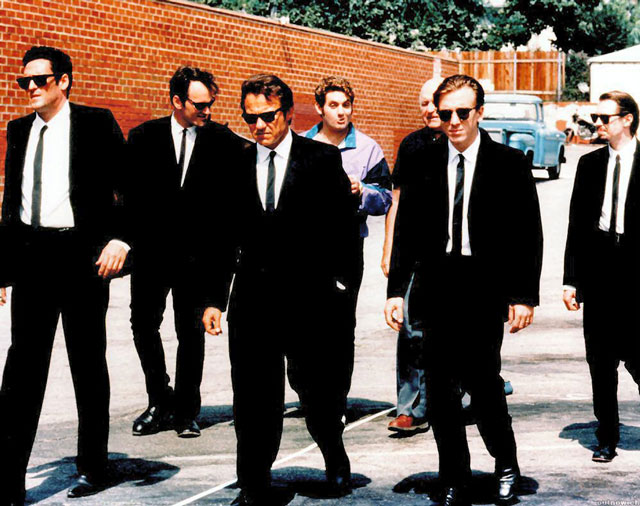
    The cocky and casual saunter that influenced every shot of a bunch of guys walking for years to come

    The film made do with simple sets and props; the iconic black suits and skinny ties the gangsters wear were donated by a designer with a fondness for hardboiled movies. The production values did not matter because of the strength of Tarantino’s writing, his dialogue recalling the macho profanity of David Mamet (one critic called it “Glengarry Glen Ross with guns”) and the hardboiled patois of Elmore Leonard.

    Reservoir Dogs is an art movie that is also a genre film — both a shrewd deconstruction and a reverent celebration of the heist movie. “Dogs is an anti-art film art film, a canny amalgam of outsider and insider art,” writes Biskind. “If the New Wave gallicised Hollywood B-movies, Tarantino re-Americanised the French hybrids, reclaiming them as it were.”

    Reservoir Dogs had its antecedents — the pop-culture subversions of David Lynch; the inter-textual cinematic collages of the Coens; the way Bret Easton-Ellis sprinkled odes to Phil Collins between the graphic murders in his novel American Psycho — but it had an incomparable sheen of nouvelle vague cool.

    Tarantino liked to say that he went to “films” rather than “film school”, devouring and ingesting everything on the shelves of the Los Angeles video store where he was a clerk. Where the New Hollywood directors like Martin Scorsese and Brian De Palma idolised Orson Welles and the French New Wave, Tarantino was a connoisseur of low culture.

    For Tarantino, Bruce Lee’s Enter the Dragon was as worthy of adoration as Jean-Luc Godard’s Breathless. In addition to Hong Kong chop socky, grindhouse flicks and spaghetti Westerns, he also loved bubble-gum pop, comic books and hardboiled detective stories. With the eye of a magpie, Tarantino picked out the shiniest pieces in the trash to make his movies.

    Reservoir Dogs was shameless in how it plundered other films for shots, motifs, characters and plot points: here a piece from The Killing, there a slice of Kansas City Confidential, perhaps slivers of The Asphalt Jungle and Ocean’s 11. The Taking of Pelham 1-2-3 gave Tarantino the idea to give his characters colour-coded names, while the 1980s Hong Kong crime epic City on Fire inspired the undercover cop and the bloody Mexican stand-off at the end of the film.

    The way Tarantino assembled the component parts, however, was exhilarating and witty. Like the good poets in the TS Eliot essay that spawned the maxim “immature poets imitate; mature poets steal”, Tarantino welded his thefts into a new whole that was “unique, utterly different from that from which it was torn”. Like the bug-eyed Mr Pink (Steve Buscemi), Tarantino is the guy who hotfoots it with the diamonds. Unlike Mr Pink, Tarantino makes a clean getaway.
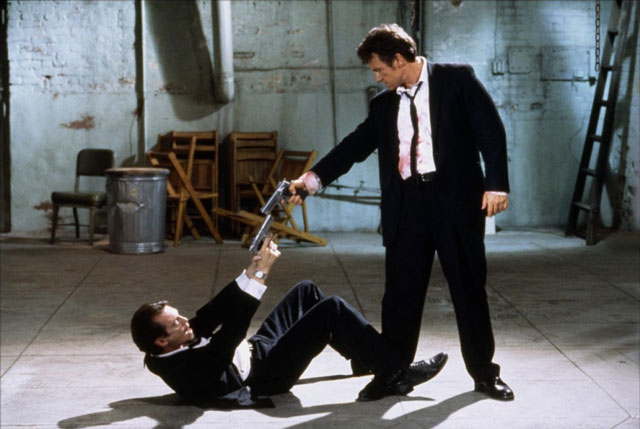
    Mr Pink (Steve Buscemi) and Mr White (Harvey Keitel) come to blows

    Unlike most heist films, Dogs shows little of the planning of the heist and nothing of the robbery itself. Dogs occupies the prosaic spaces between what most films call the action and the plot, finding humour and incident in the parts of the story that most films in the genre skip. Its characters, too, are unforgettable, and brought to vivid life by an ensemble cast.

    Though Reservoir Dogs made a return on its modest budget, it wasn’t a smash hit at the time it was released. Most people would only see the film after Tarantino broke down the doors to the mainstream with Pulp Fiction in 1994. But its impact was immediate and disproportionate to its box-office take.

    For starters, it gave Keitel’s career a turbo boost, allowing him at last to escape the shadow of Robert De Niro and Martin Scorsese. Keitel was the first but not the last fading star to get renewed shine from a Tarantino movie. Dogs also cemented the relationship between Bob and Harvey Weinstein and Tarantino.

    The film didn’t much make much money for the Weinsteins’ Miramax — that would come later with Pulp Fiction — but it positioned Miramax as a distributor and boutique studio right on the cutting edge of the movie business. It’s with good reason that Miramax became known as the firm that Quentin built.

    What really matters, though, is the film’s influence on other filmmakers. It was said of the Velvet Underground’s debut album that it only sold 1 000 copies, but each person who bought it formed a band. Within four years of the release of Dogs, it felt like everyone who had seen the film had made a movie.

    There were some worthy heirs — like Bryan Singer’s The Usual Suspects and Guy Ritchie’s Lock, Stock and Two Smoking Barrels; a few competent ones — Things to Do in Denver When You’re Dead; and many awful copies — Two Days in the Valley, Truth or Consequence NM, Killing Zoe, Love & a .45. Today, it’s hard to find a crime or noir film that doesn’t feel at least a little influenced by Dogs.

    Dogs stills stands up fairly well now, even if Tarantino quickly surpassed it with Pulp Fiction and Jackie Brown, and even if time has robbed it of its shock value. It is a little raw in places, but also smart and confident. The dialogue still crackles and burns, the film moves at a brisk pace, and the camerawork is clever without being showy.

    Tarantino may occasionally mock his critics by proclaiming a philistine’s love for cinematic violence, but there’s a moral core and aesthetic sense to his films that subverts his claims of nihilism. Dogs is, at its heart, a lamentation for the loss of integrity, heroism, competence, honour among thieves. And it has a sense of humour that sets it apart from its nastier, shallower copies.

    The violence, though shocking at the time, is not gratuitous in the same way as it is in many of the films that followed Dogs. Re-watching Dogs to write this article, I still winced during the ear slicing scene, but noticed that you don’t actually see the act. The camera discretely pans to a warehouse wall inscribed with the graffiti “Watch your head”.

    The scene that sticks with me in the end is that of the fatherly Mr White cradling the dying Mr Orange, his face wracked with pain upon hearing that the kid he stuck his neck out for is an undercover cop. For a director who claims to disdain sentimentality, Tarantino sure has a sweet side.  — (c) 2012 NewsCentral Media

    • Read more: Close Read: “Reservoir Dogs”
    • Read more: Where does the title “Reservoir Dogs” come from?

    Follow TechCentral on Google News Add TechCentral as your preferred source on Google


    Lance Harris Quentin Tarantino Reservoir Dogs
    WhatsApp YouTube
    Share. Facebook Twitter LinkedIn WhatsApp Telegram Email Copy Link
    Previous ArticleVox to make satellite Internet portable
    Next Article Microsoft readies the lifeboats

    Related Posts

    TechCentral’s top 10 movies of 2019

    31 December 2019

    TechCentral’s top 10 games of 2019

    23 December 2019

    The best movies of 2018

    31 December 2018
    Company News
    Why Africa's cloud needs more than one path

    Why Africa’s cloud needs more than one path

    23 July 2026
    Samsung's new Galaxy Z series: foldables, perfected

    Samsung’s new Galaxy Z series: foldables, perfected

    22 July 2026
    Is your cloud PBX a hacker's back door? Centracom

    Is your cloud PBX a hacker’s back door?

    22 July 2026
    Opinion
    Selling vapour is corporate suicide in slow motion - Jannie van Zyl

    Selling vapour is corporate suicide in slow motion

    16 July 2026
    Brazil's online gambling crackdown is a lesson for South Africa

    How Amazon outmanoeuvred Starlink in South Africa

    15 July 2026
    The Popia problem with agentic AI - Herman Haasbroek

    The Popia problem with agentic AI

    14 July 2026

    Subscribe to Updates

    Get the best South African technology news and analysis delivered to your e-mail inbox every morning.

    Latest Posts
    Acsa is adding AI and augmented reality to its airport app

    Acsa is adding AI and augmented reality to its airport app

    23 July 2026
    TCS | How Optasia lends billions to people banks can't see - Salvador Anglada

    TCS | How Optasia lends billions to people banks can’t see

    23 July 2026
    Massive changes coming to Amazon Prime Video - Jeff Bezos

    Massive changes coming to Amazon Prime Video

    23 July 2026
    Why Africa's cloud needs more than one path

    Why Africa’s cloud needs more than one path

    23 July 2026
    © 2009 - 2026 NewsCentral Media
    Built and maintained by Chronon
    • Cookie policy (ZA)
    • TechCentral – privacy and Popia

    Type above and press Enter to search. Press Esc to cancel.

    Manage consent

    TechCentral uses cookies to enhance its offerings. Consenting to these technologies allows us to serve you better. Not consenting or withdrawing consent may adversely affect certain features and functions of the website.

    Functional Always active
    The technical storage or access is strictly necessary for the legitimate purpose of enabling the use of a specific service explicitly requested by the subscriber or user, or for the sole purpose of carrying out the transmission of a communication over an electronic communications network.
    Preferences
    The technical storage or access is necessary for the legitimate purpose of storing preferences that are not requested by the subscriber or user.
    Statistics
    The technical storage or access that is used exclusively for statistical purposes. The technical storage or access that is used exclusively for anonymous statistical purposes. Without a subpoena, voluntary compliance on the part of your Internet Service Provider, or additional records from a third party, information stored or retrieved for this purpose alone cannot usually be used to identify you.
    Marketing
    The technical storage or access is required to create user profiles to send advertising, or to track the user on a website or across several websites for similar marketing purposes.
    • Manage options
    • Manage services
    • Manage {vendor_count} vendors
    • Read more about these purposes
    View preferences
    • {title}
    • {title}
    • {title}