
Close Menu
TechCentralTechCentral

    Subscribe to the newsletter

    Get the best South African technology news and analysis delivered to your e-mail inbox every morning.

    Facebook X (Twitter) YouTube LinkedIn
    WhatsApp Facebook X (Twitter) LinkedIn YouTube
    TechCentralTechCentral
    • News
      SA experts split on whether the singularity has begun

      SA experts split on whether the singularity has begun

      3 August 2026
      South Africa's hybrid boom is masking a flat electric car market

      South Africa’s hybrid boom is masking a flat electric car market

      3 August 2026
      SABC+ scales up

      SABC+ scales up

      3 August 2026
      The Post Office has fixed its books but not its business

      The Post Office has fixed its books but not its business

      3 August 2026
      SA companies could face cross-border crypto ban

      SA companies could face cross-border crypto ban

      3 August 2026
    • World
      Meta AI will now tell parents if their teen is in crisis

      Meta AI will now tell parents if their teen is in crisis

      17 July 2026
      IBM shares crash 25% as AI upends software spending - Arvind Krishna

      IBM shares crash 25% as AI upends software spending

      15 July 2026
      Jony Ive's first OpenAI device: an AI smart speaker - Jony Ive and Sam Altman

      Jony Ive’s first OpenAI device: an AI smart speaker

      15 July 2026
      Stripe, Advent in talks to buy PayPal for $53-billion

      Stripe, Advent in talks to buy PayPal for $53-billion

      15 July 2026
      Memory crisis sends smartphone market into steep decline

      Memory crisis sends smartphone market into steep decline

      13 July 2026
    • In-depth
      The plan to stop AI from breaking the world - Google DeepMind CEO Demis Hassabis. Image: John Sears

      The plan to stop AI from breaking the world

      16 July 2026
      The internet has a Strait of Hormuz problem

      The internet has a Strait of Hormuz problem

      15 July 2026
      AI boom sparks rally, frenzy and fear

      AI boom sparks rally, frenzy and fear

      11 June 2026
      Every plug-in hybrid on sale in South Africa, ranked by price - Lamborghini Temerario

      Every plug-in hybrid on sale in South Africa, ranked by price

      7 June 2026
      What Wi-Fi 8 will mean for wireless networks

      What Wi-Fi 8 will mean for wireless networks

      1 June 2026
    • TCS
      TCS+ | Why South African workers must become supervisors of digital labour - Accelera Digital Group Cliff de Wit

      TCS+ | Why South African workers must become supervisors of digital labour

      31 July 2026
      TCS | Rapid deployment rules can't work without municipalities: ACT - Nomvuyiso Batyi

      TCS | Icasa’s rules skip the real bottleneck: ACT

      30 July 2026
      TCS+ | iStore Business on why Apple makes sense for SMEs - Sudesh Pillay and Tamia Nontsikelelo

      TCS+ | iStore Business on why Apple makes sense for SMEs

      30 July 2026
      TCS+ | A smarter approach to cloud for South African businesses - Joel Chacko and Jonathan Oaker

      TCS+ | A smarter approach to cloud for South African businesses

      28 July 2026
      TCS | How Optasia lends billions to people banks can't see - Salvador Anglada

      TCS | How Optasia lends billions to people banks can’t see

      23 July 2026
    • Opinion
      The author, Jannie van Zyl

      Selling vapour is corporate suicide in slow motion

      16 July 2026
      Brazil's online gambling crackdown is a lesson for South Africa

      How Amazon outmanoeuvred Starlink in South Africa

      15 July 2026
      The Popia problem with agentic AI - Herman Haasbroek

      The Popia problem with agentic AI

      14 July 2026
      The author, Fanie van Rooyen

      South Africa can still catch the AI wave – here’s how

      7 July 2026
      The author, Fanie van Rooyen

      The AI utopia South Africa can’t afford

      1 July 2026
    • Company Hubs
      • 1Stream
      • Africa Data Centres
      • AfriGIS
      • Altron Digital Business
      • Altron Document Solutions
      • Altron Group
      • Arctic Wolf
      • Ascent Technology
      • AvertITD
      • BBD
      • Braintree
      • CallMiner
      • CambriLearn
      • CM Telecom
      • Contactable
      • CYBER1 Solutions
      • Digicloud Africa
      • Digimune
      • Domains.co.za
      • ESET
      • Euphoria Telecom
      • HOSTAFRICA
      • Incredible Business
      • iONLINE
      • IQbusiness
      • Iris Network Systems
      • Kaspersky
      • LSD Open
      • Mitel
      • NEC XON
      • Netstar
      • Network Platforms
      • Next DLP
      • Ovations
      • Paracon
      • Paratus
      • Q-KON
      • SevenC
      • SkyWire
      • Solid8 Technologies
      • Telit Cinterion
      • Telviva
      • Tenable
      • Vertiv
      • Videri Digital
      • Vodacom Business
      • Vox
      • Wipro
      • Workday
      • XLink
    • Sections
      • AI and machine learning
      • Banking
      • Broadcasting and Media
      • Cloud services
      • Contact centres and CX
      • Cryptocurrencies
      • Education and skills
      • Electronics and hardware
      • Energy and sustainability
      • Enterprise software
      • Financial services
      • HealthTech
      • Information security
      • Internet and connectivity
      • Internet of Things
      • Investment
      • IT services
      • Lifestyle
      • Policy and regulation
      • Public sector
      • Retail and e-commerce
      • Satellite communications
      • Science
      • SMEs and start-ups
      • Social media
      • Talent and leadership
      • Telecoms
      • Watts & Wheels
    • Events
    • Advertise
    TechCentralTechCentral
    Home » Sections » Internet and connectivity » The lessons Seacom learnt from its massive 2024 outage

    The lessons Seacom learnt from its massive 2024 outage

    Seacom has told TechCentral it learnt hard lessons about redundancy that all business leaders should heed.
    By Nkosinathi Ndlovu14 May 2026
    Twitter LinkedIn Facebook WhatsApp Email Telegram Copy Link
    News Alerts
    WhatsApp
    The lesson Seacom learnt from its massive 2024 outage - Richard Schumacher
    Richard Schumacher, MD of digital infrastructure at Seacom

    When a Belize-flagged, UK-registered cargo ship called the Rubymar was struck by a Houthi missile in the Red Sea in February 2024, it began to drift. With its anchor down in shallow water, it severed three of the region’s subsea cables before sinking on 2 March – among them was Seacom, the first privately owned subsea system to land on Africa’s east coast in 2009.

    According to Richard Schumacher, MD of digital infrastructure at Seacom, the outage taught his company and the industry a lesson that all technical leaders on the continent should heed.

    “I think the entire industry woke up – not just Seacom. It was really the first of many occurrences where everyone realised what disruption actually means to the worldwide internet,” Schumacher said in an interview with TechCentral.

    We’ve entered an era where our digital economies cannot afford to be down for any reason whatsoever

    “We’ve entered an era where our digital economies cannot afford to be down for any reason whatsoever.”

    The outage cost Seacom dearly. Seacom’s contribution to majority shareholder Remgro’s headline earnings fell about 78% that financial year. Repair to the severed cables was delayed for months by conflict in the Red Sea and traffic had to be rerouted up Africa’s west coast through Google’s Equiano as well as the Peace and Wacs cables.

    Geopolitical threats like the ongoing war in the Middle East continue to be a threat to connectivity in Africa, especially along the continent’s east coast. According to Paul Brodsky, senior research manager at undersea cable map specialist TeleGeography, any closure of the Strait of Hormuz would not pose a significant risk to connectivity in Africa. However, threats by Yemeni Houthi rebels in March 2026 to join the conflict, potentially bringing the closure of the Bab-el-Mandeb strait into the discussion, pose a more substantial risk. Again, redundancy via cables on Africa’s west coast has mitigated that risk significantly.

    Red Sea risk

    “The vast majority of Africa’s inter-regional connectivity runs to Europe, so the Persian Gulf itself is not critical to Africa connectivity. The Red Sea is extremely relevant, however. It provides a critical pathway for cables running to Europe from the east coast of Africa and from the Persian Gulf and Asia. Cable outages in the southern Red Sea are becoming more and more difficult to repair due to political instability in Yemen,” said Brodsky.

    “That said, the additional cables up the west coast of Africa have proven useful, as some traffic that is normally routed up the east coast through the Red Sea has been rerouted along west coast cables.”

    Read: South Africa is rapidly becoming a hyperconnected country

    Seacom’s Schumacher said the redundancy at the first mile should be reflected in terrestrial middle-mile and last-mile connectivity. In South Africa, he said, the first mile is in reasonable shape. Cables land at Mtunzini in KwaZulu-Natal, and at Yzerfontein and Melkbosstrand on the Cape west coast, with multiple owners taking different geographical routes. Google’s planned Umoja cable is landing in the Eastern Cape and Seacom 2.0 is planning at least two South African landings.

    The middle mile is where the gap shows up most acutely on the continent. Of the 77 subsea cable systems now touching Africa, only one sea-facing African country, Eritrea, remains unconnected – but Schumacher said the statistic flatters the picture.
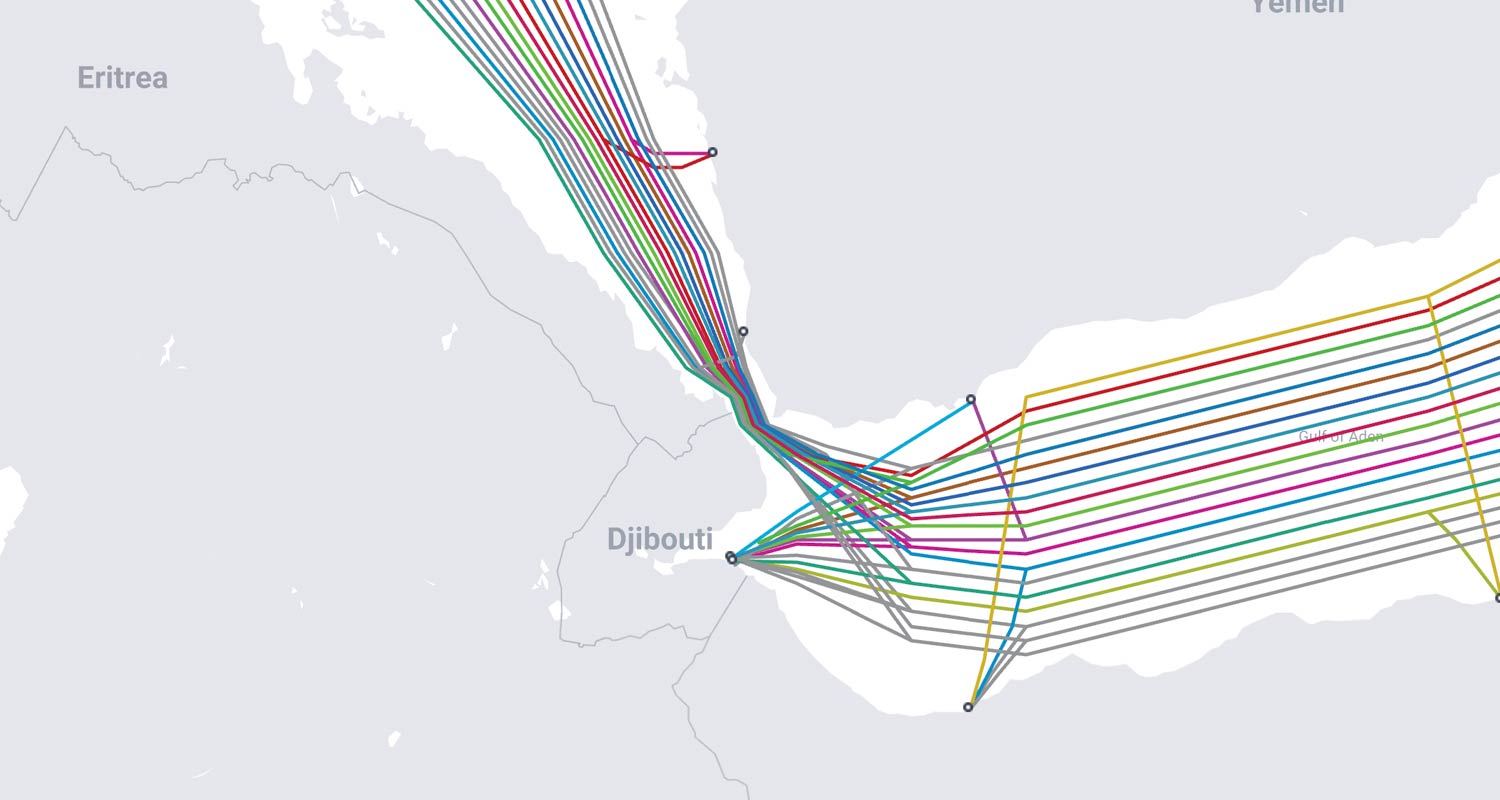
    Subsea cables are packed densely together in the Red Sea between Yemen and Djibouti. Image: TeleGeography
    Subsea cables are packed densely together in the Red Sea between Yemen and Djibouti. Image: TeleGeography

    “Any subsea cable system landing on a continent is useless, absolutely useless, unless you can take the traffic and data packets inland to businesses and end users. We have done well in South Africa, for example, but we still need to enable ourselves to take that traffic into the likes of Zimbabwe, Botswana, Lesotho, Eswatini and other landlocked countries,” said Schumacher.

    But even where the middle- and last-mile layers exist in abundance, companies must make deliberate efforts to take advantage of them by building redundancy into their networks. Schumacher warned that for many companies, redundancy feels like an option when things run smoothly, with the need for it only becoming pronounced when a disruption occurs.

    The risks are manifold, with operational, financial and reputational damage on the line. Transactions can be halted and customers frustrated, leading to losses in revenue, service-level agreement penalties, inefficiencies and long-term harm to trust and reputation.

    Read: More details emerge on massive new Seacom cable

    “It wouldn’t be wise for any network operator or consumer of that network to have single paths in terms of connectivity. Really what that means is having one connection into your premises. If there was a failure, and it’s a single point of failure, it could be detrimental to your operations and your business, and that is really a business risk,” said Schumacher.  – © 2026 NewsCentral Media

    Get breaking news from TechCentral on WhatsApp. Sign up here.

    Follow TechCentral on Google News Add TechCentral as your preferred source on Google


    Equiano Equiano cable Google Paul Brodsky Richard Schumacher Seacom TeleGeography
    WhatsApp YouTube
    Share. Facebook Twitter LinkedIn WhatsApp Telegram Email Copy Link
    Previous ArticleUS, China to coordinate on AI threats
    Next Article Malatsi pitches Reit overhaul to channel capital into digital infrastructure

    Related Posts

    Google Cloud, AI adoption gain momentum in Africa - Digicloud Africa

    Google Cloud, AI adoption gain momentum in Africa

    3 August 2026
    Africa's most popular phones have a tracking problem

    Africa’s most popular phones have a tracking problem

    24 July 2026
    The plan to stop AI from breaking the world - Google DeepMind CEO Demis Hassabis. Image: John Sears

    The plan to stop AI from breaking the world

    16 July 2026
    Company News
    Google Cloud, AI adoption gain momentum in Africa - Digicloud Africa

    Google Cloud, AI adoption gain momentum in Africa

    3 August 2026
    Domains.co.za launches self-hosted n8n VPS hosting

    Domains.co.za launches self-hosted n8n VPS hosting

    31 July 2026
    Smarter.tech '26 shows why smarter technology begins with context - Obsidian Systems

    Context is the missing piece in enterprise AI: Obsidian

    31 July 2026
    Opinion
    The author, Jannie van Zyl

    Selling vapour is corporate suicide in slow motion

    16 July 2026
    Brazil's online gambling crackdown is a lesson for South Africa

    How Amazon outmanoeuvred Starlink in South Africa

    15 July 2026
    The Popia problem with agentic AI - Herman Haasbroek

    The Popia problem with agentic AI

    14 July 2026

    Subscribe to Updates

    Get the best South African technology news and analysis delivered to your e-mail inbox every morning.

    Latest Posts
    SA experts split on whether the singularity has begun

    SA experts split on whether the singularity has begun

    3 August 2026
    South Africa's hybrid boom is masking a flat electric car market

    South Africa’s hybrid boom is masking a flat electric car market

    3 August 2026
    SABC+ scales up

    SABC+ scales up

    3 August 2026
    The Post Office has fixed its books but not its business

    The Post Office has fixed its books but not its business

    3 August 2026
    © 2009 - 2026 NewsCentral Media
    Built and maintained by Chronon
    • Cookie policy (ZA)
    • TechCentral – privacy and Popia

    Type above and press Enter to search. Press Esc to cancel.

    Manage consent

    TechCentral uses cookies to enhance its offerings. Consenting to these technologies allows us to serve you better. Not consenting or withdrawing consent may adversely affect certain features and functions of the website.

    Functional Always active
    The technical storage or access is strictly necessary for the legitimate purpose of enabling the use of a specific service explicitly requested by the subscriber or user, or for the sole purpose of carrying out the transmission of a communication over an electronic communications network.
    Preferences
    The technical storage or access is necessary for the legitimate purpose of storing preferences that are not requested by the subscriber or user.
    Statistics
    The technical storage or access that is used exclusively for statistical purposes. The technical storage or access that is used exclusively for anonymous statistical purposes. Without a subpoena, voluntary compliance on the part of your Internet Service Provider, or additional records from a third party, information stored or retrieved for this purpose alone cannot usually be used to identify you.
    Marketing
    The technical storage or access is required to create user profiles to send advertising, or to track the user on a website or across several websites for similar marketing purposes.
    • Manage options
    • Manage services
    • Manage {vendor_count} vendors
    • Read more about these purposes
    View preferences
    • {title}
    • {title}
    • {title}