
Close Menu
TechCentralTechCentral

    Subscribe to the newsletter

    Get the best South African technology news and analysis delivered to your e-mail inbox every morning.

    Facebook X (Twitter) YouTube LinkedIn
    WhatsApp Facebook X (Twitter) LinkedIn YouTube
    TechCentralTechCentral
    • News
      VALR hits back at proposed cross-border crypto ban - Farzam Ehsani

      VALR hits back at proposed cross-border crypto ban

      4 August 2026
      South Africa's AI policy collapse shows up in World Bank report

      South Africa’s AI policy collapse shows up in World Bank report

      4 August 2026
      Canal+ backs MultiChoice payments spin-out

      Canal+ backs MultiChoice payments spin-out

      4 August 2026
      Why Canal+ is betting DStv's future on live sport

      Why Canal+ is betting DStv’s future on live sport

      4 August 2026
      Shein seeking up to R660-billion valuation in IPO

      Shein seeking up to R660-billion valuation in IPO

      4 August 2026
    • World
      Meta AI will now tell parents if their teen is in crisis

      Meta AI will now tell parents if their teen is in crisis

      17 July 2026
      IBM shares crash 25% as AI upends software spending - Arvind Krishna

      IBM shares crash 25% as AI upends software spending

      15 July 2026
      Jony Ive's first OpenAI device: an AI smart speaker - Jony Ive and Sam Altman

      Jony Ive’s first OpenAI device: an AI smart speaker

      15 July 2026
      Stripe, Advent in talks to buy PayPal for $53-billion

      Stripe, Advent in talks to buy PayPal for $53-billion

      15 July 2026
      Memory crisis sends smartphone market into steep decline

      Memory crisis sends smartphone market into steep decline

      13 July 2026
    • In-depth
      The plan to stop AI from breaking the world - Google DeepMind CEO Demis Hassabis. Image: John Sears

      The plan to stop AI from breaking the world

      16 July 2026
      The internet has a Strait of Hormuz problem

      The internet has a Strait of Hormuz problem

      15 July 2026
      AI boom sparks rally, frenzy and fear

      AI boom sparks rally, frenzy and fear

      11 June 2026
      Every plug-in hybrid on sale in South Africa, ranked by price - Lamborghini Temerario

      Every plug-in hybrid on sale in South Africa, ranked by price

      7 June 2026
      What Wi-Fi 8 will mean for wireless networks

      What Wi-Fi 8 will mean for wireless networks

      1 June 2026
    • TCS
      TCS+ | Why South African workers must become supervisors of digital labour - Accelera Digital Group Cliff de Wit

      TCS+ | Why South African workers must become supervisors of digital labour

      31 July 2026
      TCS | Rapid deployment rules can't work without municipalities: ACT - Nomvuyiso Batyi

      TCS | Icasa’s rules skip the real bottleneck: ACT

      30 July 2026
      TCS+ | iStore Business on why Apple makes sense for SMEs - Sudesh Pillay and Tamia Nontsikelelo

      TCS+ | iStore Business on why Apple makes sense for SMEs

      30 July 2026
      TCS+ | A smarter approach to cloud for South African businesses - Joel Chacko and Jonathan Oaker

      TCS+ | A smarter approach to cloud for South African businesses

      28 July 2026
      TCS | How Optasia lends billions to people banks can't see - Salvador Anglada

      TCS | How Optasia lends billions to people banks can’t see

      23 July 2026
    • Opinion
      The author, Jannie van Zyl

      Selling vapour is corporate suicide in slow motion

      16 July 2026
      Brazil's online gambling crackdown is a lesson for South Africa

      How Amazon outmanoeuvred Starlink in South Africa

      15 July 2026
      The Popia problem with agentic AI - Herman Haasbroek

      The Popia problem with agentic AI

      14 July 2026
      The author, Fanie van Rooyen

      South Africa can still catch the AI wave – here’s how

      7 July 2026
      The author, Fanie van Rooyen

      The AI utopia South Africa can’t afford

      1 July 2026
    • Company Hubs
      • 1Stream
      • Africa Data Centres
      • AfriGIS
      • Altron Digital Business
      • Altron Document Solutions
      • Altron Group
      • Arctic Wolf
      • Ascent Technology
      • AvertITD
      • BBD
      • Braintree
      • CallMiner
      • CambriLearn
      • CM Telecom
      • Contactable
      • CYBER1 Solutions
      • Digicloud Africa
      • Digimune
      • Domains.co.za
      • ESET
      • Euphoria Telecom
      • HOSTAFRICA
      • Incredible Business
      • iONLINE
      • IQbusiness
      • Iris Network Systems
      • Kaspersky
      • LSD Open
      • Mitel
      • NEC XON
      • Netstar
      • Network Platforms
      • Next DLP
      • Ovations
      • Paracon
      • Paratus
      • Q-KON
      • SevenC
      • SkyWire
      • Solid8 Technologies
      • Telit Cinterion
      • Telviva
      • Tenable
      • Vertiv
      • Videri Digital
      • Vodacom Business
      • Vox
      • Wipro
      • Workday
      • XLink
    • Sections
      • AI and machine learning
      • Banking
      • Broadcasting and Media
      • Cloud services
      • Contact centres and CX
      • Cryptocurrencies
      • Education and skills
      • Electronics and hardware
      • Energy and sustainability
      • Enterprise software
      • Financial services
      • HealthTech
      • Information security
      • Internet and connectivity
      • Internet of Things
      • Investment
      • IT services
      • Lifestyle
      • Policy and regulation
      • Public sector
      • Retail and e-commerce
      • Satellite communications
      • Science
      • SMEs and start-ups
      • Social media
      • Talent and leadership
      • Telecoms
      • Watts & Wheels
    • Events
    • Advertise
    TechCentralTechCentral
    Home » Sections » Electronics and hardware » TSMC has a poison pill if China invades Taiwan

    TSMC has a poison pill if China invades Taiwan

    If China invades Taiwan, ASML and TSMC have ways to disable the world’s most sophisticated chip-making machines.
    By Agency Staff21 May 2024
    Twitter LinkedIn Facebook WhatsApp Email Telegram Copy Link
    News Alerts
    WhatsApp

    ASML Holding and Taiwan Semiconductor Manufacturing Co have ways to disable the world’s most sophisticated chip-making machines in the event that China invades Taiwan, according to people familiar with the matter.

    Officials from the US government have privately expressed concerns to both their Dutch and Taiwanese counterparts about what happens if Chinese aggression escalates into an attack on the island responsible for producing the vast majority of the world’s advanced semiconductors, two of the people said, speaking on condition of anonymity.

    ASML reassured officials about its ability to remotely disable the machines when the Dutch government met with the company on the threat, two others said. The Netherlands has run simulations on a possible invasion in order to better assess the risks, they added.

    The remote shutoff applies to Netherlands-based ASML’s line of extreme ultraviolet machines

    Spokespeople for ASML, TSMC and the Dutch trade ministry declined to comment. Spokespeople for the White House National Security Council, US department of defence and US department of commerce didn’t respond to e-mailed requests for comment.

    The remote shutoff applies to Netherlands-based ASML’s line of extreme ultraviolet machines, known within the industry as EUVs, for which TSMC is its single biggest client. EUVs harness high-frequency lightwaves to print the smallest microchip transistors in existence — creating chips that have artificial intelligence uses as well as more sensitive military applications.

    About the size of a city bus, an EUV requires regular servicing and updates. As part of that, the company can remotely force a shutoff which would act as a kill switch, the people said, speaking on condition of anonymity. The Veldhoven-based company is the world’s only manufacturer of these machines, which sell for more than €200-million apiece.

    Restrictions

    ASML’s technology has long been subject to government interventions aimed at preventing it from falling into the wrong hands. The Netherlands prohibits the company from selling EUV machines to China, for instance, because of US fears they could lend its rival an edge in the global chip war.

    It was at the behest of the US that the Dutch began this year to halt exports of ASML’s next-most sophisticated chip-making machines. Even before that ban took effect, US officials had asked ASML to cancel some previously scheduled shipments to Chinese customers.

    The company expects as much as 15% of this year’s sales to China will be affected by the latest export-control measures.

    Read: ASML reaches milestone with High NA EUV lithography system

    Evidence suggests the restrictions may have come too late to stem Chinese advances. Huawei Technologies last year produced a smartphone to rival Apple’s iPhone using chips made with older ASML printers in combination with tools from two US suppliers.

    Beijing has made technological self-sufficiency a national priority and Huawei’s efforts to advance domestic chip design and manufacture have received government backing.
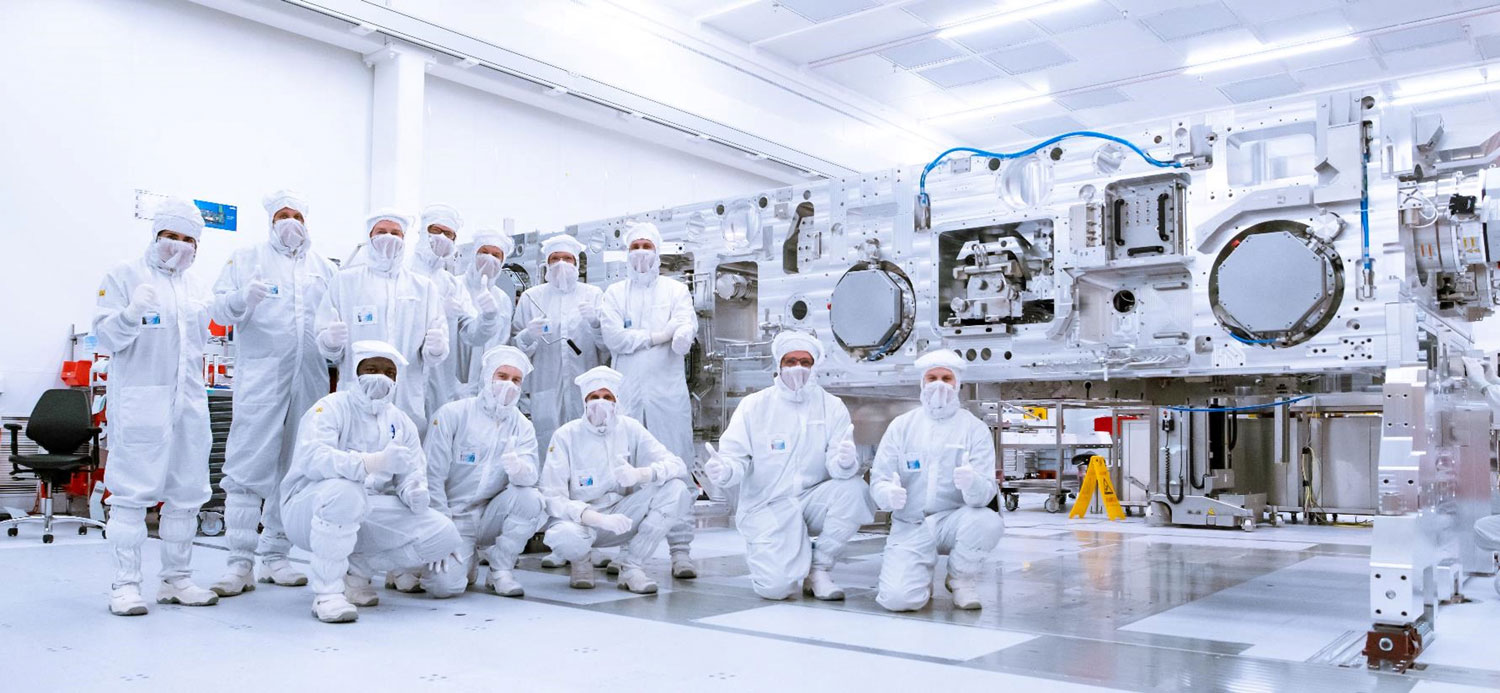
    ASML employees pose in front of the partially completed frame of the company’s ‘High NA EUV’ tool in this file photo from 2022

    China has long claimed that the island of Taiwan is its territory, with President Xi Jinping both advocating for unification and refusing to rule out a military intervention. The superpower has been building its military and nuclear arsenal on a scale not seen since World War 2, and a top US admiral testified in March that it’s readying to be able to invade Taiwan by 2027.

    The US last month approved $8-billion in aid to enhance the island’s defences. The Biden administration is also looking to boost semiconductor production on American soil, promising $39-billion in grants to chip makers to hedge against any future supply-chain disruption.

    The stakes are high, with around 90% of the world’s most advanced chips made in Taiwan. On 20 May, Taiwan inaugurated Lai Ching-te as president in the global chip hub, putting in power a man Beijing has branded an “instigator of war”.

    The EUV machine has helped turn ASML into Europe’s most valuable tech stock

    The EUV machine has helped turn ASML into Europe’s most valuable tech stock with a market capitalisation topping $370-billion — more than double that of its client Intel.

    ASML has shipped more than 200 of these machines to clients outside China since they were first developed in 2016, with TSMC snatching up more of them than any other chip maker.

    EUVs require such frequent upkeep that without ASML’s spare parts they quickly stop working, the people said. On-site maintenance of the EUVs poses a challenge because they’re housed in clean rooms that require engineers to wear special suits to avoid contamination.

    ‘Non-operable’

    ASML offers certain customers joint service contracts where they do some of the routine maintenance themselves, allowing clients like TSMC to access their own machines’ system. ASML says it can’t access its customers’ proprietary data.

    TSMC chairman Mark Liu hinted in a September interview with CNN that any invader of Taiwan would find his company’s chip-making machines out of order. “Nobody can control TSMC by force,” Liu said. “If there is a military invasion you will render TSMC factory non-operable.”  — Diederik Baazil, Cagan Koc and Jordan Robertson, with Justin Sink, Mackenzie Hawkins, Nick Wadhams and Debby Wu, (c) 2024 Bloomberg LP

    Read next: TSMC evacuates production lines after major Taiwan earthquake

    Follow TechCentral on Google News Add TechCentral as your preferred source on Google


    ASML Intel TSMC
    WhatsApp YouTube
    Share. Facebook Twitter LinkedIn WhatsApp Telegram Email Copy Link
    Previous ArticleMicrosoft debuts Copilot+ PCs with AI features
    Next Article Microsoft South Africa earmarks R1.3-billion for SMEs, skills

    Related Posts

    Intel is back in the game - Intel CEO Lip-Bu Tan. Laure Andrillon/Reuters

    Intel is back in the game

    24 July 2026
    Beijing warns of retaliation over US threats to Chinese AI firms

    China weighs blocking the West from its best AI

    21 July 2026
    IBM claims major chip breakthrough

    IBM claims major chip breakthrough

    25 June 2026
    Company News
    Why CambriLearn built the technology behind its own school

    Why CambriLearn built the technology behind its own school

    4 August 2026
    Google Cloud, AI adoption gain momentum in Africa - Digicloud Africa

    Google Cloud, AI adoption gain momentum in Africa

    3 August 2026
    Domains.co.za launches self-hosted n8n VPS hosting

    Domains.co.za launches self-hosted n8n VPS hosting

    31 July 2026
    Opinion
    The author, Jannie van Zyl

    Selling vapour is corporate suicide in slow motion

    16 July 2026
    Brazil's online gambling crackdown is a lesson for South Africa

    How Amazon outmanoeuvred Starlink in South Africa

    15 July 2026
    The Popia problem with agentic AI - Herman Haasbroek

    The Popia problem with agentic AI

    14 July 2026

    Subscribe to Updates

    Get the best South African technology news and analysis delivered to your e-mail inbox every morning.

    Latest Posts
    VALR hits back at proposed cross-border crypto ban - Farzam Ehsani

    VALR hits back at proposed cross-border crypto ban

    4 August 2026
    South Africa's AI policy collapse shows up in World Bank report

    South Africa’s AI policy collapse shows up in World Bank report

    4 August 2026
    Canal+ backs MultiChoice payments spin-out

    Canal+ backs MultiChoice payments spin-out

    4 August 2026
    Why Canal+ is betting DStv's future on live sport

    Why Canal+ is betting DStv’s future on live sport

    4 August 2026
    © 2009 - 2026 NewsCentral Media
    Built and maintained by Chronon
    • Cookie policy (ZA)
    • TechCentral – privacy and Popia

    Type above and press Enter to search. Press Esc to cancel.

    Manage consent

    TechCentral uses cookies to enhance its offerings. Consenting to these technologies allows us to serve you better. Not consenting or withdrawing consent may adversely affect certain features and functions of the website.

    Functional Always active
    The technical storage or access is strictly necessary for the legitimate purpose of enabling the use of a specific service explicitly requested by the subscriber or user, or for the sole purpose of carrying out the transmission of a communication over an electronic communications network.
    Preferences
    The technical storage or access is necessary for the legitimate purpose of storing preferences that are not requested by the subscriber or user.
    Statistics
    The technical storage or access that is used exclusively for statistical purposes. The technical storage or access that is used exclusively for anonymous statistical purposes. Without a subpoena, voluntary compliance on the part of your Internet Service Provider, or additional records from a third party, information stored or retrieved for this purpose alone cannot usually be used to identify you.
    Marketing
    The technical storage or access is required to create user profiles to send advertising, or to track the user on a website or across several websites for similar marketing purposes.
    • Manage options
    • Manage services
    • Manage {vendor_count} vendors
    • Read more about these purposes
    View preferences
    • {title}
    • {title}
    • {title}