Close Menu
TechCentralTechCentral

    Subscribe to the newsletter

    Get the best South African technology news and analysis delivered to your e-mail inbox every morning.

    Facebook X (Twitter) YouTube LinkedIn
    WhatsApp Facebook X (Twitter) LinkedIn YouTube
    TechCentralTechCentral
    • News
      The era of (relatively) cheap computers is over

      The era of (relatively) cheap computers is over

      13 January 2026
      Viu takes on social media giants with new ‘shorts’ feature

      Viu takes on social media giants with new ‘shorts’ feature

      13 January 2026
      Tech execs join SEZ advisory board - Parks Tau

      Tech execs join SEZ advisory board

      13 January 2026
      Eskom smart meter roll-out is badly behind

      Eskom smart meter roll-out is badly behind

      13 January 2026
      Google wins big as Apple rewires Siri with Gemini

      Google wins big as Apple rewires Siri with Gemini

      13 January 2026
    • World
      Work begins on what will be Africa's biggest airport

      Work begins on what will be Africa’s biggest airport

      13 January 2026
      India seeks unprecedented access to smartphone software - Narendra Modi

      India seeks unprecedented access to smartphone software

      12 January 2026
      Samsung forecasts record operating profit as AI demand sends memory chip prices sharply higher worldwide - TM Roh

      Samsung cashes in on AI data centre boom as memory prices soar

      8 January 2026
      EU pressure mounts on Musk's X over AI 'undressing' images - Wolfram Weimer

      EU pressure mounts on Musk’s X over AI ‘undressing’ images

      7 January 2026
      Intel launches Panther Lake, its next-gen PC chip

      Intel launches Panther Lake, its next-gen PC chip

      6 January 2026
    • In-depth
      Digital authoritarianism grows as African states normalise internet blackouts

      Digital authoritarianism grows as African states normalise internet blackouts

      19 December 2025
      TechCentral's South African Newsmakers of 2025

      TechCentral’s South African Newsmakers of 2025

      18 December 2025
      Black Friday goes digital in South Africa as online spending surges to record high

      Black Friday goes digital in South Africa as online spending surges to record high

      4 December 2025
      DStv dodges channel blackout in last-minute deal with Warner Bros

      Canal+ plays hardball – and DStv viewers feel the pain

      3 December 2025
      Jensen Huang Nvidia

      So, will China really win the AI race?

      14 November 2025
    • TCS
      TCS+ | Africa's digital transformation - unlocking AI through cloud and culture - Cliff de Wit Accelera Digital Group

      TCS+ | Cloud without culture won’t deliver AI: Accelera’s Cliff de Wit

      12 December 2025
      TCS+ | How Cloud on Demand helps partners thrive in the AWS ecosystem - Odwa Ndyaluvane and Xenia Rhode

      TCS+ | How Cloud On Demand helps partners thrive in the AWS ecosystem

      4 December 2025
      TCS | MTN Group CEO Ralph Mupita on competition, AI and the future of mobile

      TCS | Ralph Mupita on competition, AI and the future of mobile

      28 November 2025
      TCS | Dominic Cull on fixing South Africa's ICT policy bottlenecks

      TCS | Dominic Cull on fixing South Africa’s ICT policy bottlenecks

      21 November 2025
      TCS | BMW CEO Peter van Binsbergen on the future of South Africa's automotive industry

      TCS | BMW CEO Peter van Binsbergen on the future of South Africa’s automotive industry

      6 November 2025
    • Opinion
      ANC's attack on Solly Malatsi shows how BEE dogma trumps economic reality - Duncan McLeod

      ANC’s attack on Solly Malatsi shows how BEE dogma trumps economic reality

      14 December 2025
      Netflix, Warner Bros deal raises fresh headaches for MultiChoice - Duncan McLeod

      Netflix, Warner Bros deal raises fresh headaches for MultiChoice

      5 December 2025
      BIN scans, DDoS and the next cybercrime wave hitting South Africa's banks - Entersekt Gerhard Oosthuizen

      BIN scans, DDoS and the next cybercrime wave hitting South Africa’s banks

      3 December 2025
      ANC's attack on Solly Malatsi shows how BEE dogma trumps economic reality - Duncan McLeod

      Your data, your hardware: the DIY AI revolution is coming

      20 November 2025
      Zero Carbon Charge founder Joubert Roux

      The energy revolution South Africa can’t afford to miss

      20 November 2025
    • Company Hubs
      • Africa Data Centres
      • AfriGIS
      • Altron Digital Business
      • Altron Document Solutions
      • Altron Group
      • Arctic Wolf
      • AvertITD
      • Braintree
      • CallMiner
      • CambriLearn
      • CYBER1 Solutions
      • Digicloud Africa
      • Digimune
      • Domains.co.za
      • ESET
      • Euphoria Telecom
      • Incredible Business
      • iONLINE
      • IQbusiness
      • Iris Network Systems
      • LSD Open
      • NEC XON
      • Netstar
      • Network Platforms
      • Next DLP
      • Ovations
      • Paracon
      • Paratus
      • Q-KON
      • SevenC
      • SkyWire
      • Solid8 Technologies
      • Telit Cinterion
      • Tenable
      • Vertiv
      • Videri Digital
      • Vodacom Business
      • Wipro
      • Workday
      • XLink
    • Sections
      • AI and machine learning
      • Banking
      • Broadcasting and Media
      • Cloud services
      • Contact centres and CX
      • Cryptocurrencies
      • Education and skills
      • Electronics and hardware
      • Energy and sustainability
      • Enterprise software
      • Financial services
      • Information security
      • Internet and connectivity
      • Internet of Things
      • Investment
      • IT services
      • Lifestyle
      • Motoring
      • Public sector
      • Retail and e-commerce
      • Satellite communications
      • Science
      • SMEs and start-ups
      • Social media
      • Talent and leadership
      • Telecoms
    • Events
    • Advertise
    TechCentralTechCentral
    Home » Sections » Broadcasting and Media » Why the SABC should not be tossed to the wolves

    Why the SABC should not be tossed to the wolves

    By The Conversation29 September 2019
    Twitter LinkedIn Facebook WhatsApp Email Telegram Copy Link
    News Alerts
    WhatsApp
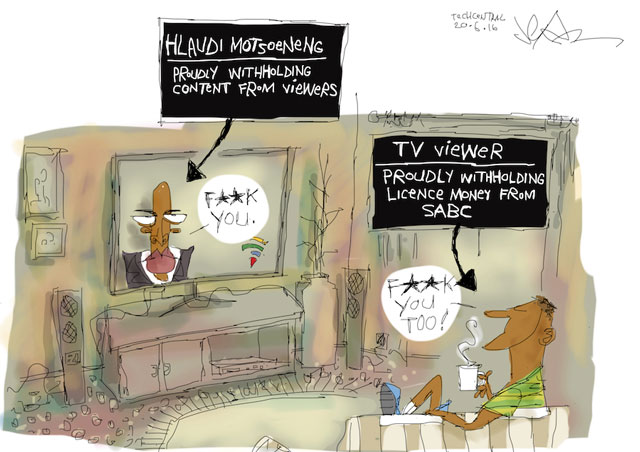
    A 2016 cartoon from TechCentral cartoonist Jerm reflects on Hlaudi Motsoeneng’s disastrous tenure as the SABC’s chief operating officer

    The SABC has been in the news for all the wrong reasons in recent times. The extent of its woes were laid bare in testimony at the judicial commission investigating allegations of corruption at various state institutions under former President Jacob Zuma.

    Witnesses, including former and current SABC, painted a frightening picture of an institution hobbled by financial bankruptcy, corruption, political interference, erosion of editorial independence, and abuse of power and low staff morale.

    The SABC has had a long a painful history. For years it was a mouthpiece of the apartheid government. But it was not destroyed after 1994 when South Africa became an inclusive democracy. Rather, the aim was to build it into a strong institution that would contribute to the new South Africa.

    It is in the very spirit of democracy and media diversity that the citizens must be exposed to a variety of media types

    After an initial promising start, that project began to fall apart. There’s no question that the SABC has violated its public broadcasting service obligations. And that it continues to place a strain on taxpayers.

    The question that needs answering is: what needs to be done to fix it?

    It is in the very spirit of democracy and media diversity that the citizens must be exposed to a variety of media types. That’s why it’s perfectly reasonable that a public broadcasting service should co-exist alongside commercial and community media forms.

    These should ideally be owned by a wide variety of proprietors, and widely divergent content.

    Essential part of the mix

    But a public broadcaster is an essential part of the mix. Unlike other media, a typical public service broadcaster has a legislated obligation to be universally geographically accessible; have universal appeal; pay attention to the needs of the minorities such as people living with disabilities; contribute to creation of national identity and sense of community; and, compete on the basis of good programming rather than in numbers or ratings.

    Another reason for defending South Africa’s public broadcaster is that the problem lies with the way in which the institution has been run, rather than the underlying concept of a public broadcaster. The problems that afflict the institution affect only some parts of the SABC — and only some people.

    It doesn’t make sense to discard the entire institution just because it has attracted people who have failed in their duties, and who have failed to make it the great broadcaster it could be.

    One of these failures has been the inability to insulate the institution from vested political interests. Yet a public broadcaster’s primary responsibility — anywhere in the world — is to exclusively serve the interest of the public, and not any political (factional) and commercial interests.

    Yet the ruinous eras of both Hlaudi Motsoeneng, the former chief operating officer, and the former news and current affairs MD Snuki Zikalala are just two examples of the calamitous failure to insulate the institution from vested political interests.

    Politically, the SABC had a good start in early post-apartheid South Africa under the leadership of Zwelekhe Sisulu, the CEO and Ivy Matsepe-Casaburri, the board chair. Nelson Mandela was the president at the time. His respect for public institutions is legendary.

    The broadcaster was being politicised. CEOs left before the end of their terms, some with massive golden handshakes

    Sisulu and Matsepe-Casaburri came from the ANC but understood the difference between a public and state broadcaster. Merit was also the primary consideration in choosing the CEO and board chairs.

    Even though the Broadcasting Act was only passed in 1999, political will was enough to protect the broadcaster. In addition, the SABC was largely stable, and had money. It used this to commission good quality dramas such as Isidingo, Generations and Yizo Yizo. Its news and current affairs programmes, such as Special Assignment, were produced by seasoned journalists. And it had a solid investigative unit.

    But the landscape began to change and the broadcaster’s market share and commercial fortunes began to shrink in the face of scores of community and regional commercial radio stations, a new free-to-air broadcaster, e.tv, and cheaper packages from DStv aimed at the growing black middle class. At the same time, the broadcaster was being politicised. CEOs left before the end of their terms, some with massive golden handshakes.

    Political interference

    President Thabo Mbeki began to rely on the SABC as the platform on which he could be defended. In 2006, the Sisulu Marcus Report revealed that the broadcaster blacklisted commentators critical of him. The SABC was to hide a clip showing the booing of the deputy president, Phumzile Mlambo-Ngcuka. This culture of censorship was continued with the banning of violent protects and insistence on the positive coverage of President Jacob Zuma.

    The country needs to devise the legislative means to insulate the SABC — internally and externally — from people who are beholden to (political and commercial) interests other than the public interest. The country cannot afford to lose the SABC.

    It is constituted in chapter IV of the Broadcasting Act in defence of the South African public. It is supposed to be a practical platform where people’s constitutional rights — freedom of speech and the right to information — are realised and equally protected.
    This role has become increasingly important given the fact that we live in an era of shrinking commercial media newsrooms amid a rise in manipulative forms of political and commercial communications designed to cover up both government and private sector corruption and other malfeasance.

    We also live in an era known for its preponderance of leisure and entertainment. As a public broadcaster, the SABC has the potential to critically engage South African citizens on serious matters for the common good, and not exploit them in pursuit of profit. The SABC can execute this task comparatively better than any other media. It also has the distinct advantage of reach.

    The state broadcaster reaches millions of South Africans, in their own languages. Its physical infrastructure makes it almost universally accessible in a country beset by inequality.

    With its 19 radio stations and four television channels, it is better suited to defend the interests of the public than other media

    With its 19 radio stations and four television channels, it is better suited to defend the interests of the public than other media. The SABC’s biggest radio station, Ukhozi FM, alone touches the lives of 7.7 million South Africans daily.

    In a developing country like South Africa, it is public broadcasting, particularly radio, that provides valuable information that matters in the lives of ordinary people. It can meet the information needs of South Africans, while also providing for the needs of the minorities, whose programmes may not be profitable. As such, an SABC that lives up to the ethos of a public service broadcaster can contribute to national identity and coherence, and a sense of community in a fragile country.

    The SABC, like South Africa itself, is a symbol of contradictions. While there are bad people who work for it, there are also many good ones. It’s because of the good people that the broadcaster has survived.

    For their sakes, and the country’s democracy, it’s imperative that the government provides the SABC with the necessary financial backing it needs to weather its current financial storms.The Conversation

    • Written by Musawenkosi Ndlovu, associate professor, Centre for Film and Media Studies, University of Cape Town
    • This article is republished from The Conversation under a Creative Commons licence


    Ivy Matsepe-Casaburri SABC top Zwelekhe Sisulu
    Subscribe to TechCentral Subscribe to TechCentral
    Share. Facebook Twitter LinkedIn WhatsApp Telegram Email Copy Link
    Previous ArticleYoco – disrupting the financial sector
    Next Article Choosing the right Office for a business

    Related Posts

    Television at 50 | How the internet broke the broadcast schedule

    Television at 50 | How the internet broke the broadcast schedule

    8 January 2026
    Television at 50 | The broadcast that changed everything - Heinrich Marnitz and Dorianne Berry

    Television at 50 | The broadcast that changed everything

    6 January 2026
    Television at 50 | A timeline of events that shaped an industry

    Television at 50 | A timeline of events that shaped an industry

    6 January 2026
    Company News
    Owning the right data is the new competitive moat in AI - CallMiner

    Owning the right data is the new competitive moat in AI

    9 January 2026
    Why trust is the real currency in modern media

    Why trust is the real currency in modern media

    6 January 2026
    Why banks and insurers need a single decisioning brain as pressures collide - SAS

    Why banks and insurers need a single decisioning brain as pressures collide

    29 December 2025
    Opinion
    ANC's attack on Solly Malatsi shows how BEE dogma trumps economic reality - Duncan McLeod

    ANC’s attack on Solly Malatsi shows how BEE dogma trumps economic reality

    14 December 2025
    Netflix, Warner Bros deal raises fresh headaches for MultiChoice - Duncan McLeod

    Netflix, Warner Bros deal raises fresh headaches for MultiChoice

    5 December 2025
    BIN scans, DDoS and the next cybercrime wave hitting South Africa's banks - Entersekt Gerhard Oosthuizen

    BIN scans, DDoS and the next cybercrime wave hitting South Africa’s banks

    3 December 2025

    Subscribe to Updates

    Get the best South African technology news and analysis delivered to your e-mail inbox every morning.

    Latest Posts
    The era of (relatively) cheap computers is over

    The era of (relatively) cheap computers is over

    13 January 2026
    Viu takes on social media giants with new ‘shorts’ feature

    Viu takes on social media giants with new ‘shorts’ feature

    13 January 2026
    Tech execs join SEZ advisory board - Parks Tau

    Tech execs join SEZ advisory board

    13 January 2026
    Work begins on what will be Africa's biggest airport

    Work begins on what will be Africa’s biggest airport

    13 January 2026
    © 2009 - 2026 NewsCentral Media
    • Cookie policy (ZA)
    • TechCentral – privacy and Popia

    Type above and press Enter to search. Press Esc to cancel.

    Manage consent

    TechCentral uses cookies to enhance its offerings. Consenting to these technologies allows us to serve you better. Not consenting or withdrawing consent may adversely affect certain features and functions of the website.

    Functional Always active
    The technical storage or access is strictly necessary for the legitimate purpose of enabling the use of a specific service explicitly requested by the subscriber or user, or for the sole purpose of carrying out the transmission of a communication over an electronic communications network.
    Preferences
    The technical storage or access is necessary for the legitimate purpose of storing preferences that are not requested by the subscriber or user.
    Statistics
    The technical storage or access that is used exclusively for statistical purposes. The technical storage or access that is used exclusively for anonymous statistical purposes. Without a subpoena, voluntary compliance on the part of your Internet Service Provider, or additional records from a third party, information stored or retrieved for this purpose alone cannot usually be used to identify you.
    Marketing
    The technical storage or access is required to create user profiles to send advertising, or to track the user on a website or across several websites for similar marketing purposes.
    • Manage options
    • Manage services
    • Manage {vendor_count} vendors
    • Read more about these purposes
    View preferences
    • {title}
    • {title}
    • {title}