Close Menu
TechCentralTechCentral

    Subscribe to the newsletter

    Get the best South African technology news and analysis delivered to your e-mail inbox every morning.

    Facebook X (Twitter) YouTube LinkedIn
    WhatsApp Facebook X (Twitter) LinkedIn YouTube
    TechCentralTechCentral
    • News
      Sentech is in dire straits

      Sentech is in dire straits

      10 February 2026
      A million reasons monopolies don't work

      A million reasons monopolies don’t work

      10 February 2026
      South Africa's data centre market ripe for consolidation - Joshua Smythwood

      South Africa’s data centre market ripe for consolidation

      10 February 2026
      Watts & Wheels S1E4: 'We drive an electric Uber'

      Watts & Wheels S1E4: ‘We drive an electric Uber’

      10 February 2026
      Online sales can't save Pick n Pay from Black Friday hangover

      Online sales can’t save Pick n Pay from Black Friday hangover

      10 February 2026
    • World
      EU regulators take aim at WhatsApp

      EU regulators take aim at WhatsApp

      9 February 2026
      Musk hits brakes on Mars mission

      Musk hits brakes on Mars mission

      9 February 2026
      Crypto firm accidentally sends R700-billion in bitcoin to its users

      Crypto firm accidentally sends R700-billion in bitcoin to its users

      8 February 2026
      AI won't replace software, says Nvidia CEO amid market rout - Jensen Huang

      AI won’t replace software, says Nvidia CEO amid market rout

      4 February 2026
      Apple acquires audio AI start-up Q.ai

      Apple acquires audio AI start-up Q.ai

      30 January 2026
    • In-depth
      How liberalisation is rewiring South Africa's power sector

      How liberalisation is rewiring South Africa’s power sector

      21 January 2026
      The top-performing South African tech shares of 2025

      The top-performing South African tech shares of 2025

      12 January 2026
      Digital authoritarianism grows as African states normalise internet blackouts

      Digital authoritarianism grows as African states normalise internet blackouts

      19 December 2025
      TechCentral's South African Newsmakers of 2025

      TechCentral’s South African Newsmakers of 2025

      18 December 2025
      Black Friday goes digital in South Africa as online spending surges to record high

      Black Friday goes digital in South Africa as online spending surges to record high

      4 December 2025
    • TCS
      TCS+ | How Cloud On Demand is helping SA businesses succeed in the cloud - Xhenia Rhode, Dion Kalicharan

      TCS+ | Cloud On Demand and Consnet: inside a real-world AWS partner success story

      30 January 2026
      Watts & Wheels S1E4: 'We drive an electric Uber'

      Watts & Wheels S1E3: ‘BYD’s Corolla Cross challenger’

      30 January 2026
      Watts & Wheels S1E4: 'We drive an electric Uber'

      Watts & Wheels S1E2: ‘China attacks, BMW digs in, Toyota’s sublime supercar’

      23 January 2026

      TCS+ | Why cybersecurity is becoming a competitive advantage for SA businesses

      20 January 2026
      Watts & Wheels S1E4: 'We drive an electric Uber'

      Watts & Wheels: S1E1 – ‘William, Prince of Wheels’

      8 January 2026
    • Opinion
      South Africa's skills advantage is being overlooked at home - Richard Firth

      South Africa’s skills advantage is being overlooked at home

      29 January 2026
      Why Elon Musk's Starlink is a 'hard no' for me - Songezo Zibi

      Why Elon Musk’s Starlink is a ‘hard no’ for me

      26 January 2026
      South Africa's new fibre broadband battle - Duncan McLeod

      South Africa’s new fibre broadband battle

      20 January 2026
      AI moves from pilots to production in South African companies - Nazia Pillay SAP

      AI moves from pilots to production in South African companies

      20 January 2026
      South Africa's new fibre broadband battle - Duncan McLeod

      ANC’s attack on Solly Malatsi shows how BEE dogma trumps economic reality

      14 December 2025
    • Company Hubs
      • Africa Data Centres
      • AfriGIS
      • Altron Digital Business
      • Altron Document Solutions
      • Altron Group
      • Arctic Wolf
      • AvertITD
      • Braintree
      • CallMiner
      • CambriLearn
      • CYBER1 Solutions
      • Digicloud Africa
      • Digimune
      • Domains.co.za
      • ESET
      • Euphoria Telecom
      • Incredible Business
      • iONLINE
      • IQbusiness
      • Iris Network Systems
      • LSD Open
      • NEC XON
      • Netstar
      • Network Platforms
      • Next DLP
      • Ovations
      • Paracon
      • Paratus
      • Q-KON
      • SevenC
      • SkyWire
      • Solid8 Technologies
      • Telit Cinterion
      • Tenable
      • Vertiv
      • Videri Digital
      • Vodacom Business
      • Wipro
      • Workday
      • XLink
    • Sections
      • AI and machine learning
      • Banking
      • Broadcasting and Media
      • Cloud services
      • Contact centres and CX
      • Cryptocurrencies
      • Education and skills
      • Electronics and hardware
      • Energy and sustainability
      • Enterprise software
      • Financial services
      • Information security
      • Internet and connectivity
      • Internet of Things
      • Investment
      • IT services
      • Lifestyle
      • Motoring
      • Public sector
      • Retail and e-commerce
      • Satellite communications
      • Science
      • SMEs and start-ups
      • Social media
      • Talent and leadership
      • Telecoms
    • Events
    • Advertise
    TechCentralTechCentral
    Home » World » Windows 95 two decades on

    Windows 95 two decades on

    By The Conversation24 August 2015
    Twitter LinkedIn Facebook WhatsApp Email Telegram Copy Link
    News Alerts
    WhatsApp

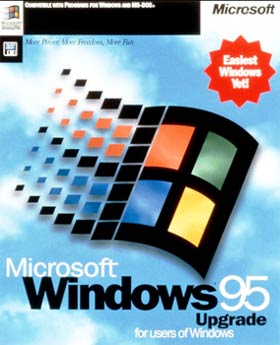
    windows-95-280It’s been 20 years since the launch of Microsoft’s Windows 95 operating system, which changed the way we interacted with computers. But what was it that was so special about the software, and why all the upgrades over the years?

    Windows 95 was Microsoft’s big push into the world of graphical user interfaces. Previous versions of Windows required users to provide input predominantly by using the keyboard, with a mouse click only here and there. Windows 95 introduced Microsoft users to a world where everything was “point and click”, with the mouse used as much as possible and the keyboard only used where necessary.

    It’s been argued that the free games packed with Windows 95 — Solitaire, Minesweeper (a favourite of Bill Gates), Hearts or FreeCell — were all designed to teach us how to use the mouse for click, drag and drop actions.

    The Windows 95 screen was composed of a number of icons and other images, rather than a collection of text windows. Documents could now be edited by highlighting words with a mouse, and clicking to cut or paste.

    Opening, copying and saving files could now also be performed by pointing and clicking. This made everyday computing tasks more intuitive and more efficient to perform, and users of the system responded favourably to it.

    The battle with Apple
    For Apple users, this appeared to be nothing particularly new. Since the launch of the Macintosh in 1984, Apple had been providing interfaces with similar functionality.

    From the perspective of 20 years later, it seems natural that Microsoft would seek to overcome a perceived technological advantage in favour of its main competitor by introducing a similar development of its own.

    This was no simple effort though. Graphical user interfaces, particularly for an operating system, require significantly more storage and processing power than text-based ones. Storing images takes vastly more space than text.

    A simple task such as opening a file by clicking on an icon requires display monitors that can show sufficient detail, which in turn requires greater processing power. This means that a “point and click” system is only possible with a particular level of hardware development. Accordingly, Windows 95 (or in fact any version of any operating system) can be considered as a showcase for what can be done with the hardware of the time.

    Users took to Windows 95 quite quickly. And as with many technological developments, the success of the system led to raised expectations, so that graphical interfaces became the norm and anything less became unthinkable.

    The need for upgrades
    Had technology and user expectations remained static, we might still be using Window 95 today. But developments in microprocessors, storage and networking inevitably led to an expanded variety and range of applications.

    This in turn raised user expectations to new levels, and drove expansion into previously unexplored territory. This means it’s unlikely that any operating system will ever be the final word, but rather will be one more step in a never-ending chain of development.

    It is easy to forget how different today’s computer use is from that of 1995. Perhaps it is an accident of history that Windows 95 coincided with the rise of the Internet, but its use at that time was primitive by today’s standards.
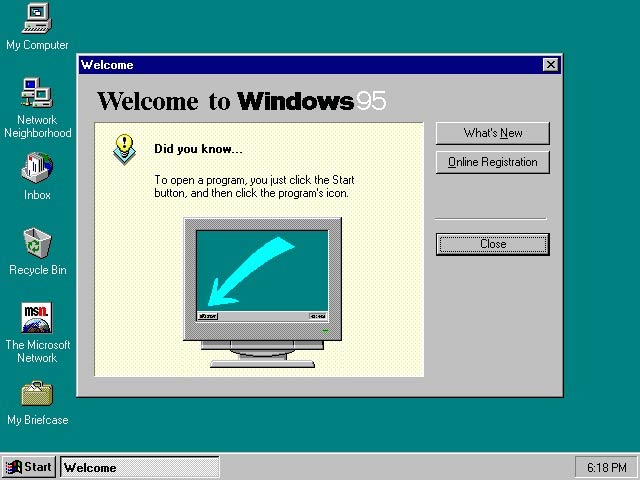
    What Windows 95 looked like upon first boot
    What Windows 95 looked like upon first boot

    This was a time before Facebook (founded in 2004), Twitter (founded in 2006) or other social networks. Internet banking was still at least a decade away. Mobile phones (large and cumbersome by today’s standards) were not ubiquitous, and were used mainly for making phone calls (how novel).

    Wireless Internet connections were still a long way away. Larry Page and Sergey Brin met at Stanford in 1995 but it would be a couple of years before they even register google.com. Internet use typically meant sending and receiving electronic mail, or perhaps exploring the brave new world of the World Wide Web using the Mosaic browser (but without the benefits of search engines).

    Connection to the Internet at home was chiefly by dial-up modems, which meant that many fledging websites were largely text, as if there were too many images, it would take too long to download them.

    The idea that photos, let along videos, would be routinely exchanged over the Internet sounded like science fiction (particularly as photographs were still typically taken on film-based cameras rather than digital ones).

    The game-changing nature of the Internet meant that computing became an increasingly important part of everyday life. This made it inevitable that Windows 95 would need to be upgraded with in a few years.

    Through the next Windows
    And that’s how it’s been over the past 20 years. The twin pressures of technological innovation and expanding applications have ensured that there have been several new versions of Windows since 1995 (some of which, it must be said, were more memorable than others).

    It is now unremarkable to upload videos to sites such as Facebook, or to pause an online movie playing on a laptop in order to pay bills online, tasks that were a pipe dream when Windows 95 was launched.

    A further driver for change, which is largely invisible to the average user, is that a typical computer now contains multiple processors. This increases the processing power of the machine, but significantly complicates the architecture of the operating system, which needs to be able to exploit this extra capability while still remaining simple to use for the average person.

    Annoying as it may have been to upgrade from say Windows 98 to Windows XP, sometimes upgrading to a new version of the operating system is simply the price of progress.

    Windows 10 is still in its infancy, but so far it seems to have the hit the mark. It may not have to deal with floppy drives or dial-up modems, but there is still a lot more going on under the hood than in the days of Windows 95 all those years ago.The Conversation

    • James Harland is associate professor in computational logic at RMIT University
    • This article was originally published on The Conversation


    WhatsApp YouTube Follow on Google News Add as preferred source on Google
    Share. Facebook Twitter LinkedIn WhatsApp Telegram Email Copy Link
    Previous ArticleBitcoin explained in plain English
    Next Article IT shares caught up in market rout

    Related Posts

    Sentech is in dire straits

    Sentech is in dire straits

    10 February 2026
    A million reasons monopolies don't work

    A million reasons monopolies don’t work

    10 February 2026
    South Africa's data centre market ripe for consolidation - Joshua Smythwood

    South Africa’s data centre market ripe for consolidation

    10 February 2026
    Company News
    Breaking down the data silos: why single views require collaboration - Altron Digital Business

    Breaking down the data silos: why single views require collaboration

    10 February 2026
    How Avast and Gen Digital are raising the bar in cybersecurity

    How Avast and Gen Digital are raising the bar in cybersecurity

    10 February 2026
    How mobile platforms are transforming online trading - Exness

    How mobile platforms are transforming online trading

    10 February 2026
    Opinion
    South Africa's skills advantage is being overlooked at home - Richard Firth

    South Africa’s skills advantage is being overlooked at home

    29 January 2026
    Why Elon Musk's Starlink is a 'hard no' for me - Songezo Zibi

    Why Elon Musk’s Starlink is a ‘hard no’ for me

    26 January 2026
    South Africa's new fibre broadband battle - Duncan McLeod

    South Africa’s new fibre broadband battle

    20 January 2026

    Subscribe to Updates

    Get the best South African technology news and analysis delivered to your e-mail inbox every morning.

    Latest Posts
    Sentech is in dire straits

    Sentech is in dire straits

    10 February 2026
    A million reasons monopolies don't work

    A million reasons monopolies don’t work

    10 February 2026
    South Africa's data centre market ripe for consolidation - Joshua Smythwood

    South Africa’s data centre market ripe for consolidation

    10 February 2026
    Watts & Wheels S1E4: 'We drive an electric Uber'

    Watts & Wheels S1E4: ‘We drive an electric Uber’

    10 February 2026
    © 2009 - 2026 NewsCentral Media
    • Cookie policy (ZA)
    • TechCentral – privacy and Popia

    Type above and press Enter to search. Press Esc to cancel.

    Manage consent

    TechCentral uses cookies to enhance its offerings. Consenting to these technologies allows us to serve you better. Not consenting or withdrawing consent may adversely affect certain features and functions of the website.

    Functional Always active
    The technical storage or access is strictly necessary for the legitimate purpose of enabling the use of a specific service explicitly requested by the subscriber or user, or for the sole purpose of carrying out the transmission of a communication over an electronic communications network.
    Preferences
    The technical storage or access is necessary for the legitimate purpose of storing preferences that are not requested by the subscriber or user.
    Statistics
    The technical storage or access that is used exclusively for statistical purposes. The technical storage or access that is used exclusively for anonymous statistical purposes. Without a subpoena, voluntary compliance on the part of your Internet Service Provider, or additional records from a third party, information stored or retrieved for this purpose alone cannot usually be used to identify you.
    Marketing
    The technical storage or access is required to create user profiles to send advertising, or to track the user on a website or across several websites for similar marketing purposes.
    • Manage options
    • Manage services
    • Manage {vendor_count} vendors
    • Read more about these purposes
    View preferences
    • {title}
    • {title}
    • {title}