
Close Menu
TechCentralTechCentral

    Subscribe to the newsletter

    Get the best South African technology news and analysis delivered to your e-mail inbox every morning.

    Facebook X (Twitter) YouTube LinkedIn
    WhatsApp Facebook X (Twitter) LinkedIn YouTube
    TechCentralTechCentral
    • News
      Global network rankings put just one SA operator on the map

      Global network rankings put just one SA operator on the map

      16 February 2026
      South African CISOs are facing a burnout epidemic

      South African CISOs are facing a burnout epidemic

      16 February 2026
      Telkom tops 25 million mobile subscribers as data growth surges - Serame Taukobong

      Telkom tops 25 million mobile subscribers as data growth surges

      16 February 2026
      BCX CEO Jonas Bogoshi to retire after seven years at the helm

      BCX CEO Jonas Bogoshi to retire after seven years at the helm

      16 February 2026
      The biggest thing missing from the state of the nation address - Cyril Ramaphosa

      The biggest thing missing from the state of the nation address

      16 February 2026
    • World
      Russia bans WhatsApp

      Russia bans WhatsApp

      12 February 2026
      EU regulators take aim at WhatsApp

      EU regulators take aim at WhatsApp

      9 February 2026
      Musk hits brakes on Mars mission

      Musk hits brakes on Mars mission

      9 February 2026
      Crypto firm accidentally sends R700-billion in bitcoin to its users

      Crypto firm accidentally sends R700-billion in bitcoin to its users

      8 February 2026
      AI won't replace software, says Nvidia CEO amid market rout - Jensen Huang

      AI won’t replace software, says Nvidia CEO amid market rout

      4 February 2026
    • In-depth
      How liberalisation is rewiring South Africa's power sector

      How liberalisation is rewiring South Africa’s power sector

      21 January 2026
      The top-performing South African tech shares of 2025

      The top-performing South African tech shares of 2025

      12 January 2026
      Digital authoritarianism grows as African states normalise internet blackouts

      Digital authoritarianism grows as African states normalise internet blackouts

      19 December 2025
      TechCentral's South African Newsmakers of 2025

      TechCentral’s South African Newsmakers of 2025

      18 December 2025
      Black Friday goes digital in South Africa as online spending surges to record high

      Black Friday goes digital in South Africa as online spending surges to record high

      4 December 2025
    • TCS
      Watts & Wheels S1E4: 'We drive an electric Uber'

      Watts & Wheels S1E4: ‘We drive an electric Uber’

      10 February 2026
      TCS+ | How Cloud On Demand is helping SA businesses succeed in the cloud - Xhenia Rhode, Dion Kalicharan

      TCS+ | Cloud On Demand and Consnet: inside a real-world AWS partner success story

      30 January 2026
      Watts & Wheels S1E4: 'We drive an electric Uber'

      Watts & Wheels S1E3: ‘BYD’s Corolla Cross challenger’

      30 January 2026
      Watts & Wheels S1E4: 'We drive an electric Uber'

      Watts & Wheels S1E2: ‘China attacks, BMW digs in, Toyota’s sublime supercar’

      23 January 2026

      TCS+ | Why cybersecurity is becoming a competitive advantage for SA businesses

      20 January 2026
    • Opinion
      A million reasons monopolies don't work - Duncan McLeod

      A million reasons monopolies don’t work

      10 February 2026
      The author, Business Leadership South Africa CEO Busi Mavuso

      Eskom unbundling U-turn threatens to undo hard-won electricity gains

      9 February 2026
      South Africa's skills advantage is being overlooked at home - Richard Firth

      South Africa’s skills advantage is being overlooked at home

      29 January 2026
      Why Elon Musk's Starlink is a 'hard no' for me - Songezo Zibi

      Why Elon Musk’s Starlink is a ‘hard no’ for me

      26 January 2026
      A million reasons monopolies don't work - Duncan McLeod

      South Africa’s new fibre broadband battle

      20 January 2026
    • Company Hubs
      • Africa Data Centres
      • AfriGIS
      • Altron Digital Business
      • Altron Document Solutions
      • Altron Group
      • Arctic Wolf
      • AvertITD
      • Braintree
      • CallMiner
      • CambriLearn
      • CYBER1 Solutions
      • Digicloud Africa
      • Digimune
      • Domains.co.za
      • ESET
      • Euphoria Telecom
      • Incredible Business
      • iONLINE
      • IQbusiness
      • Iris Network Systems
      • LSD Open
      • Mitel
      • NEC XON
      • Netstar
      • Network Platforms
      • Next DLP
      • Ovations
      • Paracon
      • Paratus
      • Q-KON
      • SevenC
      • SkyWire
      • Solid8 Technologies
      • Telit Cinterion
      • Tenable
      • Vertiv
      • Videri Digital
      • Vodacom Business
      • Wipro
      • Workday
      • XLink
    • Sections
      • AI and machine learning
      • Banking
      • Broadcasting and Media
      • Cloud services
      • Contact centres and CX
      • Cryptocurrencies
      • Education and skills
      • Electronics and hardware
      • Energy and sustainability
      • Enterprise software
      • Financial services
      • Information security
      • Internet and connectivity
      • Internet of Things
      • Investment
      • IT services
      • Lifestyle
      • Motoring
      • Public sector
      • Retail and e-commerce
      • Satellite communications
      • Science
      • SMEs and start-ups
      • Social media
      • Talent and leadership
      • Telecoms
    • Events
    • Advertise
    TechCentralTechCentral
    Home » Sections » Financial services » South Africa’s informal sector is ditching cash fast

    South Africa’s informal sector is ditching cash fast

    Card payments are muscling in on cash and outstripping other payment methods in the informal economy, new research shows.
    By Nkosinathi Ndlovu10 November 2023
    Twitter LinkedIn Facebook WhatsApp Email Telegram Copy Link
    News Alerts
    WhatsApp

    Card payment growth is muscling in on cash and outstripping other payment methods in South Africa’s informal economy, new research shows. 

    The digitisation of payments in the cash-driven informal economy is shining a light on consumer behaviour in what is often thought of as the country’s invisible or “dark” sector. 

    Lesaka Technologies, parent to the Kazang merchant solutions business, has collaborated with kasi economy expert GG Alcock and used data from more than 70 000 merchant devices to glean insights into the nature of digitisation in the informal economy.

    People, even old gogos, understand how to tap their card to pay or insert the chip and enter a Pin

    The results are outlined in the Lesaka Informal Economy Digitalisation Index, published this week. It found that card payments are skyrocketing as consumers in this segment begin turning away from cash. 

    “We are seeing a greater portion of card payments into the digital wallets that underpin our point-of-sale devices,” said Lesaka Technologies group CEO Chris Meyer. “We have transitioned from 0% to 42% of our R2-billion/month transaction volumes being card-based in the period from 2021 to 2023. More than 90% of these volumes are from debit cards.” 

    Comprised of businesses mostly in townships, rural and outlying areas, the informal or kasi economy is estimated by Alcock to be worth more than R600-billion annually. 

    In recent years, various factors have driven digitisation in the informal sector. The changes are driving consumer and merchant behaviour away from a reliance on cash.

    Informal sector

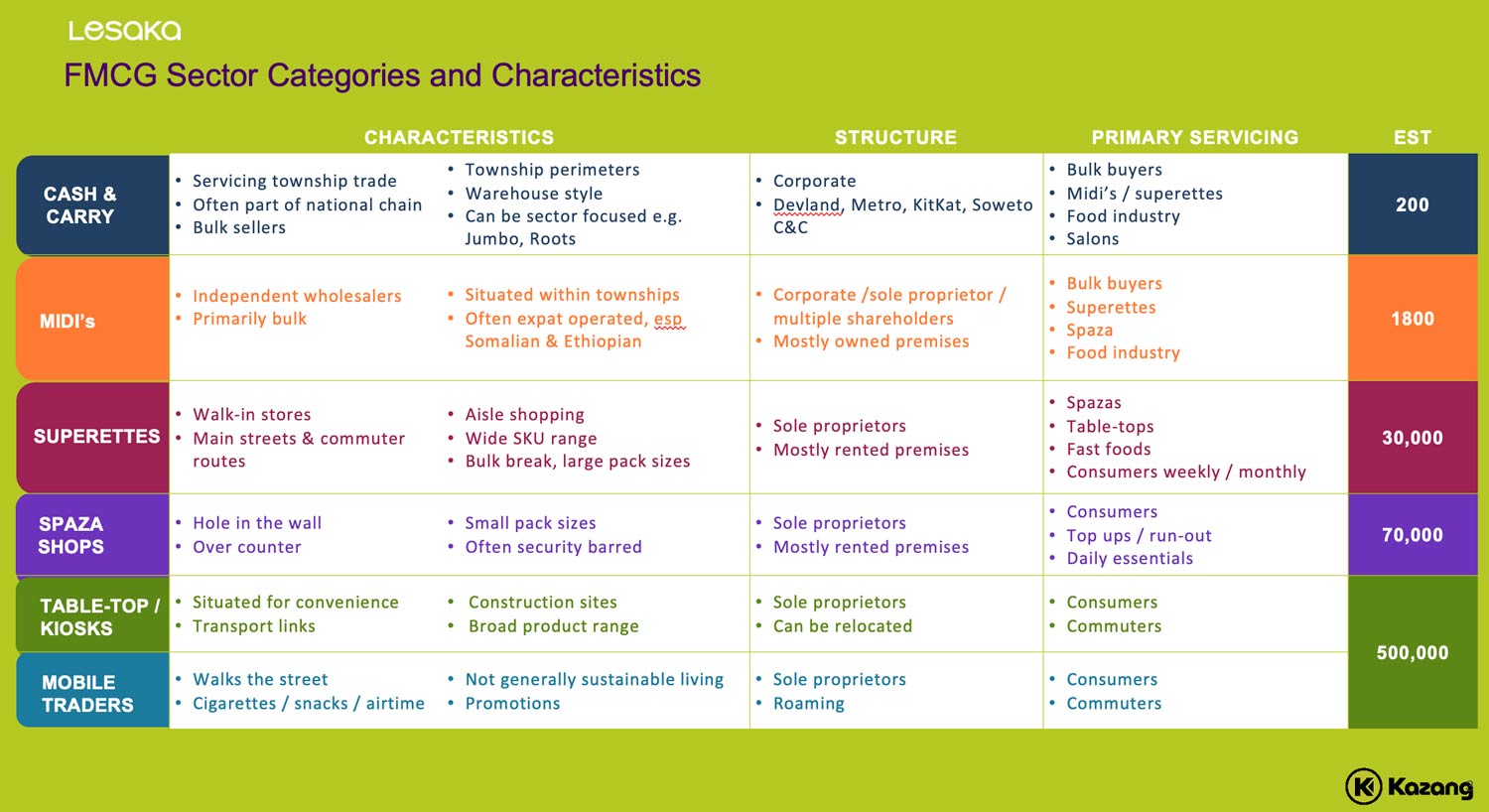
    Kazang CEO Martin Wright said the proliferation of fintech companies offering cheaper merchant services along with point-of-sale (POS) devices – which are now often “free” – has coincided with growing demand for digital payment methods in the more formalised portions of the kasi economy. This segment comprises larger cash and carries, independent wholesalers and superettes (medium-sized walk-in stores on main roads). 

    Alcock, who also wrote the book Kasinomics – African Informal Economies and the People Who Inhabit Them, explained that safety concerns are the main driver of merchant-side demand for digital payment methods. Additional merchant benefits, such as the lowering of employee fraud and the reduced cost associated with moving large sums of money around compared to cash, were also highlighted as significant.

    Read: RoomKing takes aim at SA’s backroom rental market

    Other drivers include the government transitioning millions of Sassa grant recipients from cash onto card. 

    “Three years ago, all grants were paid in cash. They then moved to the Post Office, and today the majority (58%) of grant recipients are paid through [digital] financial services,” said Lesaka Technologies South Africa CEO Lincoln Mali, explaining how the transition has accustomed many previously unbanked, lower-LSM individuals to using debit cards as a method of payment.
    Source: Lesaka Technologies

    “We also found that pre-Covid, people were afraid to tap their cards, but during the pandemic they considered it safer to do so – the pandemic changed their psychology.” 

    In the broader economy, the pandemic’s impact on digital payments also drove growth in in-app payment services such as Zapper, Apple Pay and Samsung Pay where customers tap their phones to make a payment. Although smart device penetration in the lower LSMs inhibits similar levels of growth in the informal market, Alcock explained that there is a safety factor playing a more influential role in how kasi consumers behave. 

    “People, even old gogos, understand how to tap their card to pay or insert the chip and enter a Pin if they need to. But they don’t feel safe opening their banking app in public because someone might be spying, their phone might get snatched, or they could be cornered and coerced into transferring money from their accounts,” said Alcock. 

    The uptick in digitisation is having a positive impact on visibility from a tax collection perspective

    In line with safety, Alcock explained that trust factors are also deciding which digital payment methods and brands gain traction in the informal market. 

    “People will tap their card on a machine they recognise, like a Kazang here in Gauteng or an iKhokha in KZN, but they hold back if the brand is unfamiliar. You may find that the company providing the POS machine is well known but the brand name they’re using for it isn’t,” he said. “That’s also why phone scanning or tapping methods have not worked there; people [in the informal economy] are more afraid of being hacked via their phones.” 

    The digital crimes profile in the informal economy differs from the formal market. Incidents of phishing and other sophisticated scams are superseded by cases involving some element of force. “The fact that you can block a card even though someone may have taken it from you and forced you to give them your Pin makes it much safer,” said Lesaka CEO Meyer.

    Safety and convenience

    The safety and convenience offered by card payments underpins the resilience of this payment method in the informal economy – so much so that smaller players in this segment, including spaza shops, tabletop merchants and mobile traders, now prefer it to cash.

    “The average cost to ‘swipa’ (the colloquialism for paying using a card) at spaza shops has gone down from an additional R20 to just R5. Getting a cashback was once R50 and now costs R10. Traders used to charge a high ‘convenience fee’ in the past because they actually didn’t want card payments back then. Now they incentivise card payments because they mitigate the risk of carrying cash and they often make a cash withdrawal free [for customers] if it accompanies a purchase,” said Alcock.

    Read: Big banks, take note: PayShap should be free

    The uptick in digitisation is having a positive impact on visibility from a tax collection perspective, but Alcock warns that this is a double-edged sword. Those businesses that were previously not registered for tax also did not claim VAT, which amounted to a saving for the state. As they formalise, their tax liability will be offset by that, he explained. 

    Lesaka Technologies CEO Chris Meyer

    Merchants, meanwhile, are finding that there are additional benefits to digitising their businesses. The availability of a reliable money trail has opened financing opportunities that are driving growth in the sector. 

    “There is a huge amount of anecdotal data about the kasi economy, and it has led to red herrings like ‘everyone wants to use cash because they will be invisible to the tax man’, but this is not true. Merchants often find that the value in safety and convenience offsets the cost,” said Alcock.  — (c) 2023 NewsCentral Media

    Get breaking news alerts from TechCentral on WhatsApp


    Chris Meyer GG Alcock Kazang Lesaka Lesaka Technologies Martin Wright
    WhatsApp YouTube Follow on Google News Add as preferred source on Google
    Share. Facebook Twitter LinkedIn WhatsApp Telegram Email Copy Link
    Previous ArticleBanking app kidnappings: Sabric on how not to become a victim
    Next Article Clickatell retools its chatbots for the era of ‘AI commerce’

    Related Posts

    Big changes at Lesaka as Bank Zero deal nears completion - Lincoln Mali

    Big changes at Lesaka as Bank Zero deal nears completion

    6 February 2026
    Heavyweights backing ZARU, a new rand-based stablecoin in South Africa

    Heavyweights backing ZARU, a new rand-based stablecoin

    3 February 2026
    Lesaka launches 'One Lesaka', a unified brand for financial inclusion

    Lesaka launches ‘One Lesaka’, a unified brand for financial inclusion

    25 November 2025
    Company News
    Vox Weather viewer numbers continue to climb across multiple technology platforms

    Vox Weather viewer numbers continue to climb across tech platforms

    16 February 2026
    Vivo launches X300 flagship series in SA with 200MP Zeiss cameras

    Vivo launches X300 flagship series in SA with 200MP Zeiss cameras

    16 February 2026
    Cell C delivers maiden results with growth momentum, financial flexibility - Jorges Mendes

    Cell C delivers maiden results with growth momentum, financial flexibility

    13 February 2026
    Opinion
    A million reasons monopolies don't work - Duncan McLeod

    A million reasons monopolies don’t work

    10 February 2026
    The author, Business Leadership South Africa CEO Busi Mavuso

    Eskom unbundling U-turn threatens to undo hard-won electricity gains

    9 February 2026
    South Africa's skills advantage is being overlooked at home - Richard Firth

    South Africa’s skills advantage is being overlooked at home

    29 January 2026

    Subscribe to Updates

    Get the best South African technology news and analysis delivered to your e-mail inbox every morning.

    Latest Posts
    Global network rankings put just one SA operator on the map

    Global network rankings put just one SA operator on the map

    16 February 2026
    Vox Weather viewer numbers continue to climb across multiple technology platforms

    Vox Weather viewer numbers continue to climb across tech platforms

    16 February 2026
    South African CISOs are facing a burnout epidemic

    South African CISOs are facing a burnout epidemic

    16 February 2026
    Vivo launches X300 flagship series in SA with 200MP Zeiss cameras

    Vivo launches X300 flagship series in SA with 200MP Zeiss cameras

    16 February 2026
    © 2009 - 2026 NewsCentral Media
    • Cookie policy (ZA)
    • TechCentral – privacy and Popia

    Type above and press Enter to search. Press Esc to cancel.

    Manage consent

    TechCentral uses cookies to enhance its offerings. Consenting to these technologies allows us to serve you better. Not consenting or withdrawing consent may adversely affect certain features and functions of the website.

    Functional Always active
    The technical storage or access is strictly necessary for the legitimate purpose of enabling the use of a specific service explicitly requested by the subscriber or user, or for the sole purpose of carrying out the transmission of a communication over an electronic communications network.
    Preferences
    The technical storage or access is necessary for the legitimate purpose of storing preferences that are not requested by the subscriber or user.
    Statistics
    The technical storage or access that is used exclusively for statistical purposes. The technical storage or access that is used exclusively for anonymous statistical purposes. Without a subpoena, voluntary compliance on the part of your Internet Service Provider, or additional records from a third party, information stored or retrieved for this purpose alone cannot usually be used to identify you.
    Marketing
    The technical storage or access is required to create user profiles to send advertising, or to track the user on a website or across several websites for similar marketing purposes.
    • Manage options
    • Manage services
    • Manage {vendor_count} vendors
    • Read more about these purposes
    View preferences
    • {title}
    • {title}
    • {title}