
Close Menu
TechCentralTechCentral

    Subscribe to the newsletter

    Get the best South African technology news and analysis delivered to your e-mail inbox every morning.

    Facebook X (Twitter) YouTube LinkedIn
    WhatsApp Facebook X (Twitter) LinkedIn YouTube
    TechCentralTechCentral
    • News
      Eskom's diesel bill falls 86% as breakdowns hit eight-year low

      Eskom’s diesel bill falls 86% as breakdowns hit eight-year low

      31 July 2026
      Ramaphosa signs off on taking the grid away from Eskom

      Ramaphosa signs off on taking the grid away from Eskom

      31 July 2026
      Nedbank hires MTN's former tech chief as group CIO - Nikos Angelopoulos

      Nedbank hires MTN’s former tech chief as group CIO

      31 July 2026
      Microsoft just had the biggest day in stock market history

      Microsoft just had the biggest day in stock market history

      31 July 2026
      MTN Nigeria's growth engine stalled in second quarter - Karl Toriola

      MTN Nigeria’s growth engine stalled in second quarter

      31 July 2026
    • World
      Meta AI will now tell parents if their teen is in crisis

      Meta AI will now tell parents if their teen is in crisis

      17 July 2026
      IBM shares crash 25% as AI upends software spending - Arvind Krishna

      IBM shares crash 25% as AI upends software spending

      15 July 2026
      Jony Ive's first OpenAI device: an AI smart speaker - Jony Ive and Sam Altman

      Jony Ive’s first OpenAI device: an AI smart speaker

      15 July 2026
      Stripe, Advent in talks to buy PayPal for $53-billion

      Stripe, Advent in talks to buy PayPal for $53-billion

      15 July 2026
      Memory crisis sends smartphone market into steep decline

      Memory crisis sends smartphone market into steep decline

      13 July 2026
    • In-depth
      The plan to stop AI from breaking the world - Google DeepMind CEO Demis Hassabis. Image: John Sears

      The plan to stop AI from breaking the world

      16 July 2026
      The internet has a Strait of Hormuz problem

      The internet has a Strait of Hormuz problem

      15 July 2026
      AI boom sparks rally, frenzy and fear

      AI boom sparks rally, frenzy and fear

      11 June 2026
      Every plug-in hybrid on sale in South Africa, ranked by price - Lamborghini Temerario

      Every plug-in hybrid on sale in South Africa, ranked by price

      7 June 2026
      What Wi-Fi 8 will mean for wireless networks

      What Wi-Fi 8 will mean for wireless networks

      1 June 2026
    • TCS
      TCS+ | Why South African workers must become supervisors of digital labour - Accelera Digital Group Cliff de Wit

      TCS+ | Why South African workers must become supervisors of digital labour

      31 July 2026
      TCS | Rapid deployment rules can't work without municipalities: ACT - Nomvuyiso Batyi

      TCS | Icasa’s rules skip the real bottleneck: ACT

      30 July 2026
      TCS+ | iStore Business on why Apple makes sense for SMEs - Sudesh Pillay and Tamia Nontsikelelo

      TCS+ | iStore Business on why Apple makes sense for SMEs

      30 July 2026
      TCS+ | A smarter approach to cloud for South African businesses - Joel Chacko and Jonathan Oaker

      TCS+ | A smarter approach to cloud for South African businesses

      28 July 2026
      TCS | How Optasia lends billions to people banks can't see - Salvador Anglada

      TCS | How Optasia lends billions to people banks can’t see

      23 July 2026
    • Opinion
      The author, Jannie van Zyl

      Selling vapour is corporate suicide in slow motion

      16 July 2026
      Brazil's online gambling crackdown is a lesson for South Africa

      How Amazon outmanoeuvred Starlink in South Africa

      15 July 2026
      The Popia problem with agentic AI - Herman Haasbroek

      The Popia problem with agentic AI

      14 July 2026
      The author, Fanie van Rooyen

      South Africa can still catch the AI wave – here’s how

      7 July 2026
      The author, Fanie van Rooyen

      The AI utopia South Africa can’t afford

      1 July 2026
    • Company Hubs
      • 1Stream
      • Africa Data Centres
      • AfriGIS
      • Altron Digital Business
      • Altron Document Solutions
      • Altron Group
      • Arctic Wolf
      • Ascent Technology
      • AvertITD
      • BBD
      • Braintree
      • CallMiner
      • CambriLearn
      • CM Telecom
      • Contactable
      • CYBER1 Solutions
      • Digicloud Africa
      • Digimune
      • Domains.co.za
      • ESET
      • Euphoria Telecom
      • HOSTAFRICA
      • Incredible Business
      • iONLINE
      • IQbusiness
      • Iris Network Systems
      • Kaspersky
      • LSD Open
      • Mitel
      • NEC XON
      • Netstar
      • Network Platforms
      • Next DLP
      • Ovations
      • Paracon
      • Paratus
      • Q-KON
      • SevenC
      • SkyWire
      • Solid8 Technologies
      • Telit Cinterion
      • Telviva
      • Tenable
      • Vertiv
      • Videri Digital
      • Vodacom Business
      • Vox
      • Wipro
      • Workday
      • XLink
    • Sections
      • AI and machine learning
      • Banking
      • Broadcasting and Media
      • Cloud services
      • Contact centres and CX
      • Cryptocurrencies
      • Education and skills
      • Electronics and hardware
      • Energy and sustainability
      • Enterprise software
      • Financial services
      • HealthTech
      • Information security
      • Internet and connectivity
      • Internet of Things
      • Investment
      • IT services
      • Lifestyle
      • Policy and regulation
      • Public sector
      • Retail and e-commerce
      • Satellite communications
      • Science
      • SMEs and start-ups
      • Social media
      • Talent and leadership
      • Telecoms
      • Watts & Wheels
    • Events
    • Advertise
    TechCentralTechCentral
    Home » Sections » Telecoms » Analysis shows impact of MTN pulling plug on free Twitter

    Analysis shows impact of MTN pulling plug on free Twitter

    By Andrew Fraser8 October 2018
    Twitter LinkedIn Facebook WhatsApp Email Telegram Copy Link
    News Alerts
    WhatsApp

    The end of MTN’s free Twitter promotion on 25 September may have led to a massive reduction in the volume of tweets by the users of that service, but it doesn’t seem to have had a significant effect on the volume of activity on the social network in South Africa.

    On 22 September, MTN announced that, after more than four years, it was ending its promotion that offered South African subscribers access to Twitter with no data-use charges. The reason given by MTN was that it had become unaffordable to continue to offer the service due to the huge data usage growth. This was ascribed to an increase in image and video content on the platform.

    There was an enormous reaction to the announcement, with many on Twitter lamenting MTN’s decision. Complaints ran the gamut from personal anguish to accusations of political interference by the political elite in order to remove the right of expression of the masses.

    Volumes of tweets in South Africa actually increased after the end of the promotion period

    But what is the actual impact? How many of the users that were using free Twitter access are going to leave the platform because they can no longer afford the data required? Is this short-sighted by MTN and likely to result in churn from its network? What portion of the South African Twitter community were using free Twitter? None of these questions are easy to answer, simply because much of the data is hard to come by.

    Analysis of simple research found that the “freeTwitter” users’ activity declined by at least 30%, and that around 18% seem to have stopped posting on the network altogether. Despite this, the impact on the entire South African Twitter community has been minimal. In fact, volumes of tweets in South Africa actually increased after the end of the promotion period.

    Called into question

    Some of the results of the research also call into question MTN’s claims regarding the number of Twitter users on its network. A back-of-an-envelope (and very imprecise) calculation, based on the number of users that stopped activity altogether, would give the proportion of South African Twitter users on MTN’s network at around 25% — consistent with its mobile network market share in South Africa. According to MTN’s estimates, that would mean that the Twitter community in South Africa is 52-million strong (18% of the entire global Twitter user base), which is extremely unlikely.

    Let’s start with the big numbers: how many Twitter users are there in South Africa in total? Nobody knows exactly, except maybe Twitter — and it doesn’t release that information. World Wide Worx’s SA Social Media Landscape 2018 report (released in September 2017) estimates the South African Twitter community at eight million users. This may be slightly conservative due to sampling limitations but seems reasonable given the connected population in South Africa (21 million, according to the research firm) and the global user base of Twitter (approximately 300 million).

    However, MTN claimed there were 13 million users of free Twitter on their network. That is a big discrepancy — MTN is arguing that the Twitter users on its network alone (MTN has around 30% market share of mobile connections in South Africa) outnumber World Wide Worx’s whole country estimate by 60%. Thirteen million also looks suspect because MTN simply has no visibility on its network of actual Twitter user details. What MTN can see is data traffic, and it can identify that traffic based on Internet protocol addresses, by Sim numbers and likely by device IMEI (International Mobile Equipment Identity) numbers. None of these will provide the actual Twitter user account information, so all MTN can measure is the data travelling from one of its network IPs to the Twitter IP. A guess is that the source of the number that MTN has publicised is from 13 million separate devices that have accessed the Twitter IPs over the period that the promotion was active (four years and nearly five months). It is very difficult to link that to a specific number of Twitter users, however.

    We can’t state definitively what the overall impact is, but it is possible to do some research on a sample of Twitter users

    So, is it possible to measure the impact of the end of the promotion without any definitive data regarding the number of users on MTN or even size of the South African Twitter community? We can’t state definitively what the overall impact is, but it is possible to do some research on a sample of Twitter users that are highly likely to be users of the service, and to measure their aggregated activity on the social network. That should give some indication whether the activity has reduced significantly. Likewise, we can source a random sample of South African Twitter users and see whether there have been similar changes in activity.

    To get a sample of “freeTwitter” users, a search using Twitter’s standard search API pulled all the tweets that mentioned the hashtags #RIPfreeTwitter, #freeTwitter and (much lower incidents) #MTNmustfall. This search query harvested tweets between 14 September and 26 September 2018. It resulted in a sample of approximately 38 000 separate Twitter users that had used these hashtags. Unfortunately, since the #RIPfreeTwitter and #freeTwitter hashtags trended after MTN’s announcement of the promotion’s end, there were many spam accounts that utilised the hashtags to gain some exposure. This kind of “hashtag-jacking” is common with trending topics on Twitter.

    ‘Spammy’

    To reduce the impact of these spam accounts, they were filtered using a benchmark proposed by Ben Nimmo of the Atlantic Council’s Digital Forensic Research Lab. He proposes that a Twitter account that posts 72 times per day or more over an extended period is likely to be automated or “spammy”. Seventy-two posts per day is equivalent to a tweet every 10 minutes for 12 hours — an unlikely frequency over a sustained period.

    After an initial filter for spam, the complete Twitter timelines of the remaining accounts for the period 1 to 27 September were harvested. The MTN promotion ended at midnight on 25 September, so the sampled tweets would include 48 hours after the end of the promotion.

    Once the timelines were pulled, another spam filter was run to remove the accounts that posted at an unreasonably high frequency in the specified period, and a final sample of approximately 6.7 million individual tweets was then analysed.

    To get a control sample to confirm that any significant changes in activity in the “freeTwitter” sample are relevant (and not due to general posting patterns) a sample was sourced by conducting a search for tweets geolocated in South Africa on 25 September. From that result, 700 random accounts were selected and their timelines for the studied period were pulled. After filtering the “control” sample for spam, 599 accounts remained in the sample. If Twitter’s geolocation is 90% correct, this sample would deliver a 2.4% confidence interval at a 95% confidence level. In other words, the sample should be representative of the entire South African Twitter community in terms of activity.

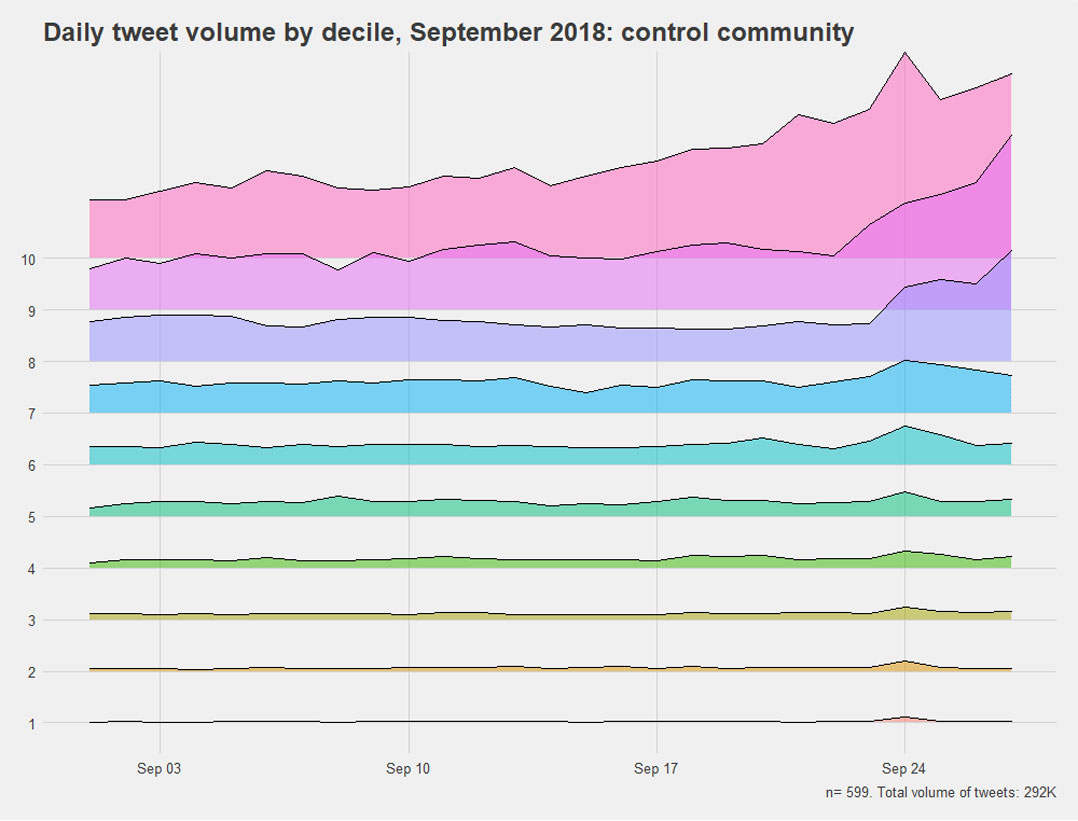
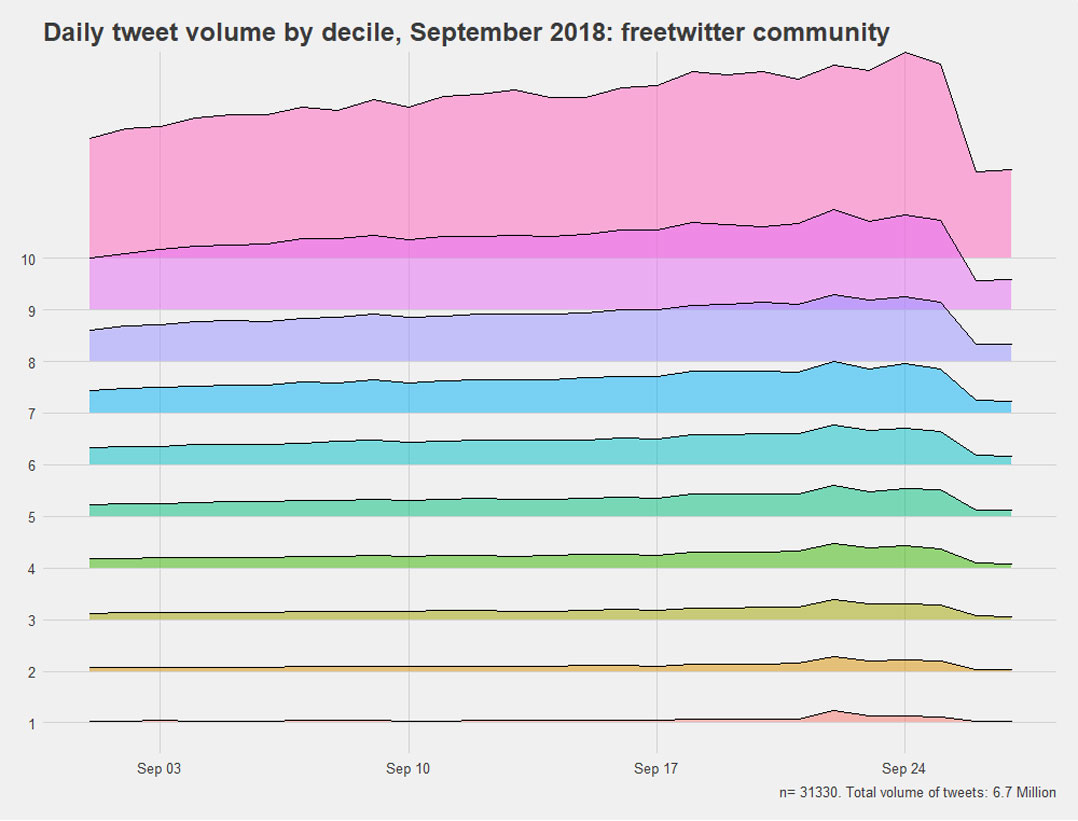
    What is immediately apparent from the data is that there is a considerable drop-off in the activity of the “freeTwitter” sample after the cut off on 25 September. The mean daily aggregated tweets of the sample fell by 30%. This is not visible in the control sample where this measure actually increased by 80%.

    To see a more granular view of the tweet activity, we can visualise the two samples by decile (see charts below). In both samples, the top 10% of the accounts are responsible for a much higher tweet frequency than the other deciles — this is likely due to some spam accounts that were operating below the threshold of 72 tweets/day.
    Another measure of the impact of the end of this promotion is to measure the net number of accounts that are no longer active in the period after 25 September. We can compare the proportion of these accounts in the “freeTwitter” and control samples. In the free Twitter sample, 18.7% of accounts that were active in the month leading up to the cut-off were silent after 25 September. By contrast, the control group had only 4.4% of accounts that were not active after the cut-off.

    It is evident that the end of free Twitter has had an impact on a particular community in South Africa: the sample of users that aligned with the free Twitter concept in the content of their tweets had a marked reduction in activity, on the whole by around 30%, but higher in the lower deciles (between 60 and 65% for deciles 1 – 8). In addition, the proportion of users that appear to have stopped using the social media network completely (albeit only for the two days in the sample) in the “freeTwitter” sample is approximately 18.7% (more than one in every six users).

    The control group which represents the South African Twitter community at large, by contrast increased daily activity after the end of MTN’s free Twitter by around 80% on average. The loss of users in the control group is also small, less than 5% (note that this will include the free Twitter impact).

    From this data, we can conclude that the end of MTN’s service hasn’t really dented the overall activity on South African Twitter, although it has likely had a small impact on the number of users. But it is nowhere near the levels that some have indicated. It also seems that either MTN’s estimation of the size of its free Twitter user base is massively overestimated (due to the limited impact on overall activity), or that most of their users simply carried on using the social network while paying for their data. The latter seems unlikely, given the results in the “freeTwitter” sample.  — (c) 2018 NewsCentral Media

    Follow TechCentral on Google News Add TechCentral as your preferred source on Google


    Andrew Fraser MTN MTN South Africa top Twitter
    WhatsApp YouTube
    Share. Facebook Twitter LinkedIn WhatsApp Telegram Email Copy Link
    Previous ArticleNo, Internet companies, we did not consent to this
    Next Article Tito Mboweni as finance minister: what it means

    Related Posts

    MTN Nigeria's growth engine stalled in second quarter - Karl Toriola

    MTN Nigeria’s growth engine stalled in second quarter

    31 July 2026
    The retailer that is about to become your bank

    The retailer that is about to become your bank

    30 July 2026
    Cisco hands Africa business to partner veteran Ossama Eldeeb

    Cisco hands Africa business to partner veteran Ossama Eldeeb

    30 July 2026
    Company News
    Domains.co.za launches self-hosted n8n VPS hosting

    Domains.co.za launches self-hosted n8n VPS hosting

    31 July 2026
    Smarter.tech '26 shows why smarter technology begins with context - Obsidian Systems

    Context is the missing piece in enterprise AI: Obsidian

    31 July 2026
    Huawei launches 12 intelligent transport solutions in South Africa - Sam Tang

    Huawei launches 12 intelligent transport solutions in South Africa

    30 July 2026
    Opinion
    The author, Jannie van Zyl

    Selling vapour is corporate suicide in slow motion

    16 July 2026
    Brazil's online gambling crackdown is a lesson for South Africa

    How Amazon outmanoeuvred Starlink in South Africa

    15 July 2026
    The Popia problem with agentic AI - Herman Haasbroek

    The Popia problem with agentic AI

    14 July 2026

    Subscribe to Updates

    Get the best South African technology news and analysis delivered to your e-mail inbox every morning.

    Latest Posts
    Eskom's diesel bill falls 86% as breakdowns hit eight-year low

    Eskom’s diesel bill falls 86% as breakdowns hit eight-year low

    31 July 2026
    Ramaphosa signs off on taking the grid away from Eskom

    Ramaphosa signs off on taking the grid away from Eskom

    31 July 2026
    Domains.co.za launches self-hosted n8n VPS hosting

    Domains.co.za launches self-hosted n8n VPS hosting

    31 July 2026
    Smarter.tech '26 shows why smarter technology begins with context - Obsidian Systems

    Context is the missing piece in enterprise AI: Obsidian

    31 July 2026
    © 2009 - 2026 NewsCentral Media
    Built and maintained by Chronon
    • Cookie policy (ZA)
    • TechCentral – privacy and Popia

    Type above and press Enter to search. Press Esc to cancel.

    Manage consent

    TechCentral uses cookies to enhance its offerings. Consenting to these technologies allows us to serve you better. Not consenting or withdrawing consent may adversely affect certain features and functions of the website.

    Functional Always active
    The technical storage or access is strictly necessary for the legitimate purpose of enabling the use of a specific service explicitly requested by the subscriber or user, or for the sole purpose of carrying out the transmission of a communication over an electronic communications network.
    Preferences
    The technical storage or access is necessary for the legitimate purpose of storing preferences that are not requested by the subscriber or user.
    Statistics
    The technical storage or access that is used exclusively for statistical purposes. The technical storage or access that is used exclusively for anonymous statistical purposes. Without a subpoena, voluntary compliance on the part of your Internet Service Provider, or additional records from a third party, information stored or retrieved for this purpose alone cannot usually be used to identify you.
    Marketing
    The technical storage or access is required to create user profiles to send advertising, or to track the user on a website or across several websites for similar marketing purposes.
    • Manage options
    • Manage services
    • Manage {vendor_count} vendors
    • Read more about these purposes
    View preferences
    • {title}
    • {title}
    • {title}