
Close Menu
TechCentralTechCentral

    Subscribe to the newsletter

    Get the best South African technology news and analysis delivered to your e-mail inbox every morning.

    Facebook X (Twitter) YouTube LinkedIn
    WhatsApp Facebook X (Twitter) LinkedIn YouTube
    TechCentralTechCentral
    • News
      AI fraud is outrunning South African banking defences

      AI fraud is outrunning South African banking defences

      14 August 2026
      AI's hunger for capital is the next big risk to the global economy

      AI’s hunger for capital is the next big risk to the global economy

      14 August 2026
      South Africa targets 2030 for its first satellite launch from home soil

      South Africa targets 2030 for its first satellite launch from home soil

      13 August 2026
      New poll undermines the case against a Starlink deal

      New poll undermines the case against a Starlink deal

      13 August 2026
      Musk's Terafab: 1 300 Loftus Versfeld pitches under one roof

      Musk’s Terafab: 1 300 Loftus Versfeld pitches under one roof

      13 August 2026
    • World
      Russia building its own Starlink - and faster than expected - Vadym Skibitskyi

      Russia building its own Starlink – and faster than expected

      11 August 2026
      Meta AI will now tell parents if their teen is in crisis

      Meta AI will now tell parents if their teen is in crisis

      17 July 2026
      IBM shares crash 25% as AI upends software spending - Arvind Krishna

      IBM shares crash 25% as AI upends software spending

      15 July 2026
      Jony Ive's first OpenAI device: an AI smart speaker - Jony Ive and Sam Altman

      Jony Ive’s first OpenAI device: an AI smart speaker

      15 July 2026
      Stripe, Advent in talks to buy PayPal for $53-billion

      Stripe, Advent in talks to buy PayPal for $53-billion

      15 July 2026
    • In-depth
      Google DeepMind CEO Demis Hassabis. Image: John Sears

      The plan to stop AI from breaking the world

      16 July 2026
      The internet has a Strait of Hormuz problem

      The internet has a Strait of Hormuz problem

      15 July 2026
      AI boom sparks rally, frenzy and fear

      AI boom sparks rally, frenzy and fear

      11 June 2026
      Every plug-in hybrid on sale in South Africa, ranked by price - Lamborghini Temerario

      Every plug-in hybrid on sale in South Africa, ranked by price

      7 June 2026
      What Wi-Fi 8 will mean for wireless networks

      What Wi-Fi 8 will mean for wireless networks

      1 June 2026
    • TCS
      TCS+ | Specops' Darren James on continuous trust in an AI world

      TCS+ | Specops’ Darren James on continuous trust in an AI world

      7 August 2026
      TCS+ | How AI is turning hardware into a subscription service - Shane van der Merwe Merchant West

      TCS+ | How AI is turning hardware into a subscription service

      6 August 2026
      TCS+ | Why South African workers must become supervisors of digital labour - Accelera Digital Group Cliff de Wit

      TCS+ | Why South African workers must become supervisors of digital labour

      31 July 2026
      TCS | Rapid deployment rules can't work without municipalities: ACT - Nomvuyiso Batyi

      TCS | Icasa’s rules skip the real bottleneck: ACT

      30 July 2026
      TCS+ | iStore Business on why Apple makes sense for SMEs - Sudesh Pillay and Tamia Nontsikelelo

      TCS+ | iStore Business on why Apple makes sense for SMEs

      30 July 2026
    • Opinion
      The author, Jannie van Zyl

      Selling vapour is corporate suicide in slow motion

      16 July 2026
      Brazil's online gambling crackdown is a lesson for South Africa

      How Amazon outmanoeuvred Starlink in South Africa

      15 July 2026
      The Popia problem with agentic AI - Herman Haasbroek

      The Popia problem with agentic AI

      14 July 2026
      The author, Fanie van Rooyen

      South Africa can still catch the AI wave – here’s how

      7 July 2026
      The author, Fanie van Rooyen

      The AI utopia South Africa can’t afford

      1 July 2026
    • Company Hubs
      • 1Stream
      • Africa Data Centres
      • AfriGIS
      • Altron Digital Business
      • Altron Document Solutions
      • Altron Group
      • Arctic Wolf
      • Ascent Technology
      • AvertITD
      • BBD
      • Braintree
      • CallMiner
      • CambriLearn
      • CM Telecom
      • Contactable
      • CYBER1 Solutions
      • Digicloud Africa
      • Digimune
      • Domains.co.za
      • ESET
      • Euphoria Telecom
      • HOSTAFRICA
      • Incredible Business
      • iONLINE
      • IQbusiness
      • Iris Network Systems
      • Kaspersky
      • LSD Open
      • Mitel
      • NEC XON
      • Netstar
      • Network Platforms
      • Next DLP
      • Ovations
      • Paracon
      • Paratus
      • Q-KON
      • SevenC
      • SkyWire
      • Solid8 Technologies
      • Telit Cinterion
      • Telviva
      • Tenable
      • Vertiv
      • Videri Digital
      • Vodacom Business
      • Vox
      • Wipro
      • Workday
      • XLink
    • Sections
      • AI and machine learning
      • Banking
      • Broadcasting and Media
      • Cloud services
      • Contact centres and CX
      • Cryptocurrencies
      • Education and skills
      • Electronics and hardware
      • Energy and sustainability
      • Enterprise software
      • Financial services
      • HealthTech
      • Information security
      • Internet and connectivity
      • Internet of Things
      • Investment
      • IT services
      • Lifestyle
      • Policy and regulation
      • Public sector
      • Retail and e-commerce
      • Satellite communications
      • Science
      • SMEs and start-ups
      • Social media
      • Talent and leadership
      • Telecoms
      • Watts & Wheels
    • Events
    • Advertise
    TechCentralTechCentral
    Home » Sections » Energy and sustainability » Data centres are straining electricity grids worldwide 

    Data centres are straining electricity grids worldwide 

    Governments around the world are pausing to reconsider the approval of construction permits for new data centres.
    By Nkosinathi Ndlovu14 February 2024
    Twitter LinkedIn Facebook WhatsApp Email Telegram Copy Link
    News Alerts
    WhatsApp

    Governments around the world are pausing to reconsider the approval of construction permits for new data centres due to the strain that their huge demand for electricity places on national grids. 

    So far, there is no indication that South Africa is planning similar measures, even as data centres proliferate in the country – and especially in the Gauteng region. 

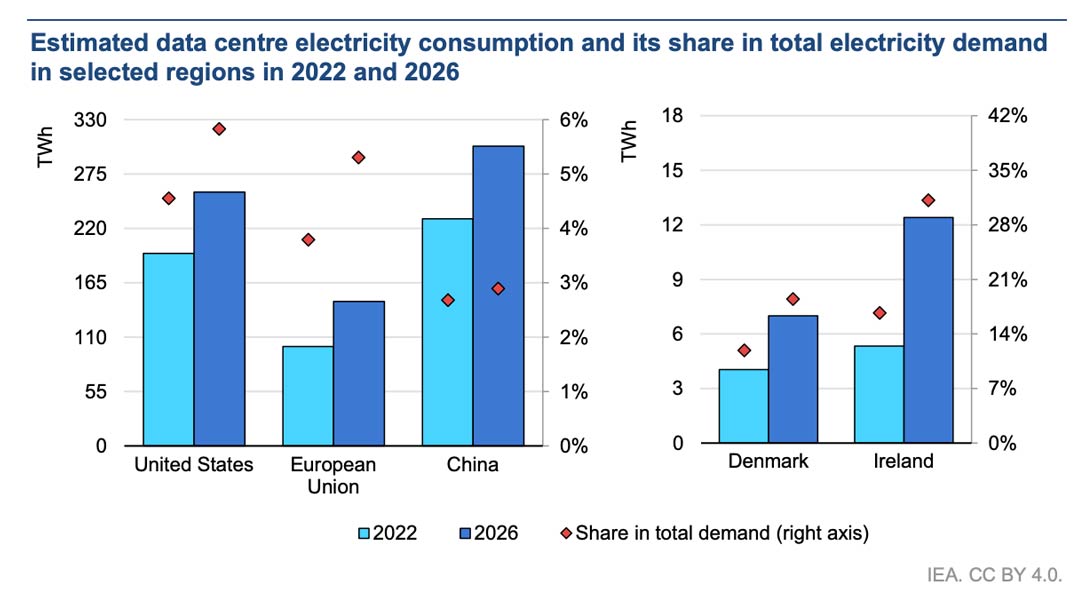
    In recent years, Ireland, Germany, Singapore and China have placed restrictions on the development of new data centres to ease demand-side pressure and reach environmental sustainability goals, the Financial Times reported (paywall) on Monday. 

    Data centres typically have preferential access to the grid, like other high-priority industrial applications

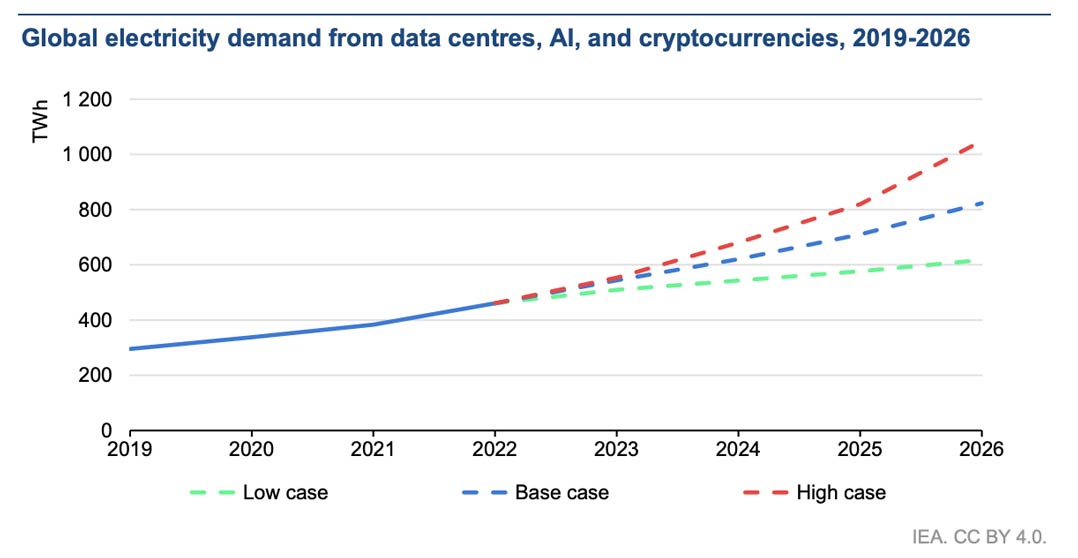
    “An important new source of higher electricity consumption is coming from energy-intensive data centres, artificial intelligence and cryptocurrencies, which could double by 2026,” according to a recent report by the International Energy Agency (IEA). 

    According to the FT report, among new data centre projects at the highest risk of being stopped are those in Ireland, which historically has been a choice location for technology giants such as Meta Platforms, Google and Microsoft. They have been attracted to that country’s low taxes and easy access to high-capacity subsea cables for transporting data around the world. 

    In 2021, Ireland’s Commission for Regulation of Utilities updated its requirements for allowing data centres to connect to the national grid. The new stipulations take into consideration whether the location of a proposed site has sufficient grid capacity there and if the applicant can be flexible by reducing power consumption when asked to do so.

    Environment

    Beyond the concerns about power consumption, a stronger focus on the environmental impact of data centres has taken centre stage in jurisdictions like Germany. As a result, requirements around renewable energy contributions to the grid and waste heat recycling have been incorporated into the legislation for permit approvals. Restrictions have also been placed on the number of permits approved in residential areas. 

    The restrictions are seen by legislators as a way of curbing the rapid growth in power demand from data centres, but given the rate of digitisation worldwide, data centre growth – and the power these facilities consume – will continue to rise quickly. 

    “We expect global electricity consumption of data centres, cryptocurrencies and artificial intelligence to range between 620TWh and 1 050TWh in 2026, with our base case for demand at just over 800TWh – up from 460TWh in 2022. This corresponds to an additional 160TWh to 590TWh of electricity demand in 2026 compared to 2022, roughly equivalent to adding at least one Sweden or at most one Germany,” said the IEA report. 
    Source: International Energy Agency

    According to the report, computing typically accounts for around 40% of a data centre’s total power consumption. With compute-intensive use cases such as AI and cryptocurrency mining on the rise, the demand for electricity from a single data centre could see “tenfold” growth in the case where AI is fully implemented in the facility. 

    The calculation is based on a comparison between the average electricity demand of a typical Google search – 0.3Wh of electricity – to OpenAI’s ChatGPT which uses 2.9Wh per user request. Considering nine billion searches daily, this would require almost 10TWh of additional electricity in a year, according to the IEA.  

    The surge in demand has influenced a renewed interest in nuclear energy in Europe and the Americas, according to the FT. In February 2023, 11 EU member states – led by France – formed an alliance with the goal of adding 50GW of nuclear capacity to the region by 2050, according to a report by Euractiv. 

    South Africa’s energy crisis presents a troubling conundrum for companies looking to build data centres

    According to a post on the website DataCentre Knowledge, the US government has provided more than US$600-million in funding to companies involved in the development of small modular reactors, a new generation of safer, cleaner and more efficient nuclear power plants that have a small geographical footprint and produce up to 300MW of power. 

    But national governments are not the only ones pursuing a nuclear energy strategy. In May last year, Microsoft announced that it had signed a power purchase agreement with a Sam Altman-backed nuclear fusion start-up called Helion. Helion’s first fusion power plant is scheduled for 2028, and unlike the fission-based nuclear reactors of yesteryear, fusion-based reactors promise high energy output with zero carbon emissions.  

    In the South African context, the energy crisis presents a troubling conundrum for companies looking to build data centres. On one hand, growth in demand for digital services justifies the business case for additional infrastructure; on the other, the ongoing energy deficit – and uncertainty on the future stability of South Africa’s energy supply – introduces an element of risk which affects long-term planning.

    Fortunately, these challenges are not getting in the way of investment – yet. Earlier this month, Microsoft announced it will build a new data centre in Centurion, near Pretoria, adding to five data centres already in operation in Johannesburg and Cape Town.
    Source: International Energy Agency

    “[The energy deficit] raises costs because there may be greater reliance on backup power, but data centres typically have preferential access to the grid, like other high-priority industrial applications,” said Jon Tullett, senior research manager at International Data Corp. 

    Large commercial data centres in South Africa typically consume 12-20MW of power. Just like their international counterparts, local facilities are sophisticated in their approach to power usage efficiency (PUE) and using the right mix of energy sources. 

    “New South African cloud data centres are built to the same standards as hyperscale facilities elsewhere in the world. They focus on reducing PUE, and there’s a growing emphasis on renewable sources of energy,” said Tullett.

    Read: Microsoft to build another data centre in South Africa

    Some data centre operators in South Africa, including Vantage Data Centers, which recently built the first phase of a campus facility in Midrand, have announced plans to wheel renewable energy over the grid from elsewhere in South Africa.   — (c) 2024 NewsCentral Media 

    Get breaking news alerts from TechCentral on WhatsApp

    Follow TechCentral on Google News Add TechCentral as your preferred source on Google


    IDC IEA International Data Corp International Energy Agency Jon Tullett
    WhatsApp YouTube
    Share. Facebook Twitter LinkedIn WhatsApp Telegram Email Copy Link
    Previous ArticleGrowing fraud could kill SMS as a business platform
    Next Article One bitcoin now costs R1-million

    Related Posts

    South Africa's window of cheap tech is closing

    South Africa’s window of cheap tech is closing

    3 June 2026
    There's an oddity hiding in South Africa's EV market

    There’s an oddity hiding in South Africa’s EV market

    21 May 2026
    The 48-month phone contract trap

    The 48-month phone contract trap

    6 May 2026
    Company News
    Kaspersky on how to secure a supply chain you do not control

    Kaspersky on how to secure a supply chain you do not control

    13 August 2026
    Build or buy software? AI is rewriting the answer - BBD Software

    Build or buy software? AI is rewriting the answer

    12 August 2026
    Max zoom meets max speed with the new 5G Huawei Pura 90s series

    Max Zoom meets Max Speed with the 5G Huawei Pura 90s series

    11 August 2026
    Opinion
    The author, Jannie van Zyl

    Selling vapour is corporate suicide in slow motion

    16 July 2026
    Brazil's online gambling crackdown is a lesson for South Africa

    How Amazon outmanoeuvred Starlink in South Africa

    15 July 2026
    The Popia problem with agentic AI - Herman Haasbroek

    The Popia problem with agentic AI

    14 July 2026

    Subscribe to Updates

    Get the best South African technology news and analysis delivered to your e-mail inbox every morning.

    Latest Posts
    AI fraud is outrunning South African banking defences

    AI fraud is outrunning South African banking defences

    14 August 2026
    AI's hunger for capital is the next big risk to the global economy

    AI’s hunger for capital is the next big risk to the global economy

    14 August 2026
    South Africa targets 2030 for its first satellite launch from home soil

    South Africa targets 2030 for its first satellite launch from home soil

    13 August 2026
    New poll undermines the case against a Starlink deal

    New poll undermines the case against a Starlink deal

    13 August 2026
    © 2009 - 2026 NewsCentral Media
    Built and maintained by Chronon
    • Cookie policy (ZA)
    • TechCentral – privacy and Popia

    Type above and press Enter to search. Press Esc to cancel.

    Manage consent

    TechCentral uses cookies to enhance its offerings. Consenting to these technologies allows us to serve you better. Not consenting or withdrawing consent may adversely affect certain features and functions of the website.

    Functional Always active
    The technical storage or access is strictly necessary for the legitimate purpose of enabling the use of a specific service explicitly requested by the subscriber or user, or for the sole purpose of carrying out the transmission of a communication over an electronic communications network.
    Preferences
    The technical storage or access is necessary for the legitimate purpose of storing preferences that are not requested by the subscriber or user.
    Statistics
    The technical storage or access that is used exclusively for statistical purposes. The technical storage or access that is used exclusively for anonymous statistical purposes. Without a subpoena, voluntary compliance on the part of your Internet Service Provider, or additional records from a third party, information stored or retrieved for this purpose alone cannot usually be used to identify you.
    Marketing
    The technical storage or access is required to create user profiles to send advertising, or to track the user on a website or across several websites for similar marketing purposes.
    • Manage options
    • Manage services
    • Manage {vendor_count} vendors
    • Read more about these purposes
    View preferences
    • {title}
    • {title}
    • {title}