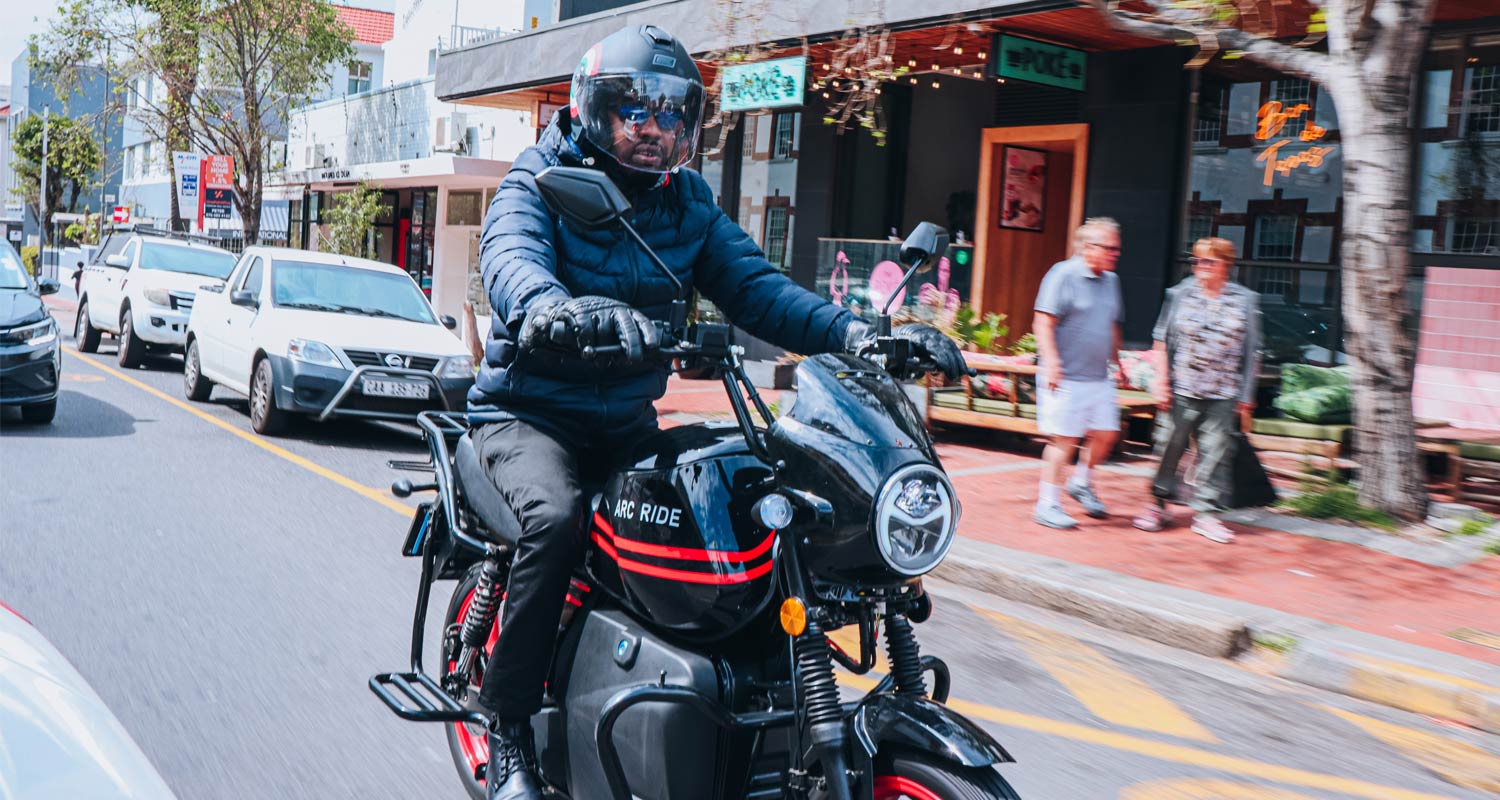
Kenyan motorcycle company ARC Ride has launched an electric delivery bike in South Africa priced from R22 500, betting that last-mile riders paying close to R27/l for petrol would rather pay per battery swap.
The Panther was unveiled in Cape Town this month. Under a battery-as-a-service model, riders exchange a flat battery for a charged one at an ARC Hub or an unmanned swap cabinet. A full swap costs R50 for up to 110km of range; partial swaps are billed pro rata.
ARC Ride says a 125cc petrol bike burns more than R59 in fuel per 100km at about R27/l, against roughly R45.45 per 100km on the Panther – about 23% less. The comparison holds up inland, where 95 unleaded cost R26.92/l after the 2 September adjustment. At the current coastal price of R26.05/l, the saving shrinks to about 20%.
The gap may soon widen. Central Energy Fund (CEF) data reported on 28 September pointed to a rise of about R3.06/l for 95 unleaded on 7 October, which would take the inland price to about R29.98/l. On ARC Ride’s numbers, a swap would then be about 30% cheaper than petrol.
ARC Ride’s press release promised riders “up to 20% more net earnings”, but the detail described fuel and maintenance savings worth “up to 20% of a rider’s total weekly operational expenses”.
When TechCentral queried the discrepancy, ARC Ride spokesperson Justus Visagie said the figure is a reduction of up to 20% in weekly operating costs, “not a 20% rise in earnings”, and that the release is being corrected. “How much that lifts take-home pay depends on what a rider earns,” he said.
Visagie said the estimate, which the release credited to “ARC Ride’s own fleet operating data”, is “modelled on its operations in other African markets rather than measured on South African fleets”.
Unmanned battery-swapping cabinets
Fleet partners in Gauteng and the Western Cape offer the bike on rental and lease.
Mikael Cloete, MD of ARC Ride South Africa, told TechCentral the company has hubs in Randburg, Centurion and Lyndhurst in Gauteng and at Paarden Eiland and Claremont in Cape Town, with a sixth, in Bellville, due to open in October. They are supported by what he called “a growing network of unmanned battery-swapping cabinets”, though he did not say how many.
“We’re seeing interest from some of South Africa’s largest delivery fleets, and the conversation goes well beyond cost savings compared with traditional petrol motorcycles,” he said, without naming the fleets. “For fleets, it’s the combination of the motorcycle, battery swapping and hands-on support that makes the offering compelling.” Fuel costs have had fleet operators weighing electric vehicles since at least May.
ARC Ride was founded in Nairobi in 2019 and is led by CEO Joseph Hurst-Croft. On 8 September, it raised US$33.3-million in asset-backed debt and equity in a round led by Novastar Ventures and Norrsken22. It plans to add 5 000 motorcycles to its fleet.
The Western Cape government helped the company with registration, homologation and compliance, which ARC Ride says were completed “within months”. In the release, premier Alan Winde says moving delivery fleets onto electric two-wheelers “helps reduce our carbon footprint and ease congestion in one of the world’s most congested cities”.
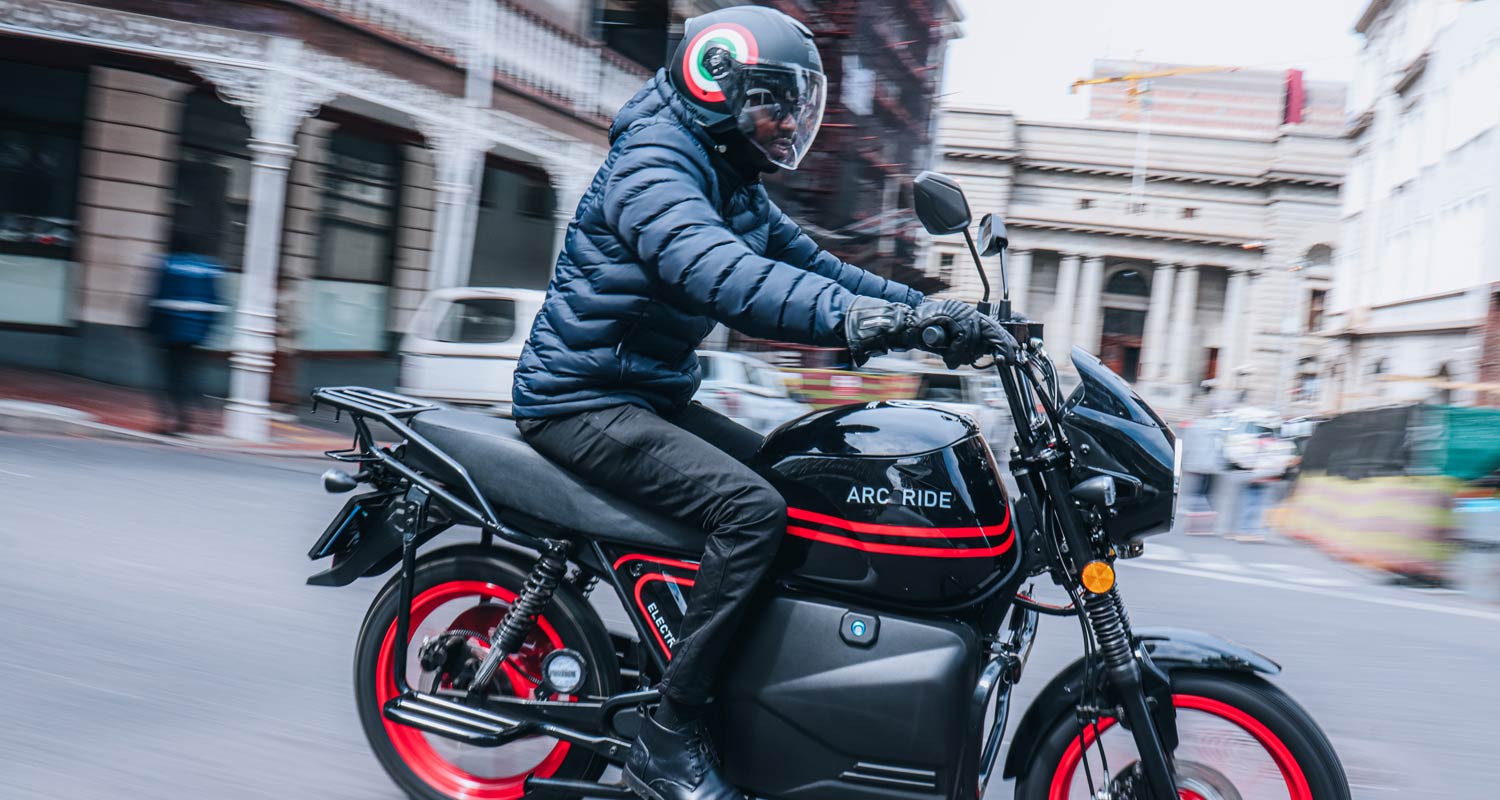
ARC Ride leans on Stellenbosch University’s Electric Mobility Lab. The lab’s 2025 Cape Town study by Halloran Stratford and Thinus Booysen, funded by the Western Cape government’s motorised transport department, modelled 39 005 delivery trips by 385 motorcycles in Gardens and Rondebosch over 14 days. It found the fleet could shrink to 125 bikes without losing service. The model used the Roam Air, made by Kenyan rival Roam, which has donated two motorcycles to the lab.
The release’s emissions figures – about 50.5g of CO2/km for a petrol bike and a cut of up to 85% – come from the lab’s earlier Nairobi study, a model built on tracking data from 118 motorbikes. That result assumes Kenya’s grid, at 0.226kg of CO2/kWh, against 0.931kg for South Africa’s. On South Africa’s grid, the same inputs give about 32g/km, a cut of roughly 36%, unless the bikes are charged from solar.
The release also says hubs can draw up to 99.5% of their daytime charging power from solar. In the Cape Town paper, that figure measures how much of the available solar output gets used, and it assumes managed charging and a 66kWp solar plant, neither of which ARC Ride says its hubs have.
The same paper puts the electricity cost of an electric delivery bike at about $0.44/100km on Cape Town’s low-season tariff, roughly R7.60 at the paper’s exchange rate. ARC Ride’s R45.45 also covers what the release calls “charging infrastructure, and total battery replacement risk”.
Booysen cited bigger savings in a piece published by TechCentral in April: “It’s already been estimated that electrifying this segment will reduce total cost of ownership for riders by 35-40%.” That lifetime measure is not directly comparable with ARC Ride’s weekly figure.
Stratford, quoted in the release, was more cautious. “Electrifying our last-mile delivery fleets is inevitable. But for this to be a success, it must be done responsibly, with sufficient planning and with all stakeholders’ best interests in mind.” – © 2026 NewsCentral Media