
Close Menu
TechCentralTechCentral

    Subscribe to the newsletter

    Get the best South African technology news and analysis delivered to your e-mail inbox every morning.

    Facebook X (Twitter) YouTube LinkedIn
    WhatsApp Facebook X (Twitter) LinkedIn YouTube
    TechCentralTechCentral
    • News
      SA experts split on whether the singularity has begun

      SA experts split on whether the singularity has begun

      3 August 2026
      South Africa's hybrid boom is masking a flat electric car market

      South Africa’s hybrid boom is masking a flat electric car market

      3 August 2026
      SABC+ scales up

      SABC+ scales up

      3 August 2026
      The Post Office has fixed its books but not its business

      The Post Office has fixed its books but not its business

      3 August 2026
      SA companies could face cross-border crypto ban

      SA companies could face cross-border crypto ban

      3 August 2026
    • World
      Meta AI will now tell parents if their teen is in crisis

      Meta AI will now tell parents if their teen is in crisis

      17 July 2026
      IBM shares crash 25% as AI upends software spending - Arvind Krishna

      IBM shares crash 25% as AI upends software spending

      15 July 2026
      Jony Ive's first OpenAI device: an AI smart speaker - Jony Ive and Sam Altman

      Jony Ive’s first OpenAI device: an AI smart speaker

      15 July 2026
      Stripe, Advent in talks to buy PayPal for $53-billion

      Stripe, Advent in talks to buy PayPal for $53-billion

      15 July 2026
      Memory crisis sends smartphone market into steep decline

      Memory crisis sends smartphone market into steep decline

      13 July 2026
    • In-depth
      The plan to stop AI from breaking the world - Google DeepMind CEO Demis Hassabis. Image: John Sears

      The plan to stop AI from breaking the world

      16 July 2026
      The internet has a Strait of Hormuz problem

      The internet has a Strait of Hormuz problem

      15 July 2026
      AI boom sparks rally, frenzy and fear

      AI boom sparks rally, frenzy and fear

      11 June 2026
      Every plug-in hybrid on sale in South Africa, ranked by price - Lamborghini Temerario

      Every plug-in hybrid on sale in South Africa, ranked by price

      7 June 2026
      What Wi-Fi 8 will mean for wireless networks

      What Wi-Fi 8 will mean for wireless networks

      1 June 2026
    • TCS
      TCS+ | Why South African workers must become supervisors of digital labour - Accelera Digital Group Cliff de Wit

      TCS+ | Why South African workers must become supervisors of digital labour

      31 July 2026
      TCS | Rapid deployment rules can't work without municipalities: ACT - Nomvuyiso Batyi

      TCS | Icasa’s rules skip the real bottleneck: ACT

      30 July 2026
      TCS+ | iStore Business on why Apple makes sense for SMEs - Sudesh Pillay and Tamia Nontsikelelo

      TCS+ | iStore Business on why Apple makes sense for SMEs

      30 July 2026
      TCS+ | A smarter approach to cloud for South African businesses - Joel Chacko and Jonathan Oaker

      TCS+ | A smarter approach to cloud for South African businesses

      28 July 2026
      TCS | How Optasia lends billions to people banks can't see - Salvador Anglada

      TCS | How Optasia lends billions to people banks can’t see

      23 July 2026
    • Opinion
      The author, Jannie van Zyl

      Selling vapour is corporate suicide in slow motion

      16 July 2026
      Brazil's online gambling crackdown is a lesson for South Africa

      How Amazon outmanoeuvred Starlink in South Africa

      15 July 2026
      The Popia problem with agentic AI - Herman Haasbroek

      The Popia problem with agentic AI

      14 July 2026
      The author, Fanie van Rooyen

      South Africa can still catch the AI wave – here’s how

      7 July 2026
      The author, Fanie van Rooyen

      The AI utopia South Africa can’t afford

      1 July 2026
    • Company Hubs
      • 1Stream
      • Africa Data Centres
      • AfriGIS
      • Altron Digital Business
      • Altron Document Solutions
      • Altron Group
      • Arctic Wolf
      • Ascent Technology
      • AvertITD
      • BBD
      • Braintree
      • CallMiner
      • CambriLearn
      • CM Telecom
      • Contactable
      • CYBER1 Solutions
      • Digicloud Africa
      • Digimune
      • Domains.co.za
      • ESET
      • Euphoria Telecom
      • HOSTAFRICA
      • Incredible Business
      • iONLINE
      • IQbusiness
      • Iris Network Systems
      • Kaspersky
      • LSD Open
      • Mitel
      • NEC XON
      • Netstar
      • Network Platforms
      • Next DLP
      • Ovations
      • Paracon
      • Paratus
      • Q-KON
      • SevenC
      • SkyWire
      • Solid8 Technologies
      • Telit Cinterion
      • Telviva
      • Tenable
      • Vertiv
      • Videri Digital
      • Vodacom Business
      • Vox
      • Wipro
      • Workday
      • XLink
    • Sections
      • AI and machine learning
      • Banking
      • Broadcasting and Media
      • Cloud services
      • Contact centres and CX
      • Cryptocurrencies
      • Education and skills
      • Electronics and hardware
      • Energy and sustainability
      • Enterprise software
      • Financial services
      • HealthTech
      • Information security
      • Internet and connectivity
      • Internet of Things
      • Investment
      • IT services
      • Lifestyle
      • Policy and regulation
      • Public sector
      • Retail and e-commerce
      • Satellite communications
      • Science
      • SMEs and start-ups
      • Social media
      • Talent and leadership
      • Telecoms
      • Watts & Wheels
    • Events
    • Advertise
    TechCentralTechCentral
    Home » Opinion » Alistair Fairweather » Emojis: it’s not all talk :)

    Emojis: it’s not all talk :)

    By Alistair Fairweather10 November 2014
    Twitter LinkedIn Facebook WhatsApp Email Telegram Copy Link
    News Alerts
    WhatsApp

    Alistair-Fairweather-180-profileHave you heard of the world’s fastest growing language? It was born just 20 years ago, and already hundreds of millions (possibly billions) of people use it to communicate every day. You’ve probably used it today without even thinking. I’m talking about Emoji.

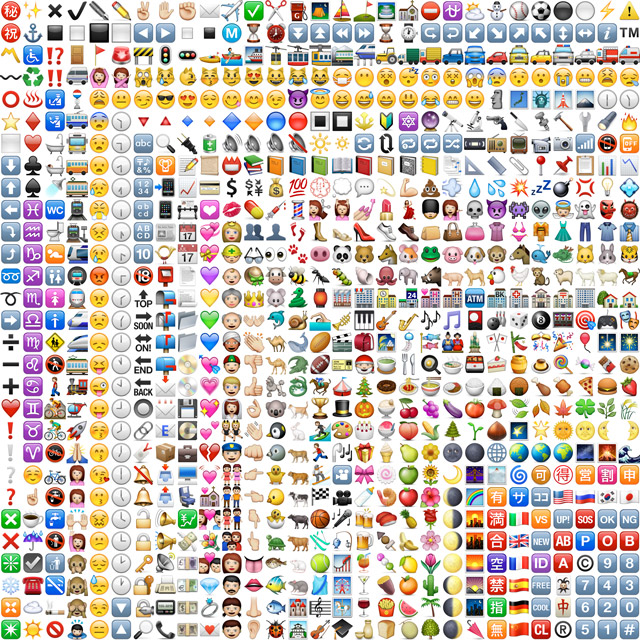
    These expressive little symbols have slowly seeped into every form of textual communication on the planet. From smiley faces to praying hands to trains, snowmen, hamburgers and cellos — Emoji’s 722 characters capture a huge range of emotion and experience. Not bad for a gimmick designed to appeal to Japanese teenagers in the mid-1990s.

    Although they look very similar, Emojis should not be confused with the more general category of graphical emoticons. The latter are also expressive pictographs, but they are invariably locked to a single platform. You cannot send a Skype emoticon to someone on BlackBerry Messenger or Google Hangouts.

    But because Emoji is a typeface (such as Arial or Times New Roman) it is entirely platform independent. And so its quirky little characters show up everywhere from Twitter to WhatsApp to e-mail. The trend has already reached its logical conclusion: a copy of Moby Dick, translated into Emojis, has been acquired by America’s Library of Congress. Yes, really.

    How did Emoji become a typeface? It had nothing to do with ambitions for global reach or universal communication and everything to do with solving an engineering challenge. In the mid 1990s, the mobile Internet was in its infancy. Even sending a tiny 16×16 icon could take a long time and cost a fortune. And so Shigetaka Kurita, the father of Emoji, had to figure out a better way to send the symbols without clogging up the network.

    His solution was brilliant in its simplicity. Instead of sending the actual icons between phones, he mapped the symbols to unused characters in the standard Japanese character set. He then pre-loaded the icons on every phone along with the character map. So what would otherwise be a meaningless placeholder character became a smiley face or a dancing lady.

    Kurita could never have guessed the long-term consequences of his clever but specific solution. By creating a typeface, Kurita unintentionally created an open standard. This allowed his Japanese competitors to use the same technology and an arms race of symbolic communication ensued. The number of Emojis ballooned from a few dozen to hundreds, capturing aspects of every part of life including, bizarrely, a symbol for a smiling pile of poo.

    By the middle of the 2000s, Emoji had already begun to trickle out into the rest of the world, but when Apple adopted it in 2011 (with the release of iOS 5), it went truly global. Since then, it has swept through the world. It’s rare to find someone with a smartphone (regardless of brand) that doesn’t either use or, at the very least, receive Emojis.

    The psychology that drives this kind of thing is well known. Text messaging lacks social cues such as tone of voice and facial expression. Symbols lend emotion to otherwise flat text. The first person to solve this conundrum was Scott Fahlman, a professor of computer science at Carnegie Mellon University. In a famous e-mail in 1982 (yes, 1982), he came up with the first text-based emoticons 🙂 and 🙁 for smiley and sad faces.
    emoji-640

    His modest proposal created the emoticon, and by extension gave rise to Emojis. In a fit of grumpy purism, Fahlman has since complained that Emojis are “ugly” and lack imagination. The rest of the world’s population respectfully disagrees.

    If you need a sign of just how globally significant Emojis have become, look at the campaign to introduce icons for different races. All of the Emojis representing people are currently light skinned. Understandably, this irritates and marginalises the majority of the globe’s population.

    After much dithering, the The Unicode Consortium (the standards body in charge of Emojis) has agreed to roll out support for different skin tones by the middle of 2015. These skin tones will be in a spectrum of shades, representing a much wider range of humanity that the current lily white.

    The most surprising thing, though, isn’t the technology behind Emoji, or the politics surrounding it. Without a scrap of marketing, activism or legislation, without any fanfare or press, this new language has quietly slid into our everyday lives. And to that I say (smiley face), (thumbs up), (rocket ship).

    • Alistair Fairweather is chief technology officer for integrated advertising agency Machine
    • This column was first published in the Mail & Guardian Online, the smart news source

    Follow TechCentral on Google News Add TechCentral as your preferred source on Google


    Alistair Fairweather Emoji WhatsApp
    WhatsApp YouTube
    Share. Facebook Twitter LinkedIn WhatsApp Telegram Email Copy Link
    Previous ArticleBytes snaps up Inter-Active Technologies
    Next Article Start-ups, stay in SA, says Vinny Lingham

    Related Posts

    The best way to automate customer engagement using AI and WhatsApp - CM.com

    The best way to automate customer engagement using AI and WhatsApp

    9 July 2026
    WhatsApp eyes its next act: a global superapp

    WhatsApp eyes its next act: a global superapp

    25 June 2026
    WhatsApp starts charging South Africans - for the extras

    WhatsApp starts charging South Africans – for the extras

    19 June 2026
    Company News
    Google Cloud, AI adoption gain momentum in Africa - Digicloud Africa

    Google Cloud, AI adoption gain momentum in Africa

    3 August 2026
    Domains.co.za launches self-hosted n8n VPS hosting

    Domains.co.za launches self-hosted n8n VPS hosting

    31 July 2026
    Smarter.tech '26 shows why smarter technology begins with context - Obsidian Systems

    Context is the missing piece in enterprise AI: Obsidian

    31 July 2026
    Opinion
    The author, Jannie van Zyl

    Selling vapour is corporate suicide in slow motion

    16 July 2026
    Brazil's online gambling crackdown is a lesson for South Africa

    How Amazon outmanoeuvred Starlink in South Africa

    15 July 2026
    The Popia problem with agentic AI - Herman Haasbroek

    The Popia problem with agentic AI

    14 July 2026

    Subscribe to Updates

    Get the best South African technology news and analysis delivered to your e-mail inbox every morning.

    Latest Posts
    SA experts split on whether the singularity has begun

    SA experts split on whether the singularity has begun

    3 August 2026
    South Africa's hybrid boom is masking a flat electric car market

    South Africa’s hybrid boom is masking a flat electric car market

    3 August 2026
    SABC+ scales up

    SABC+ scales up

    3 August 2026
    The Post Office has fixed its books but not its business

    The Post Office has fixed its books but not its business

    3 August 2026
    © 2009 - 2026 NewsCentral Media
    Built and maintained by Chronon
    • Cookie policy (ZA)
    • TechCentral – privacy and Popia

    Type above and press Enter to search. Press Esc to cancel.

    Manage consent

    TechCentral uses cookies to enhance its offerings. Consenting to these technologies allows us to serve you better. Not consenting or withdrawing consent may adversely affect certain features and functions of the website.

    Functional Always active
    The technical storage or access is strictly necessary for the legitimate purpose of enabling the use of a specific service explicitly requested by the subscriber or user, or for the sole purpose of carrying out the transmission of a communication over an electronic communications network.
    Preferences
    The technical storage or access is necessary for the legitimate purpose of storing preferences that are not requested by the subscriber or user.
    Statistics
    The technical storage or access that is used exclusively for statistical purposes. The technical storage or access that is used exclusively for anonymous statistical purposes. Without a subpoena, voluntary compliance on the part of your Internet Service Provider, or additional records from a third party, information stored or retrieved for this purpose alone cannot usually be used to identify you.
    Marketing
    The technical storage or access is required to create user profiles to send advertising, or to track the user on a website or across several websites for similar marketing purposes.
    • Manage options
    • Manage services
    • Manage {vendor_count} vendors
    • Read more about these purposes
    View preferences
    • {title}
    • {title}
    • {title}