Close Menu
TechCentralTechCentral

    Subscribe to the newsletter

    Get the best South African technology news and analysis delivered to your e-mail inbox every morning.

    Facebook X (Twitter) YouTube LinkedIn
    WhatsApp Facebook X (Twitter) LinkedIn YouTube
    TechCentralTechCentral
    • News
      How Amazon outmanoeuvred Starlink in South Africa

      How Amazon outmanoeuvred Starlink in South Africa

      15 July 2026
      Amazon Leo all set for South African launch - From left, Maziv CEO Dietlof Mare, communications minister Solly Malatsi, Herotel CEO Van Zyl Botha and Amazon's David Zapolsky

      Amazon Leo all set for South African launch

      15 July 2026
      SpaceX is the Dutch East India Company of the space age

      SpaceX is the Dutch East India Company of the space age

      15 July 2026
      The internet has a Strait of Hormuz problem

      The internet has a Strait of Hormuz problem

      15 July 2026
      Cape Town's Cue raises R82-million to take AI service agents global

      Cape Town’s Cue raises R82-million to take AI service agents global

      15 July 2026
    • World
      Swingeing jobs cuts at Microsoft's Xbox unit

      Swingeing jobs cuts at Microsoft’s Xbox unit

      6 July 2026

      SK Hynix ends Samsung’s 26-year reign at the top

      22 June 2026
      Google on the hook for what its AI tells users, court rules

      Google on the hook for what its AI tells users, court rules

      15 June 2026
      How Russians juggle VPNs to outwit the Kremlin

      How Russians juggle VPNs to outwit the Kremlin

      15 June 2026
      Amazon CEO flagged Anthropic AI risks to Washington - Andy Jassy

      Amazon CEO flagged Anthropic AI risks to Washington

      14 June 2026
    • In-depth
      AI boom sparks rally, frenzy and fear

      AI boom sparks rally, frenzy and fear

      11 June 2026
      Every plug-in hybrid on sale in South Africa, ranked by price - Lamborghini Temerario

      Every plug-in hybrid on sale in South Africa, ranked by price

      7 June 2026
      What Wi-Fi 8 will mean for wireless networks

      What Wi-Fi 8 will mean for wireless networks

      1 June 2026
      Alfa's electric rebel - Alfa Romeo Junior Elettrica Veloce

      Alfa’s electric rebel

      29 April 2026
      Africa switches on as Europe dims the lights

      Africa switches on as Europe dims the lights

      9 April 2026
    • TCS
      Watts & Wheels S1E7: 'Ferrari's EV breaks the internet'

      Watts & Wheels S1E7: ‘Ferrari’s EV breaks the internet’

      8 July 2026
      TCS+ | How Tracker is turning vehicle data into business strategy - Silvia Schollenberger

      TCS+ | How Tracker is turning vehicle data into business strategy

      1 July 2026
      TCS+ | IBM Bob: an AI-powered 'development partner' for the enterprise - David Spurway

      TCS+ | IBM Bob: an AI-powered development partner for the enterprise

      30 June 2026
      Watts & Wheels S1E6: 'A flawless Alfa and a bakkie that divides'

      Watts & Wheels S1E6: ‘A flawless Alfa and a bakkie that divides’

      17 June 2026
      Watts & Wheels S1E6: 'A flawless Alfa and a bakkie that divides'

      Watts & Wheels S1E5: ‘A Bentley of the bush and a car that swims’

      8 June 2026
    • Opinion
      The author, Fanie van Rooyen

      South Africa can still catch the AI wave – here’s how

      7 July 2026
      The author, Fanie van Rooyen

      The AI utopia South Africa can’t afford

      1 July 2026
      The author, Jannie van Zyl

      South Africa’s broadband future is being decided in orbit, not in Pretoria

      30 June 2026
      The author, Pambos Soteriades

      The pivot South Africa’s MVNOs cannot afford to miss

      23 June 2026
      Brazil's online gambling crackdown is a lesson for South Africa

      Brazil’s online gambling crackdown is a lesson for South Africa

      22 June 2026
    • Company Hubs
      • 1Stream
      • Africa Data Centres
      • AfriGIS
      • Altron Digital Business
      • Altron Document Solutions
      • Altron Group
      • Arctic Wolf
      • Ascent Technology
      • AvertITD
      • BBD
      • Braintree
      • CallMiner
      • CambriLearn
      • CM Telecom
      • Contactable
      • CYBER1 Solutions
      • Digicloud Africa
      • Digimune
      • Domains.co.za
      • ESET
      • Euphoria Telecom
      • HOSTAFRICA
      • Incredible Business
      • iONLINE
      • IQbusiness
      • Iris Network Systems
      • Kaspersky
      • LSD Open
      • Mitel
      • NEC XON
      • Netstar
      • Network Platforms
      • Next DLP
      • Ovations
      • Paracon
      • Paratus
      • Q-KON
      • SevenC
      • SkyWire
      • Solid8 Technologies
      • Telit Cinterion
      • Telviva
      • Tenable
      • Vertiv
      • Videri Digital
      • Vodacom Business
      • Wipro
      • Workday
      • XLink
    • Sections
      • AI and machine learning
      • Banking
      • Broadcasting and Media
      • Cloud services
      • Contact centres and CX
      • Cryptocurrencies
      • Education and skills
      • Electronics and hardware
      • Energy and sustainability
      • Enterprise software
      • Financial services
      • HealthTech
      • Information security
      • Internet and connectivity
      • Internet of Things
      • Investment
      • IT services
      • Lifestyle
      • Policy and regulation
      • Public sector
      • Retail and e-commerce
      • Satellite communications
      • Science
      • SMEs and start-ups
      • Social media
      • Talent and leadership
      • Telecoms
      • Watts & Wheels
    • Events
    • Advertise
    TechCentralTechCentral
    Home » In-depth » Expert warns SA on too much renewable energy

    Expert warns SA on too much renewable energy

    By Antoinette Slabbert16 March 2017
    Twitter LinkedIn Facebook WhatsApp Email Telegram Copy Link
    News Alerts
    WhatsApp

    In planning its future energy path towards lower carbon emissions, South Africa should be wary of unproven claims that total reliance on variable renewable energy sources is feasible, says South Australian energy researcher and director of environmental lobby group Bright New World Ben Heard.

    Heard, who proposes nuclear as a low-carbon alternative to coal-fired electricity generation, is currently visiting South Africa as a guest of the Nuclear Industry Association of South Africa.

    He says that while many modelled scenarios have been published claiming to show that a 100% renewable electricity system is achievable, there is virtually no historical evidence that demonstrates that such systems are indeed viable.

    “The only developed nation today with electricity from 100% renewable sources is Iceland, thanks to a unique endowment of shallow geothermal aquifers, abundant hydropower, and a population of only 300 000 people,” says Heard.

    “Of the studies published to date, 24 have forecast regional, national or global energy requirements at sufficient detail to be considered potentially credible.”

    He reviewed all 24 as well as the subsequent study by the Council for Scientific and Industrial Research (CSIR) and found them wanting.

    Heard explains that certain renewable sources are reliable. These include geothermal, which comes at a prohibitive cost and hydro, which relies on sustained water sources that South Africa doesn’t have.

    Wind and solar PV, which South Africa has abundant sources of, are, however, variable. They are only available when the sun shines and the wind blows. In fact, the early data from projects connected to the Eskom grid shows an average availability of around only 30%.

    A high portion of variable generation would increase the reliance on peaking power, which increases cost, as Eskom’s experience with increased use of diesel generators has illustrated.

    This would increase the overall cost to the system.

    These variable wind and solar technologies are also asynchronous. This refers to the need to maintain the frequency of the system close to the prescribed standard.

    Heard explains that supply needs to meet demand on an electricity system within one tenth of a second. He says changes in frequency arise from the small, instantaneous, and ongoing variation in load that occurs due to consumer behaviour (such as turning lights on and off), to larger changes in demand occurring in the normal course of a day.

    “Instantaneous frequency control is typically provided by the inertia of ‘synchronous’ generators, where electricity is generated through turbines spinning in unison at close to the regulated standard. However, increased wind and solar penetration, with asynchronous generation of electricity, displaces traditional synchronous generators (coal and nuclear for example) from the market.”

    The result is that a high portion of wind and solar energy increases grid instability. This is fine up to a point, he says, but nobody knows what percentage of renewables would exceed the tolerance of the system.

    He says South Australia relies on 40% of its electricity supply to be generated by variable renewables and as a result is experiencing “real problems” with grid instability.

    While it is difficult to generalise about the optimum level of penetration of variable renewables, the number is most probably between 15% and 30%, he says.

    The CSIR in December 2016 presented the results of its study regarding the country’s future energy mix. It proposed that more than 70% use of renewables could save the country R90bn/year.
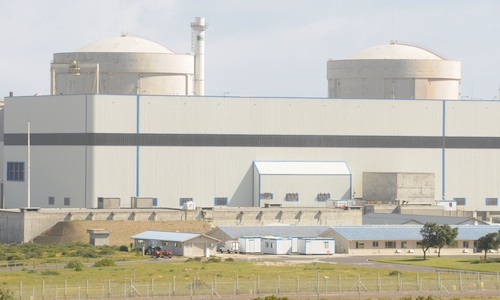
    The Koeberg nuclear power station near Cape Town

    Heard is, however, critical of the results. He says the CSIR assumed electricity demand to grow by 15% by 2030, which he considers to be too low.

    The CSIR further took advantage of the geographic spread of renewables for balancing — if the sun doesn’t shine on the solar plants in the Northern Cape, it would be shining on other plants situated in other provinces for example.

    That, Heard says, is dependent on a strong transmission system, but only the generation was costed, not the transmission.

    He says the CSIR did not model energy flow.

    Nevertheless, there is room for renewables and with demand set to rise, the industry could grow considerably.

    South Africa, however, has to invest in base load power, Heard says. That will provide the consistent, reliable supply needed to grow industry in the country’s effort to eradicate poverty and unemployment. “It is almost impossible to under-invest in base load.”

    From an environmental perspective, nuclear is the answer to replace coal to ensure a reduction in carbon emissions, he says.

    Heard is convinced that nuclear can be affordable, provided the procurement is done through an open and competitive bidding process.

    With regard to the South African process to acquire 9,6GW of nuclear generation capacity, Heard says it is “so far so good”. The process has started with different levels of expression of interest and one will see how it further develops, he says.

    “Constructing nuclear is initially more expensive than wind generation, but the quality and the asset life is quite different,” Heard says. Wind generation plants generally have a lifetime of no more than 25 years, while nuclear plants can run for at least 60 years. If the initial cost is paid, generation becomes cheap, he says. Fuel costs are low, which means that nuclear cost is very stable over the lifetime of the plant.

    “I think if South Africa runs an open and competitive process, it will get a good deal,” he says, citing the example of the United Arab Emirates, which procured 5,6GW at US$4 000/kW installed capacity.

    • This article was originally published on Moneyweb and is used here with permission

    Follow TechCentral on Google News Add TechCentral as your preferred source on Google


    Ben Heard CSIR Nuclear Industry Association of South Africa
    WhatsApp YouTube
    Share. Facebook Twitter LinkedIn WhatsApp Telegram Email Copy Link
    Previous ArticleGalaxy S8 to use ‘facial recognition for payments’
    Next Article No welfare payments crisis, says Zuma

    Related Posts

    Battlefield tech could save lives on South Africa's roads - Dithoto Modungwa

    Battlefield tech could save lives on South Africa’s roads

    10 July 2026
    South Africa's leap to modern Wi-Fi has barely begun

    Mobile operators locked out as Icasa opens 900MHz of spectrum

    27 May 2026
    Wapa's Paul Colmer said publication of the regulations is hugely significant

    South Africa’s dynamic spectrum breakthrough

    20 February 2026
    Company News
    Biometrics alone won't stop AI-powered fraud - Contactable

    Biometrics alone won’t stop AI-powered fraud

    15 July 2026
    How Paratus and Eutelsat are connecting Southern Africa's mines

    How Paratus and Eutelsat are connecting Southern Africa’s mines

    14 July 2026
    Rain supercharges 5G with Huawei

    Rain supercharges 5G with Huawei

    10 July 2026
    Opinion
    The author, Fanie van Rooyen

    South Africa can still catch the AI wave – here’s how

    7 July 2026
    The author, Fanie van Rooyen

    The AI utopia South Africa can’t afford

    1 July 2026
    The author, Jannie van Zyl

    South Africa’s broadband future is being decided in orbit, not in Pretoria

    30 June 2026

    Subscribe to Updates

    Get the best South African technology news and analysis delivered to your e-mail inbox every morning.

    Latest Posts
    How Amazon outmanoeuvred Starlink in South Africa

    How Amazon outmanoeuvred Starlink in South Africa

    15 July 2026
    Amazon Leo all set for South African launch - From left, Maziv CEO Dietlof Mare, communications minister Solly Malatsi, Herotel CEO Van Zyl Botha and Amazon's David Zapolsky

    Amazon Leo all set for South African launch

    15 July 2026
    SpaceX is the Dutch East India Company of the space age

    SpaceX is the Dutch East India Company of the space age

    15 July 2026
    The internet has a Strait of Hormuz problem

    The internet has a Strait of Hormuz problem

    15 July 2026
    © 2009 - 2026 NewsCentral Media
    Built and maintained by Chronon
    • Cookie policy (ZA)
    • TechCentral – privacy and Popia

    Type above and press Enter to search. Press Esc to cancel.

    Manage consent

    TechCentral uses cookies to enhance its offerings. Consenting to these technologies allows us to serve you better. Not consenting or withdrawing consent may adversely affect certain features and functions of the website.

    Functional Always active
    The technical storage or access is strictly necessary for the legitimate purpose of enabling the use of a specific service explicitly requested by the subscriber or user, or for the sole purpose of carrying out the transmission of a communication over an electronic communications network.
    Preferences
    The technical storage or access is necessary for the legitimate purpose of storing preferences that are not requested by the subscriber or user.
    Statistics
    The technical storage or access that is used exclusively for statistical purposes. The technical storage or access that is used exclusively for anonymous statistical purposes. Without a subpoena, voluntary compliance on the part of your Internet Service Provider, or additional records from a third party, information stored or retrieved for this purpose alone cannot usually be used to identify you.
    Marketing
    The technical storage or access is required to create user profiles to send advertising, or to track the user on a website or across several websites for similar marketing purposes.
    • Manage options
    • Manage services
    • Manage {vendor_count} vendors
    • Read more about these purposes
    View preferences
    • {title}
    • {title}
    • {title}