

Close Menu
TechCentralTechCentral

    Subscribe to the newsletter

    Get the best South African technology news and analysis delivered to your e-mail inbox every morning.

    Facebook X (Twitter) YouTube LinkedIn
    WhatsApp Facebook X (Twitter) LinkedIn YouTube
    TechCentralTechCentral
    • News
      Vuyani Jarana: Mobile coverage masks a deeper broadband failure

      Vuyani Jarana: Mobile coverage masks a deeper broadband failure

      30 January 2026
      SABC Plus to flight Microsoft AI training videos

      SABC Plus to flight Microsoft AI training videos

      30 January 2026
      Fibre ducts

      Fibre industry consolidation in KZN

      30 January 2026
      Watts & Wheels S1E3: 'BYD's Corolla Cross challenger'

      Watts & Wheels S1E3: ‘BYD’s Corolla Cross challenger’

      30 January 2026
      What ordinary South Africans really think of AI

      What ordinary South Africans really think of AI

      30 January 2026
    • World
      Apple acquires audio AI start-up Q.ai

      Apple acquires audio AI start-up Q.ai

      30 January 2026
      SpaceX IPO may be largest in history

      SpaceX IPO may be largest in history

      28 January 2026
      Nvidia throws AI at the weather

      Nvidia throws AI at weather forecasting

      27 January 2026
      Debate erupts over value of in-flight Wi-Fi

      Debate erupts over value of in-flight Wi-Fi

      26 January 2026
      Intel takes another hit - Intel CEO Lip-Bu Tan. Laure Andrillon/Reuters

      Intel takes another hit

      23 January 2026
    • In-depth
      How liberalisation is rewiring South Africa's power sector

      How liberalisation is rewiring South Africa’s power sector

      21 January 2026
      The top-performing South African tech shares of 2025

      The top-performing South African tech shares of 2025

      12 January 2026
      Digital authoritarianism grows as African states normalise internet blackouts

      Digital authoritarianism grows as African states normalise internet blackouts

      19 December 2025
      TechCentral's South African Newsmakers of 2025

      TechCentral’s South African Newsmakers of 2025

      18 December 2025
      Black Friday goes digital in South Africa as online spending surges to record high

      Black Friday goes digital in South Africa as online spending surges to record high

      4 December 2025
    • TCS
      TCS+ | How Cloud On Demand is helping SA businesses succeed in the cloud - Xhenia Rhode, Dion Kalicharan

      TCS+ | Cloud On Demand and Consnet: inside a real-world AWS partner success story

      30 January 2026
      Watts & Wheels S1E3: 'BYD's Corolla Cross challenger'

      Watts & Wheels S1E2: ‘China attacks, BMW digs in, Toyota’s sublime supercar’

      23 January 2026

      TCS+ | Why cybersecurity is becoming a competitive advantage for SA businesses

      20 January 2026
      Watts & Wheels S1E3: 'BYD's Corolla Cross challenger'

      Watts & Wheels: S1E1 – ‘William, Prince of Wheels’

      8 January 2026
      TCS+ | Africa's digital transformation - unlocking AI through cloud and culture - Cliff de Wit Accelera Digital Group

      TCS+ | Cloud without culture won’t deliver AI: Accelera’s Cliff de Wit

      12 December 2025
    • Opinion
      South Africa's skills advantage is being overlooked at home - Richard Firth

      South Africa’s skills advantage is being overlooked at home

      29 January 2026
      Why Elon Musk's Starlink is a 'hard no' for me - Songezo Zibi

      Why Elon Musk’s Starlink is a ‘hard no’ for me

      26 January 2026
      South Africa's new fibre broadband battle - Duncan McLeod

      South Africa’s new fibre broadband battle

      20 January 2026
      AI moves from pilots to production in South African companies - Nazia Pillay SAP

      AI moves from pilots to production in South African companies

      20 January 2026
      South Africa's new fibre broadband battle - Duncan McLeod

      ANC’s attack on Solly Malatsi shows how BEE dogma trumps economic reality

      14 December 2025
    • Company Hubs
      • Africa Data Centres
      • AfriGIS
      • Altron Digital Business
      • Altron Document Solutions
      • Altron Group
      • Arctic Wolf
      • AvertITD
      • Braintree
      • CallMiner
      • CambriLearn
      • CYBER1 Solutions
      • Digicloud Africa
      • Digimune
      • Domains.co.za
      • ESET
      • Euphoria Telecom
      • Incredible Business
      • iONLINE
      • IQbusiness
      • Iris Network Systems
      • LSD Open
      • NEC XON
      • Netstar
      • Network Platforms
      • Next DLP
      • Ovations
      • Paracon
      • Paratus
      • Q-KON
      • SevenC
      • SkyWire
      • Solid8 Technologies
      • Telit Cinterion
      • Tenable
      • Vertiv
      • Videri Digital
      • Vodacom Business
      • Wipro
      • Workday
      • XLink
    • Sections
      • AI and machine learning
      • Banking
      • Broadcasting and Media
      • Cloud services
      • Contact centres and CX
      • Cryptocurrencies
      • Education and skills
      • Electronics and hardware
      • Energy and sustainability
      • Enterprise software
      • Financial services
      • Information security
      • Internet and connectivity
      • Internet of Things
      • Investment
      • IT services
      • Lifestyle
      • Motoring
      • Public sector
      • Retail and e-commerce
      • Satellite communications
      • Science
      • SMEs and start-ups
      • Social media
      • Talent and leadership
      • Telecoms
    • Events
    • Advertise
    TechCentralTechCentral
    Home » Sections » Energy and sustainability » Harnessing nuclear fusion is now a matter of ‘when’, not ‘if’

    Harnessing nuclear fusion is now a matter of ‘when’, not ‘if’

    Nuclear fusion holds huge promise as a source of clean, abundant energy that could power the world.
    By The Conversation20 December 2022
    Twitter LinkedIn Facebook WhatsApp Email Telegram Copy Link
    News Alerts
    WhatsApp
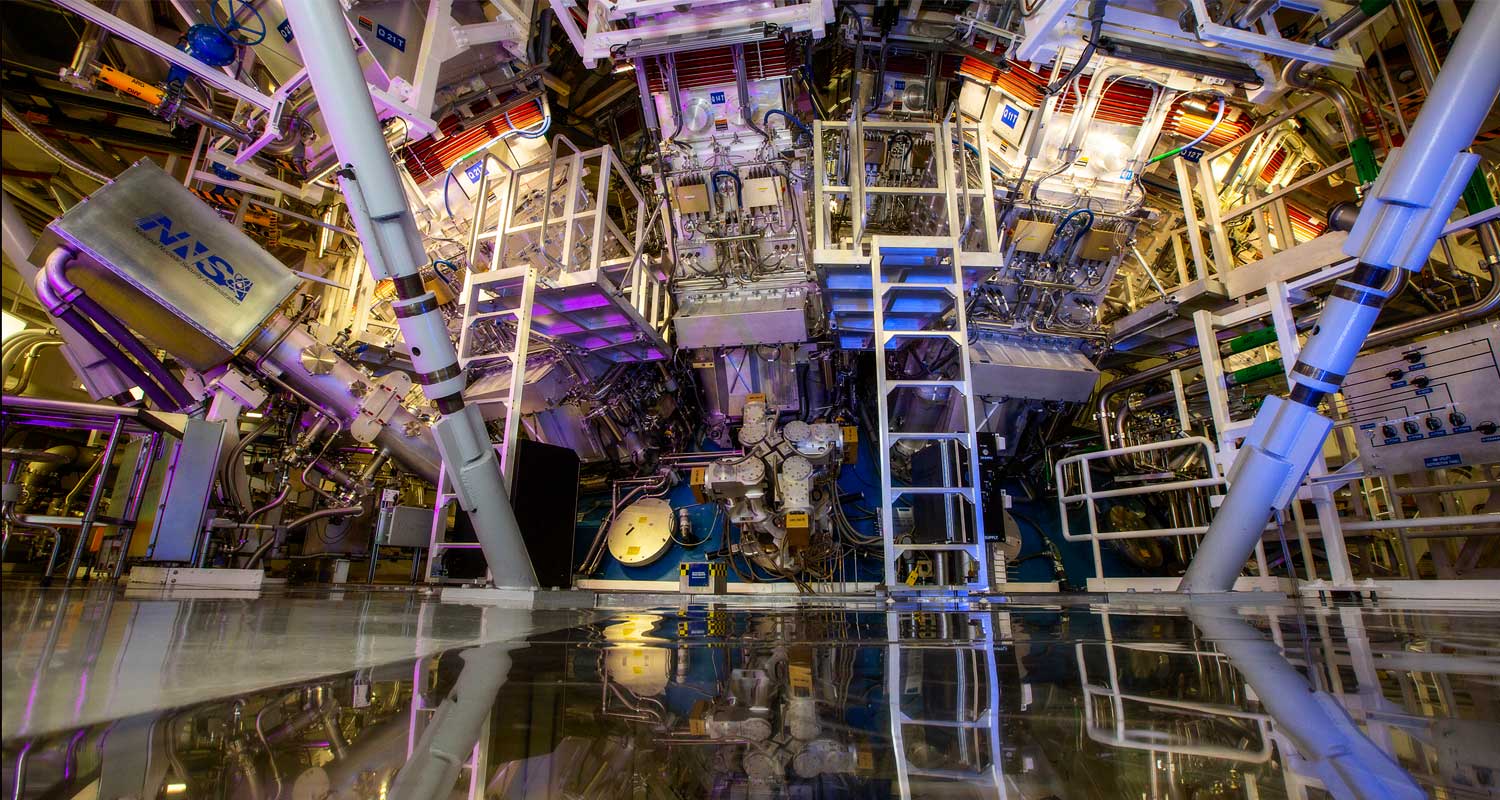
    NIF’s target chamber, where a powerful laser is used to start nuclear fusion reactions. Image: Jason Laurea/Lawrence Livermore National Laboratory, CC BY-NC-SA

    Nuclear fusion holds huge promise as a source of clean, abundant energy that could power the world.

    Now fusion researchers at a national laboratory in the US have achieved something physicists have been working towards for decades, a process known as “ignition”. This step involves getting more energy out from fusion reactions than is put in by a laser.

    But just how close are we to producing energy from fusion that can power people’s homes? While ignition is only a proof of principle and a first step in a very long process, other developments are also in the works and together they could spark renewed enthusiasm for making fusion a practical reality.

    The fusion energy released by the implosion was more than that put in by the laser, a massive achievement

    First it’s important to recognise that the latest result is indeed a real milestone. The researchers at the National Ignition Facility (NIF) in California fired the world’s biggest laser at a capsule filled with hydrogen fuel, causing it to implode and starting fusion reactions that mimic what happens in the sun.

    The fusion energy released by the implosion was more than that put in by the laser, a massive achievement given that, just a few years ago, the NIF laser could only get out about a thousandth of the energy it put in.

    However, around 10 000 times more energy had to be put into the laser than it produced in light energy. It can only be run once a day. And every target is so exquisitely designed that each one costs thousands of dollars.

    To produce a reactor for a working power station, you would need a laser that produced light energy at much greater efficiency (a few tens of percent) and shot targets successfully at 10 times per second, with each target costing a few cents. In addition, each laser shot would need to produce many times – perhaps 100 times – more energy out than was put in.

    Tech is proven

    Very little research has actually been done on fusion “reactors”, where neutrons from the reactions would help drive a steam turbine to produce electricity. But there are other reasons for hope.

    Firstly, while NIF has taken more than a decade to achieve ignition, during the same period, scientists have independently developed new lasers. These use electronic devices called diodes to transfer energy to the laser and are very, very efficient, converting a good fraction of the electricity from the grid into laser light.

    Prototype versions of such lasers have been proven to work at the rates of 10 times per second, which would be required for them to be useful in fusion. These lasers are not yet of the size needed for fusion, but the technology is proven, and the UK leads in this type of research.

    Also, the approach to fusion used by the scientists at NIF has some well-known, inherent inefficiencies, and there are several other ideas that could be much more effective.

    Nobody is absolutely certain that these other ideas would work, as they have their own unique problems, and have never been tried at scale. To do so would require hundreds of millions of dollars of investment for each of them with no guarantee of success (otherwise it would not be research). However, there is now a wind of change blowing: the private sector.

    Nuclear fusion is the same process that powers the sun

    Various funds with a very long-term outlook have started to invest in new start-up firms that are touting fusion as a commercially viable source of energy. Given that it was private industry that has revolutionised the electric car market (and the rocket industry), maybe that sector could also give fusion the “kick” it requires.

    Private firms can work a lot faster than governments, and pivot quickly to adopt new ideas when required. Estimates of the total private funding in the sector now stand in excess of US$2-billion, peanuts compared to the $2-trillion in revenue produced by the oil and gas industry each year. There is still a lot of room in the marketplace for the high-risk, high-pay-off players.

    The latest results show that the basic science works: the laws of physics do not prevent us from achieving the goal of unlimited clean energy from fusion. The problems are technical and economic. While fusion may be too far off to solve matters on the timescale of a decade or two, the latest advance will at least bolster enthusiasm about solving one of humanity’s grand challenges.The Conversation

    • The authors are this piece, Justin Wark and Gianluca Gregori, are professors of physics at the University of Oxford
    • This article is republished from The Conversation under a Creative Commons licence


    Gianluca Gregori Justin Wark
    WhatsApp YouTube Follow on Google News Add as preferred source on Google
    Share. Facebook Twitter LinkedIn WhatsApp Telegram Email Copy Link
    Previous ArticleThe year that nearly broke crypto
    Next Article Load shedding is crippling telecoms: Shameel Joosub
    Company News
    Huawei turns 25 in South Africa, celebrates with major device discounts

    Huawei turns 25 in South Africa, celebrates with major device discounts

    30 January 2026
    Phishing has not disappeared, but it has grown up - KnowBe4

    Phishing has not disappeared, but it has grown up

    30 January 2026
    Smartphone affordability: South Africa's new economic divide - PayJoy

    Smartphone affordability: South Africa’s new economic divide

    29 January 2026
    Opinion
    South Africa's skills advantage is being overlooked at home - Richard Firth

    South Africa’s skills advantage is being overlooked at home

    29 January 2026
    Why Elon Musk's Starlink is a 'hard no' for me - Songezo Zibi

    Why Elon Musk’s Starlink is a ‘hard no’ for me

    26 January 2026
    South Africa's new fibre broadband battle - Duncan McLeod

    South Africa’s new fibre broadband battle

    20 January 2026

    Subscribe to Updates

    Get the best South African technology news and analysis delivered to your e-mail inbox every morning.

    Latest Posts
    Vuyani Jarana: Mobile coverage masks a deeper broadband failure

    Vuyani Jarana: Mobile coverage masks a deeper broadband failure

    30 January 2026
    TCS+ | How Cloud On Demand is helping SA businesses succeed in the cloud - Xhenia Rhode, Dion Kalicharan

    TCS+ | Cloud On Demand and Consnet: inside a real-world AWS partner success story

    30 January 2026
    Huawei turns 25 in South Africa, celebrates with major device discounts

    Huawei turns 25 in South Africa, celebrates with major device discounts

    30 January 2026
    SABC Plus to flight Microsoft AI training videos

    SABC Plus to flight Microsoft AI training videos

    30 January 2026
    © 2009 - 2026 NewsCentral Media
    • Cookie policy (ZA)
    • TechCentral – privacy and Popia

    Type above and press Enter to search. Press Esc to cancel.

    Manage consent

    TechCentral uses cookies to enhance its offerings. Consenting to these technologies allows us to serve you better. Not consenting or withdrawing consent may adversely affect certain features and functions of the website.

    Functional Always active
    The technical storage or access is strictly necessary for the legitimate purpose of enabling the use of a specific service explicitly requested by the subscriber or user, or for the sole purpose of carrying out the transmission of a communication over an electronic communications network.
    Preferences
    The technical storage or access is necessary for the legitimate purpose of storing preferences that are not requested by the subscriber or user.
    Statistics
    The technical storage or access that is used exclusively for statistical purposes. The technical storage or access that is used exclusively for anonymous statistical purposes. Without a subpoena, voluntary compliance on the part of your Internet Service Provider, or additional records from a third party, information stored or retrieved for this purpose alone cannot usually be used to identify you.
    Marketing
    The technical storage or access is required to create user profiles to send advertising, or to track the user on a website or across several websites for similar marketing purposes.
    • Manage options
    • Manage services
    • Manage {vendor_count} vendors
    • Read more about these purposes
    View preferences
    • {title}
    • {title}
    • {title}