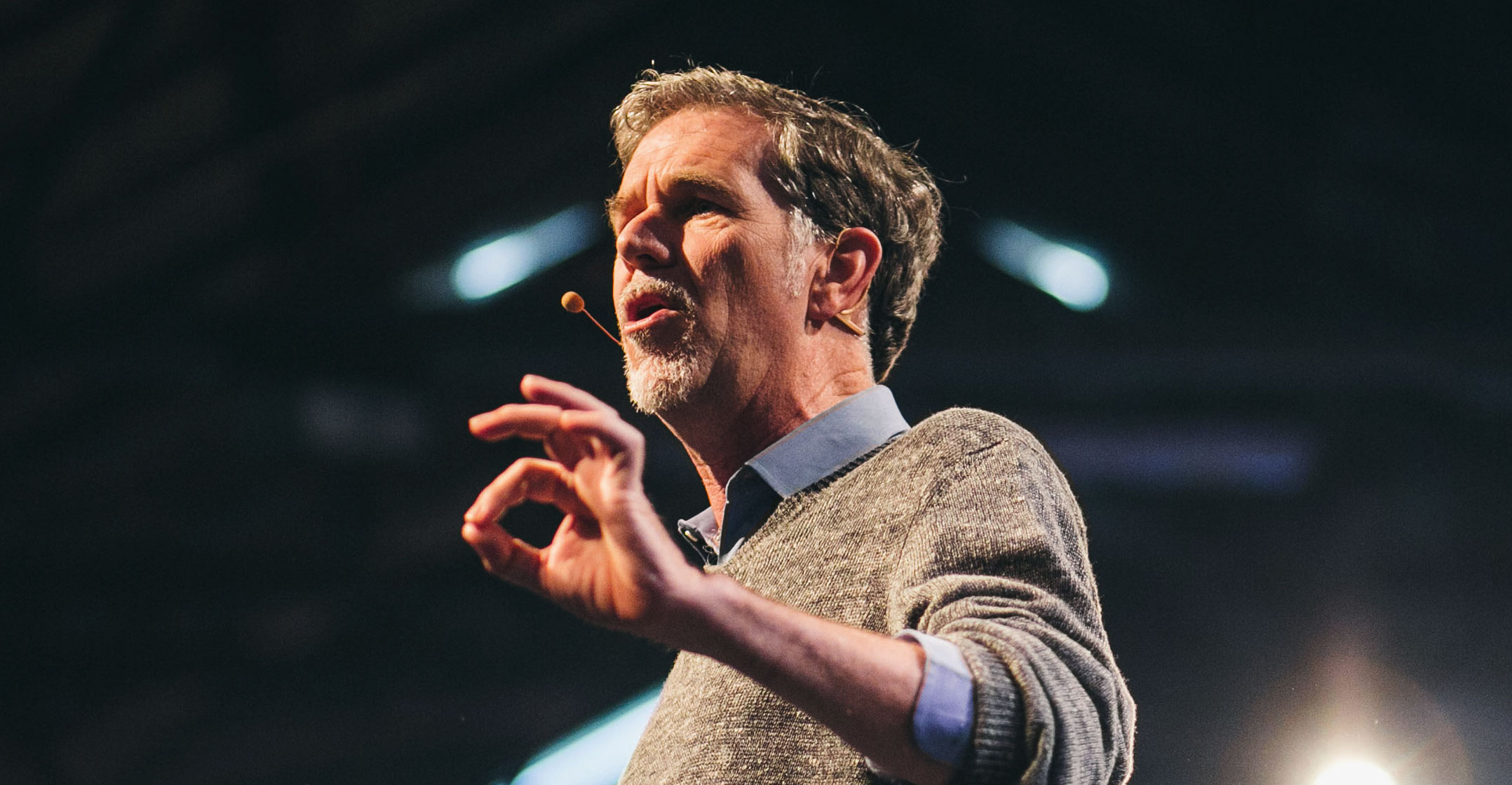
About three years ago, Reed Hastings set out to answer a question that had bedevilled Hollywood for the past decade: How did a small DVD-by-mail company build the most popular TV service in the world?
Hastings, the co-founder and CEO of Netflix, was never fond of revisiting his past. “There’s not a nostalgic bone in his body,” says Patty McCord, a former employee and longtime friend. But after outmanoeuvring media barons, tech conglomerates and start-ups to build a global entertainment colossus, Hastings agreed to write a book.
He didn’t want to write a gushy memoir, what Hastings calls “CEO pontification books”, in which corporate bigwigs chronicle their rise to the top of the business world, offering their life as a model for aspiring entrepreneurs. They’ve all left him dissatisfied. “Every time I read one, I wonder, ‘What’s the reality? What’s it really like?’” he says, speaking from his home in Santa Cruz, California.
Take The Ride of a Lifetime, Bob Iger’s reflection on his time at Walt Disney, now Netflix’s chief competitor. The book offered great insights about Iger’s early days at ABC, but, in Hastings’ view, everything was a little too tidy. “He covered all the acquisitions that went well and none of the disastrous ones.”
Inspired by books such as The HP Way and Beyond Entrepreneurship, Hastings chose to write about what he says is the real key to Netflix’s success: its culture. That topic will strike some as hopelessly dull. Who wants to read a tome about travel and expense policies? But the Netflix culture is already an object of fascination for Silicon Valley and Hollywood — ever since Hastings released a 127-page PowerPoint presentation on the topic in 2009. That slide deck has since been viewed more than 20 million times and hailed by Facebook chief operating officer Sheryl Sandberg as perhaps the most important document ever to come out of Silicon Valley.
No Rules Rules
Hastings, 59, is hoping his new book will have a similar impact. No Rules Rules, co-written with Erin Meyer, expands upon the PowerPoint presentation, outlining a 10-step plan to replicate the Netflix culture of “freedom and responsibility”.
“The goal is to give back and influence young organisations about a set of principles we think are valuable,” Hastings says.
Though Hastings didn’t set out to write about himself, No Rules Rules serves many of the same functions as a memoir, reflecting what he has learned in his 30-year journey from young, ambitious entrepreneur to one of the world’s richest people. It also offers a glimpse inside the mind of a man who is affectionately called a robot by his employees. Hastings is brilliant and focused, an engineer who predicted the future of Hollywood 20 years ago and has seldom erred in executing on his vision. But he is also unsentimental and less outgoing than your typical entertainment mogul.
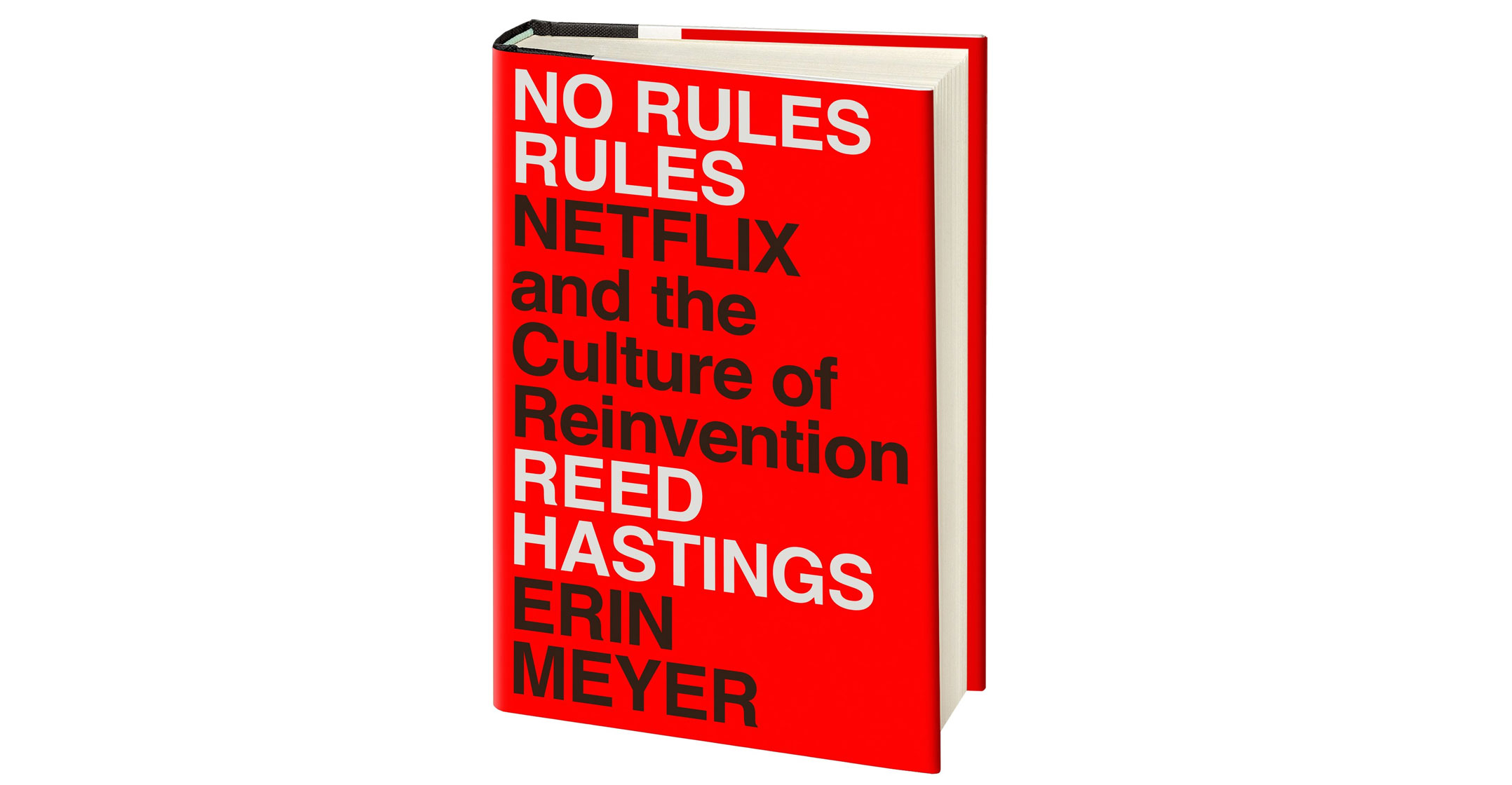 “Erin dragged many very personal stories out of me,” he says, while describing his personal journey as only “marginally interesting” and unlikely to change anyone’s life. “A good book about culture may change some other organisation in a positive way.”
Hastings is fond of talking about how few decisions he makes, suggesting that his job is little more than cutting ribbons and kissing babies.
When Hastings first released the culture slideshow, McCord was convinced it would damage the company. The presentation encouraged employees to openly criticise one another for the sake of transparency, and it recommended that managers get rid of workers whose performance was “merely adequate”. She was in charge of recruiting and human resources at the time and recalls thinking, “Oh God. You’ll scare away all our candidates.” Ultimately, however, it filtered out the candidates who were wrong for the company. “It made discussion and hiring very different,” McCord says. “It wasn’t just talking about whether or not you were qualified but whether or not you liked to be independent. Do you deliver when you say you will?”
The approach boiled down to a simple idea: Hire the very best people and get out of their way. Netflix employees are paid far more than they would earn at almost any other company, receiving unlimited vacation time, generous parental leave and no official limit on expenses. The company’s decentralised decision making lets people take big swings without approval from above. Hastings is fond of talking about how few decisions he makes, suggesting that his job is little more than cutting ribbons and kissing babies.
But former employees have complained about the downside. While Netflix’s practices may filter out some underperformers, the approach can feel impersonal and leaves the ever-present spectre of losing your job.
High-performance culture
“It does hurt when people say it was terrible at Netflix,” says Hastings, but he’s confident that most employees enjoy the workplace. “The percentage of people leaving is at its lowest it’s ever been.” (Some of that, he acknowledges, is due to high compensation and some is due to the pandemic.)
Netflix’s high-performance culture was forged during a round of layoffs in 2001, just after the dot-com bubble popped. The company needed to raise money to prop up its unprofitable business and had to fire a third of its staff to stay solvent. The layoffs, though painful, had no effect on the company’s performance. If anything, the company was better off. Hastings and McCord soon realised that Netflix could do more with less.
A Boston native, Hastings travelled across the country in 1985 to study computer science at Stanford University, the sun in Silicon Valley’s solar system. After graduating, he worked at a couple of technology firms before coming up with the idea for Purify, which identified errors in computer programs. Hastings built a prototype of the product by himself before approaching other people to help — one of whom was Raymond Peck, then dating Hastings’s co-worker.
 The early years of that start-up were fun, Peck says. Hastings would host hot-tub parties and beer bashes for the small group of employees. But even then Hastings showed an ambition that amazed his colleagues. Hastings’ view for the business “was almost evangelical — the fervour he had for doing great and amazing things,” Peck says.
Hastings would often ask McCord to rate him as a boss. She had joined the company after stints at Borland Software and Sun Microsystems, where management threw chairs across the room, McCord says. On the jerk meter, you barely flicker, she would tell him.
Most of Hastings’s fellow CEOs were more interested in taking their staff on private jets, but he just wanted to write code. “It was a very geeky software company,” says McCord. “Reed wrote the first program — he was the geek of the geeks.”
Pure Software — as it was then known — was successful enough that it started buying other companies, and that’s when things got complicated. New employees didn’t assimilate, creating a company with many fiefdoms and cultures. Hastings began to compromise in hiring, bringing on “B people” instead of “A people”. Pure shuffled through five heads of sales in five years.
Hastings tried to compensate by micromanaging. Everywhere he went, he’d ask people what they were doing and try to offer assistance. McCord would give tours of the offices to prospective hires and point out Hastings’ cubicle. “You like it when he’s in his cubicle because it means he’s not in yours,” McCord would say. (Hastings has no office at Netflix; he just floats around from room to room.)
Walked out
Not long after Pure went public in 1995, it acquired a company called Atria that was similarly sized and generated a lot of money. But the software was flawed, and the company’s leaders blamed the customers instead of fixing it, Peck recalls. Not long after that, Hastings sold the company — then called Pure Atria — to Rational Software and walked out the door.
“We had built something amazing, and then because of market forces and his inability to continue that culture, that got destroyed,” Peck says.
Hastings never planned to run Netflix. He took his money from Pure and made a series of investments, of which Netflix was just one. Hastings had taught maths in Swaziland after college and planned to explore the world of education. He joined the California Board of Education in 1996 and that led to a campaign to expand access to charter schools in the state. He has since spent more than US$100-million on education initiatives.
Netflix’s first CEO was Marc Randolph, a former employee of Hastings’ at Pure. But he had an entrepreneur’s mindset, and was better suited to starting companies than building them. So Hastings, who was already on Netflix’s board, stepped in to help steer the ship. They ran the company together for a couple of years, and then Hastings took over full time.
Given a second chance at leading, Hastings swore not to repeat the same mistakes. He has avoided acquisitions and tried to make no compromises when hiring the best people — even when it led to being sued for poaching.
As Netflix has grown, what started as a technology company led by engineers has morphed into an entertainment company led by thousands of people trained in Hollywood studios. The two sides have often disagreed, including over how best to market Netflix’s shows and movies. (The engineers prefer to use only algorithms to target an audience, while Hollywood executives like billboards and parties.) Yet Hastings says any lingering tension has been resolved in Los Angeles’ favour. The company now spends two-thirds of its money on content, and has more employees in Los Angeles than Silicon Valley.
In the last decade, Hastings has made just one huge blunder: splitting Netflix’s original DVD-by-mail business from the streaming business and renaming it Qwikster. But even then, he knew that the future of TV was online.
Netflix’s rivals in tech and media have tried all sorts of approaches, but Hastings has stuck to a few general principles.
Its service doesn’t sell ads. It doesn’t rely on user-generated content (Netflix doesn’t want to be YouTube or TikTok). And it hasn’t strayed into tangential businesses such as gaming or music or theme parks.
The singular goal was adding more subscribers to its service.
“They have a really long-term strategy,” says Peter Chernin, a veteran media executive and investor. “They focused on growth with the assumption that growth will lead to great profitability.”
Co-CEO
That focus is about to be tested. In July, Hastings announced that Ted Sarandos, his longtime lieutenant, would be his co-CEO. This formalised an arrangement that had been functioning in practice for many years, and reflected the company’s shift from Silicon Valley to Hollywood.
Sarandos used to travel to Silicon Valley every week to meet with the engineers. Now it’s the reverse, with Hastings visiting Los Angeles. When movie stars and directors think about Netflix, they don’t think about Hastings. You won’t find him on red carpets like Amazon.com’s Jeff Bezos or at premieres like Apple boss Tim Cook. That’s Sarandos’s role.
Co-CEO arrangements are unusual and rarely successful. Sarandos, for all his skills as an executive, is in some ways the opposite of Hastings. Hastings is an intellectual; Sarandos, a schmoozer and pop-culture encyclopaedia. While Hastings is analytical and unemotional, Sarandos is more prone to making decisions based on personal relationships.
 Hastings dismisses the concerns, noting that Sarandos has been a huge evangelist for the culture he created, and the company’s anchor in its transition to Hollywood. Hastings has also reassured employees and investors he’s not going anywhere soon. “It’s not like I want go sailing,” he says. Hastings still wakes up every day to look at a dashboard of new sign-ups and top-performing shows.
Yet the promotion of Sarandos and the writing of the book are clear signals that Hastings has begun to map out Netflix’s future without him at the top.
“I love the work of Netflix, but it’s also true it won’t be forever,” he says. Hastings points to Microsoft as his model: “Look at Microsoft, now 20 years from Bill Gates. There’s still a lot of Bill Gates in Microsoft. There’s a lot of evidence you can make a big imprint that lasts for a long time.” — Reported by Lucas Shaw, (c) 2020 Bloomberg LP