Close Menu
TechCentralTechCentral

    Subscribe to the newsletter

    Get the best South African technology news and analysis delivered to your e-mail inbox every morning.

    Facebook X (Twitter) YouTube LinkedIn
    WhatsApp Facebook X (Twitter) LinkedIn YouTube
    TechCentralTechCentral
    • News
      MultiChoice scraps annual DStv price hikes for 2026 - David Mignot

      MultiChoice scraps annual DStv price hike

      20 February 2026
      What Gen Z really thinks about the tech world it inherited - Tinashe Mazodze

      What Gen Z really thinks about the tech world it inherited

      20 February 2026
      Showmax 'can't continue' in its current form

      Showmax ‘can’t continue’ in its current form

      20 February 2026
      Free Market Foundation slams treasury's proposed gambling tax

      Free Market Foundation slams treasury’s proposed gambling tax

      20 February 2026
      South Africa's dynamic spectrum breakthrough - Paul Colmer

      South Africa’s dynamic spectrum breakthrough

      20 February 2026
    • World
      Prominent Southern African journalist targeted with Predator spyware

      Prominent Southern African journalist targeted with Predator spyware

      18 February 2026
      More drama in Warner Bros tug of war

      More drama in Warner Bros tug of war

      17 February 2026
      Russia bans WhatsApp

      Russia bans WhatsApp

      12 February 2026
      EU regulators take aim at WhatsApp

      EU regulators take aim at WhatsApp

      9 February 2026
      Musk hits brakes on Mars mission

      Musk hits brakes on Mars mission

      9 February 2026
    • In-depth
      How liberalisation is rewiring South Africa's power sector

      How liberalisation is rewiring South Africa’s power sector

      21 January 2026
      The top-performing South African tech shares of 2025

      The top-performing South African tech shares of 2025

      12 January 2026
      Digital authoritarianism grows as African states normalise internet blackouts

      Digital authoritarianism grows as African states normalise internet blackouts

      19 December 2025
      TechCentral's South African Newsmakers of 2025

      TechCentral’s South African Newsmakers of 2025

      18 December 2025
      Black Friday goes digital in South Africa as online spending surges to record high

      Black Friday goes digital in South Africa as online spending surges to record high

      4 December 2025
    • TCS
      Watts & Wheels S1E4: 'We drive an electric Uber'

      Watts & Wheels S1E4: ‘We drive an electric Uber’

      10 February 2026
      TCS+ | How Cloud On Demand is helping SA businesses succeed in the cloud - Xhenia Rhode, Dion Kalicharan

      TCS+ | Cloud On Demand and Consnet: inside a real-world AWS partner success story

      30 January 2026
      Watts & Wheels S1E4: 'We drive an electric Uber'

      Watts & Wheels S1E3: ‘BYD’s Corolla Cross challenger’

      30 January 2026
      Watts & Wheels S1E4: 'We drive an electric Uber'

      Watts & Wheels S1E2: ‘China attacks, BMW digs in, Toyota’s sublime supercar’

      23 January 2026

      TCS+ | Why cybersecurity is becoming a competitive advantage for SA businesses

      20 January 2026
    • Opinion
      A million reasons monopolies don't work - Duncan McLeod

      A million reasons monopolies don’t work

      10 February 2026
      The author, Business Leadership South Africa CEO Busi Mavuso

      Eskom unbundling U-turn threatens to undo hard-won electricity gains

      9 February 2026
      South Africa's skills advantage is being overlooked at home - Richard Firth

      South Africa’s skills advantage is being overlooked at home

      29 January 2026
      Why Elon Musk's Starlink is a 'hard no' for me - Songezo Zibi

      Why Elon Musk’s Starlink is a ‘hard no’ for me

      26 January 2026
      A million reasons monopolies don't work - Duncan McLeod

      South Africa’s new fibre broadband battle

      20 January 2026
    • Company Hubs
      • Africa Data Centres
      • AfriGIS
      • Altron Digital Business
      • Altron Document Solutions
      • Altron Group
      • Arctic Wolf
      • AvertITD
      • Braintree
      • CallMiner
      • CambriLearn
      • CYBER1 Solutions
      • Digicloud Africa
      • Digimune
      • Domains.co.za
      • ESET
      • Euphoria Telecom
      • Incredible Business
      • iONLINE
      • IQbusiness
      • Iris Network Systems
      • LSD Open
      • Mitel
      • NEC XON
      • Netstar
      • Network Platforms
      • Next DLP
      • Ovations
      • Paracon
      • Paratus
      • Q-KON
      • SevenC
      • SkyWire
      • Solid8 Technologies
      • Telit Cinterion
      • Tenable
      • Vertiv
      • Videri Digital
      • Vodacom Business
      • Wipro
      • Workday
      • XLink
    • Sections
      • AI and machine learning
      • Banking
      • Broadcasting and Media
      • Cloud services
      • Contact centres and CX
      • Cryptocurrencies
      • Education and skills
      • Electronics and hardware
      • Energy and sustainability
      • Enterprise software
      • Financial services
      • Information security
      • Internet and connectivity
      • Internet of Things
      • Investment
      • IT services
      • Lifestyle
      • Motoring
      • Public sector
      • Retail and e-commerce
      • Satellite communications
      • Science
      • SMEs and start-ups
      • Social media
      • Talent and leadership
      • Telecoms
    • Events
    • Advertise
    TechCentralTechCentral
    Home » In-depth » How to build the world’s fastest car

    How to build the world’s fastest car

    By The Conversation24 September 2015
    Twitter LinkedIn Facebook WhatsApp Email Telegram Copy Link
    News Alerts
    WhatsApp
    Not built for the morning school run
    Not built for the morning school run

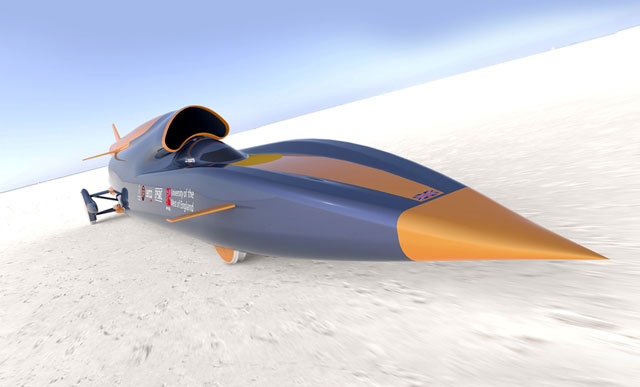
    In 2016, a team of engineers and adventurers will travel to the South African desert and attempt to become the first people to drive a car at a thousand miles an hour (1 609km/h). The British-made vehicle, Bloodhound SSC, is designed to smash the current world land-speed record of 763mph to become the fastest car ever built.

    Amazingly, this incredible target isn’t even the project’s main goal. Breaking the land-speed record is nothing new for the UK, which has held the title for 79 of the past 100 years — and continuously for the last 32 years, most recently with Thrust SSC) driven by Andy Green. But when Green, along with previous record holder Richard Noble and the then science minister Lord Drayson, launched Bloodhound in 2008, their aim was to inspire the next generation of problem solvers to put their great talent into science, technology, engineering and mathematics.

    The other goal, of course, was to challenge the country’s engineers to complete a world-class research and development project. But how do you even start to design and build a car that is hundreds of miles an hour faster than any other the world has ever seen? There are three main things to consider. Is it slippery enough? Is it powerful enough? And is it strong enough?

    Anyone will know just from flying a kite that there is great power in the moving air. That’s fine if you are working with the airflow but with Bloodhound we will be trying to push against it faster than the speed of sound. Pushing an object through the air creates a tremendous amount of resistance force and the greater the frontal area of the object, the higher that resistance will be.

    Thrust SSC used two jet engines to provide the power. These operate by sucking air in from the front, compressing it, burning fuel, and forcing it out the back to create thrust. This kind of design needs a large frontal area so the jet engines can scoop up enough air. But analysis showed a design like this would never be able to reach 1 000mph. The frontal area would generate so much resistance that you would never be able to produce enough power with current technology to counter it. Instead we had to design a vehicle with a smaller frontal area and that required the use of a rocket engine (more of that later).

    To check the aerodynamics, a computer model was run at the University of Swansea using a system known as computational fluid dynamics (CFD). This enabled the team to understand how the car shape would respond to airflow over the bodywork at low speeds (subsonic), as it approached the sound barrier (transonic), and high speeds (supersonic). As a result, we were able to simulate more than 150 designs to ensure that we had a stable vehicle at any speed.

    Powering the beast
    Because of the need for a small frontal area, two jet engines would be impossible. The solution was to combine a single jet engine with rocket power. Rockets can produce incredible power either by burning a mix of liquid fuel and liquid oxygen or by lighting an explosive mixture of solid fuel and oxidiser. The problem with both these models is the chemicals. Liquid oxygen is very difficult to manage and must be kept at -182°C. Rockets with solid fuel, once started, cannot be stopped until all the fuel is consumed. Once again a third way was needed.

    We selected a hybrid rocket that uses very pure hydrogen peroxide (the stuff you may use to lighten your hair) as an oxidiser and a rubber grain as a fuel. This meant we could turn off the flow of oxidiser and stop the explosion, producing a controllable rocket.

    But this created another problem: how to get the oxidiser into the rocket. With a solution suitable for a land-speed record, we used a high-powered Jaguar sports car engine to power a fuel pump that is able to deliver 1 000l of peroxide to the rocket in 20 seconds. These three engines together should be enough to get us to 1 000mph.

    Another concern is that all of the components of the car are subjected to huge pressures. For example, the outside of the wheels spin so fast that they generate a force 50 000 times greater than the Earth’s gravity. That means that each gram of material has an effective mass of 50kg. Meanwhile, the shaft that drives the fuel pump must carry considerable torque while moving a liquid that would erode many materials.

    To overcome these challenges, the wheels were forged from a single block of high-grade aluminium. This ensured the grains of metal that made up the block were all aligned, reducing the chances of a defect or a rupture. The body shell of the car has been manufactured from carbon fibre to ensure a light but incredibly strong structure. And the fuel pump drive shaft is manufactured from Custom 465, a material that is chemically unreactive but strong enough to turn the pump. We then thoroughly tested each component to replicate the forces it will experience during the record attempt.

    All of these problems show how designing and building a car like Bloodhound requires a huge wealth of expertise. From the chemists who develop the materials to the engineers who work out how to manufacture the components and integrate them into a single working system, breaking the land-speed record is a cooperative project involving many more people than just the driver. When the car makes its nerve-biting record attempt in 2016, it’ll be as if they’re all in the cockpit with him.The Conversation

    • Phil Spiers is head of structural testing at the Advanced Manufacturing Research Centre, University of Sheffield
    • This article was originally published on The Conversation

    Follow TechCentral on Google News Add TechCentral as your preferred source on Google


    Bloodhound SSC Phil Spiers
    WhatsApp YouTube
    Share. Facebook Twitter LinkedIn WhatsApp Telegram Email Copy Link
    Previous ArticleNo sin for a black man to earn a decent salary: Hlaudi
    Next Article ANC warns SABC over pay hikes

    Related Posts

    Buyer found for Bloodhound supersonic car project

    17 December 2018

    How to build a 1 000mph car

    24 July 2016

    R465m shortfall hits Bloodhound SSC plan

    8 February 2016
    Company News
    Service is everyone's problem now - and that's exactly why the Atlassian Service Collection matters

    Service is everyone’s problem now – why the Atlassian Service Collection matters

    20 February 2026
    Customers have new expectations. Is your CX ready? 1Stream

    Customers have new expectations. Is your CX ready?

    19 February 2026
    South Africa's cybersecurity challenge is not a tool problem - Nicholas Applewhite, Trinexia South Africa

    South Africa’s cybersecurity challenge is not a tool problem

    19 February 2026
    Opinion
    A million reasons monopolies don't work - Duncan McLeod

    A million reasons monopolies don’t work

    10 February 2026
    The author, Business Leadership South Africa CEO Busi Mavuso

    Eskom unbundling U-turn threatens to undo hard-won electricity gains

    9 February 2026
    South Africa's skills advantage is being overlooked at home - Richard Firth

    South Africa’s skills advantage is being overlooked at home

    29 January 2026

    Subscribe to Updates

    Get the best South African technology news and analysis delivered to your e-mail inbox every morning.

    Latest Posts
    MultiChoice scraps annual DStv price hikes for 2026 - David Mignot

    MultiChoice scraps annual DStv price hike

    20 February 2026
    What Gen Z really thinks about the tech world it inherited - Tinashe Mazodze

    What Gen Z really thinks about the tech world it inherited

    20 February 2026
    Showmax 'can't continue' in its current form

    Showmax ‘can’t continue’ in its current form

    20 February 2026
    Free Market Foundation slams treasury's proposed gambling tax

    Free Market Foundation slams treasury’s proposed gambling tax

    20 February 2026
    © 2009 - 2026 NewsCentral Media
    • Cookie policy (ZA)
    • TechCentral – privacy and Popia

    Type above and press Enter to search. Press Esc to cancel.

    Manage consent

    TechCentral uses cookies to enhance its offerings. Consenting to these technologies allows us to serve you better. Not consenting or withdrawing consent may adversely affect certain features and functions of the website.

    Functional Always active
    The technical storage or access is strictly necessary for the legitimate purpose of enabling the use of a specific service explicitly requested by the subscriber or user, or for the sole purpose of carrying out the transmission of a communication over an electronic communications network.
    Preferences
    The technical storage or access is necessary for the legitimate purpose of storing preferences that are not requested by the subscriber or user.
    Statistics
    The technical storage or access that is used exclusively for statistical purposes. The technical storage or access that is used exclusively for anonymous statistical purposes. Without a subpoena, voluntary compliance on the part of your Internet Service Provider, or additional records from a third party, information stored or retrieved for this purpose alone cannot usually be used to identify you.
    Marketing
    The technical storage or access is required to create user profiles to send advertising, or to track the user on a website or across several websites for similar marketing purposes.
    • Manage options
    • Manage services
    • Manage {vendor_count} vendors
    • Read more about these purposes
    View preferences
    • {title}
    • {title}
    • {title}