
Close Menu
TechCentralTechCentral

    Subscribe to the newsletter

    Get the best South African technology news and analysis delivered to your e-mail inbox every morning.

    Facebook X (Twitter) YouTube LinkedIn
    WhatsApp Facebook X (Twitter) LinkedIn YouTube
    TechCentralTechCentral
    • News
      Cape Town agency powers biggest gaming Kickstarter ever - Kyle Puller

      Cape Town agency powers biggest gaming Kickstarter ever

      3 May 2026
      Schreiber suspends home affairs officials over fake AI references - Leon Schreiber

      Schreiber suspends home affairs officials over fake AI references

      30 April 2026
      South Africa headed to the polls in November

      South Africa headed to the polls in November

      30 April 2026
      Google humbles Big Tech's cloud heavyweights

      Google humbles Big Tech’s cloud heavyweights

      30 April 2026
      Logistics start-up Shiprazor pulls in R44-million seed round

      Logistics start-up Shiprazor pulls in R44-million seed round

      30 April 2026
    • World
      'It was my idea': Musk claims paternity of OpenAI - Elon Musk

      ‘It was my idea’: Musk claims paternity of OpenAI

      29 April 2026
      Pivotal week for US tech stocks

      Pivotal week for US tech stocks

      28 April 2026
      Worries over OpenAI's growth as Anthropic gains ground - Sam Altman. Shelby Tauber/Reuters

      Worries over OpenAI’s growth as Anthropic gains ground

      28 April 2026
      Taylor Swift trademarks her voice to fight AI fakes

      Taylor Swift trademarks her voice to fight AI fakes

      28 April 2026
      DeepSeek's long-awaited V4 model enters preview

      DeepSeek’s long-awaited V4 model enters preview

      24 April 2026
    • In-depth
      Alfa's electric rebel - Alfa Romeo Junior Elettrica Veloce

      Alfa’s electric rebel

      29 April 2026
      Africa switches on as Europe dims the lights

      Africa switches on as Europe dims the lights

      9 April 2026
      The biggest untapped EV market on Earth is hiding in plain sight

      The biggest untapped EV market on Earth is hiding in plain sight

      1 April 2026
      The R18-billion tech giant hiding in plain sight - Jens Montanana

      The R16-billion tech giant hiding in plain sight

      26 March 2026
      The last generation of coders

      The last generation of coders

      18 February 2026
    • TCS

      TCS+ | ‘The ISP for ISPs’: Vox’s shift to wholesale aggregator

      20 April 2026
      TCS | Werner Lindemann on how AI is rewriting the infosec rulebook

      TCS | Werner Lindemann on how AI is rewriting the infosec rulebook

      15 April 2026
      TCS | Donovan Marsh on AI and the future of filmmaking

      TCS | Donovan Marsh on AI and the future of filmmaking

      7 April 2026
      TCS+ | Vodacom Business moves to crack the SME tech gap - Andrew Fulton, Sannesh Beharie

      TCS+ | Vodacom Business moves to crack the SME tech gap

      7 April 2026
      TCS | MTN's Divysh Joshi on the strategy behind Pi - Divyesh Joshi

      TCS | MTN’s Divyesh Joshi on the strategy behind Pi

      1 April 2026
    • Opinion
      Free calls, dead voice and Shameel Joosub's Spanish ghost - Duncan McLeod

      Free calls, dead voice and Shameel Joosub’s Spanish ghost

      22 April 2026
      The conflict of interest at the heart of PayShap's slow adoption - Cheslyn Jacobs

      The conflict of interest at the heart of PayShap’s slow adoption

      26 March 2026
      South Africa's energy future hinges on getting wheeling right - Aishah Gire

      South Africa’s energy future hinges on getting wheeling right

      10 March 2026
      Free calls, dead voice and Shameel Joosub's Spanish ghost - Duncan McLeod

      Apple just dropped a bomb on the Windows world

      5 March 2026
      R230-million in the bag for Endeavor's third Harvest Fund - Alison Collier

      VC’s centre of gravity is shifting – and South Africa is in the frame

      3 March 2026
    • Company Hubs
      • 1Stream
      • Africa Data Centres
      • AfriGIS
      • Altron Digital Business
      • Altron Document Solutions
      • Altron Group
      • Arctic Wolf
      • Ascent Technology
      • AvertITD
      • BBD
      • Braintree
      • CallMiner
      • CambriLearn
      • Contactable
      • CYBER1 Solutions
      • Digicloud Africa
      • Digimune
      • Domains.co.za
      • ESET
      • Euphoria Telecom
      • HOSTAFRICA
      • Incredible Business
      • iONLINE
      • IQbusiness
      • Iris Network Systems
      • Kaspersky
      • LSD Open
      • Mitel
      • NEC XON
      • Netstar
      • Network Platforms
      • Next DLP
      • Ovations
      • Paracon
      • Paratus
      • Q-KON
      • SevenC
      • SkyWire
      • Solid8 Technologies
      • Telit Cinterion
      • Telviva
      • Tenable
      • Vertiv
      • Videri Digital
      • Vodacom Business
      • Wipro
      • Workday
      • XLink
    • Sections
      • AI and machine learning
      • Banking
      • Broadcasting and Media
      • Cloud services
      • Contact centres and CX
      • Cryptocurrencies
      • Education and skills
      • Electronics and hardware
      • Energy and sustainability
      • Enterprise software
      • Financial services
      • HealthTech
      • Information security
      • Internet and connectivity
      • Internet of Things
      • Investment
      • IT services
      • Lifestyle
      • Motoring
      • Policy and regulation
      • Public sector
      • Retail and e-commerce
      • Satellite communications
      • Science
      • SMEs and start-ups
      • Social media
      • Talent and leadership
      • Telecoms
    • Events
    • Advertise
    TechCentralTechCentral
    Home » In-depth » It’s China vs US in new computing arms race

    It’s China vs US in new computing arms race

    By Agency Staff9 April 2018
    Twitter LinkedIn Facebook WhatsApp Email Telegram Copy Link
    News Alerts
    WhatsApp

    As the US and China threaten to impose tariffs on goods from aluminium to wine, the two nations are waging a separate economic battle that could determine who owns the next wave of computing.

    Chinese universities and US technology companies such as IBM and Microsoft are racing to develop quantum computers, a type of processing that’s forecast to be so powerful it can transform how drug makers, agriculture companies and car manufacturers discover compounds and materials.

    Quantum computing uses the movement of subatomic particles to process data in amounts that modern computers can’t handle. Mostly theoretical now, the technology is expected to be able to perform calculations that make today’s computers look akin to an abacus.

    Mostly theoretical now, the technology is expected to be able to perform calculations that make today’s computers look akin to an abacus

    While overall spending by China is unknown, its government is building a US$10bn National Laboratory for Quantum Information Sciences in Hefei, Anhui Province, which is slated to open in 2020. US-funded research in quantum is about $200m/year, according to a July 2016 government report, and some researchers and companies don’t believe that’s enough.

    One “killer app” may be encryption, the code scrambling technology that secures modern global commerce and communications. China, Chinese universities and Western financial institutions are rushing to patent more ways to use quantum technology for encryption, a study by research firm Patinformatics found.

    “We’re talking about encrypting data so it can’t be broken, certainly not by a classical computer,” said Tony Trippe, MD of Dublin, Ohio-based Patinformatics. “It would be an unhackable system.”

    At the same time, it could break encryption that was on a classical computer. “An organisation or a nation that had quantum computer technologies would have a significantly easier time of wreaking havoc on other systems,” he said.

    Trump

    US President Donald Trump accused the Chinese government in March of stealing intellectual property by forcing American companies to share their most valuable secrets and sign joint venture agreements with local firms if they want to operate in China, although there are no specific allegations regarding quantum computers.

    China has also been aggressive in pushing homegrown innovation as it supports companies in obtaining patents and trademarks around the world, and has increased its research funding. In its annual scorecard, the Organisation for Economic Cooperation and Development called China “the second largest scientific powerhouse”, behind the US.

    Technology companies from Microsoft to IBM to Google view quantum computing as the next revolution.
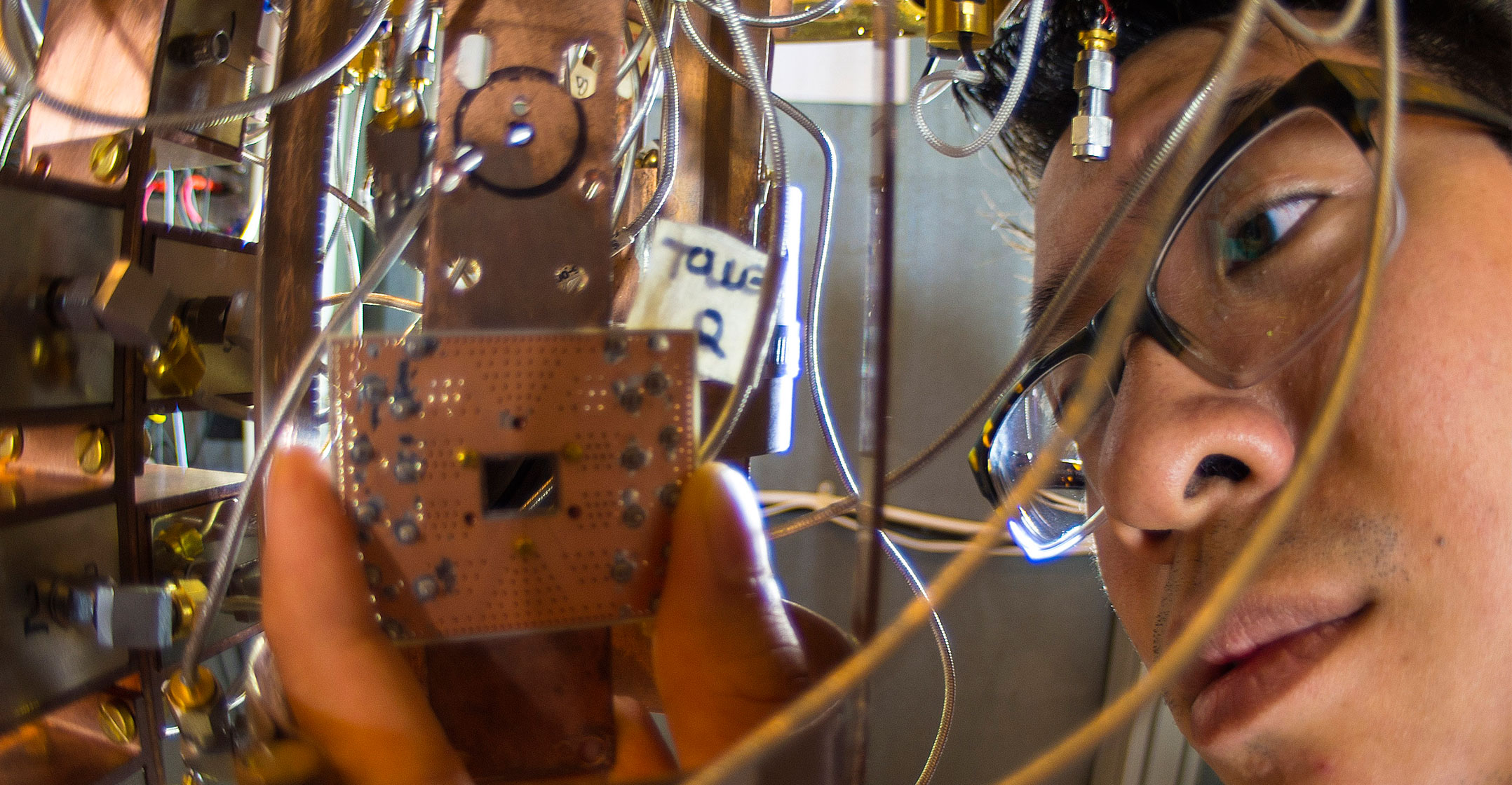
    IBM Research scientist Jerry Chow conducts a quantum computing experiment at IBM’s Thomas J Watson Research Centre

    “Over time, quantum in the field of computation is so important is that it will redefine the category of computers themselves,” said Dario Gil, vice president of IBM’s Artificial Intelligence research. “It is the future of computing.”

    IBM’s inventions may be having the most impact on the nascent field, when judged by the number of times its research has been cited by others in their patent applications. The Armonk, New York-based company already has developed computers being tested by customers, including Oak Ridge National Laboratory in Tennessee, the US energy department’s biggest lab, as well as finance companies like JPMorgan Chase & Co and Barclays, Gil said.

    Intel, which started its own programme two years ago, said the technology promises to be “transformational”.

    There are many tough problems to solve before quantum computing is a commercial reality. Some of these problems involve materials science, quantum chip design and manufacturing

    “There are many tough problems to solve before quantum computing is a commercial reality,” said Jim Clarke, director of quantum hardware at Intel. “Some of these problems involve materials science, quantum chip design and manufacturing — those are sweet-spot problems for Intel.”

    Clarke said Intel is competitive in the number of patents it’s seeking, though many aren’t yet public. Applications are made public after 18 months.

    While there will still be a place for what’s being called “classical computers” — a category that includes modern smartphones and even super computers — the quantum computers could have “an infinite number of applications” in the fields of life sciences, chemistry and agriculture, said IBM’s Gil.

    It’s too early to say which company or country will be the leader in quantum computers, though at this stage it looks like US companies will excel in hardware while Chinese and Japanese ones are focused on the software and applications, Patinformatics’ Trippe said.

    “Japanese and Chinese companies aren’t as concerned about building them as they are about how they’ll be used,” Trippe said. “They’ve started to patent the potential. The next five years are going to be pretty fascinating.”

    The US China Economic and Security Review Commission, created by the US congress in 2000 to assess national security implications of bilateral trade between the countries, said in its most recent report that China “has closed the technological gap” with the US in quantum information science, a sector Americans have long dominated, “due to a concerted strategy by the Chinese government and inconsistent and unstable levels of R&D funding and limited government coordination by the United States”.

    Closing in

    Studies by the US Chamber of Commerce and Bloomberg have independently shown that China is rising in its overall score for innovation, which includes education, government research and the number of patents. The World Intellectual Property Organisation reported on 21 March that China is closing in on the US in filing international patent applications.

    Quantum physics is one area in which the Chinese government, through its ministry of science & technology, is beefing up its technological prowess, according to a report by the US trade representative that laid the groundwork for Trump’s tariff plans. The China Academy of Sciences and Beijing University are among the Chinese research firms seeking more patents on quantum IT, according to Patinformatics.

    The Chinese government invested by giving a lot of money to companies and researchers to “replicate what we did in the US and elsewhere”, said Carl J Williams, deputy director of the Physical Measurement Laboratory at the US National Institute of Standards and Technology. “They’ve come a long way.”

    The Chinese researchers are focused on encryption, based on their patent applications. In August 2016, China’s state news agency said the government had launched the world’s first quantum communications satellite, and a year later claimed to have sent the first “unbreakable” code from space.

    “That should be very scary,” said Jonathan Dowling, co-director of Louisiana State University’s Hearne Institute for Theoretical Physics, “at least to the intelligence agencies.”

    In the US, the department of energy, Naval Research Lab and defence contractor Northrop Grumman are among the government entities or contractors researching quantum computers. Overall, though, the US government has cut back on its own funding of computing and cryptography hardware, Dowling said.

    A July 2016 report by the National Science and Technology Council under former President Barack Obama recommended it be “considered a priority for federal coordination and investment”.

    In the coming age of quantum, it’s an open question whether federal funding will enable the US to maintain the edge it’s had during the PC era and smartphone wars. Scott Crowder, IBM’s chief technology officer for quantum computing, told a house panel in October that “the US government investment in driving this critical technology is not sufficient to stay competitive”.

    LSU’s Dowling said it could mean the US comes out the loser in the quantum race.

    “What we’re seeing is a bunch of different things going on at once with no overall organisation,” LSU’s Dowling said, “unlike in China, where they are exactly sure what they’re doing.”  — Reported by Susan Decker and Christopher Yasiejko, with assistance from Dina Bass, Jeremy Kahn and Ian King, (c) 2018 Bloomberg LP


    Follow TechCentral on Google News Add TechCentral as your preferred source on Google


    Donald Trump Google IBM Microsoft Patinformatics top
    WhatsApp YouTube
    Share. Facebook Twitter LinkedIn WhatsApp Telegram Email Copy Link
    Previous ArticleGlobal tech boom isn’t done, SA experts say
    Next Article How to stop haemorrhaging your data on Facebook

    Related Posts

    Google humbles Big Tech's cloud heavyweights

    Google humbles Big Tech’s cloud heavyweights

    30 April 2026
    Hospitality sector embraces Google Workspace and Gemini to cut admin - Digicloud Africa, Rand Data Systems

    Hospitality sector embraces Google Workspace and Gemini to cut admin

    30 April 2026
    Goldman Sachs warns of tech bubble

    Goldman Sachs warns of tech bubble

    29 April 2026
    Company News
    The breach is in the database - Ascent Technology Johan Lamberts

    The breach is in the database

    30 April 2026
    Hospitality sector embraces Google Workspace and Gemini to cut admin - Digicloud Africa, Rand Data Systems

    Hospitality sector embraces Google Workspace and Gemini to cut admin

    30 April 2026
    Paratus Mozambique powers 2026 Santa Maria fishing showdown

    Paratus Mozambique powers 2026 Santa Maria fishing showdown

    30 April 2026
    Opinion
    Free calls, dead voice and Shameel Joosub's Spanish ghost - Duncan McLeod

    Free calls, dead voice and Shameel Joosub’s Spanish ghost

    22 April 2026
    The conflict of interest at the heart of PayShap's slow adoption - Cheslyn Jacobs

    The conflict of interest at the heart of PayShap’s slow adoption

    26 March 2026
    South Africa's energy future hinges on getting wheeling right - Aishah Gire

    South Africa’s energy future hinges on getting wheeling right

    10 March 2026

    Subscribe to Updates

    Get the best South African technology news and analysis delivered to your e-mail inbox every morning.

    Latest Posts
    Cape Town agency powers biggest gaming Kickstarter ever - Kyle Puller

    Cape Town agency powers biggest gaming Kickstarter ever

    3 May 2026
    Schreiber suspends home affairs officials over fake AI references - Leon Schreiber

    Schreiber suspends home affairs officials over fake AI references

    30 April 2026
    South Africa headed to the polls in November

    South Africa headed to the polls in November

    30 April 2026
    Google humbles Big Tech's cloud heavyweights

    Google humbles Big Tech’s cloud heavyweights

    30 April 2026
    © 2009 - 2026 NewsCentral Media
    • Cookie policy (ZA)
    • TechCentral – privacy and Popia

    Type above and press Enter to search. Press Esc to cancel.

    Manage consent

    TechCentral uses cookies to enhance its offerings. Consenting to these technologies allows us to serve you better. Not consenting or withdrawing consent may adversely affect certain features and functions of the website.

    Functional Always active
    The technical storage or access is strictly necessary for the legitimate purpose of enabling the use of a specific service explicitly requested by the subscriber or user, or for the sole purpose of carrying out the transmission of a communication over an electronic communications network.
    Preferences
    The technical storage or access is necessary for the legitimate purpose of storing preferences that are not requested by the subscriber or user.
    Statistics
    The technical storage or access that is used exclusively for statistical purposes. The technical storage or access that is used exclusively for anonymous statistical purposes. Without a subpoena, voluntary compliance on the part of your Internet Service Provider, or additional records from a third party, information stored or retrieved for this purpose alone cannot usually be used to identify you.
    Marketing
    The technical storage or access is required to create user profiles to send advertising, or to track the user on a website or across several websites for similar marketing purposes.
    • Manage options
    • Manage services
    • Manage {vendor_count} vendors
    • Read more about these purposes
    View preferences
    • {title}
    • {title}
    • {title}