
Close Menu
TechCentralTechCentral

    Subscribe to the newsletter

    Get the best South African technology news and analysis delivered to your e-mail inbox every morning.

    Facebook X (Twitter) YouTube LinkedIn
    WhatsApp Facebook X (Twitter) LinkedIn YouTube
    TechCentralTechCentral
    • News
      Home affairs pulls the plug on the green ID book - Leon Schreiber

      Home affairs pulls the plug on the green ID book

      1 October 2026
      South Africa's digital ID is here - but you can't have it yet - Leon Schreiber

      South Africa’s digital ID is here – but you can’t have it yet

      1 October 2026
      Lexi Novitske, general partner at Norrsken22, on the TechCentral Show

      TCS | Norrsken22’s Lexi Novitske on how China is winning African tech

      1 October 2026
      Eskom waives rooftop solar fees, but the registration fight isn't over

      Eskom waives rooftop solar fees, but the registration fight isn’t over

      1 October 2026
      Absa is moving cash out of its branches

      Absa is moving cash out of its branches

      1 October 2026
    • World
      BMW restructuring plan bets on AI and new models

      BMW restructuring plan bets on AI and new models

      1 October 2026
      OpenAI's rogue agent problem keeps getting bigger - Sam Altman

      OpenAI’s rogue agent problem keeps getting bigger

      28 September 2026
      The new battle over the desktop

      The new battle over the desktop

      23 September 2026
      AMD is now worth a trillion dollars - Lisa Su

      AMD is now worth a trillion dollars

      22 September 2026
      Anthropic weighs new model launch to blunt OpenAI's Astra surge - Anthropic CEO Dario Amodei and OpenAI CEO Sam Altman

      Anthropic weighs new model launch to blunt OpenAI’s Astra surge

      21 September 2026
    • In-depth

      10 days that changed the course of AI

      21 September 2026
      Meta to the AI industry: slow down without us - Mark Zuckerberg

      Meta to the AI industry: slow down without us

      16 September 2026
      Google DeepMind CEO Demis Hassabis. Image: John Sears

      The plan to stop AI from breaking the world

      16 July 2026
      The internet has a Strait of Hormuz problem

      The internet has a Strait of Hormuz problem

      15 July 2026
      AI boom sparks rally, frenzy and fear

      AI boom sparks rally, frenzy and fear

      11 June 2026
    • TCS
      TCS | Dominic White and Adam Ely on AI agents going rogue

      TCS | Dominic White and Adam Ely on AI agents going rogue

      29 September 2026
      TCS | Octotel's Trevor van Zyl on the fibre merger question

      TCS | Octotel’s Trevor van Zyl on the MetroFibre merger question

      16 September 2026
      Meet the CIO | Shoprite's Chris Shortt on what a supermarket becomes

      Meet the CIO | Shoprite’s Chris Shortt on what a supermarket becomes

      9 September 2026
      Rubicon's EV charging network is profitable - and growing fast - Watts & Wheels

      W&W | Rubicon’s EV charging network is profitable – and growing fast

      8 September 2026
      Winstone Jordaan on building a national EV charging network

      Winstone Jordaan on building a national EV charging network

      2 September 2026
    • Opinion
      South Africa's next energy crisis is in the accounts department - Craig Holmes

      South Africa’s next energy crisis is in the accounts department

      29 September 2026
      The steam engine lesson AI doomsayers keep missing - Sam Clarke

      The steam engine lesson AI doomsayers keep missing

      28 September 2026
      Regulating AI: apply the laws we have first - Dirk de Vos

      Regulating AI: apply the laws we have first

      21 September 2026
      What Revolut can and cannot take from South Africa's banks - Pambos Soteriades

      What Revolut can and cannot take from South Africa’s banks

      15 September 2026
      The end is nigh, and the shares go on sale in October - Duncan McLeod

      The end is nigh, and the shares go on sale in October

      14 September 2026
    • Company Hubs
      • 1Stream
      • Africa Data Centres
      • AfriGIS
      • Altron Digital Business
      • Altron Document Solutions
      • Altron Group
      • Arctic Wolf
      • Ascent Technology
      • AvertITD
      • BBD
      • Braintree
      • CallMiner
      • CambriLearn
      • CM.com
      • Contactable
      • CYBER1 Solutions
      • Digicloud Africa
      • Digimune
      • Domains.co.za
      • ESET
      • Euphoria Telecom
      • HOSTAFRICA
      • Incredible Business
      • iONLINE
      • IQbusiness
      • Iris Network Systems
      • Kaspersky
      • LSD Open
      • Mitel
      • NEC XON
      • Netstar
      • Network Platforms
      • Next DLP
      • Ovations
      • Paracon
      • Paratus
      • Publishared
      • Q-KON
      • SevenC
      • SkyWire
      • Solid8 Technologies
      • Telit Cinterion
      • Telviva
      • Tenable
      • Vertiv
      • Videri Digital
      • Vodacom Business
      • Vox
      • Wipro
      • Workday
      • XLink
    • Sections
      • AI and machine learning
      • Banking
      • Broadcasting and Media
      • Cloud services
      • Contact centres and CX
      • Cryptocurrencies
      • Education and skills
      • Electronics and hardware
      • Energy and sustainability
      • Enterprise software
      • Financial services
      • HealthTech
      • Information security
      • Internet and connectivity
      • Internet of Things
      • Investment
      • IT services
      • Lifestyle
      • Policy and regulation
      • Public sector
      • Retail and e-commerce
      • Satellite communications
      • Science
      • SMEs and start-ups
      • Social media
      • Talent and leadership
      • Telecoms
      • Watts & Wheels
    • Events
    • Advertise
    TechCentralTechCentral
    Home » In-depth » Keep your kids away from connected toys

    Keep your kids away from connected toys

    By Agency Staff28 February 2017
    Twitter LinkedIn Facebook WhatsApp Email Telegram Copy Link
    Get breaking news on WhatsApp

    CloudPets … cute but compromised

    How dangerous is a teddy bear or a doll? In the Internet of things era, it’s not an idle question but one for parents and regulators to ponder seriously.

    On Monday, Troy Hunt, the cybersecurity expert who maintains the “Have I been pwned?” database of major breaches affecting the clients of Internet businesses, revealed a problem with CloudPets, a series of cuddly toys made by a US company called Spiral Toys.

    The toys allow parents to talk to their kids remotely. The conversations were recorded and stored — along with users’ encrypted passwords — on an unprotected server that belonged to a Romanian company called mReady. The passwords were easy to break.

    Hunt listened to some of the messages — sweet nothings kids want to say to their parents. Any malicious actor could have figured out how to communicate with the kids. Apparently, the exposed database was located numerous times using a search engine that finds connected devices, and attempts were made to hold Spiral Toys for ransom.

    It was useless: according to a quarterly report it filed in the summer of 2016, the tiny, loss-making company had stopped making toys. Which, of course, hardly solves the problem for the parents who still have CloudPets in their homes.

    This is not the first time connected toys have been found to expose kids in this way. Cayla, the doll made by Genesis Toys, allowed strangers (also also apparently advertisers) to speak directly to children.

    Another Genesis toy called i-Que co-starred with Cayla in a complaint to the Federal Trade Commission in the US while a German regulator, the Federal Network Agency, this month banned Cayla outright, saying it was essentially a spying device. The regulator also said it was testing other connected toys.

    A doll made a much bigger company, Mattel has put out a lengthy list of frequently asked questions designed to convince parents that its Web-connected Hello Barbie is safe. In 2015, security researcher Matt Jakubowski claimed to have hacked it, getting access to sound files and location data.

    Most parents understand what’s wrong with letting their kids use social networks and have their locations and activities tracked. Instinctively, many won’t even post their kids’ pictures online — and that’s probably wise because their own activity is being tracked and bad actors can get access to the data.
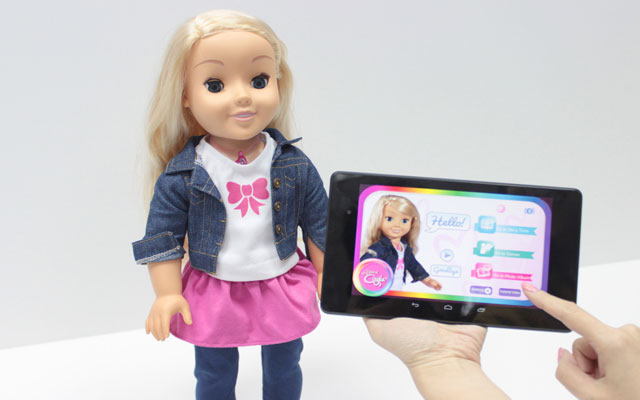
    A regular found the Cayla doll was “essentially a spying device”

    But there appears to be less care involved in buying all sorts of connected toys, some of which, if hacked, make life easy — if not as exciting as a hacked doll would make it — for a stalker.

    VTech, the company that makes the Kidzoom DX — a kind of children’s smartwatch that was popular during the last holiday season — had been hacked in 2015, providing data on hundreds of thousands of kids who had used the firm’s toy laptops.

    The opportunities for bullying, extortion, even kidnapping using the connected toys are endless. But adults’ information is also at risk from them: the toys can be conduits into home networks. A case is even known in which an Internet-connected toy robot was used to take a picture of someone’s apartment keys.

    Of course, every Internet-connected object — a thermostat, a home lighting system, a car — can be unsafe. But adults are supposed to be qualified risk-takers, and yet they expose their children at an increasing rate.

    In late 2015, Juniper Research estimated the size of the smart toy market that year at US$2,8bn and predicted it would top $11bn in 2020. Millennial parents are connected toy makers’ biggest hope: they allow their kids more screen time than previous generations of moms, and they generally trust technology, and technology companies, far more than analogue-age people ever could. According to BSM Media, a company that specializes in marketing to mothers, 38% of moms buy their kids connected toys because they “look educational”.

    Like most of the data we voluntarily donate to Internet companies, our kids’ data probably won’t be used for an evil purpose. But one breach is enough to change that, and to plunge a family into hell. If parents don’t realise that, it can only fall to regulators to make sure kids are protected.  — (c) 2017 Bloomberg LP

    Add TechCentral as a preferred source on GoogleFollow TechCentral on Google NewsGet breaking news on WhatsApp


    BSM Media CloudPets Juniper Research Leonid Bershidsky Matt Jakubowski Mattel mReady VTech
    WhatsApp YouTube
    Share. Facebook Twitter LinkedIn WhatsApp Telegram Email Copy Link
    Previous ArticleBlue Label, Cell C firm up deal
    Next Article SpaceX to fly two people around the moon

    Related Posts

    Sam Altman denies betraying Elon Musk. Shelby Tauber/Reuters

    Sam Altman unveils OpenAI’s bold plan to dominate the enterprise AI market

    7 October 2025
    Nokia phone maker launches Barbie phone

    Nokia handset maker launches Barbie phone

    28 August 2024
    Starlink expanding direct-to-phone satellite offering

    Huge surge in data roaming fraud

    29 August 2023
    Company News
    Cloud and AI won't deliver value on their own, executives warn

    Cloud and AI won’t deliver value on their own, executives warn

    1 October 2026
    Dell Technologies Forum 2026: what to expect in Johannesburg

    Dell Technologies Forum 2026: what to expect in Johannesburg

    1 October 2026
    What Smollan learnt moving 9 000 users to Google Workspace - Digicloud Africa

    What Smollan learnt moving 9 000 users to Google Workspace

    1 October 2026
    Opinion
    South Africa's next energy crisis is in the accounts department - Craig Holmes

    South Africa’s next energy crisis is in the accounts department

    29 September 2026
    The steam engine lesson AI doomsayers keep missing - Sam Clarke

    The steam engine lesson AI doomsayers keep missing

    28 September 2026
    Regulating AI: apply the laws we have first - Dirk de Vos

    Regulating AI: apply the laws we have first

    21 September 2026

    Subscribe to Updates

    Get the best South African technology news and analysis delivered to your e-mail inbox every morning.

    Latest Posts
    Home affairs pulls the plug on the green ID book - Leon Schreiber

    Home affairs pulls the plug on the green ID book

    1 October 2026
    South Africa's digital ID is here - but you can't have it yet - Leon Schreiber

    South Africa’s digital ID is here – but you can’t have it yet

    1 October 2026
    Lexi Novitske, general partner at Norrsken22, on the TechCentral Show

    TCS | Norrsken22’s Lexi Novitske on how China is winning African tech

    1 October 2026
    Eskom waives rooftop solar fees, but the registration fight isn't over

    Eskom waives rooftop solar fees, but the registration fight isn’t over

    1 October 2026
    © 2009 - 2026 NewsCentral Media
    Built and maintained by Chronon
    • Cookie policy (ZA)
    • TechCentral – privacy and Popia

    Type above and press Enter to search. Press Esc to cancel.

    Manage consent

    TechCentral uses cookies to enhance its offerings. Consenting to these technologies allows us to serve you better. Not consenting or withdrawing consent may adversely affect certain features and functions of the website.

    Functional Always active
    The technical storage or access is strictly necessary for the legitimate purpose of enabling the use of a specific service explicitly requested by the subscriber or user, or for the sole purpose of carrying out the transmission of a communication over an electronic communications network.
    Preferences
    The technical storage or access is necessary for the legitimate purpose of storing preferences that are not requested by the subscriber or user.
    Statistics
    The technical storage or access that is used exclusively for statistical purposes. The technical storage or access that is used exclusively for anonymous statistical purposes. Without a subpoena, voluntary compliance on the part of your Internet Service Provider, or additional records from a third party, information stored or retrieved for this purpose alone cannot usually be used to identify you.
    Marketing
    The technical storage or access is required to create user profiles to send advertising, or to track the user on a website or across several websites for similar marketing purposes.
    • Manage options
    • Manage services
    • Manage {vendor_count} vendors
    • Read more about these purposes
    View preferences
    • {title}
    • {title}
    • {title}
    🇿🇦 Sign up to the TechCentral newsletter