Close Menu
TechCentralTechCentral

    Subscribe to the newsletter

    Get the best South African technology news and analysis delivered to your e-mail inbox every morning.

    Facebook X (Twitter) YouTube LinkedIn
    WhatsApp Facebook X (Twitter) LinkedIn YouTube
    TechCentralTechCentral
    • News
      Vuyani Jarana: Mobile coverage masks a deeper broadband failure

      Vuyani Jarana: Mobile coverage masks a deeper broadband failure

      30 January 2026
      SABC Plus to flight Microsoft AI training videos

      SABC Plus to flight Microsoft AI training videos

      30 January 2026
      Fibre ducts

      Fibre industry consolidation in KZN

      30 January 2026
      Watts & Wheels S1E3: 'BYD's Corolla Cross challenger'

      Watts & Wheels S1E3: ‘BYD’s Corolla Cross challenger’

      30 January 2026
      What ordinary South Africans really think of AI

      What ordinary South Africans really think of AI

      30 January 2026
    • World
      Apple acquires audio AI start-up Q.ai

      Apple acquires audio AI start-up Q.ai

      30 January 2026
      SpaceX IPO may be largest in history

      SpaceX IPO may be largest in history

      28 January 2026
      Nvidia throws AI at the weather

      Nvidia throws AI at weather forecasting

      27 January 2026
      Debate erupts over value of in-flight Wi-Fi

      Debate erupts over value of in-flight Wi-Fi

      26 January 2026
      Intel takes another hit - Intel CEO Lip-Bu Tan. Laure Andrillon/Reuters

      Intel takes another hit

      23 January 2026
    • In-depth
      How liberalisation is rewiring South Africa's power sector

      How liberalisation is rewiring South Africa’s power sector

      21 January 2026
      The top-performing South African tech shares of 2025

      The top-performing South African tech shares of 2025

      12 January 2026
      Digital authoritarianism grows as African states normalise internet blackouts

      Digital authoritarianism grows as African states normalise internet blackouts

      19 December 2025
      TechCentral's South African Newsmakers of 2025

      TechCentral’s South African Newsmakers of 2025

      18 December 2025
      Black Friday goes digital in South Africa as online spending surges to record high

      Black Friday goes digital in South Africa as online spending surges to record high

      4 December 2025
    • TCS
      TCS+ | How Cloud On Demand is helping SA businesses succeed in the cloud - Xhenia Rhode, Dion Kalicharan

      TCS+ | Cloud On Demand and Consnet: inside a real-world AWS partner success story

      30 January 2026
      Watts & Wheels S1E3: 'BYD's Corolla Cross challenger'

      Watts & Wheels S1E2: ‘China attacks, BMW digs in, Toyota’s sublime supercar’

      23 January 2026

      TCS+ | Why cybersecurity is becoming a competitive advantage for SA businesses

      20 January 2026
      Watts & Wheels S1E3: 'BYD's Corolla Cross challenger'

      Watts & Wheels: S1E1 – ‘William, Prince of Wheels’

      8 January 2026
      TCS+ | Africa's digital transformation - unlocking AI through cloud and culture - Cliff de Wit Accelera Digital Group

      TCS+ | Cloud without culture won’t deliver AI: Accelera’s Cliff de Wit

      12 December 2025
    • Opinion
      South Africa's skills advantage is being overlooked at home - Richard Firth

      South Africa’s skills advantage is being overlooked at home

      29 January 2026
      Why Elon Musk's Starlink is a 'hard no' for me - Songezo Zibi

      Why Elon Musk’s Starlink is a ‘hard no’ for me

      26 January 2026
      South Africa's new fibre broadband battle - Duncan McLeod

      South Africa’s new fibre broadband battle

      20 January 2026
      AI moves from pilots to production in South African companies - Nazia Pillay SAP

      AI moves from pilots to production in South African companies

      20 January 2026
      South Africa's new fibre broadband battle - Duncan McLeod

      ANC’s attack on Solly Malatsi shows how BEE dogma trumps economic reality

      14 December 2025
    • Company Hubs
      • Africa Data Centres
      • AfriGIS
      • Altron Digital Business
      • Altron Document Solutions
      • Altron Group
      • Arctic Wolf
      • AvertITD
      • Braintree
      • CallMiner
      • CambriLearn
      • CYBER1 Solutions
      • Digicloud Africa
      • Digimune
      • Domains.co.za
      • ESET
      • Euphoria Telecom
      • Incredible Business
      • iONLINE
      • IQbusiness
      • Iris Network Systems
      • LSD Open
      • NEC XON
      • Netstar
      • Network Platforms
      • Next DLP
      • Ovations
      • Paracon
      • Paratus
      • Q-KON
      • SevenC
      • SkyWire
      • Solid8 Technologies
      • Telit Cinterion
      • Tenable
      • Vertiv
      • Videri Digital
      • Vodacom Business
      • Wipro
      • Workday
      • XLink
    • Sections
      • AI and machine learning
      • Banking
      • Broadcasting and Media
      • Cloud services
      • Contact centres and CX
      • Cryptocurrencies
      • Education and skills
      • Electronics and hardware
      • Energy and sustainability
      • Enterprise software
      • Financial services
      • Information security
      • Internet and connectivity
      • Internet of Things
      • Investment
      • IT services
      • Lifestyle
      • Motoring
      • Public sector
      • Retail and e-commerce
      • Satellite communications
      • Science
      • SMEs and start-ups
      • Social media
      • Talent and leadership
      • Telecoms
    • Events
    • Advertise
    TechCentralTechCentral
    Home » Sections » Energy and sustainability » Load shedding: How did it suddenly get to this?

    Load shedding: How did it suddenly get to this?

    By Hilton Tarrant18 October 2019
    Twitter LinkedIn Facebook WhatsApp Email Telegram Copy Link
    News Alerts
    WhatsApp

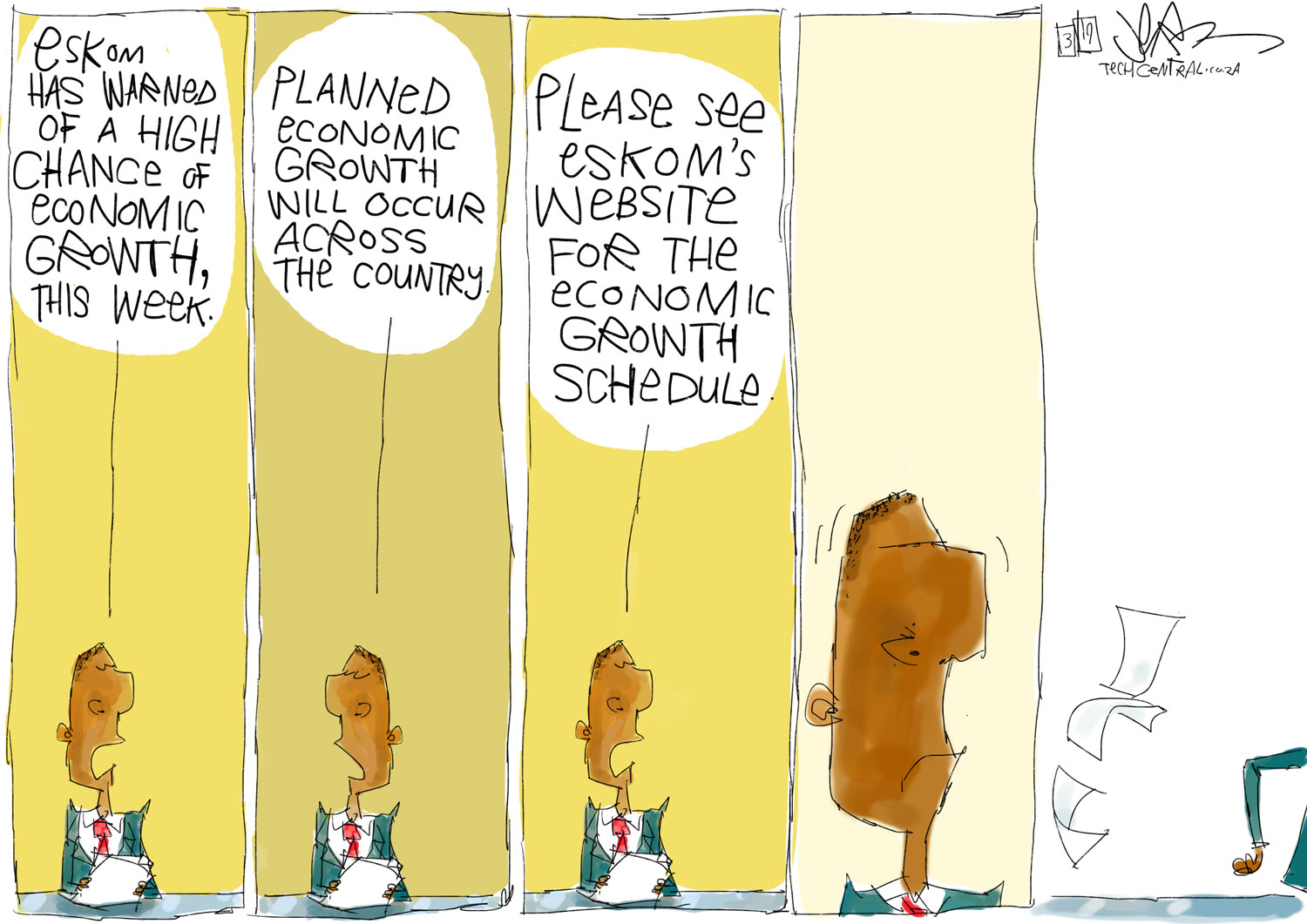
    While the immediate causes of the generation crisis at Eskom are well known, the emergency it found itself in this week has been some time coming. The utility and others have confirmed a number of outages, both planned and unplanned.

    These include one unit offline at the Koeberg nuclear power station for refuelling (planned), “five generating units that are unavailable due to boiler tube leaks” and the failure of the coal conveyor at Medupi power station on Saturday, “thus limiting the generating capability to approximately half the station output” (some have suggested the real figure is lower than half).

    The decision to implement stage-2 load shedding with very little warning on Wednesday is shocking, given that Eskom admits it has been using “pumped storage and OCGT (open-cycle gas turbine_ generators … extensively” since Saturday. Eventually, diesel and water levels got to the point where these were no longer available options.

    The issues predate Saturday, however.

    From a peak in April of 72.99%, the utility’s energy availability factor (EAF) has — barring one or two exceptions — steadily deteriorated over the past six months. For the year-to-date, EAF is averaging 67.75%, much lower than the 71.84% achieved last year. This only tells half the story, however, as Eskom always ramps up planned maintenance from spring. In theory, this was to have roughly doubled from the 3/3.5GW level to 6GW from late August. This will, understandably, impact EAF as this plant is not available.

    Source: Eskom weekly supply status bulletins

    The critical and flawed assumption (base case) in Eskom’s system outlook, which informs the three-month outlook updated weekly, is that unplanned breakdowns will total 8.5GW. This is a not insignificant amount of generation, representing around 16% of its total dispatchable capacity.

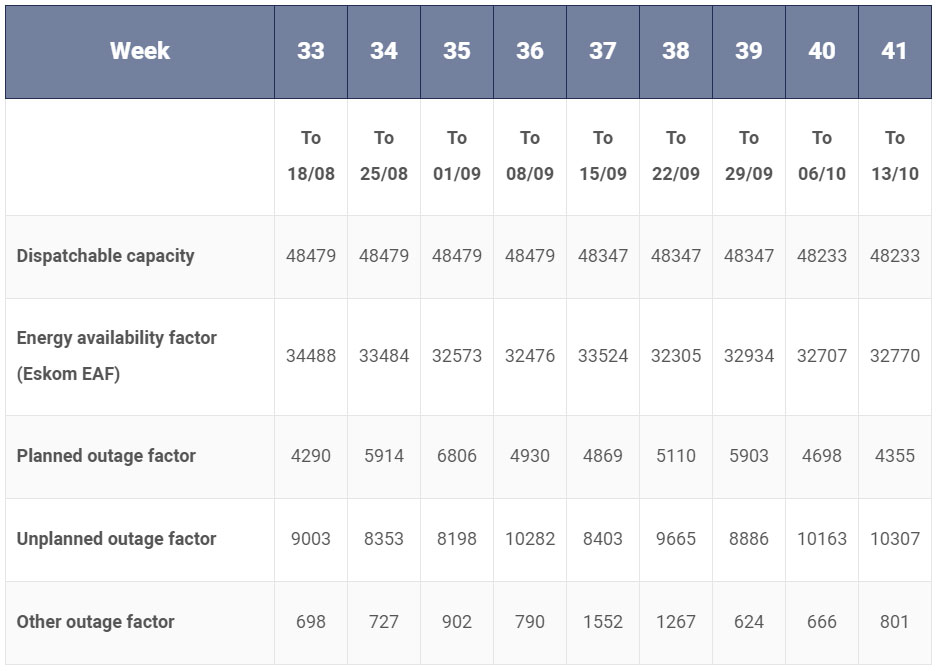
    Since early April when detailed statistics became available from Eskom, it has managed to keep unplanned outages at below this level for only nine of the 26 weeks (a third of the time). After winter, when planned maintenance was ramped up, unplanned outages were below the 8.5GW level for only three of the nine weeks to last Sunday (13 October).
    * Estimates – based on factors divided by capacity, as disclosed (separately) by Eskom

    Complicating matters further is a new metric disclosed by Eskom — the “other outage factor”. Over the 26-week period, this has equated to anything from 535MW (1.12%) to 1 552MW (3.21%).

    For the year to date, unplanned outages have averaged 20.83% (versus 15.87% in 2018), while the other outage factor has averaged 1.52% (versus 1.89% in 2018).

    Its winter plan, as detailed in the joint briefing by minister of public enterprises Pravin Gordhan and Eskom chair Jabu Mabuza (and Eskom executives) in April, required unplanned maintenance to be under the 9.5GW level. But unplanned outages peaked at 10.9GW in early August and were above 9.5GW for 13 of the 17 weeks since early June!

    Even at significantly above the 8.5GW level, however, Eskom has managed to keep the lights on through a combination of:

    • Reducing planned maintenance to below originally forecast levels;
    • Non-commercial sources (Kusile and Medupi units not yet having achieved commercial operation);
    • Renewable supply (excluded from dispatchable generation figures above); and
    • Emergency peaking resources (pumped storage and OCGT turbines).

    The base case of 8.5GW is therefore wholly unrealistic, especially at this stage.

    As this author wrote in April: “The fundamental problem with this plan is that it constructs a reality where Eskom is seemingly able to choose or plan which stage of load shedding to implement. Load shedding is a function of available generation capacity. On any given day, that may change due to hundreds of variables. And sometimes, as happened in mid-March, bad luck arrives all at once.”

    This weekend, bad luck again arrived all at once. That it happened during a period when Koeberg is being refuelled (with 930MW offline) is far less than ideal.

    Source: Eskom weekly supply status bulletins

    In its summer plan, presented on 4 September, Eskom said it needed to execute an average of 5.5GW of planned maintenance. It is simply not managing to do so.

    In April, I held that the “next nine months are going to require an almighty effort, day by day, to ensure that plant is not run unnecessarily hard and that the required maintenance gets done in order to keep load shedding from spiralling to stage 4 again. The risks are real.”

    Over the next few days, Eskom has to avoid losing control of this situation, failing which we will be right back in the chaos of mid-March, which took three weeks to get out of.

    The prognosis for 2020 — especially winter — is going to depend a lot on how much maintenance it is able to conclude over the next five-and-a-half months.

    Quick fixes like adding 220MW to its Ingula Pumped Storage Scheme (which it has done) and running a unit from each of Kusile and Medupi hard despite these not yet having achieved commercial operation (which it continues to do) do not solve the underlying problem.

    Oh, and a group chief executive might help.

    • This article was originally published on Moneyweb and is used here with permission

    Eskom Jabu Mabuza Pravin Gordhan top
    WhatsApp YouTube Follow on Google News Add as preferred source on Google
    Share. Facebook Twitter LinkedIn WhatsApp Telegram Email Copy Link
    Previous ArticleSolar, wind find favour in South Africa’s new energy blueprint
    Next Article Vast Networks to close its doors

    Related Posts

    Outa warns homeowners against rushing to register rooftop solar

    Outa warns homeowners against rushing to register rooftop solar

    27 January 2026
    How liberalisation is rewiring South Africa's power sector

    How liberalisation is rewiring South Africa’s power sector

    21 January 2026
    No risk of load shedding after Koeberg output scaled back

    No risk of load shedding after Koeberg output scaled back

    21 January 2026
    Company News
    Huawei turns 25 in South Africa, celebrates with major device discounts

    Huawei turns 25 in South Africa, celebrates with major device discounts

    30 January 2026
    Phishing has not disappeared, but it has grown up - KnowBe4

    Phishing has not disappeared, but it has grown up

    30 January 2026
    Smartphone affordability: South Africa's new economic divide - PayJoy

    Smartphone affordability: South Africa’s new economic divide

    29 January 2026
    Opinion
    South Africa's skills advantage is being overlooked at home - Richard Firth

    South Africa’s skills advantage is being overlooked at home

    29 January 2026
    Why Elon Musk's Starlink is a 'hard no' for me - Songezo Zibi

    Why Elon Musk’s Starlink is a ‘hard no’ for me

    26 January 2026
    South Africa's new fibre broadband battle - Duncan McLeod

    South Africa’s new fibre broadband battle

    20 January 2026

    Subscribe to Updates

    Get the best South African technology news and analysis delivered to your e-mail inbox every morning.

    Latest Posts
    Vuyani Jarana: Mobile coverage masks a deeper broadband failure

    Vuyani Jarana: Mobile coverage masks a deeper broadband failure

    30 January 2026
    TCS+ | How Cloud On Demand is helping SA businesses succeed in the cloud - Xhenia Rhode, Dion Kalicharan

    TCS+ | Cloud On Demand and Consnet: inside a real-world AWS partner success story

    30 January 2026
    Huawei turns 25 in South Africa, celebrates with major device discounts

    Huawei turns 25 in South Africa, celebrates with major device discounts

    30 January 2026
    SABC Plus to flight Microsoft AI training videos

    SABC Plus to flight Microsoft AI training videos

    30 January 2026
    © 2009 - 2026 NewsCentral Media
    • Cookie policy (ZA)
    • TechCentral – privacy and Popia

    Type above and press Enter to search. Press Esc to cancel.

    Manage consent

    TechCentral uses cookies to enhance its offerings. Consenting to these technologies allows us to serve you better. Not consenting or withdrawing consent may adversely affect certain features and functions of the website.

    Functional Always active
    The technical storage or access is strictly necessary for the legitimate purpose of enabling the use of a specific service explicitly requested by the subscriber or user, or for the sole purpose of carrying out the transmission of a communication over an electronic communications network.
    Preferences
    The technical storage or access is necessary for the legitimate purpose of storing preferences that are not requested by the subscriber or user.
    Statistics
    The technical storage or access that is used exclusively for statistical purposes. The technical storage or access that is used exclusively for anonymous statistical purposes. Without a subpoena, voluntary compliance on the part of your Internet Service Provider, or additional records from a third party, information stored or retrieved for this purpose alone cannot usually be used to identify you.
    Marketing
    The technical storage or access is required to create user profiles to send advertising, or to track the user on a website or across several websites for similar marketing purposes.
    • Manage options
    • Manage services
    • Manage {vendor_count} vendors
    • Read more about these purposes
    View preferences
    • {title}
    • {title}
    • {title}