Close Menu
TechCentralTechCentral

    Subscribe to the newsletter

    Get the best South African technology news and analysis delivered to your e-mail inbox every morning.

    Facebook X (Twitter) YouTube LinkedIn
    WhatsApp Facebook X (Twitter) LinkedIn YouTube
    TechCentralTechCentral
    • News
      Cell C launches 5G

      Cell C launches 5G

      21 August 2026
      MVNOs are doing the heavy lifting at Cell C - Jorges Mendes

      MVNOs are doing the heavy lifting at Cell C

      21 August 2026
      Hot rand is cold comfort for tech buyers

      Hot rand is cold comfort for tech buyers

      21 August 2026
      Joburg says it has bought its way out of an Eskom blackout

      Joburg says it has bought its way out of an Eskom blackout

      21 August 2026
      Management consulting as we know it is over

      Management consulting as we know it is over

      21 August 2026
    • World
      Russia building its own Starlink - and faster than expected - Vadym Skibitskyi

      Russia building its own Starlink – and faster than expected

      11 August 2026
      Meta AI will now tell parents if their teen is in crisis

      Meta AI will now tell parents if their teen is in crisis

      17 July 2026
      IBM shares crash 25% as AI upends software spending - Arvind Krishna

      IBM shares crash 25% as AI upends software spending

      15 July 2026
      Jony Ive's first OpenAI device: an AI smart speaker - Jony Ive and Sam Altman

      Jony Ive’s first OpenAI device: an AI smart speaker

      15 July 2026
      Stripe, Advent in talks to buy PayPal for $53-billion

      Stripe, Advent in talks to buy PayPal for $53-billion

      15 July 2026
    • In-depth
      Google DeepMind CEO Demis Hassabis. Image: John Sears

      The plan to stop AI from breaking the world

      16 July 2026
      The internet has a Strait of Hormuz problem

      The internet has a Strait of Hormuz problem

      15 July 2026
      AI boom sparks rally, frenzy and fear

      AI boom sparks rally, frenzy and fear

      11 June 2026
      Every plug-in hybrid on sale in South Africa, ranked by price - Lamborghini Temerario

      Every plug-in hybrid on sale in South Africa, ranked by price

      7 June 2026
      What Wi-Fi 8 will mean for wireless networks

      What Wi-Fi 8 will mean for wireless networks

      1 June 2026
    • TCS
      Meet the CIO | Discovery's Derek Wilcocks on AI, guardrails and growth

      Meet the CIO | Derek Wilcocks on how AI personalised Vitality

      13 August 2026
      TCS | Money just became native to the internet - Steven Boykey Sidley

      TCS | Money just became native to the internet – Steven Boykey Sidley

      12 August 2026
      TCS+ | Specops' Darren James on continuous trust in an AI world

      TCS+ | Specops’ Darren James on continuous trust in an AI world

      7 August 2026
      TCS+ | How AI is turning hardware into a subscription service - Shane van der Merwe Merchant West

      TCS+ | How AI is turning hardware into a subscription service

      6 August 2026
      TCS+ | Why South African workers must become supervisors of digital labour - Accelera Digital Group Cliff de Wit

      TCS+ | Why South African workers must become supervisors of digital labour

      31 July 2026
    • Opinion
      The author, Jannie van Zyl

      Selling vapour is corporate suicide in slow motion

      16 July 2026
      Brazil's online gambling crackdown is a lesson for South Africa

      How Amazon outmanoeuvred Starlink in South Africa

      15 July 2026
      The Popia problem with agentic AI - Herman Haasbroek

      The Popia problem with agentic AI

      14 July 2026
      The author, Fanie van Rooyen

      South Africa can still catch the AI wave – here’s how

      7 July 2026
      The author, Fanie van Rooyen

      The AI utopia South Africa can’t afford

      1 July 2026
    • Company Hubs
      • 1Stream
      • Africa Data Centres
      • AfriGIS
      • Altron Digital Business
      • Altron Document Solutions
      • Altron Group
      • Arctic Wolf
      • Ascent Technology
      • AvertITD
      • BBD
      • Braintree
      • CallMiner
      • CambriLearn
      • CM Telecom
      • Contactable
      • CYBER1 Solutions
      • Digicloud Africa
      • Digimune
      • Domains.co.za
      • ESET
      • Euphoria Telecom
      • HOSTAFRICA
      • Incredible Business
      • iONLINE
      • IQbusiness
      • Iris Network Systems
      • Kaspersky
      • LSD Open
      • Mitel
      • NEC XON
      • Netstar
      • Network Platforms
      • Next DLP
      • Ovations
      • Paracon
      • Paratus
      • Q-KON
      • SevenC
      • SkyWire
      • Solid8 Technologies
      • Telit Cinterion
      • Telviva
      • Tenable
      • Vertiv
      • Videri Digital
      • Vodacom Business
      • Vox
      • Wipro
      • Workday
      • XLink
    • Sections
      • AI and machine learning
      • Banking
      • Broadcasting and Media
      • Cloud services
      • Contact centres and CX
      • Cryptocurrencies
      • Education and skills
      • Electronics and hardware
      • Energy and sustainability
      • Enterprise software
      • Financial services
      • HealthTech
      • Information security
      • Internet and connectivity
      • Internet of Things
      • Investment
      • IT services
      • Lifestyle
      • Policy and regulation
      • Public sector
      • Retail and e-commerce
      • Satellite communications
      • Science
      • SMEs and start-ups
      • Social media
      • Talent and leadership
      • Telecoms
      • Watts & Wheels
    • Events
    • Advertise
    TechCentralTechCentral
    Home » Sections » Science » MeerKAT helps solve the mystery of the ORCs

    MeerKAT helps solve the mystery of the ORCs

    By The Conversation22 March 2022
    Twitter LinkedIn Facebook WhatsApp Email Telegram Copy Link
    News Alerts
    WhatsApp
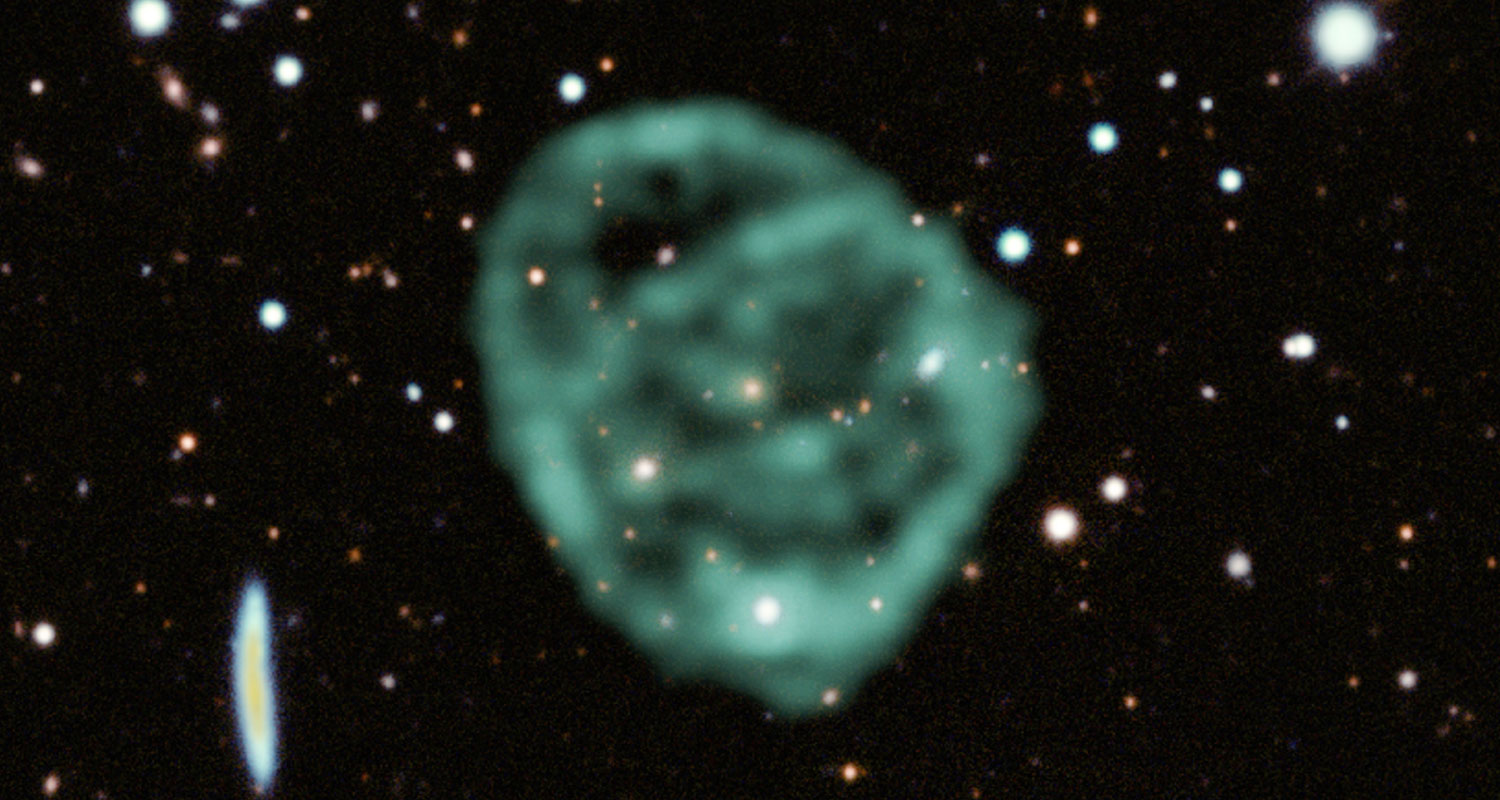
    The MeerKAT (green/grey) image of the odd radio circle ORC1 superimposed on an optical image from the Dark Energy Survey. Created by Jayanne English using data from MeerKAT and the Dark Energy Survey

    In 2019, my colleagues and I discovered spooky glowing rings in the sky using CSIRO’s Askap radio telescope in Western Australia. The rings were unlike anything seen before, and we had no idea what they were.

    We dubbed them odd radio circles, or ORCs. They continue to puzzle us, but new data from South Africa’s MeerKAT telescope is helping to solve the mystery.

    We can now see each ORC is centred on a galaxy too faint to be detected earlier. The circles are most likely enormous explosions of hot gas, about a million light years across, emanating from the central galaxy.

    Our paper showing these results has been peer-reviewed and accepted for publication by Monthly Notices of the Royal Astronomical Society.

    We now have beautiful images of one of these rings taken with South Africa’s MeerKAT radio telescope, which shows the ORC in stunning detail.

    For example, MeerKAT sees a small blob of radio emission in the centre of the ring, which is coincident with a distant galaxy. We are now fairly certain this galaxy generated the ORC.

    We see these central galaxies in other ORC too, all at vast distances from Earth. We now think that these rings surround distant galaxies about a billion light years away, which means the rings are enormous – around a million light years across.

    From modelling the faint cloudy radio emission that MeerKAT detects within the rings, it seems the rings are the edges of a spherical shell surrounding the galaxy, like a blast wave from a giant explosion in the galaxy. They look like rings instead of orbs only because the sphere appears brighter at the edges where there is more material along the line of sight, much like a soap bubble.

    MeerKAT has also mapped the polarisation of the radio waves, which tells us about the magnetic field in the ring. Our polarisation image shows a magnetic field running along the edge of the sphere.

    This suggests that an explosion in the central galaxy caused a hot blast to collide with the tenuous gas outside the galaxy. The resulting shockwave then energised electrons in the gas, making them spiral around the magnetic field, generating radio waves.

    One big surprise from the MeerKAT result is that within the ring we see several curved filaments of radio emission. We still don’t know what these are.
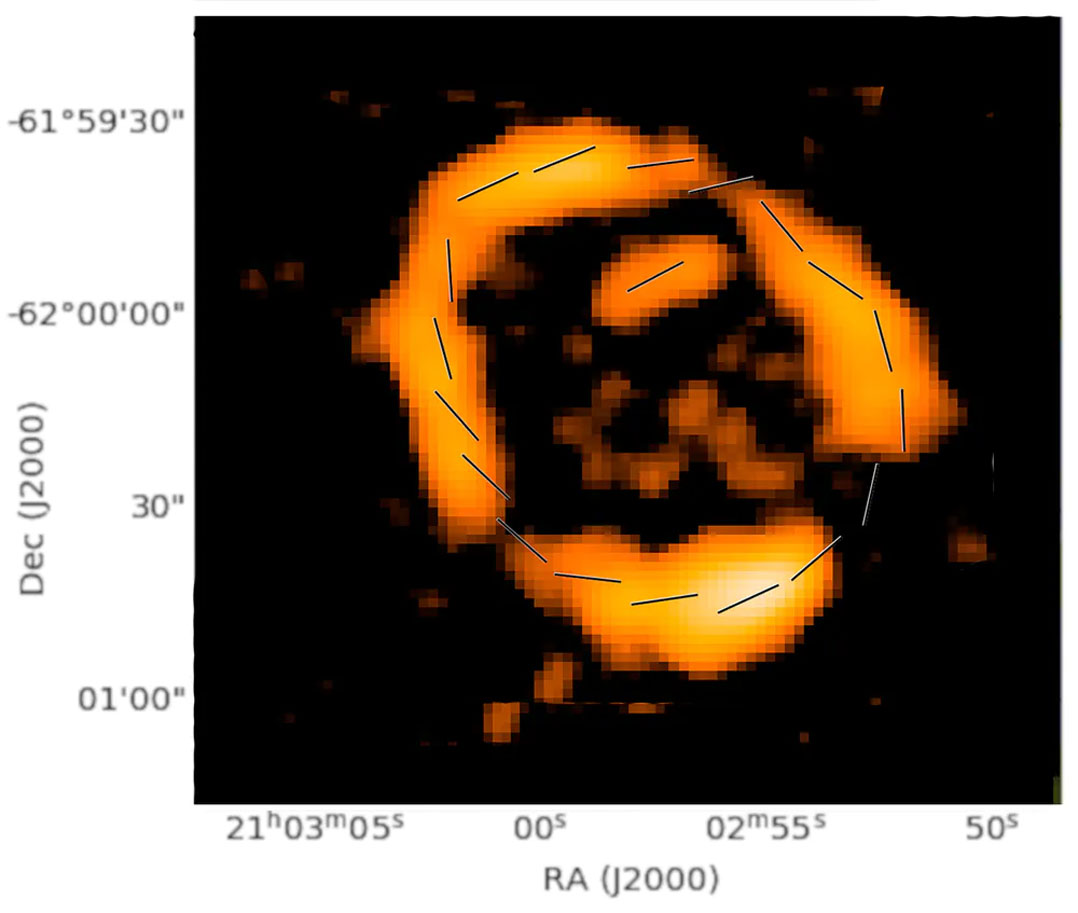
    Lines around the edge of the ORC show the direction of the magnetic field. A circular magnetic field like this indicates it has been compressed by a shock wave from the central galaxy. Created by Larry Rudnick from MeerKAT data

    But we do know that the sphere is so huge that it has swallowed up other galaxies as it blasted out from the central galaxy. Perhaps the filaments are trails of gas ripped off the galaxies by the passing shockwave?

    The big question, of course, is what caused the explosion. We are exploring two possibilities.

    One is that they were caused by the merging of two supermassive black holes. Such a “merger event” releases an enormous amount of energy, enough to generate the ORC.

    Another possibility is that the central galaxy went through a “starburst” event, in which millions of stars were suddenly born from the gas in the galaxy. Such a starburst causes hot gas to blast out from the galaxy, causing a spherical shockwave.

    Both black hole mergers and starburst events are rare, which accounts for why ORCs are so rare (only five have so far been reported).

    The puzzle of ORCs is not solved yet, and we still have much to learn about these mysterious rings in the sky. So far, we have only detected them with radio telescopes – we see nothing from the rings at optical, infrared or X-ray wavelengths.

    To find out more, we need a tool even more sensitive than MeerKAT and Askap: the Square Kilometre Array

    To find out more, we need a tool even more sensitive than MeerKAT and Askap. Fortunately, the global astronomical community is building just such an observatory – the Square Kilometre Array (SKA), an international effort with telescopes in South Africa and Australia.

    Askap and MeerKAT were built to test the sites and technology for the SKA. Quite apart from their role as precursors for the SKA, both telescopes have been hugely successful in their own right, making major discoveries in their first years of operation.

    Their success in discovering and studying ORCs therefore bodes well for the SKA.

    The two telescopes are also beautifully complementary – Askap is superb at surveying large areas of sky and finding new objects, while MeerKAT is unrivalled for zooming in on those objects and studying them with higher sensitivity and resolution.

    The SKA promises to surpass both. No doubt the SKA will find many more ORCs, and will also be able to probe them to find out what they are telling us about the lifecycle of galaxies.The Conversation

    • Ray Norris is professor, school of science, Western Sydney University
    • This article is republished from The Conversation under a Creative Commons licence

    Follow TechCentral on Google News Add TechCentral as your preferred source on Google


    ASKAP MeerKAT SKA Square Kilometre Array
    WhatsApp YouTube
    Share. Facebook Twitter LinkedIn WhatsApp Telegram Email Copy Link
    Previous ArticleCourt hearing will decide security of electricity supply in SA
    Next Article Eskom mulls taking on Cop26 funds as equity injection

    Related Posts

    Africa's moon telescope project will listen for alien technology

    Africa’s moon telescope project will listen for alien technology

    17 August 2026
    universe

    UCT astronomers uncover vast hidden supercluster behind the Milky Way

    12 March 2026
    A MeerKAT antenna

    MeerKAT detects most powerful natural radio laser ever observed

    19 February 2026
    Company News
    Paratus Uganda first to market with Starlink service

    Paratus Uganda first to market with Starlink service

    21 August 2026
    Smarter operations take centre stage at Electra Mining Africa 2026

    Smarter operations take centre stage at Electra Mining Africa 2026

    20 August 2026
    Fidelity turns to Sigfox to spot fires before they start

    Fidelity turns to Sigfox to spot fires before they start

    19 August 2026
    Opinion
    The author, Jannie van Zyl

    Selling vapour is corporate suicide in slow motion

    16 July 2026
    Brazil's online gambling crackdown is a lesson for South Africa

    How Amazon outmanoeuvred Starlink in South Africa

    15 July 2026
    The Popia problem with agentic AI - Herman Haasbroek

    The Popia problem with agentic AI

    14 July 2026

    Subscribe to Updates

    Get the best South African technology news and analysis delivered to your e-mail inbox every morning.

    Latest Posts
    Cell C launches 5G

    Cell C launches 5G

    21 August 2026
    MVNOs are doing the heavy lifting at Cell C - Jorges Mendes

    MVNOs are doing the heavy lifting at Cell C

    21 August 2026
    Hot rand is cold comfort for tech buyers

    Hot rand is cold comfort for tech buyers

    21 August 2026
    Joburg says it has bought its way out of an Eskom blackout

    Joburg says it has bought its way out of an Eskom blackout

    21 August 2026
    © 2009 - 2026 NewsCentral Media
    Built and maintained by Chronon
    • Cookie policy (ZA)
    • TechCentral – privacy and Popia

    Type above and press Enter to search. Press Esc to cancel.

    Manage consent

    TechCentral uses cookies to enhance its offerings. Consenting to these technologies allows us to serve you better. Not consenting or withdrawing consent may adversely affect certain features and functions of the website.

    Functional Always active
    The technical storage or access is strictly necessary for the legitimate purpose of enabling the use of a specific service explicitly requested by the subscriber or user, or for the sole purpose of carrying out the transmission of a communication over an electronic communications network.
    Preferences
    The technical storage or access is necessary for the legitimate purpose of storing preferences that are not requested by the subscriber or user.
    Statistics
    The technical storage or access that is used exclusively for statistical purposes. The technical storage or access that is used exclusively for anonymous statistical purposes. Without a subpoena, voluntary compliance on the part of your Internet Service Provider, or additional records from a third party, information stored or retrieved for this purpose alone cannot usually be used to identify you.
    Marketing
    The technical storage or access is required to create user profiles to send advertising, or to track the user on a website or across several websites for similar marketing purposes.
    • Manage options
    • Manage services
    • Manage {vendor_count} vendors
    • Read more about these purposes
    View preferences
    • {title}
    • {title}
    • {title}