Close Menu
TechCentralTechCentral

    Subscribe to the newsletter

    Get the best South African technology news and analysis delivered to your e-mail inbox every morning.

    Facebook X (Twitter) YouTube LinkedIn
    WhatsApp Facebook X (Twitter) LinkedIn YouTube
    TechCentralTechCentral
    • News
      Home affairs opens visa fast lane - with tech talent a top priority

      Home affairs opens visa fast lane – with tech talent a top priority

      21 July 2026
      Mastercard bets billions on the tech that could eat its lunch - Prakriti Singh

      Mastercard bets billions on the tech that could eat its lunch

      21 July 2026
      From care homes to production lines, the robots are coming

      From care homes to production lines, the robots are coming

      21 July 2026
      Remote work in South Africa hits record high

      Remote work in South Africa hits record high

      21 July 2026
      China weighs blocking the West from its best AI

      China weighs blocking the West from its best AI

      21 July 2026
    • World
      Meta AI will now tell parents if their teen is in crisis

      Meta AI will now tell parents if their teen is in crisis

      17 July 2026
      IBM shares crash 25% as AI upends software spending - Arvind Krishna

      IBM shares crash 25% as AI upends software spending

      15 July 2026
      Jony Ive's first OpenAI device: an AI smart speaker - Jony Ive and Sam Altman

      Jony Ive’s first OpenAI device: an AI smart speaker

      15 July 2026
      Stripe, Advent in talks to buy PayPal for $53-billion

      Stripe, Advent in talks to buy PayPal for $53-billion

      15 July 2026
      Memory crisis sends smartphone market into steep decline

      Memory crisis sends smartphone market into steep decline

      13 July 2026
    • In-depth
      The plan to stop AI from breaking the world - Google DeepMind CEO Demis Hassabis. Image: John Sears

      The plan to stop AI from breaking the world

      16 July 2026
      The internet has a Strait of Hormuz problem

      The internet has a Strait of Hormuz problem

      15 July 2026
      AI boom sparks rally, frenzy and fear

      AI boom sparks rally, frenzy and fear

      11 June 2026
      Every plug-in hybrid on sale in South Africa, ranked by price - Lamborghini Temerario

      Every plug-in hybrid on sale in South Africa, ranked by price

      7 June 2026
      What Wi-Fi 8 will mean for wireless networks

      What Wi-Fi 8 will mean for wireless networks

      1 June 2026
    • TCS
      Watts & Wheels S1E7: 'Ferrari's EV breaks the internet'

      Watts & Wheels S1E7: ‘Ferrari’s EV breaks the internet’

      8 July 2026
      TCS+ | How Tracker is turning vehicle data into business strategy - Silvia Schollenberger

      TCS+ | How Tracker is turning vehicle data into business strategy

      1 July 2026
      TCS+ | IBM Bob: an AI-powered 'development partner' for the enterprise - David Spurway

      TCS+ | IBM Bob: an AI-powered development partner for the enterprise

      30 June 2026
      Watts & Wheels S1E6: 'A flawless Alfa and a bakkie that divides'

      Watts & Wheels S1E6: ‘A flawless Alfa and a bakkie that divides’

      17 June 2026
      Watts & Wheels S1E6: 'A flawless Alfa and a bakkie that divides'

      Watts & Wheels S1E5: ‘A Bentley of the bush and a car that swims’

      8 June 2026
    • Opinion
      Selling vapour is corporate suicide in slow motion - Jannie van Zyl

      Selling vapour is corporate suicide in slow motion

      16 July 2026
      Brazil's online gambling crackdown is a lesson for South Africa

      How Amazon outmanoeuvred Starlink in South Africa

      15 July 2026
      The Popia problem with agentic AI - Herman Haasbroek

      The Popia problem with agentic AI

      14 July 2026
      The author, Fanie van Rooyen

      South Africa can still catch the AI wave – here’s how

      7 July 2026
      The author, Fanie van Rooyen

      The AI utopia South Africa can’t afford

      1 July 2026
    • Company Hubs
      • 1Stream
      • Africa Data Centres
      • AfriGIS
      • Altron Digital Business
      • Altron Document Solutions
      • Altron Group
      • Arctic Wolf
      • Ascent Technology
      • AvertITD
      • BBD
      • Braintree
      • CallMiner
      • CambriLearn
      • CM Telecom
      • Contactable
      • CYBER1 Solutions
      • Digicloud Africa
      • Digimune
      • Domains.co.za
      • ESET
      • Euphoria Telecom
      • HOSTAFRICA
      • Incredible Business
      • iONLINE
      • IQbusiness
      • Iris Network Systems
      • Kaspersky
      • LSD Open
      • Mitel
      • NEC XON
      • Netstar
      • Network Platforms
      • Next DLP
      • Ovations
      • Paracon
      • Paratus
      • Q-KON
      • SevenC
      • SkyWire
      • Solid8 Technologies
      • Telit Cinterion
      • Telviva
      • Tenable
      • Vertiv
      • Videri Digital
      • Vodacom Business
      • Wipro
      • Workday
      • XLink
    • Sections
      • AI and machine learning
      • Banking
      • Broadcasting and Media
      • Cloud services
      • Contact centres and CX
      • Cryptocurrencies
      • Education and skills
      • Electronics and hardware
      • Energy and sustainability
      • Enterprise software
      • Financial services
      • HealthTech
      • Information security
      • Internet and connectivity
      • Internet of Things
      • Investment
      • IT services
      • Lifestyle
      • Policy and regulation
      • Public sector
      • Retail and e-commerce
      • Satellite communications
      • Science
      • SMEs and start-ups
      • Social media
      • Talent and leadership
      • Telecoms
      • Watts & Wheels
    • Events
    • Advertise
    TechCentralTechCentral
    Home » News » Microsoft steps up push to bring VR and AR to the masses

    Microsoft steps up push to bring VR and AR to the masses

    By Dina Bass2 March 2021
    Twitter LinkedIn Facebook WhatsApp Email Telegram Copy Link
    News Alerts
    WhatsApp
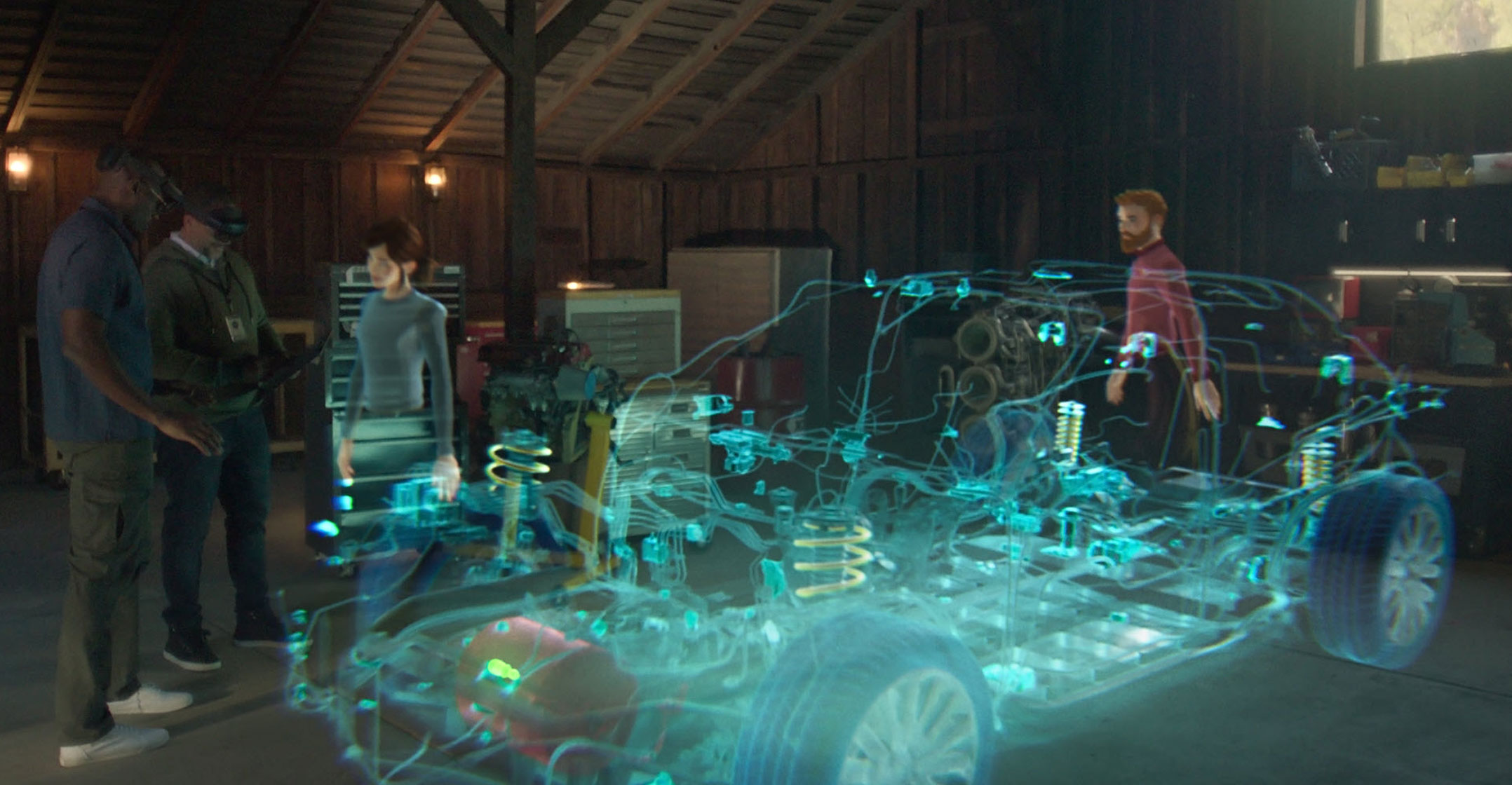
    Microsoft Mesh, a new mixed reality platform, will allow geographically distributed teams to meet and collaborate in shared mixed reality sessions where participants appear as digital representations of themselves. Image: Microsoft

    Microsoft has unveiled software tools designed to make it easier and less expensive for people to access virtual reality and augmented reality content, and for more creators to build these digital and holographic worlds.

    The company’s Mesh software will enable users to work and play together virtually by interacting with the same set of holograms on devices at various price points and from different manufacturers, ranging from Microsoft’s US$3 500 HoloLens augmented reality goggles and Facebook’s Oculus and other specialised VR headsets to cellphones and computers where users can get a 2D view. Mesh also lets multiple people see the same holograms from different locations, allowing for events such as concerts or company meetings where one user attends in person and the other “holoports in” from home.

    “You can be anywhere as a hologram or an avatar, and it’s not just you,” Microsoft CEO Satya Nadella said in an interview. “You now have not just yourself but all of your co-workers or your friends with you and you can do things together, not just with real objects, but with holograms.”

    Though companies have been touting AR and VR as breakthrough technologies for years, they have yet to gain traction with a wide audience

    In a demonstration, Microsoft technical fellow Alex Kipman described the product and answered questions through his holographic avatar — a torso, bearded head and pair of disembodied hands — using both a HoloLens and an HP Reverb headset in turn. A school of jellyfish, a shark and two planets floated around the space, all holograms that could be passed back and forth, resized and examined.

    The software giant first announced a product in this space in 2015 with HoloLens, a pricey product that has largely focused on corporate uses, like medical imaging and complex equipment repair. Though companies have been touting AR and VR as breakthrough technologies for years, they have yet to gain traction with a wide audience. Facebook, HP and Snap have released various forms of goggles and glasses that use the technology, but augmented and virtual reality still haven’t reached mass appeal save for some lower-end mobile applications, like Niantic’s Pokemon Go AR game. Microsoft is betting that a set of cloud-based tools to make it easier to develop compelling AR and VR applications for almost any type of device will have broader appeal. Nadella said the key is bringing these technologies to the gadgets and platforms that engineers design for and consumers use most, rather than requiring them to jump through additional hoops to access them.

    A way in

    “There’s always the cost, but there’s also — what’s that ubiquitous device that I have with me always that I can use to interact? It’s not like I have a HoloLens on me — it’s not like I am wearing it right now,” Nadella said. “Whereas, I have a computer right now or I’m using my phone. That’s why Mesh is not just about HoloLens.” Seeing 3D holograms will still require some sort of headgear, Nadella said, but as more AR and VR experiences become available for larger groups, phones and PCs allow a way in without expensive devices.

    Based on Microsoft’s Azure cloud, data and artificial intelligence tools, Mesh is available now in preview. Customers can also request access to a Mesh-enabled version of the AltspaceVR meeting app to let companies hold corporate meetings with secure sign-ins and privacy features. Microsoft will roll out additional features in the coming year and is planning to add them to its Teams teleconferencing app.

    The Redmond, Washington-based software maker will demonstrate prototypes of how the technology can be used on Tuesday at the company’s Ignite conference in a keynote speech, which Microsoft is also streaming in virtual reality using Mesh.

    In one demonstration, Niantic CEO John Hanke will don a HoloLens and hunt for Pokemon near California’s Lake Merritt, joined initially by Kipman’s avatar and later another friend also clad in a HoloLens. Around them, Pokemon frolic in groups, reacting to each other. While the features demonstrated are not yet part of a finished product, Niantic is working on games and services that make use of similar concepts and hopes to use Mesh for things like programming the presence of two or more holograms.

    “The thing that’s exciting to me is this notion of mixing the real and the virtual in terms of social interaction,” Hanke said. “In the future you could join from Texas and play with your mom and dad and the kids, or you could join your college roommate in New York City and walk around Central Park playing together virtually, comingled with people in the physical world.”

    To Microsoft, the idea of Mesh is similar to that of Xbox Live, the online gaming service the company introduced in 2002 that provided the networking infrastructure so game developers could create online multiplayer games between friends and strangers without having to build that technology themselves, Kipman said.

    The thing that’s exciting to me is this notion of mixing the real and the virtual in terms of social interaction

    “Apply that same analogy here with Microsoft Mesh,” he said. “It’s possible today to create experiences with multiple people sharing the same holographic landscape in the room, but it’s significantly hard, and you don’t see a lot of that, because most developers don’t have the time or know-how to be able to do it appropriately.”

    Mesh also uses spatial sound to change the audio based on where holograms and people participating are located, giving the user a sense of space in the virtual world. A friend sitting beside another friend’s hologram in a work meeting or at a concert can whisper to their neighbour, for example.

    Entertainment events

    Hānai World, a new company from Cirque du Soleil co-founder Guy Laliberté, plans to use Mesh to create entertainment events that mix live and virtual aspects. The events will take place in physical venues and through mixed reality headsets, with previews starting at the end of the year. Ray Dalio’s marine science nonprofit OceanX will use the technology to create a holographic table on ships that scientists can gather around, in person or remotely, to view three-dimensional holograms of exploration areas, and Accenture has created a virtual headquarters to bring in new employees and help with connections during the pandemic.

    While Mesh makes creating these programs easier, there’s still more work to be done in complex scenarios. For example, to broadcast a DJ set or a concert, developers would have to place sensors around the performers’ space to capture the 3D experience. That’s why sports programming is still a way off, Kipman said — it would require sensor tracking on too many players and too large a space.

    Nadella plans to keep investing in VR and AR, likening it to Microsoft’s decision 10 years ago to go “all in” on cloud computing, which took a while to pay off.

    “That’s what it takes,” he said. “I don’t think about this as, ‘oh, it’s about HoloLens’, I think of this as Microsoft should — and the industry should — continue to push on how can people communicate, collaborate and build community, whether it’s for work or for play.”  — (c) 2021 Bloomberg LP

    Follow TechCentral on Google News Add TechCentral as your preferred source on Google


    Alex Kipman Facebook HoloLens HP Microsoft Microsoft HoloLens Microsoft Mesh Oculus Satya Nadella top
    WhatsApp YouTube
    Share. Facebook Twitter LinkedIn WhatsApp Telegram Email Copy Link
    Previous ArticleBiden putting tech, not troops, at centre of US-China strategy
    Next Article Customer experience is the new currency of business

    Related Posts

    Core opens Microsoft Surface reseller programme to South African SMEs - John Press

    Core opens Microsoft Surface reseller programme to South African SMEs

    17 July 2026
    The plan to stop AI from breaking the world - Google DeepMind CEO Demis Hassabis. Image: John Sears

    The plan to stop AI from breaking the world

    16 July 2026
    AI Barometer: the best AI for every job right now

    AI Barometer: the best AI for every job right now

    13 July 2026
    Company News
    Cloud adoption is done. Execution is the new frontier - Cloud on Demand

    Cloud adoption is done. Execution is the new frontier

    21 July 2026
    Data poisoning in AI models: what businesses need to know - Domains.co.za

    Data poisoning in AI models: what businesses need to know

    21 July 2026
    The AI-led industrial revolution has begun - CallMiner Bruce McMahon

    The AI-led industrial revolution has begun

    20 July 2026
    Opinion
    Selling vapour is corporate suicide in slow motion - Jannie van Zyl

    Selling vapour is corporate suicide in slow motion

    16 July 2026
    Brazil's online gambling crackdown is a lesson for South Africa

    How Amazon outmanoeuvred Starlink in South Africa

    15 July 2026
    The Popia problem with agentic AI - Herman Haasbroek

    The Popia problem with agentic AI

    14 July 2026

    Subscribe to Updates

    Get the best South African technology news and analysis delivered to your e-mail inbox every morning.

    Latest Posts
    Home affairs opens visa fast lane - with tech talent a top priority

    Home affairs opens visa fast lane – with tech talent a top priority

    21 July 2026
    Mastercard bets billions on the tech that could eat its lunch - Prakriti Singh

    Mastercard bets billions on the tech that could eat its lunch

    21 July 2026
    From care homes to production lines, the robots are coming

    From care homes to production lines, the robots are coming

    21 July 2026
    Cloud adoption is done. Execution is the new frontier - Cloud on Demand

    Cloud adoption is done. Execution is the new frontier

    21 July 2026
    © 2009 - 2026 NewsCentral Media
    Built and maintained by Chronon
    • Cookie policy (ZA)
    • TechCentral – privacy and Popia

    Type above and press Enter to search. Press Esc to cancel.

    Manage consent

    TechCentral uses cookies to enhance its offerings. Consenting to these technologies allows us to serve you better. Not consenting or withdrawing consent may adversely affect certain features and functions of the website.

    Functional Always active
    The technical storage or access is strictly necessary for the legitimate purpose of enabling the use of a specific service explicitly requested by the subscriber or user, or for the sole purpose of carrying out the transmission of a communication over an electronic communications network.
    Preferences
    The technical storage or access is necessary for the legitimate purpose of storing preferences that are not requested by the subscriber or user.
    Statistics
    The technical storage or access that is used exclusively for statistical purposes. The technical storage or access that is used exclusively for anonymous statistical purposes. Without a subpoena, voluntary compliance on the part of your Internet Service Provider, or additional records from a third party, information stored or retrieved for this purpose alone cannot usually be used to identify you.
    Marketing
    The technical storage or access is required to create user profiles to send advertising, or to track the user on a website or across several websites for similar marketing purposes.
    • Manage options
    • Manage services
    • Manage {vendor_count} vendors
    • Read more about these purposes
    View preferences
    • {title}
    • {title}
    • {title}