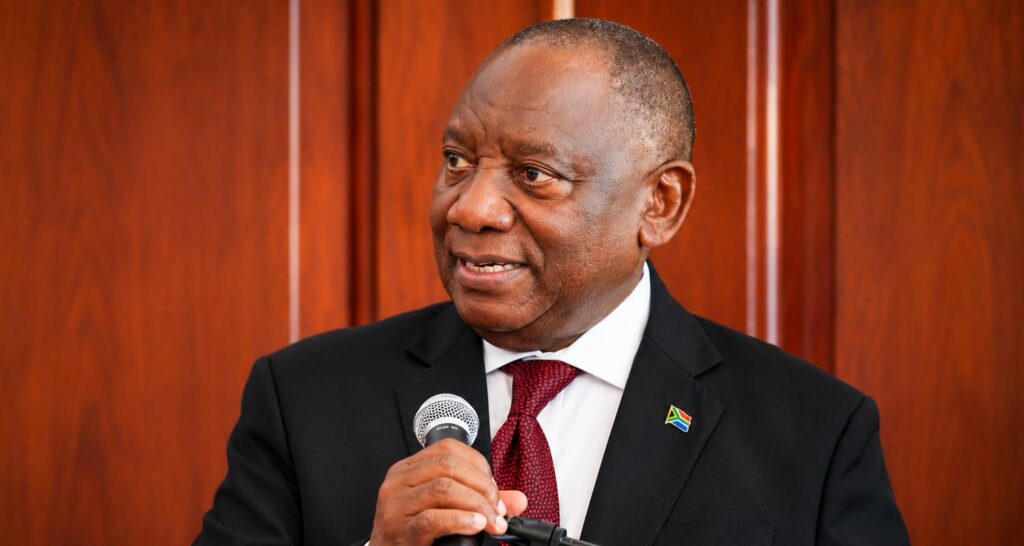
President Cyril Ramaphosa has told the roughly 300 South Africans travelling with him to Silicon Valley that their AI mission will be judged by what they do when they get home.
Addressing the delegation in San Francisco, Ramaphosa said he wanted a “focused set of practical initiatives” identified within 90 days of the group’s return, with “clear responsibilities, measurable outcomes and a commitment to follow through”.
“We have not come to Silicon Valley merely to see the future. We have come to help shape South Africa’s place in that future,” he said.
The presidency has billed the visit, which runs from 15-21 November, as a chance to gain insights into the global AI ecosystem and to sell South Africa as an investment destination. It pointed to the money in play: hyperscalers are planning about US$650-billion in AI capital expenditure in 2026, and venture capital investment in AI reached $259-billion in 2025, government said.
We have not come to Silicon Valley merely to see the future. We have come to help shape South Africa’s place in that future.
President Cyril Ramaphosa
Presidency spokesman Vincent Magwenya has insisted the trip is “specifically around AI” and that Ramaphosa will not go to Washington. It comes two weeks after the US trade representative announced Donald Trump’s intent to remove South Africa from the African Growth and Opportunity Act (Agoa), which gives its exports duty-free access to the US.
Ramaphosa’s central argument was that South Africa must not repeat the industrial era, when it exported raw materials and value was created elsewhere.
“Africa, but more importantly South Africa, must not simply provide the minerals that power the computers, the data that trains the models and the markets that consume these products,” he said. “South Africa must also develop the technologies, build the enterprises, own intellectual property and create the jobs of the future.”
He wants the country to move “from being a location for digital infrastructure to becoming a centre of digital innovation”, building on the data centres Microsoft, Amazon Web Services and Google have already set up. Microsoft committed R5.4-billion to new AI data centre infrastructure in 2025.
‘Contact to contract’
His asks are investment: in data centres, advanced computing, digital infrastructure and research, and partnerships that transfer knowledge and skills. He urged business delegates to “move from contact to contract”, and said the government should be an early adopter of AI and clear away red tape. “The pace of technological change will not wait for the pace of our bureaucracy,” he said.
On his return, he plans to set up “a structure that is going to enhance our AI capabilities”, drawing in business, government, students and researchers.
Eight of the 32 cabinet ministers are travelling: those of finance; international relations; science, technology & innovation; trade, industry & competition; communications & digital technologies; electricity & energy; small business development; and the presidency. They are joined by Roelf Meyer, the ambassador to the US.
The delegation also includes senior officials, start-up founders and 27 postgraduate students. Ramaphosa said sponsors, departments and companies had covered costs, “up to and including our flights”, but did not say which companies. “We’ve spent some money but not too much money,” he said, without disclosing how much taxpayers were on the hook for.
The official programme includes Stanford University and visits to Google, Cisco, Palo Alto Networks and Microsoft.
The presidential commission on the fourth Industrial Revolution, which Ramaphosa set up, recommended in its final report, gazetted in October 2020, that South Africa establish an AI institute. Wits University researchers who reviewed the report found “a huge gap between what we see on the ground and the recommendations of the commission”, they wrote in January 2021.
The president’s investment drive had drawn R1.51-trillion in pledges by 2023, but he said at the time that about R263-billion had been realised in infrastructure investment.
I don’t think we have the luxury of spending another five years just discussing how we start dipping our toes into the AI waters.
Wits University’s Prof Benjamin Rosman
Nor does South Africa yet have a national AI policy. Malatsi withdrew the draft in April after it was found to cite fictitious sources. The redraft is due before cabinet only by March 2027, months later than promised, so the 90-day initiatives are likely to arrive before the policy meant to guide them.
Benjamin Rosman of Wits University, who chairs the panel redrafting the policy, told delegates that the next two to five years “will be among the most consequential years in the history of technology and society ever”. “I don’t think we have the luxury of spending another five years just discussing how we start dipping our toes into the AI waters,” he said. – (c) 2026 NewsCentral Media