

Close Menu
TechCentralTechCentral

    Subscribe to the newsletter

    Get the best South African technology news and analysis delivered to your e-mail inbox every morning.

    Facebook X (Twitter) YouTube LinkedIn
    WhatsApp Facebook X (Twitter) LinkedIn YouTube
    TechCentralTechCentral
    • News
      Vula Medical named as South Africa's 2025 app of the year

      Vula Medical named as South Africa’s 2025 app of the year

      5 December 2025
      Netflix, Warner Bros talks raise fresh headaches for MultiChoice

      Netflix, Warner Bros talks raise fresh headaches for MultiChoice

      5 December 2025
      Big Microsoft 365 price increases coming next year

      Big Microsoft price increases coming next year

      5 December 2025
      Vodacom to take control of Safaricom in R36-billion deal - Shameel Joosub

      Vodacom to take control of Safaricom in R36-billion deal

      4 December 2025
      Black Friday goes digital in South Africa as online spending surges to record high

      Black Friday goes digital in South Africa as online spending surges to record high

      4 December 2025
    • World
      Amazon and Google launch multi-cloud service for faster connectivity

      Amazon and Google launch multi-cloud service for faster connectivity

      1 December 2025
      Google makes final court plea to stop US breakup

      Google makes final court plea to stop US breakup

      21 November 2025
      Bezos unveils monster rocket: New Glenn 9x4 set to dwarf Saturn V

      Bezos unveils monster rocket: New Glenn 9×4 set to dwarf Saturn V

      21 November 2025
      Tech shares turbocharged by Nvidia's stellar earnings

      Tech shares turbocharged by stellar Nvidia earnings

      20 November 2025
      Config file blamed for Cloudflare meltdown that disrupted the web

      Config file blamed for Cloudflare meltdown that disrupted the web

      19 November 2025
    • In-depth
      Jensen Huang Nvidia

      So, will China really win the AI race?

      14 November 2025
      Valve's Linux console takes aim at Microsoft's gaming empire

      Valve’s Linux console takes aim at Microsoft’s gaming empire

      13 November 2025
      iOCO's extraordinary comeback plan - Rhys Summerton

      iOCO’s extraordinary comeback plan

      28 October 2025
      Why smart glasses keep failing - no, it's not the tech - Mark Zuckerberg

      Why smart glasses keep failing – it’s not the tech

      19 October 2025
      BYD to blanket South Africa with megawatt-scale EV charging network - Stella Li

      BYD to blanket South Africa with megawatt-scale EV charging network

      16 October 2025
    • TCS
      TCS+ | How Cloud on Demand helps partners thrive in the AWS ecosystem - Odwa Ndyaluvane and Xenia Rhode

      TCS+ | How Cloud On Demand helps partners thrive in the AWS ecosystem

      4 December 2025
      TCS | MTN Group CEO Ralph Mupita on competition, AI and the future of mobile

      TCS | Ralph Mupita on competition, AI and the future of mobile

      28 November 2025
      TCS | Dominic Cull on fixing South Africa's ICT policy bottlenecks

      TCS | Dominic Cull on fixing South Africa’s ICT policy bottlenecks

      21 November 2025
      TCS | BMW CEO Peter van Binsbergen on the future of South Africa's automotive industry

      TCS | BMW CEO Peter van Binsbergen on the future of South Africa’s automotive industry

      6 November 2025
      TCS | Why Altron is building an AI factory - Bongani Andy Mabaso

      TCS | Why Altron is building an AI factory in Johannesburg

      28 October 2025
    • Opinion
      Your data, your hardware: the DIY AI revolution is coming - Duncan McLeod

      Your data, your hardware: the DIY AI revolution is coming

      20 November 2025
      Zero Carbon Charge founder Joubert Roux

      The energy revolution South Africa can’t afford to miss

      20 November 2025
      It's time for a new approach to government IT spend in South Africa - Richard Firth

      It’s time for a new approach to government IT spend in South Africa

      19 November 2025
      How South Africa's broken Rica system fuels murder and mayhem - Farhad Khan

      How South Africa’s broken Rica system fuels murder and mayhem

      10 November 2025
      South Africa's AI data centre boom risks overloading a fragile grid - Paul Colmer

      South Africa’s AI data centre boom risks overloading a fragile grid

      30 October 2025
    • Company Hubs
      • Africa Data Centres
      • AfriGIS
      • Altron Digital Business
      • Altron Document Solutions
      • Altron Group
      • Arctic Wolf
      • AvertITD
      • Braintree
      • CallMiner
      • CambriLearn
      • CYBER1 Solutions
      • Digicloud Africa
      • Digimune
      • Domains.co.za
      • ESET
      • Euphoria Telecom
      • Incredible Business
      • iONLINE
      • IQbusiness
      • Iris Network Systems
      • LSD Open
      • NEC XON
      • Netstar
      • Network Platforms
      • Next DLP
      • Ovations
      • Paracon
      • Paratus
      • Q-KON
      • SevenC
      • SkyWire
      • Solid8 Technologies
      • Telit Cinterion
      • Tenable
      • Vertiv
      • Videri Digital
      • Vodacom Business
      • Wipro
      • Workday
      • XLink
    • Sections
      • AI and machine learning
      • Banking
      • Broadcasting and Media
      • Cloud services
      • Contact centres and CX
      • Cryptocurrencies
      • Education and skills
      • Electronics and hardware
      • Energy and sustainability
      • Enterprise software
      • Financial services
      • Information security
      • Internet and connectivity
      • Internet of Things
      • Investment
      • IT services
      • Lifestyle
      • Motoring
      • Public sector
      • Retail and e-commerce
      • Satellite communications
      • Science
      • SMEs and start-ups
      • Social media
      • Talent and leadership
      • Telecoms
    • Events
    • Advertise
    TechCentralTechCentral
    Home » In-depth » Move over Wi-Fi, here comes Li-Fi

    Move over Wi-Fi, here comes Li-Fi

    By The Conversation29 September 2015
    Twitter LinkedIn Facebook WhatsApp Email Telegram Copy Link
    News Alerts
    WhatsApp
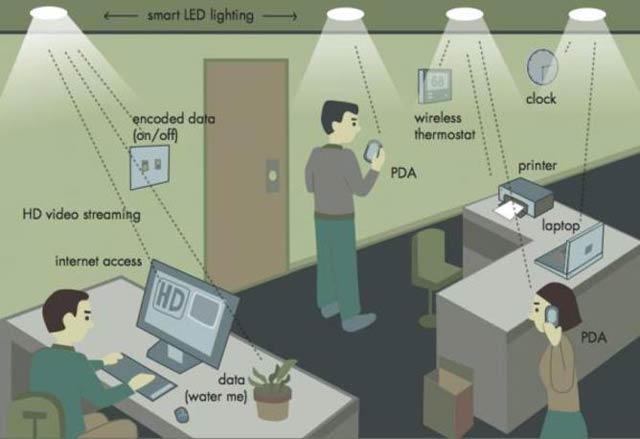
    How a Li-Fi network would work. Boston University
    How a Li-Fi network would work. Boston University

    The tungsten lightbulb has served us well over the century or so since it was introduced, but its days are numbered now with the arrival of LED lighting, which consumes a tenth of the power of incandescent bulbs and has a lifespan 30 times longer. Potential uses of LEDs are not limited to illumination: smart lighting products are emerging that can offer various additional features, including linking your laptop or smartphone to the Internet. Move over Wi-Fi, Li-Fi is here.

    Wireless communication with visible light is, in fact, not a new idea. Everyone knows about using smoke signals on a desert island to try to capture attention. Perhaps less well known is that in the time of Napoleon much of Europe was covered with optical telegraphs, otherwise known as the semaphore.

    Alexander Graham Bell, inventor of the telephone, actually regarded the photophone as his most important invention, a device that used a mirror to relay the vibrations caused by speech over a beam of light.

    In the same way that interrupting (modulating) a plume of smoke can break it into parts that form an SOS message in Morse code, so visible light communications — Li-Fi — rapidly modulates the intensity of a light to encode data as binary zeroes and ones. But this doesn’t mean that Li-Fi transceivers will flicker; the modulation will be too fast for the eye to see.

    The enormous and growing user demand for wireless data is placing huge pressure on existing Wi-Fi technology, which uses the radio and microwave frequency spectrum. With exponential growth of mobile devices, by 2019 more than 10bn devices are expected to exchange around 35 quintillion (1018) bytes of information each month. This won’t be possible using existing wireless technology due to frequency congestion and electromagnetic interference. The problem is most acutely felt in public spaces in urban areas, where many users try to share the limited capacity available from Wi-Fi transmitters or mobile phone network cell towers.

    A fundamental communications principle is that the maximum data transfer possible scales with the electromagnetic frequency bandwidth available. The radio frequency spectrum is heavily used and regulated, and there just isn’t enough additional space to satisfy the growth in demand. So Li-Fi has the potential to replace radio and microwave frequency Wi-Fi.

    Visible light spectrum has huge, unused and unregulated capacity for communications. The light from LEDs can be modulated very quickly: data rates as high as 3,5Gbit/s using a single blue LED or 1,7Gbit/s with white light have been demonstrated by researchers in our EPSRC-funded Ultra-Parallel Visible Light Communications programme.

    Unlike Wi-Fi transmitters, optical communications are well-confined inside the walls of a room. This confinement might seem to be a limitation for Li-Fi, but it offers the key advantage that it is very secure: if the curtains are drawn then nobody outside the room can eavesdrop. An array of light sources in the ceiling could send different signals to different users. The transmitter power can be localised, more efficiently used and won’t interfere with adjacent Li-Fi sources. Indeed, the lack of radio frequency interference is another advantage over Wi-Fi. Visible light communications is intrinsically safe, and could end the need for travellers to switch devices to flight mode.

    A further advantage of Li-Fi is that it can use existing power lines as LED lighting so no new infrastructure is needed.

    The Internet of things is an ambitious vision of a hyper-connected world of objects autonomously communicating with each other. For example, your fridge might inform your smartphone that you have run out of milk, and even order it for you. Sensors in your car will directly alert you though your smartphone that your tyres are too worn or have low pressure.
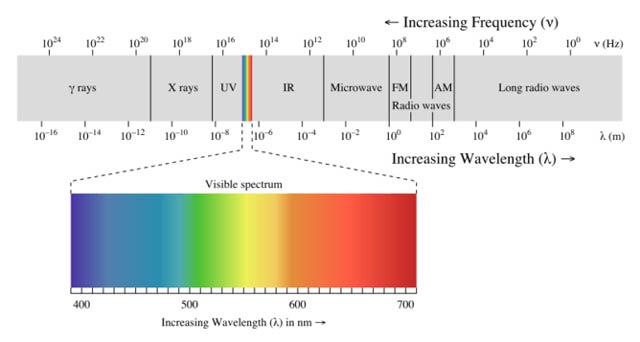
     Light frequencies on the electromagnetic spectrum are underused, while to either side is congested. Philip Ronan, CC BY-SA
    Light frequencies on the electromagnetic spectrum are underused, while to either side is congested. Philip Ronan, CC BY-SA

    Given the number of “things” that can be fitted with sensors and controllers then network-enabled and connected, the bandwidth needed for all these devices to communicate is vast. Industry monitor Gartner predicts that 25bn such devices will be connected by 2020, but given that most of this information needs only to be transferred a short distance, Li-Fi is an attractive — and perhaps the only — solution to making this a reality.

    Several companies are already offering products for visible light communications. The Li-1st from PureLiFi, based in Edinburgh, offers a simple plug-and-play solution for secure wireless point-to-point internet access with a capacity of 11,5Mbit/s — comparable to first generation Wi-Fi. Another is Oledcomm from France, which exploits the safe, non-radio frequency nature of Li-Fi with installations in hospitals.

    There are still many technological challenges to tackle but already the first steps have been taken to make Li-Fi a reality. In the future your light switch will turn on much more than just illumination.The Conversation

    • Pavlos Manousiadis is research fellow, Graham Turnbull is professor and head of the School of Physics and Astronomy, and Ifor Samuel is professor of polymer optoelectronics, all at the University of St Andrews
    • This article was originally published on The Conversation
    • Subscribe to TechCentral’s free daily newsletter


    Graham Turnbill Ifor Samuel Pavlos Manousiadis
    Subscribe to TechCentral Subscribe to TechCentral
    Share. Facebook Twitter LinkedIn WhatsApp Telegram Email Copy Link
    Previous ArticleHitachi ‘bribe’ shows Medupi ‘rotten’: DA
    Next Article SA start-up in Silicon Valley coup
    Company News
    Beat the summer heat with Samsung's WindFree air conditioners

    Beat the summer heat with Samsung’s WindFree air conditioners

    5 December 2025
    AI is not a technology problem - iqbusiness

    AI is not a technology problem – iqbusiness

    5 December 2025
    Telcos are sitting on a data gold mine - but few know what do with it - Phillip du Plessis

    Telcos are sitting on a data gold mine – but few know what do with it

    4 December 2025
    Opinion
    Your data, your hardware: the DIY AI revolution is coming - Duncan McLeod

    Your data, your hardware: the DIY AI revolution is coming

    20 November 2025
    Zero Carbon Charge founder Joubert Roux

    The energy revolution South Africa can’t afford to miss

    20 November 2025
    It's time for a new approach to government IT spend in South Africa - Richard Firth

    It’s time for a new approach to government IT spend in South Africa

    19 November 2025

    Subscribe to Updates

    Get the best South African technology news and analysis delivered to your e-mail inbox every morning.

    Latest Posts
    Vula Medical named as South Africa's 2025 app of the year

    Vula Medical named as South Africa’s 2025 app of the year

    5 December 2025
    Beat the summer heat with Samsung's WindFree air conditioners

    Beat the summer heat with Samsung’s WindFree air conditioners

    5 December 2025
    Netflix, Warner Bros talks raise fresh headaches for MultiChoice

    Netflix, Warner Bros talks raise fresh headaches for MultiChoice

    5 December 2025
    Big Microsoft 365 price increases coming next year

    Big Microsoft price increases coming next year

    5 December 2025
    © 2009 - 2025 NewsCentral Media
    • Cookie policy (ZA)
    • TechCentral – privacy and Popia

    Type above and press Enter to search. Press Esc to cancel.

    Manage consent

    TechCentral uses cookies to enhance its offerings. Consenting to these technologies allows us to serve you better. Not consenting or withdrawing consent may adversely affect certain features and functions of the website.

    Functional Always active
    The technical storage or access is strictly necessary for the legitimate purpose of enabling the use of a specific service explicitly requested by the subscriber or user, or for the sole purpose of carrying out the transmission of a communication over an electronic communications network.
    Preferences
    The technical storage or access is necessary for the legitimate purpose of storing preferences that are not requested by the subscriber or user.
    Statistics
    The technical storage or access that is used exclusively for statistical purposes. The technical storage or access that is used exclusively for anonymous statistical purposes. Without a subpoena, voluntary compliance on the part of your Internet Service Provider, or additional records from a third party, information stored or retrieved for this purpose alone cannot usually be used to identify you.
    Marketing
    The technical storage or access is required to create user profiles to send advertising, or to track the user on a website or across several websites for similar marketing purposes.
    • Manage options
    • Manage services
    • Manage {vendor_count} vendors
    • Read more about these purposes
    View preferences
    • {title}
    • {title}
    • {title}