
Close Menu
TechCentralTechCentral

    Subscribe to the newsletter

    Get the best South African technology news and analysis delivered to your e-mail inbox every morning.

    Facebook X (Twitter) YouTube LinkedIn
    WhatsApp Facebook X (Twitter) LinkedIn YouTube
    TechCentralTechCentral
    • News
      From care homes to production lines, the robots are coming

      From care homes to production lines, the robots are coming

      21 July 2026
      Remote work in South Africa hits record high

      Remote work in South Africa hits record high

      21 July 2026
      China weighs blocking the West from its best AI

      China weighs blocking the West from its best AI

      21 July 2026
      Openserve hits back in fibre ISP row

      Openserve hits back in fibre ISP row

      20 July 2026
      Best network, worst vibes: the puzzle of SA telecoms

      Best network, worst vibes: the puzzle of SA telecoms

      20 July 2026
    • World
      Meta AI will now tell parents if their teen is in crisis

      Meta AI will now tell parents if their teen is in crisis

      17 July 2026
      IBM shares crash 25% as AI upends software spending - Arvind Krishna

      IBM shares crash 25% as AI upends software spending

      15 July 2026
      Jony Ive's first OpenAI device: an AI smart speaker - Jony Ive and Sam Altman

      Jony Ive’s first OpenAI device: an AI smart speaker

      15 July 2026
      Stripe, Advent in talks to buy PayPal for $53-billion

      Stripe, Advent in talks to buy PayPal for $53-billion

      15 July 2026
      Memory crisis sends smartphone market into steep decline

      Memory crisis sends smartphone market into steep decline

      13 July 2026
    • In-depth
      The plan to stop AI from breaking the world - Google DeepMind CEO Demis Hassabis. Image: John Sears

      The plan to stop AI from breaking the world

      16 July 2026
      The internet has a Strait of Hormuz problem

      The internet has a Strait of Hormuz problem

      15 July 2026
      AI boom sparks rally, frenzy and fear

      AI boom sparks rally, frenzy and fear

      11 June 2026
      Every plug-in hybrid on sale in South Africa, ranked by price - Lamborghini Temerario

      Every plug-in hybrid on sale in South Africa, ranked by price

      7 June 2026
      What Wi-Fi 8 will mean for wireless networks

      What Wi-Fi 8 will mean for wireless networks

      1 June 2026
    • TCS
      Watts & Wheels S1E7: 'Ferrari's EV breaks the internet'

      Watts & Wheels S1E7: ‘Ferrari’s EV breaks the internet’

      8 July 2026
      TCS+ | How Tracker is turning vehicle data into business strategy - Silvia Schollenberger

      TCS+ | How Tracker is turning vehicle data into business strategy

      1 July 2026
      TCS+ | IBM Bob: an AI-powered 'development partner' for the enterprise - David Spurway

      TCS+ | IBM Bob: an AI-powered development partner for the enterprise

      30 June 2026
      Watts & Wheels S1E6: 'A flawless Alfa and a bakkie that divides'

      Watts & Wheels S1E6: ‘A flawless Alfa and a bakkie that divides’

      17 June 2026
      Watts & Wheels S1E6: 'A flawless Alfa and a bakkie that divides'

      Watts & Wheels S1E5: ‘A Bentley of the bush and a car that swims’

      8 June 2026
    • Opinion
      Selling vapour is corporate suicide in slow motion - Jannie van Zyl

      Selling vapour is corporate suicide in slow motion

      16 July 2026
      Brazil's online gambling crackdown is a lesson for South Africa

      How Amazon outmanoeuvred Starlink in South Africa

      15 July 2026
      The Popia problem with agentic AI - Herman Haasbroek

      The Popia problem with agentic AI

      14 July 2026
      The author, Fanie van Rooyen

      South Africa can still catch the AI wave – here’s how

      7 July 2026
      The author, Fanie van Rooyen

      The AI utopia South Africa can’t afford

      1 July 2026
    • Company Hubs
      • 1Stream
      • Africa Data Centres
      • AfriGIS
      • Altron Digital Business
      • Altron Document Solutions
      • Altron Group
      • Arctic Wolf
      • Ascent Technology
      • AvertITD
      • BBD
      • Braintree
      • CallMiner
      • CambriLearn
      • CM Telecom
      • Contactable
      • CYBER1 Solutions
      • Digicloud Africa
      • Digimune
      • Domains.co.za
      • ESET
      • Euphoria Telecom
      • HOSTAFRICA
      • Incredible Business
      • iONLINE
      • IQbusiness
      • Iris Network Systems
      • Kaspersky
      • LSD Open
      • Mitel
      • NEC XON
      • Netstar
      • Network Platforms
      • Next DLP
      • Ovations
      • Paracon
      • Paratus
      • Q-KON
      • SevenC
      • SkyWire
      • Solid8 Technologies
      • Telit Cinterion
      • Telviva
      • Tenable
      • Vertiv
      • Videri Digital
      • Vodacom Business
      • Wipro
      • Workday
      • XLink
    • Sections
      • AI and machine learning
      • Banking
      • Broadcasting and Media
      • Cloud services
      • Contact centres and CX
      • Cryptocurrencies
      • Education and skills
      • Electronics and hardware
      • Energy and sustainability
      • Enterprise software
      • Financial services
      • HealthTech
      • Information security
      • Internet and connectivity
      • Internet of Things
      • Investment
      • IT services
      • Lifestyle
      • Policy and regulation
      • Public sector
      • Retail and e-commerce
      • Satellite communications
      • Science
      • SMEs and start-ups
      • Social media
      • Talent and leadership
      • Telecoms
      • Watts & Wheels
    • Events
    • Advertise
    TechCentralTechCentral
    Home » News » New book examines how science and tech shaped SA’s history

    New book examines how science and tech shaped SA’s history

    By The Conversation14 February 2022
    Twitter LinkedIn Facebook WhatsApp Email Telegram Copy Link
    News Alerts
    WhatsApp

    As historians, we have both been immersed for many years in trying to understand and write about South Africa’s complex, conflictual history. Conquest, colonial domination and racial division in the shape of apartheid played a central role. So, too, did the rise of black opposition and the transition in 1994 to an ANC government.

    There were many strands in the weaving of this history, some neglected in the focus on race and political power. These include the profound role that science and technology played in shaping South Africa’s history. In our new book, The Scientific Imagination in South Africa, 1700 to the Present, we offer an historical overview of scientific ideas, practices and institutions in South Africa over more than three centuries.

    We refer in the title to the “scientific imagination”. That’s because we link science both with power and with ideas about how human society can be reshaped. We also aim to discuss science as an expression of human curiosity, ingenuity and the ability to make unlikely connections.

    South Africa has been a regional rather than a world power. In global terms it was not a major centre for invention

    This book is a history of individuals, ideas and institutions that were at the fulcrum of important scientific developments. Writing history is bounded by what has happened. Our text explores the complexity of the colonial era and its indelible legacies. We argue that science and technology both facilitated colonialism and to some degree stood outside such processes.

    Racial policies and modernist approaches privileged the narratives of formal, written, largely disciplinary-based sciences. The book incorporates discussion of indigenous and local knowledge when it fed into scientific discussion, such as in understanding the local environment in the eighteenth century. We also explore alternative approaches and conflicts over knowledge.

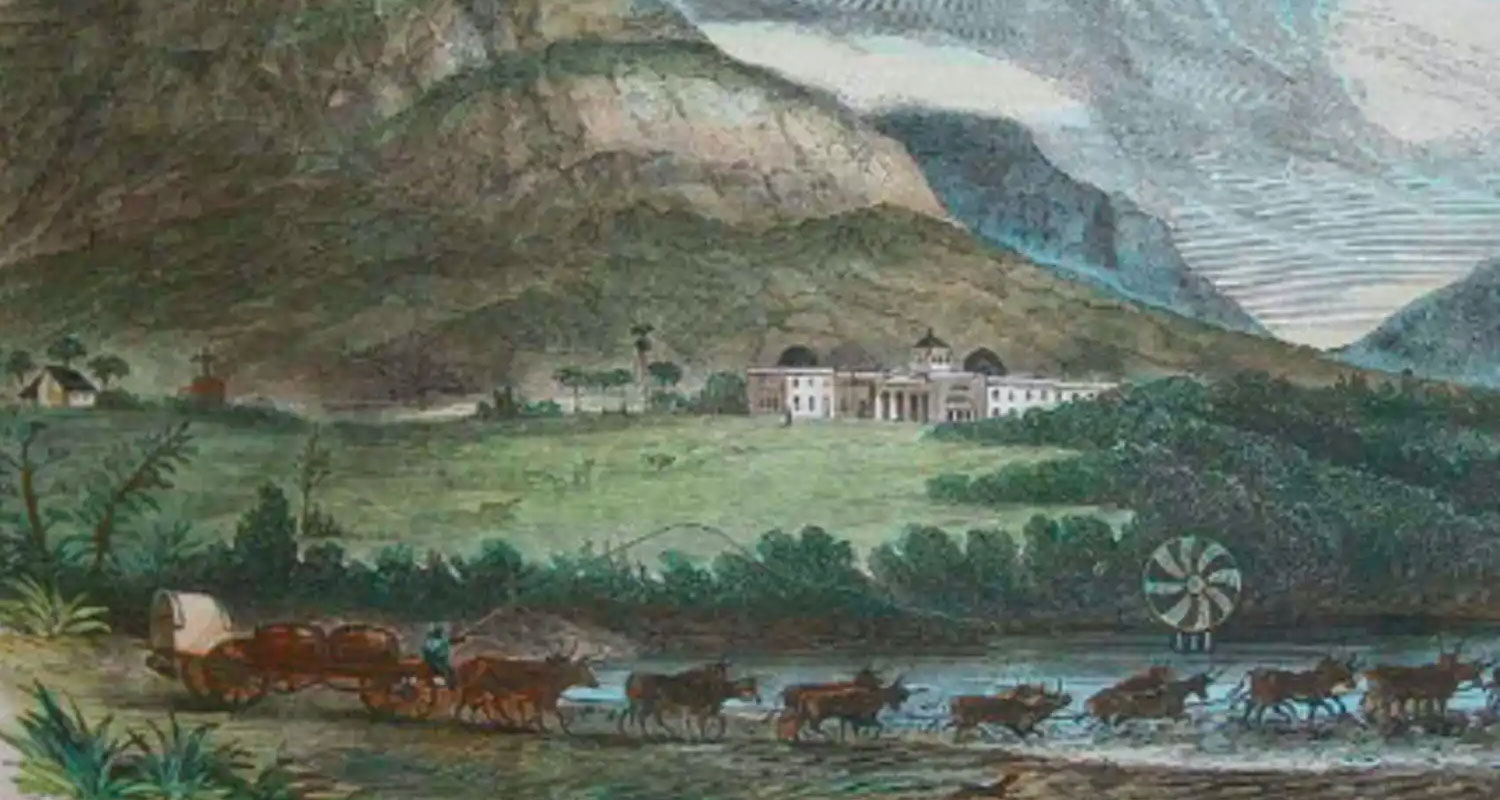
    South Africa has been a regional rather than a world power. In global terms it was not a major centre for invention. Yet its geographic position at the southern foot of the African continent made it a staging post for Portuguese, Dutch and British maritime empires. It became part of an expanded European and global imaginary. Colonisation by Britain from 1806 brought the region into tight connection with one of the most powerful – and technologically advanced – world empires.

    ‘Cradle’

    From the late eighteenth century, the Cape became an important site for botanical and zoological exploration. The wealth of its plant species, as well as the extraordinary diversity of wildlife, attracted sustained attention. By the early 20th century, the discovery of ancient fossils, stone implements and hominin remains suggested that the country may have constituted a “cradle” of modern human evolution.

    South Africa was not a core zone of invention. But it was, at key moments, a significant incubator and testing ground of innovation. Application could be as important as discovery. In the nineteenth century, improved breeds and new agricultural technology, including dams, wells, fodder and fencing, underpinned exports of wool and ostrich feathers. Devastating new rifles helped to change the balance of power in favour of colonial regimes.

    In the 20th century, the mineral revolution necessitated developments in applied geology and the chemistry of gold extraction. The scientific imagination was also more exploratory in curiosity-driven fields such as astronomy, palaeontology and wildlife conservation.

    Our text also builds on many individual stories. James Barry, who came to the Cape in the 1810s, was probably the first formally trained woman doctor in Britain. She made a significant contribution to modernising Cape Town’s early medical institutions. She also performed one of the first successful Caesarean operations in the British empire, for an ancestor of the man who became the first Afrikaner nationalist prime minister. It was in commemoration of this operation that he carried the unusual name James Barry Munnik Hertzog.

    Elsewhere in South Africa, rich mineral resources gave impetus to a sequence of discoveries. Hans Merensky, son of a German missionary, was sent to train as a geologist in Prussia. Returning to South Africa, he played a major role in identifying coastal diamond deposits, as well as platinum and phosphates. Platinum group minerals have outstripped gold in their value. Merensky invested his wealth in a farm, Westfalia, which became an important site for scientific work in improving avocado pears.

    South Africa gave birth both to Afrikaner and African nationalism, which affected the trajectory of scientific endeavour. White South Africans were also carriers of a darker tradition – the attempts to justify racial segregation in scientific terms. In the relatively brief era of African nationalist rule after 1994, the state has espoused more universalist goals and the segregationist drive to account for racial difference has yielded to an emphasis on common humankind.

    Up to the challenge

    We explore the circulation of ideas, recognising that many originate in the north but are not trapped in the social context of their origin. Scientific ideas are potentially universal and can be appropriated and modified everywhere.

    Today, it is clear that scientific work in multiple sites with diverse backing is important for South Africa to address its socioeconomic and environmental problems. There are signs that its scientists are up to the challenge: after all, it was in South Africa that the Omicron variant of Covid was first identified. Scientists were sufficiently inserted in global networks to identify this variant and sufficiently open to publicise it.

    The scientific imagination needs to be nurtured in the country, along with the capacity to think creatively about history and society.

    • The ConversationThe Scientific Imagination in South Africa, 1700 to the Present, is published by Cambridge University Press (2021)
    • Written by William Beinart, professor, University of Oxford, and Saul Dubow, Smuts professor of Commonwealth history, University of Cambridge
      This article is republished from The Conversation under a Creative Commons licence

    Follow TechCentral on Google News Add TechCentral as your preferred source on Google


    Saul Dubow William Beinart
    WhatsApp YouTube
    Share. Facebook Twitter LinkedIn WhatsApp Telegram Email Copy Link
    Previous ArticleUber will accept bitcoin for rides – eventually
    Next Article Private sector alone won’t solve SA’s woes – Ramaphosa
    Company News
    Cloud adoption is done. Execution is the new frontier - Cloud on Demand

    Cloud adoption is done. Execution is the new frontier

    21 July 2026
    Data poisoning in AI models: what businesses need to know - Domains.co.za

    Data poisoning in AI models: what businesses need to know

    21 July 2026
    The AI-led industrial revolution has begun - CallMiner Bruce McMahon

    The AI-led industrial revolution has begun

    20 July 2026
    Opinion
    Selling vapour is corporate suicide in slow motion - Jannie van Zyl

    Selling vapour is corporate suicide in slow motion

    16 July 2026
    Brazil's online gambling crackdown is a lesson for South Africa

    How Amazon outmanoeuvred Starlink in South Africa

    15 July 2026
    The Popia problem with agentic AI - Herman Haasbroek

    The Popia problem with agentic AI

    14 July 2026

    Subscribe to Updates

    Get the best South African technology news and analysis delivered to your e-mail inbox every morning.

    Latest Posts
    From care homes to production lines, the robots are coming

    From care homes to production lines, the robots are coming

    21 July 2026
    Cloud adoption is done. Execution is the new frontier - Cloud on Demand

    Cloud adoption is done. Execution is the new frontier

    21 July 2026
    Data poisoning in AI models: what businesses need to know - Domains.co.za

    Data poisoning in AI models: what businesses need to know

    21 July 2026
    Remote work in South Africa hits record high

    Remote work in South Africa hits record high

    21 July 2026
    © 2009 - 2026 NewsCentral Media
    Built and maintained by Chronon
    • Cookie policy (ZA)
    • TechCentral – privacy and Popia

    Type above and press Enter to search. Press Esc to cancel.

    Manage consent

    TechCentral uses cookies to enhance its offerings. Consenting to these technologies allows us to serve you better. Not consenting or withdrawing consent may adversely affect certain features and functions of the website.

    Functional Always active
    The technical storage or access is strictly necessary for the legitimate purpose of enabling the use of a specific service explicitly requested by the subscriber or user, or for the sole purpose of carrying out the transmission of a communication over an electronic communications network.
    Preferences
    The technical storage or access is necessary for the legitimate purpose of storing preferences that are not requested by the subscriber or user.
    Statistics
    The technical storage or access that is used exclusively for statistical purposes. The technical storage or access that is used exclusively for anonymous statistical purposes. Without a subpoena, voluntary compliance on the part of your Internet Service Provider, or additional records from a third party, information stored or retrieved for this purpose alone cannot usually be used to identify you.
    Marketing
    The technical storage or access is required to create user profiles to send advertising, or to track the user on a website or across several websites for similar marketing purposes.
    • Manage options
    • Manage services
    • Manage {vendor_count} vendors
    • Read more about these purposes
    View preferences
    • {title}
    • {title}
    • {title}

