Close Menu
TechCentralTechCentral

    Subscribe to the newsletter

    Get the best South African technology news and analysis delivered to your e-mail inbox every morning.

    Facebook X (Twitter) YouTube LinkedIn
    WhatsApp Facebook X (Twitter) LinkedIn YouTube
    TechCentralTechCentral
    • News
      Oracle is slashing its workforce as it automates with AI

      Oracle is slashing its workforce as it automates with AI

      23 June 2026
      Namibia tells Starlink to take a hike - again

      Namibia tells Starlink to take a hike – again

      22 June 2026
      Joburg the epicentre of South Africa's tech brain drain

      Joburg the epicentre of South Africa’s tech brain drain

      22 June 2026
      South Africa went cashless - except for the millions who didn't

      South Africa went cashless – except for the millions who didn’t

      22 June 2026
      That drone over your house is almost certainly breaking the law

      That drone over your house is almost certainly breaking the law

      22 June 2026
    • World

      SK Hynix ends Samsung’s 26-year reign at the top

      22 June 2026
      Google on the hook for what its AI tells users, court rules

      Google on the hook for what its AI tells users, court rules

      15 June 2026
      How Russians juggle VPNs to outwit the Kremlin

      How Russians juggle VPNs to outwit the Kremlin

      15 June 2026
      Amazon CEO flagged Anthropic AI risks to Washington - Andy Jassy

      Amazon CEO flagged Anthropic AI risks to Washington

      14 June 2026
      Trouble at Xbox

      Trouble at Xbox

      11 June 2026
    • In-depth
      AI boom sparks rally, frenzy and fear

      AI boom sparks rally, frenzy and fear

      11 June 2026
      Every plug-in hybrid on sale in South Africa, ranked by price - Lamborghini Temerario

      Every plug-in hybrid on sale in South Africa, ranked by price

      7 June 2026
      What Wi-Fi 8 will mean for wireless networks

      What Wi-Fi 8 will mean for wireless networks

      1 June 2026
      Alfa's electric rebel - Alfa Romeo Junior Elettrica Veloce

      Alfa’s electric rebel

      29 April 2026
      Africa switches on as Europe dims the lights

      Africa switches on as Europe dims the lights

      9 April 2026
    • TCS
      Watts & Wheels S1E6: 'A flawless Alfa and a bakkie that divides'

      Watts & Wheels S1E6: ‘A flawless Alfa and a bakkie that divides’

      17 June 2026
      Watts & Wheels S1E6: 'A flawless Alfa and a bakkie that divides'

      Watts & Wheels S1E5: ‘A Bentley of the bush and a car that swims’

      8 June 2026
      TCS | Charge's R1.8-billion bet on an off-grid EV future - Charge chairman Joubert Roux

      TCS | Charge’s R1.8-billion bet on an off-grid EV future

      18 May 2026
      TCS+ | The Up&Up Group on the hidden cost of AI - Jason Harrison

      TCS+ | The Up&Up Group on the hidden cost of AI

      13 May 2026
      Michael Rossouw

      TCS+ | The retirement decision most South Africans get wrong

      6 May 2026
    • Opinion
      Finish the job Mandela started - Farzam Ehsani

      Finish the job Mandela started

      18 June 2026
      The author, Fanie van Rooyen

      The US just showed it can switch off our AI

      17 June 2026
      The clock is ticking on South African banks' biggest advantage - Pambos Soteriades

      The clock is ticking on South African banks’ biggest advantage

      9 June 2026

      Clashing judgments leave South Africa’s crypto law unsettled

      2 June 2026
      The clock is ticking on South African banks' biggest advantage - Pambos Soteriades

      The trap inside South Africa’s banking MVNO boom

      1 June 2026
    • Company Hubs
      • 1Stream
      • Africa Data Centres
      • AfriGIS
      • Altron Digital Business
      • Altron Document Solutions
      • Altron Group
      • Arctic Wolf
      • Ascent Technology
      • AvertITD
      • BBD
      • Braintree
      • CallMiner
      • CambriLearn
      • CM Telecom
      • Contactable
      • CYBER1 Solutions
      • Digicloud Africa
      • Digimune
      • Domains.co.za
      • ESET
      • Euphoria Telecom
      • HOSTAFRICA
      • Incredible Business
      • iONLINE
      • IQbusiness
      • Iris Network Systems
      • Kaspersky
      • LSD Open
      • Mitel
      • NEC XON
      • Netstar
      • Network Platforms
      • Next DLP
      • Ovations
      • Paracon
      • Paratus
      • Q-KON
      • SevenC
      • SkyWire
      • Solid8 Technologies
      • Telit Cinterion
      • Telviva
      • Tenable
      • Vertiv
      • Videri Digital
      • Vodacom Business
      • Wipro
      • Workday
      • XLink
    • Sections
      • AI and machine learning
      • Banking
      • Broadcasting and Media
      • Cloud services
      • Contact centres and CX
      • Cryptocurrencies
      • Education and skills
      • Electronics and hardware
      • Energy and sustainability
      • Enterprise software
      • Financial services
      • HealthTech
      • Information security
      • Internet and connectivity
      • Internet of Things
      • Investment
      • IT services
      • Lifestyle
      • Motoring
      • Policy and regulation
      • Public sector
      • Retail and e-commerce
      • Satellite communications
      • Science
      • SMEs and start-ups
      • Social media
      • Talent and leadership
      • Telecoms
    • Events
    • Advertise
    TechCentralTechCentral
    Home » Editor's pick » New light shed on Homo naledi mystery

    New light shed on Homo naledi mystery

    By The Conversation28 July 2016
    Twitter LinkedIn Facebook WhatsApp Email Telegram Copy Link
    News Alerts
    WhatsApp
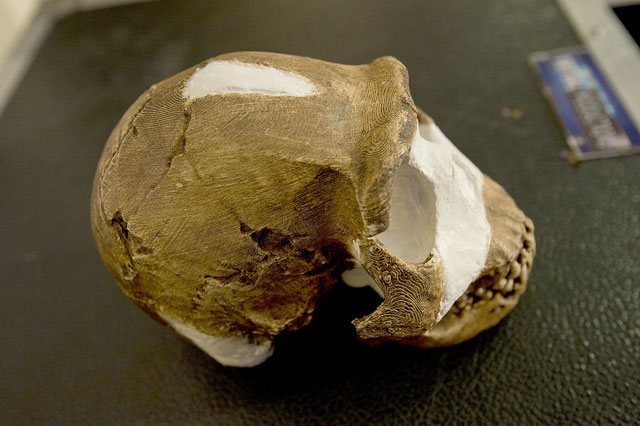
    A replica of a Homo naledi skull
    A replica of a Homo naledi skull

    Many questions have been thrown up by the discovery in South Africa of a previously unidentified human relative, Homo naledi. Perhaps the one that’s grabbed people’s attention the most is how Homo naledi’s bones ended up in the Dinaledi Chamber in the Rising Star cave complex in the Cradle of Humankind near Johannesburg.

    The team that found and classified the remains has suggested that the Homo naledi group deliberately deposited carcasses in complete darkness at the very back of the cave system. According to this claim, Homo naledi adopted a relatively “modern” or ritualistic form of behaviour even though the species had smaller brains than today’s humans.

    To date, no opening has been found within the Dinaledi Chamber apart from the existing entrance. But might there have been an additional entrance at some time in the past? New research I have conducted and published in the South African Journal of Science centred on mysterious black spots found on Homo naledi bones from the cave. My findings suggest that the answer to this question may have been “yes” — there very well may have been an entrance.

    I strongly believe that there was possibly a temporary entrance into the chamber, in addition to the one used by explorers today. This temporary entrance may been covered up by a rock fall that also trapped the individuals whose bones were found some time later.

    Why do I believe this? Because those mysterious black spots are manganese dioxide and were probably deposited on the bones by lichen. And lichen need light to grow — so there must have been some light penetrating into the Dinaledi chamber. My scenario is that the Homo naledi family group was trapped in the Dinaledi Chamber after a rockfall — but that there was still, for a time, enough light to penetrate the chamber. This allowed lichen to grow on many of the bones of Homo naledi.

    Then, with subsequent rockfalls in a phreatic maze, the Dinaledi Chamber was sealed except for the difficult route whereby explorers can enter the cave at the present time.

    Evidence from elsewhere

    The team which discovered the remains noted that “some bones and teeth are dotted with black iron-manganese oxy-hydroxide deposits and coatings”.

    I examined the remains in question and found that the spots were analogous to the kind of associated with modern lichen which are “symbionts”, including fungi — that disperse in spots — and algae, which require at least some light to grow.

    My colleagues and I have previously examined instances of lichen in the Cradle of Humankind area. Lichen can grow on certain substrates, including bone or rock, with a dotted or spotted distribution. The spotted distribution of lichen is sometimes associated with dotted distributions of manganese oxy-hydroxide on the same surfaces.
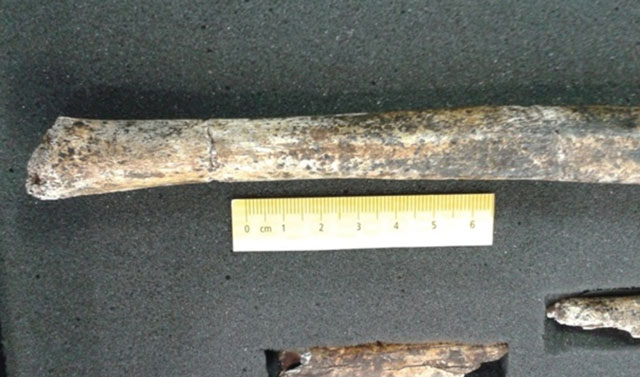
    The black markings on these Homo naledi bones are manganese dioxide
    The black markings on these Homo naledi bones are manganese dioxide

    The source of the manganese in the Cradle of Humankind region would include dolomite and chert. These are rock materials that date back two billion years ago, related to a shallow saline sea that existed at that time.

    In the Cradle of Humankind, lichen has proved to grow not only on chert, but also on dolomite. It can also grow on bone surfaces.

    Hominid cranial specimens from the nearby Sterkfontein caves have small dots or spots of manganese oxyhydroxide on surfaces of bone, even within the inner cranial wall of these skulls. It seems likely that these dots or spots of manganese oxyhydroxide may have been areas where lichens were able to grow — in a partially sunlit micro-environment — for a relatively short period of time. Then sand would have covered the crania, blocking out the light and halting the lichen’s ability to keep growing.

    So, what does such evidence in the Cradle of Humankind tell us about Homo naledi’s mysterious black spots?

    The circumstances in the Wonder Cave — which is within 10kms of the Rising Star cave complex — offer some important clues to what might have happened to create spots on the Homo naledi remains.

    When one walks from the entrance of the cavern into the darkness of the dolomitic solution cavity, the following becomes obvious.

    Where there is intense light and heat on dry exposed surfaces outside the cave, there is little or no lichen growth at all. But, in the moister and slightly darker regions of the cave, there is an area where light and moisture appear to be optimal for the present lichen colonists.

    Then, in the darkness at the back of the cave where very little light penetrates, there’s a decrease in the mean size of lichens, until there is no lichen growth at all — although there may be some moisture because of water dripping through the phreatic maze of the dolomitic cave system.

    All of this suggests that, for the Homo naledi bones in the Rising Star cave to have become spotted with manganese dioxide, they had to have some exposure to light. That could only have happened if light got into the cave. And this was only possible if there was some sort of entrance that has, in the distant past, been covered over. If correct, this would contradict the original team’s proposal that, in prehistory, the Dinaledi Chamber could only be accessed by means of very narrow and circuitous passages, in complete darkness.

    Time to reassess?

    Based on my findings I believe that there was, at some time, a second entrance to the Dinaledi Chamber. This allowed at least some light to penetrate into the cave and to facilitate the growth of lichen and the subsequent deposition of manganese oxyhydroxide on the Homo naledi bones.

    I’d further hypothesise that such an entrance, if it existed at all, was temporary. A rockfall in the maze cave system may have subsequently sealed the entrance at some stage in the dolomitic solution cavity. The darkness that settled over the cave would have terminated any lichen growth.

    If there was more than one entrance into the Dinaledi Chamber, as suggested by my work and research conducted by Aurore Val, the “intentional depositional model” will need to be reassessed. It would seem unlikely that the Homo naledi group deliberately deposited or buried its dead.

    Author’s note: I would like to acknowledge the support of the National Research Foundation, the Andrew Mellon Foundation, and the Centre of Excellence for the Palaeosciences.The Conversation

    • Francis Thackeray is Phillip Tobias Chair in Palaeoanthropology, Evolutionary Studies Institute, University of the Witwatersrand
    • This article was originally published on The Conversation

    Follow TechCentral on Google News Add TechCentral as your preferred source on Google


    Francis Thackeray Homo naledi
    WhatsApp YouTube
    Share. Facebook Twitter LinkedIn WhatsApp Telegram Email Copy Link
    Previous ArticleSA telecoms policy ‘dysfunctional’
    Next Article MTN targets 2017 Nigeria listing

    Related Posts

    SA scientist named in Time 100 list

    22 April 2016

    Picture essay: meet Homo naledi

    10 September 2015
    Company News
    A smarter way to buy or renew your Red Hat subscriptions - LSD Open

    A smarter way to buy or renew your Red Hat subscriptions

    22 June 2026
    Moving past the pilot: inside the CloudZA and AWS closed-door AI executive roundtable

    CloudZA and AWS chart the road from AI pilots to production

    19 June 2026
    The role of edge infrastructure in South Africa's AI leap - OADC Open Access Data Centres

    The role of edge infrastructure in South Africa’s AI leap

    19 June 2026
    Opinion
    Finish the job Mandela started - Farzam Ehsani

    Finish the job Mandela started

    18 June 2026
    The author, Fanie van Rooyen

    The US just showed it can switch off our AI

    17 June 2026
    The clock is ticking on South African banks' biggest advantage - Pambos Soteriades

    The clock is ticking on South African banks’ biggest advantage

    9 June 2026

    Subscribe to Updates

    Get the best South African technology news and analysis delivered to your e-mail inbox every morning.

    Latest Posts
    Oracle is slashing its workforce as it automates with AI

    Oracle is slashing its workforce as it automates with AI

    23 June 2026
    Namibia tells Starlink to take a hike - again

    Namibia tells Starlink to take a hike – again

    22 June 2026
    Joburg the epicentre of South Africa's tech brain drain

    Joburg the epicentre of South Africa’s tech brain drain

    22 June 2026
    South Africa went cashless - except for the millions who didn't

    South Africa went cashless – except for the millions who didn’t

    22 June 2026
    © 2009 - 2026 NewsCentral Media
    • Cookie policy (ZA)
    • TechCentral – privacy and Popia

    Type above and press Enter to search. Press Esc to cancel.

    Manage consent

    TechCentral uses cookies to enhance its offerings. Consenting to these technologies allows us to serve you better. Not consenting or withdrawing consent may adversely affect certain features and functions of the website.

    Functional Always active
    The technical storage or access is strictly necessary for the legitimate purpose of enabling the use of a specific service explicitly requested by the subscriber or user, or for the sole purpose of carrying out the transmission of a communication over an electronic communications network.
    Preferences
    The technical storage or access is necessary for the legitimate purpose of storing preferences that are not requested by the subscriber or user.
    Statistics
    The technical storage or access that is used exclusively for statistical purposes. The technical storage or access that is used exclusively for anonymous statistical purposes. Without a subpoena, voluntary compliance on the part of your Internet Service Provider, or additional records from a third party, information stored or retrieved for this purpose alone cannot usually be used to identify you.
    Marketing
    The technical storage or access is required to create user profiles to send advertising, or to track the user on a website or across several websites for similar marketing purposes.
    • Manage options
    • Manage services
    • Manage {vendor_count} vendors
    • Read more about these purposes
    View preferences
    • {title}
    • {title}
    • {title}