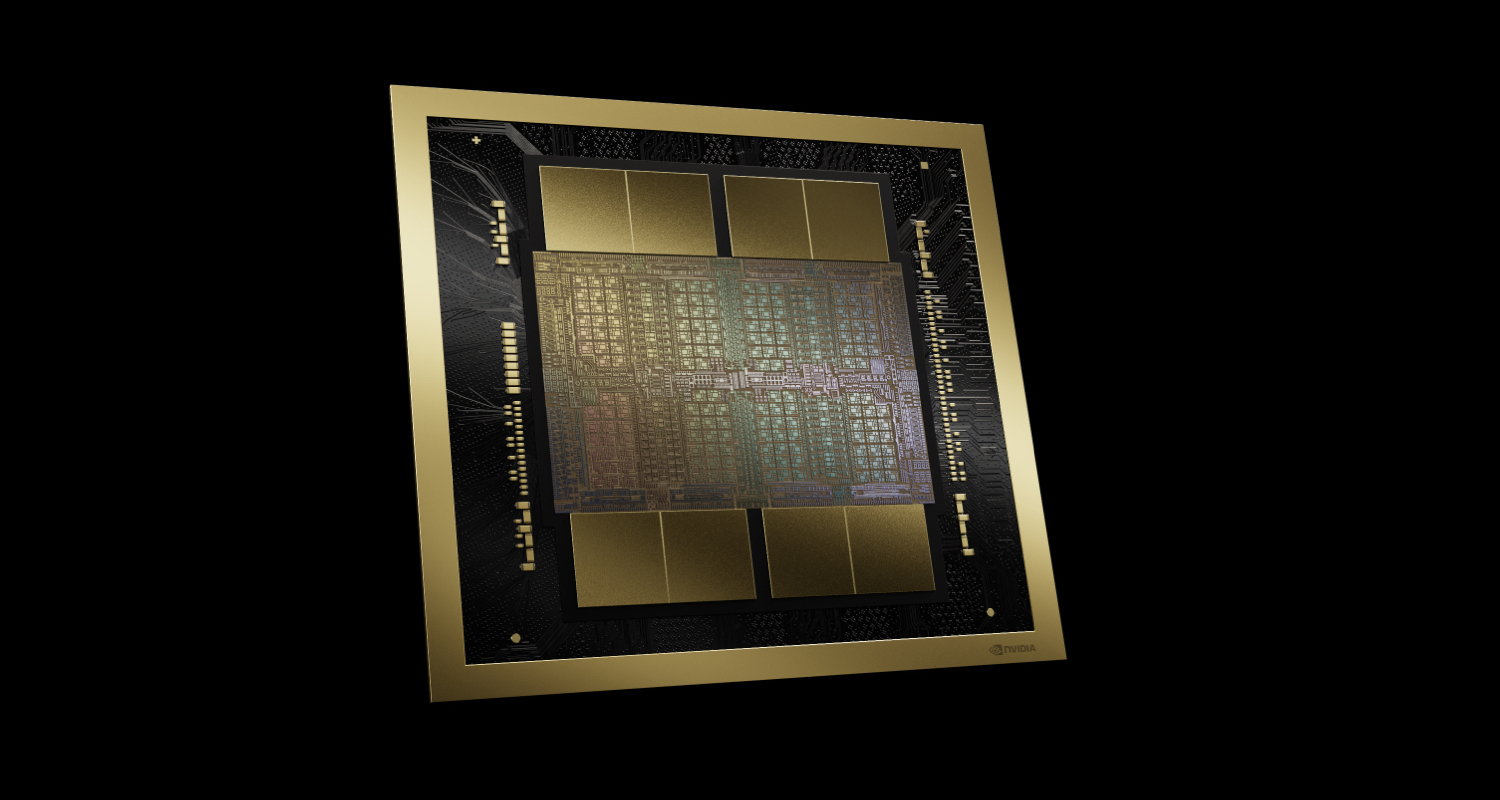
South African start-up Stratos Lab has begun deploying what it and its partners say will be the most powerful AI cloud on the continent, built on Nvidia’s latest shipping B300 “Blackwell Ultra” GPUs and hosted at a data centre in Centurion, north of Johannesburg. The stack will be up within three months.
Announced on Wednesday at the Activate AI conference in Cape Town, the venture pairs Stratos Lab as cloud operator, Dubai-based integrator Ecoblox and carrier-neutral operator Digital Parks Africa (DPA) as initial host. Taiwan’s Giga Computing, a Gigabyte company, is supplying the servers.
The first phase is 50 Giga Computing servers carrying 400 Nvidia B300 GPUs, eight to a server, which the partners put at 7.2 exaflops of combined throughput. Ecoblox interim CEO Doug Makishima said the order was placed about a month ago and the machines were completing final export-compliance checks with the Taiwanese authorities. “These GPUs are heavily export controlled by the US and Taiwanese governments,” he said, adding that Ecoblox expected them to ship “in two to three weeks” by air freight.
Stratos Lab CEO Chris Mostert said his team, with Ecoblox and DPA, will finalise the layout, cooling and power at DPA’s Samrand campus this week, and install the cluster in stages over five to six weeks. Makishima said Stratos Lab will later build its own sites using Ecoblox’s modular, container-based data centres.
Mostert put the initial investment at US$25-million, which Makishima said covers the GPU compute alone, with a further, unconfirmed US$25-million under discussion with a Mauritius-based bank on a matching basis. A second, not-yet-concluded order for 50 AMD-based GPU servers of “equivalent performance” will “almost double the capacity”.
Testing the claim
The partners are careful about the “most powerful” claim. Makishima acknowledged that rival Cassava Technologies, which spoke at the same conference, had more chips, but argued they were older Hopper-generation H100s and H200s against Stratos Lab’s newer Blackwell-class B300s.
“We’re building out B300s, Nvidia’s latest Blackwell architecture, so if you measure it based on eflops, we are by far the most powerful cluster coming online currently,” he said. (An eflop, or exaflop, is a measure of computer processing speed that means a computer can perform one quintillion (one followed by 18 zeros) calculations per second.)
Read: Traders brace for a R4.5-trillion swing in Nvidia’s value
The B300 began shipping in January 2026, and Nvidia has since unveiled its successor, Vera Rubin, due in the cloud in the second half of the year. Cassava has taken delivery of 3 000 GPUs in South Africa, with 12 000 planned across the continent.
The 7.2 eflops headline is a low-precision AI measure, not the double-precision maths that ranks the world’s supercomputers: it is the 50 servers’ 144 petaflops of FP4 each, 7 200 petaflops in total, or 7.2 eflops, since an exaflops is 1 000 petaflops.

On a like-for-like basis, the claim is harder to sustain. Restated in FP8, a higher-precision measure, that figure halves to about 3.6 eflops, while Cassava’s 3 000 Hopper GPUs, at about four petaflops of FP8 apiece, come to roughly 12 eflops, more than three times as much. B300s are far more capable per chip, rack and watt, so Makishima may have the narrower measure in mind, but on raw compute the smaller cluster does not lead. The companies said their chief technology officer would follow up with training-relevant figures; until then the comparison is unresolved.
Power, not floor space
The cluster is flexible across GPU-as-a-service, bare-metal and “agent-as-a-service” workloads, with the interconnect deciding whether it suits training or inference. Early customers were “heavily leaning towards inference”, Makishima said, though it could be reconfigured for training.
Each rack draws up to 65kW, far above standard compute, and is sealed with a rear-door heat exchanger tied to the building’s cooling loop. “That means they can stand shoulder-to-shoulder. So the only limitation is how much power the data centre can give us, not the floor space,” Makishima said.
Stratos Lab has signed one anchor customer, so far undisclosed, with others “lining up”. Mostert said the launch is deliberately ahead of demand. “I would rather go with the narrative that we’ve deployed more than we have customers for and that we’re happy to find new customers,” he said.
Sovereignty and switches
Both executives leaned on data sovereignty, a live policy theme as government weighs South Africa’s stance in the global AI race. Makishima argued local ownership reduced reliance on foreign clouds such as Amazon, Google and CoreWeave. Mostert said a South African institution could “block it off” so the hardware “stays in country and never leaves”, a strategic national resource.
Makishima said that, “as far as we know”, there were no backdoors to switch the GPUs off remotely once they left the factory. But US lawmakers have pushed to require location-tracking on exported AI chips, amid Washington’s tightening control over where its processors end up.
Mostert, a veteran of the local tech scene through the rAge computer expo, NAG magazine and internet service provider SciTech, said interest has been immediate. “Everybody that I tell about this, they just want a little piece of the GPU to run their model.” – © 2026 NewsCentral Media
- Subscribe to TechCentral’s daily newsletter
- Get breaking news alerts on WhatsApp