Close Menu
TechCentralTechCentral

    Subscribe to the newsletter

    Get the best South African technology news and analysis delivered to your e-mail inbox every morning.

    Facebook X (Twitter) YouTube LinkedIn
    WhatsApp Facebook X (Twitter) LinkedIn YouTube
    TechCentralTechCentral
    • News
      Netflix, Warner Bros talks raise fresh headaches for MultiChoice

      Netflix, Warner Bros talks raise fresh headaches for MultiChoice

      5 December 2025
      Big Microsoft 365 price increases coming next year

      Big Microsoft price increases coming next year

      5 December 2025
      Vodacom to take control of Safaricom in R36-billion deal - Shameel Joosub

      Vodacom to take control of Safaricom in R36-billion deal

      4 December 2025
      Black Friday goes digital in South Africa as online spending surges to record high

      Black Friday goes digital in South Africa as online spending surges to record high

      4 December 2025
      BYD takes direct aim at Toyota with launch of sub-R500 000 Sealion 5 PHEV

      BYD takes direct aim at Toyota with launch of sub-R500 000 Sealion 5 PHEV

      4 December 2025
    • World
      Amazon and Google launch multi-cloud service for faster connectivity

      Amazon and Google launch multi-cloud service for faster connectivity

      1 December 2025
      Google makes final court plea to stop US breakup

      Google makes final court plea to stop US breakup

      21 November 2025
      Bezos unveils monster rocket: New Glenn 9x4 set to dwarf Saturn V

      Bezos unveils monster rocket: New Glenn 9×4 set to dwarf Saturn V

      21 November 2025
      Tech shares turbocharged by Nvidia's stellar earnings

      Tech shares turbocharged by stellar Nvidia earnings

      20 November 2025
      Config file blamed for Cloudflare meltdown that disrupted the web

      Config file blamed for Cloudflare meltdown that disrupted the web

      19 November 2025
    • In-depth
      Jensen Huang Nvidia

      So, will China really win the AI race?

      14 November 2025
      Valve's Linux console takes aim at Microsoft's gaming empire

      Valve’s Linux console takes aim at Microsoft’s gaming empire

      13 November 2025
      iOCO's extraordinary comeback plan - Rhys Summerton

      iOCO’s extraordinary comeback plan

      28 October 2025
      Why smart glasses keep failing - no, it's not the tech - Mark Zuckerberg

      Why smart glasses keep failing – it’s not the tech

      19 October 2025
      BYD to blanket South Africa with megawatt-scale EV charging network - Stella Li

      BYD to blanket South Africa with megawatt-scale EV charging network

      16 October 2025
    • TCS
      TCS+ | How Cloud on Demand helps partners thrive in the AWS ecosystem - Odwa Ndyaluvane and Xenia Rhode

      TCS+ | How Cloud On Demand helps partners thrive in the AWS ecosystem

      4 December 2025
      TCS | MTN Group CEO Ralph Mupita on competition, AI and the future of mobile

      TCS | Ralph Mupita on competition, AI and the future of mobile

      28 November 2025
      TCS | Dominic Cull on fixing South Africa's ICT policy bottlenecks

      TCS | Dominic Cull on fixing South Africa’s ICT policy bottlenecks

      21 November 2025
      TCS | BMW CEO Peter van Binsbergen on the future of South Africa's automotive industry

      TCS | BMW CEO Peter van Binsbergen on the future of South Africa’s automotive industry

      6 November 2025
      TCS | Why Altron is building an AI factory - Bongani Andy Mabaso

      TCS | Why Altron is building an AI factory in Johannesburg

      28 October 2025
    • Opinion
      Your data, your hardware: the DIY AI revolution is coming - Duncan McLeod

      Your data, your hardware: the DIY AI revolution is coming

      20 November 2025
      Zero Carbon Charge founder Joubert Roux

      The energy revolution South Africa can’t afford to miss

      20 November 2025
      It's time for a new approach to government IT spend in South Africa - Richard Firth

      It’s time for a new approach to government IT spend in South Africa

      19 November 2025
      How South Africa's broken Rica system fuels murder and mayhem - Farhad Khan

      How South Africa’s broken Rica system fuels murder and mayhem

      10 November 2025
      South Africa's AI data centre boom risks overloading a fragile grid - Paul Colmer

      South Africa’s AI data centre boom risks overloading a fragile grid

      30 October 2025
    • Company Hubs
      • Africa Data Centres
      • AfriGIS
      • Altron Digital Business
      • Altron Document Solutions
      • Altron Group
      • Arctic Wolf
      • AvertITD
      • Braintree
      • CallMiner
      • CambriLearn
      • CYBER1 Solutions
      • Digicloud Africa
      • Digimune
      • Domains.co.za
      • ESET
      • Euphoria Telecom
      • Incredible Business
      • iONLINE
      • IQbusiness
      • Iris Network Systems
      • LSD Open
      • NEC XON
      • Netstar
      • Network Platforms
      • Next DLP
      • Ovations
      • Paracon
      • Paratus
      • Q-KON
      • SevenC
      • SkyWire
      • Solid8 Technologies
      • Telit Cinterion
      • Tenable
      • Vertiv
      • Videri Digital
      • Vodacom Business
      • Wipro
      • Workday
      • XLink
    • Sections
      • AI and machine learning
      • Banking
      • Broadcasting and Media
      • Cloud services
      • Contact centres and CX
      • Cryptocurrencies
      • Education and skills
      • Electronics and hardware
      • Energy and sustainability
      • Enterprise software
      • Financial services
      • Information security
      • Internet and connectivity
      • Internet of Things
      • Investment
      • IT services
      • Lifestyle
      • Motoring
      • Public sector
      • Retail and e-commerce
      • Satellite communications
      • Science
      • SMEs and start-ups
      • Social media
      • Talent and leadership
      • Telecoms
    • Events
    • Advertise
    TechCentralTechCentral
    Home » In-depth » Physicists prove ‘quantum spookiness’

    Physicists prove ‘quantum spookiness’

    By The Conversation26 October 2015
    Twitter LinkedIn Facebook WhatsApp Email Telegram Copy Link
    News Alerts
    WhatsApp
    It’s proven: the universe is weird. Robert Couse-Baker/Flickr. CC BY-ND
    It’s proven: the universe is weird. Robert Couse-Baker/Flickr. CC BY-ND

    The world of quantum mechanics is weird. Objects that are far apart can influence each other in what Albert Einstein called “spooky action at a distance”, and cats can potentially be dead and alive at the same time. For decades, scientists have tried to prove that these effects are not just mathematical quirks, but real properties of the physical world.

    And they are getting somewhere. Researchers have finally proven in a new study that the link between particles at a distance reflects how the universe behaves, rather than being an experimental artefact. Meanwhile, another team of researchers have set out to show that a living creature, albeit a bacterium, can be in two different quantum states at the same time — just like the cat in Schrödinger’s thought experiment.

    But let’s begin with the paper, published in Nature, which proves that the world is inherently spooky. All systems described by quantum mechanics can display so-called entanglement. For example, an electron, like a coin, can spin in two directions (up and down). But two electrons can be entangled so that a measurement of the spin of one electron will define the spin of the other.

    According to quantum mechanics, the spin of one electron cannot be known in advance of a measurement yet will be perfectly correlated with the other, even if it is in a distant location. Einstein didn’t like this because it seemed to imply that the information can be sent from one electron to the other instantaneously — breaking a rule that says nothing can travel faster than the speed of light. He instead thought that there were “hidden variables” encoded in each electron that could determine the result if only we could access them.

    But in the 1960s, Northern Irish scientist John Bell came up with a method to test Einstein’s theory. “Bell’s inequality” is satisfied only if actions in one location cannot affect another instantly and the outcomes of measurements are well defined beforehand — something dubbed “local realism”.

    Bell showed, theoretically, that quantum entanglement would violate his inequality test but local realist theories containing Einstein’s hidden variables would not. This is because the link between entangled particles is stronger than Einstein wanted to believe. So if the measured correlation between pairs of particles from an experiment was above a certain threshold, it would be incompatible with hidden variables and entanglement would win the day.

    The desire to test this in the lab has driven huge experimental advances in the 51 years since Bell’s paper. However, all implementations of Bell tests to date have contained loopholes that have left some wiggle room for the universe to obey local realist theories.

    One of these was that the efficiency of the measurements was too low (known as the detection loophole). Although the data obtained violated Bell’s inequality test, it may not be a representative sample of a complete set due because some photons in the experiment couldn’t be detected. Another loophole was that the measurements were too slow (the locality loophole). If the measurement devices were able to communicate via some unknown, slower-than-light channel they could share information and influence the outcome of the impending measurement.

    The new study is the first experiment to simultaneously close both of these loopholes in a test of Bell’s inequality. The scientists used a laser to make two specific electrons, each within a diamond located over 1km apart, to increase their energy and emit a particle of light (a photon), which was entangled with the state of the electron. The photons were then sent through an optical fibre to be united at a third location. If they arrived at just the same time, the photons would interact with each other and become entangled — meaning their remote electron buddies would become entangled, too.

    The electrons’ spins were then measured to test Bell’s inequality. The two loopholes were closed by ensuring that the efficiency and speed of the read-out were sufficiently high. As a result, the team were able to demonstrate conclusively that the universe does not obey local realism: the outcomes of measurements cannot be known in advance, and half of an entangled state can exert spooky action on its remote partner.

    Physics’ famous feline
    Entanglement is not the only type of unusual quantum behaviour. Another effect, known as superposition, is the ability of a particle to exist in two states (for example spin or even location) simultaneously, and is now regularly observed in laboratories around the world. For example, electrons have been known to travel through two slits at the same time — when we are not watching. The minute we observe each slit to catch this behaviour in action, the particle chooses just one.

    However, we do not directly observe these effects in daily life. For example, my glass cannot be in two places at once or I would struggle to drink. But because we don’t encounter such bizarre things, it would seem logical that at some scale things “switch over” from the weird world of the quantum to our familiar everyday.

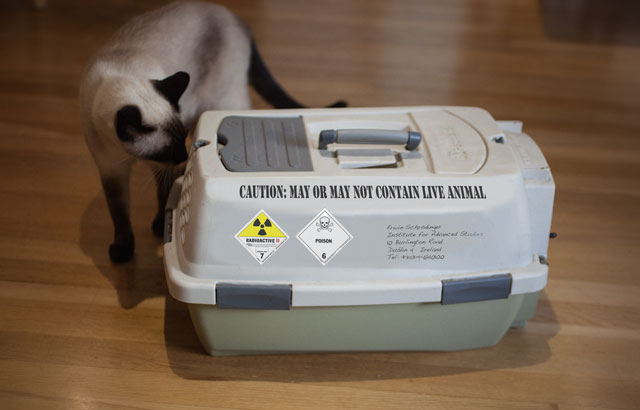
    But what is the scale at which this switch happens? If we had a technically perfect experiment, would we be able to observe large objects in these superposition states? This is the question posed by Schrödinger’s thought experiment in which a cat is placed in a sealed box with a flask of poison and a single radioactive atom, which will undergo decay at a random time. If the atom decays, the flask is broken and the cat is poisoned; if it does not, the cat lives on. By waiting for the atom to decay, does the cat exist in both states at once as the atom does? We know that when we open the box, we must find the cat alive or dead, but is it a property of the universe or the observer that makes the cat “choose” its state?

    Back to the team preparing to address this very question. Their proposal involves putting a bacterium rather than a cat in a state of superposition. Recent technical advances based on superconducting microwave resonators – devices used to detect radiation and for quantum computation – have enabled physicists to observe quantum effects in tiny flexible aluminium membranes (known as micromechanical oscillators) coupled to the circuits.

    Tiny membranes count as large objects in the world of quantum physics because, even with a mass of only 50 picograms (50 trillionth of a gram), they contain hundreds of billions of atoms. However, these resonators have to be cooled to within a fraction of absolute zero (-273°C) before any quantum behaviour emerges. Otherwise thermal vibrations mask the effects.

    The team plans to put a bacterium on top of such a membrane, which would then be cooled to its lowest state of energy. The membrane would then be placed into a superposition of two different states of motion: two different types of oscillations. They aim to show that the effect of the bacterium on the properties of the oscillator would be minimal, with the oscillator effectively behaving as if the bacterium were not there. In this way, the bacterium would effectively be in two states of motion at once. The researchers also plan to entangle the position of the bacterium with the spin of an electron inside it.

    The proposed experiment would be impressive — but mainly for showing that quantum mechanics holds true for objects bigger than subatomic particles. But it seems unlikely to answer whether Schrödinger’s cat can be alive and dead at the same time because the bacterium would remain in a constant glass-like state of cryopreservation. If this were the cat, it would exist in suspended animation rather than in a superposition of simultaneous life and death.The Conversation

    • Peter Mosley is lecturer in physics at the University of Bath
    • This article was originally published on The Conversation


    Albert Einstein John Bell Peter Mosley
    Subscribe to TechCentral Subscribe to TechCentral
    Share. Facebook Twitter LinkedIn WhatsApp Telegram Email Copy Link
    Previous ArticleUse Vodacom billions to fund varsities: DA
    Next Article Post Office fails to pay workers in full

    Related Posts

    Scientists discover universe is awash in gravitational waves

    29 June 2023

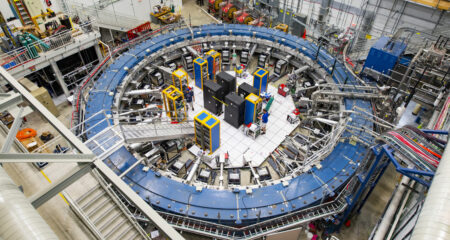
    The standard model of particle physics may be broken

    11 May 2022

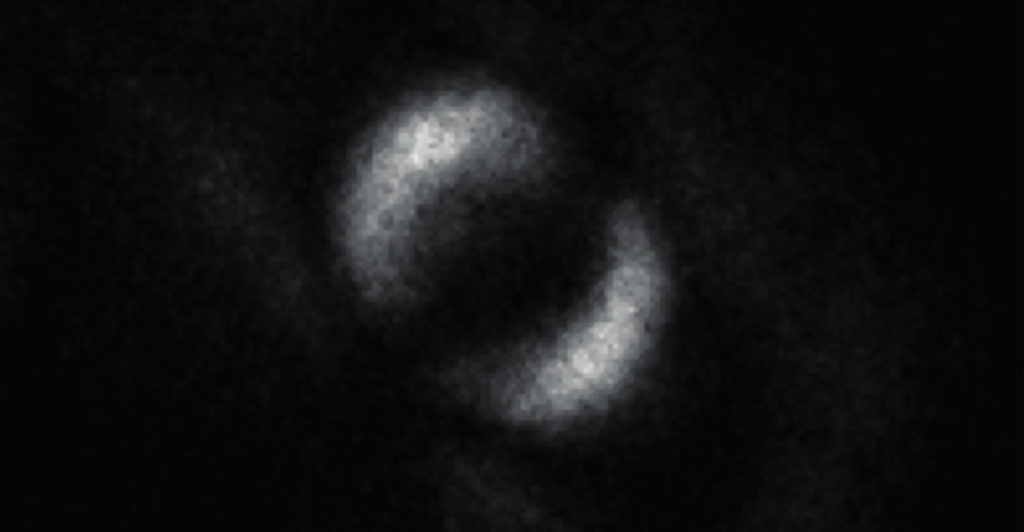
    Phenomenon that baffled Einstein is captured in photo for first time

    14 July 2019
    Company News
    Beat the summer heat with Samsung's WindFree air conditioners

    Beat the summer heat with Samsung’s WindFree air conditioners

    5 December 2025
    AI is not a technology problem - iqbusiness

    AI is not a technology problem – iqbusiness

    5 December 2025
    Telcos are sitting on a data gold mine - but few know what do with it - Phillip du Plessis

    Telcos are sitting on a data gold mine – but few know what do with it

    4 December 2025
    Opinion
    Your data, your hardware: the DIY AI revolution is coming - Duncan McLeod

    Your data, your hardware: the DIY AI revolution is coming

    20 November 2025
    Zero Carbon Charge founder Joubert Roux

    The energy revolution South Africa can’t afford to miss

    20 November 2025
    It's time for a new approach to government IT spend in South Africa - Richard Firth

    It’s time for a new approach to government IT spend in South Africa

    19 November 2025

    Subscribe to Updates

    Get the best South African technology news and analysis delivered to your e-mail inbox every morning.

    Latest Posts
    Beat the summer heat with Samsung's WindFree air conditioners

    Beat the summer heat with Samsung’s WindFree air conditioners

    5 December 2025
    Netflix, Warner Bros talks raise fresh headaches for MultiChoice

    Netflix, Warner Bros talks raise fresh headaches for MultiChoice

    5 December 2025
    Big Microsoft 365 price increases coming next year

    Big Microsoft price increases coming next year

    5 December 2025
    AI is not a technology problem - iqbusiness

    AI is not a technology problem – iqbusiness

    5 December 2025
    © 2009 - 2025 NewsCentral Media
    • Cookie policy (ZA)
    • TechCentral – privacy and Popia

    Type above and press Enter to search. Press Esc to cancel.

    Manage consent

    TechCentral uses cookies to enhance its offerings. Consenting to these technologies allows us to serve you better. Not consenting or withdrawing consent may adversely affect certain features and functions of the website.

    Functional Always active
    The technical storage or access is strictly necessary for the legitimate purpose of enabling the use of a specific service explicitly requested by the subscriber or user, or for the sole purpose of carrying out the transmission of a communication over an electronic communications network.
    Preferences
    The technical storage or access is necessary for the legitimate purpose of storing preferences that are not requested by the subscriber or user.
    Statistics
    The technical storage or access that is used exclusively for statistical purposes. The technical storage or access that is used exclusively for anonymous statistical purposes. Without a subpoena, voluntary compliance on the part of your Internet Service Provider, or additional records from a third party, information stored or retrieved for this purpose alone cannot usually be used to identify you.
    Marketing
    The technical storage or access is required to create user profiles to send advertising, or to track the user on a website or across several websites for similar marketing purposes.
    • Manage options
    • Manage services
    • Manage {vendor_count} vendors
    • Read more about these purposes
    View preferences
    • {title}
    • {title}
    • {title}