Close Menu
TechCentralTechCentral

    Subscribe to the newsletter

    Get the best South African technology news and analysis delivered to your e-mail inbox every morning.

    Facebook X (Twitter) YouTube LinkedIn
    WhatsApp Facebook X (Twitter) LinkedIn YouTube
    TechCentralTechCentral
    • News
      Two telcos, $1-trillion and two very different fintech bets - Vodacom and MTN

      Two telcos, $1-trillion and two very different fintech bets

      21 May 2026
      There's an oddity hiding in South Africa's EV market

      There’s an oddity hiding in South Africa’s EV market

      21 May 2026
      Rica blindspot exposed

      Rica blindspot exposed

      21 May 2026
      Nvidia does it again - Jensen Juang

      Nvidia does it again

      21 May 2026
      Starlink satellites being blasted into space aboard a SpaceX Falcon 9 rocket in a file photograph

      SpaceX wants to fly a rocket every 53 minutes

      21 May 2026
    • World
      SpaceX's record-setting IPO is here

      SpaceX’s record-setting IPO is here

      21 May 2026
      Vatican confronts the age of artificial intelligence. Edgar Beltrán/The Pillar 

      Vatican confronts the age of artificial intelligence

      19 May 2026
      The walkout that could hit every laptop and AI server - Samsung

      The walkout that could hit every laptop and AI server

      18 May 2026
      Pop star sues Samsung for $15-million - Dua Lipa

      Pop star sues Samsung for $15-million

      11 May 2026
      OpenAI's new audio APIs aim for conversational voice agents

      OpenAI’s new audio APIs aim for conversational voice agents

      8 May 2026
    • In-depth
      Alfa's electric rebel - Alfa Romeo Junior Elettrica Veloce

      Alfa’s electric rebel

      29 April 2026
      Africa switches on as Europe dims the lights

      Africa switches on as Europe dims the lights

      9 April 2026
      The biggest untapped EV market on Earth is hiding in plain sight

      The biggest untapped EV market on Earth is hiding in plain sight

      1 April 2026
      Datatec is firing on all cylinders - Jens Montanana

      The R16-billion tech giant hiding in plain sight

      26 March 2026
      The last generation of coders

      The last generation of coders

      18 February 2026
    • TCS
      TCS+ | The Up&Up Group on the hidden cost of AI - Jason Harrison

      TCS+ | The Up&Up Group on the hidden cost of AI

      13 May 2026
      Michael Rossouw

      TCS+ | The retirement decision most South Africans get wrong

      6 May 2026
      TCS | The Cape Town start-up listening for TB with AI - Braden van Breda

      TCS | The Cape Town start-up listening for TB with AI

      4 May 2026

      TCS+ | ‘The ISP for ISPs’: Vox’s shift to wholesale aggregator

      20 April 2026
      TCS | Werner Lindemann on how AI is rewriting the infosec rulebook

      TCS | Werner Lindemann on how AI is rewriting the infosec rulebook

      15 April 2026
    • Opinion
      AI won't fix your culture - it will expose it - Jackie Kennedy

      AI won’t fix your culture – it will expose it

      19 May 2026
      Free calls, dead voice and Shameel Joosub's Spanish ghost - Duncan McLeod

      Free calls, dead voice and Shameel Joosub’s Spanish ghost

      22 April 2026
      The conflict of interest at the heart of PayShap's slow adoption - Cheslyn Jacobs

      The conflict of interest at the heart of PayShap’s slow adoption

      26 March 2026
      South Africa's energy future hinges on getting wheeling right - Aishah Gire

      South Africa’s energy future hinges on getting wheeling right

      10 March 2026
      Free calls, dead voice and Shameel Joosub's Spanish ghost - Duncan McLeod

      Apple just dropped a bomb on the Windows world

      5 March 2026
    • Company Hubs
      • 1Stream
      • Africa Data Centres
      • AfriGIS
      • Altron Digital Business
      • Altron Document Solutions
      • Altron Group
      • Arctic Wolf
      • Ascent Technology
      • AvertITD
      • BBD
      • Braintree
      • CallMiner
      • CambriLearn
      • CM Telecom
      • Contactable
      • CYBER1 Solutions
      • Digicloud Africa
      • Digimune
      • Domains.co.za
      • ESET
      • Euphoria Telecom
      • HOSTAFRICA
      • Incredible Business
      • iONLINE
      • IQbusiness
      • Iris Network Systems
      • Kaspersky
      • LSD Open
      • Mitel
      • NEC XON
      • Netstar
      • Network Platforms
      • Next DLP
      • Ovations
      • Paracon
      • Paratus
      • Q-KON
      • SevenC
      • SkyWire
      • Solid8 Technologies
      • Telit Cinterion
      • Telviva
      • Tenable
      • Vertiv
      • Videri Digital
      • Vodacom Business
      • Wipro
      • Workday
      • XLink
    • Sections
      • AI and machine learning
      • Banking
      • Broadcasting and Media
      • Cloud services
      • Contact centres and CX
      • Cryptocurrencies
      • Education and skills
      • Electronics and hardware
      • Energy and sustainability
      • Enterprise software
      • Financial services
      • HealthTech
      • Information security
      • Internet and connectivity
      • Internet of Things
      • Investment
      • IT services
      • Lifestyle
      • Motoring
      • Policy and regulation
      • Public sector
      • Retail and e-commerce
      • Satellite communications
      • Science
      • SMEs and start-ups
      • Social media
      • Talent and leadership
      • Telecoms
    • Events
    • Advertise
    TechCentralTechCentral
    Home » Opinion » Alison Gillwald » SA fails test of network society

    SA fails test of network society

    By Editor12 October 2011
    Twitter LinkedIn Facebook WhatsApp Email Telegram Copy Link
    News Alerts
    WhatsApp

    [By Alison Gillwald]

    Ten years ago, world-renowned academic and activist Manuel Castells came to SA. It was not long after the publication of his seminal trilogy on the rise of the network society. From Silicon Valley to Yokohama, he had tracked the ways states can accelerate the technological modernisation of economies — in some cases transforming the fate of nations within a few years.

    Castells compared such states with those, such as Russia, that retarded their national progress. He concluded pessimistically, in his final volume, that Africa’s pervasive predatory states stalled development by denying citizens participation in the informational economy. So endemic was this condition, he argued, that not even the democratic and developmental forces then emerging in SA would pull the region out of underdevelopment.

    We were still flushed with our miraculous transition to democracy. The first G8 meeting ever held in the South — and focusing on information and communications technology and development — had recently been hosted in SA by Thabo Mbeki, then deputy president. At a two-day seminar organised by the University of Cape Town’s Centre for Higher Education and Training, featuring some of the country’s leading economists, new policymakers and liberation intellectuals, we challenged Castells’s pessimistic view.

    A more equitable society would include the participatory opening up of the communications sector. SA would ensure universal access to this brave new digital world and lead the region, in the flying-geese formation for which Japan was famous in the East Asian region, to developmental heights — so some of us argued, and Castells was tentatively persuaded.

    Soon after that, as if to confirm our conviction, both a National Presidential Commission on the Information Society and Development and an International Presidential Advisory Council were established. The latter included all the biggest commercial, entrepreneurial and academic names in technology globally, including Castells.

    But neither institution was able to stave off SA’s steady descent, over the next decade, down various global technology indices. Of 138 countries measured in the World Economic Forum e-Readiness Report, SA fell from 34th in 2004 to 61st in 2009 and was ranked 95th in terms of ICT usage. On the International Telecommunications Development Index, which also measures multiple factors contributing to information-society development, including infrastructure and access, the intensity of ICT use and ICT capability or skills, SA has slipped from 77th in 2002 to 91st in 2007.

    ‘Managed liberalisation’
    The advice of international experts remained unheeded. SA clung to its failing policy of “managed liberalisation”, which constrained competition, despite evidence that the global demand for affordable services was being met best through effectively regulated competitive markets. The international presidential advisory body petered out.

    Flawed institutional arrangements in the sector compromised regulatory effectiveness. The absence of political leadership, after the first rush of reform in the sector, led to key state institutions being unable to attract or retain the skills to direct and regulate this key infrastructure industry, with its monopolistic and duopolistic legacies.

    The ICT sector in SA entered a decade-long period of policy and regulatory paralysis in which decision-making and administrative justice were ultimately abdicated to the courts. Castells, meanwhile, published more globally read texts expounding his central concept of “informationalism” — the mode of production of the advanced stage of capitalism, distinguishable from the previous industrial era by “the action of knowledge upon knowledge itself” as the main source of productivity.

    Last month, Castells returned to SA. A decade after his first visit, in another two-day seminar at Cape Town’s Centre for Higher Education and Training, he once more engaged with us on our informational development and the harnessing of these creatively destructive technologies and their global networks in the service of wider economic, political and social gains.

    Gone was our naive conviction that the miracle nation could overcome all. The impact of the global recession, structural unemployment, the human and economic cost of HIV/Aids, and the political discontent arising from the economic marginalisation of so many brought our idealism face to face with reality.

    In that seminar, 10 years after the first, Castells concluded that there had been no informational development, or the human development on which it depended; indeed, it seemed that, in global comparative terms, there was retardation.

    Particularly bleak was the slow pace, even regression, in some areas of human development — a necessary condition for informational development. The figures for basic indicators such as life expectancy are devastatingly low. There is a severe shortage of higher-level skills and institutional capacity in areas crucial to building a globally competitive knowledge economy.

    In Japan, South Korea, Singapore and the Scandinavian countries, today’s leading informational economies, the state played a central role in developing a forceful supply-side policy. It invested in education — critical to citizens’ ability to adjust to technological change. Such states created the conditions for extensive investment in telecommunications and (now, particularly) broadband infrastructure.

    Far from leading the flying-geese formation for developmental take-off of the region, SA has been overtaken as the continental leader on many ICT indicators. The most noteworthy is broadband, where penetration rates in some North African and island states way exceed SA’s.

    There is increasing evidence of links between broadband penetration and economic growth. Thus SA’s poor performance in this area is cause for great concern. A 2010 global survey by the World Bank indicated that a 10% increase in broadband penetration results in a 1,38% increase in GDP. Today, a greater number of South Africans have Internet access at work and school than before, but we have one of the highest GDPs per capita in Africa and only 5% broadband penetration. We have not reached the critical mass of connections, estimated to be around 20%, for the “network effects” and associated positive multipliers to kick in and stimulate economic growth.

    Today, ICT and broadband networks are at the core of economic-recovery strategies from the US to Australia, from Singapore to Mauritius. Yet they are little more than a footnote in the diagnostic report of SA’s National Planning Commission. The New Growth Path contains a two-line reference. In both, ICT is very narrowly conceived — as an industrial-age communications infrastructure for commercial distribution and regional integration. ICT’s transformative potential to drive productivity, to stimulate growth and employment, and to enable democracy is largely ignored.

    • Alison Gillwald is executive director of research at ICT Africa and adjunct professor at UCT’s GSB Infrastructure Reform and Regulation Programme
    • First published in the Mail & Guardian. Visit the Mail & Guardian Online, the smart news source
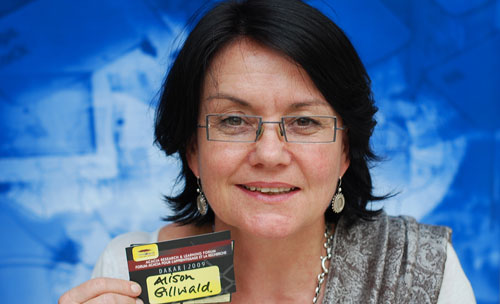
    • Image of Gillward courtesy of the Acacia Learning Forum
    • Subscribe to our free daily newsletter
    • Follow us on Twitter or on Facebook
    • Visit our sister website, SportsCentral (still in beta)

    Follow TechCentral on Google News Add TechCentral as your preferred source on Google


    Alison Gillwald Manuel Castells Thabo Mbeki
    WhatsApp YouTube
    Share. Facebook Twitter LinkedIn WhatsApp Telegram Email Copy Link
    Previous ArticleM-Net and e.tv go to war over digital TV
    Next Article BlackBerry offers explanation for service failure

    Related Posts

    A shift in South Africa's communications landscape - Richard Firth

    Telkom urges Icasa to scrap call termination fees completely

    12 December 2024
    State of the nation: stage 4

    Private sector shielding SA from further collapse

    21 July 2023
    ANC's attack on Solly Malatsi shows how BEE dogma trumps economic reality - Duncan McLeod

    Minister Ntshavheni is at risk of tripping up

    24 March 2022
    Company News
    South Africa's operators can fix Rica - and win big doing it - Contactable

    South Africa’s operators can fix Rica – and win big doing it

    21 May 2026
    Check Point swaps static rules for agentic AI - Jonathan Zanger

    Check Point swaps static rules for agentic AI

    21 May 2026
    Anatomy of a reset: why the helpdesk is now the breach - Specops Software

    Anatomy of a reset: why the helpdesk is now the breach

    21 May 2026
    Opinion
    AI won't fix your culture - it will expose it - Jackie Kennedy

    AI won’t fix your culture – it will expose it

    19 May 2026
    Free calls, dead voice and Shameel Joosub's Spanish ghost - Duncan McLeod

    Free calls, dead voice and Shameel Joosub’s Spanish ghost

    22 April 2026
    The conflict of interest at the heart of PayShap's slow adoption - Cheslyn Jacobs

    The conflict of interest at the heart of PayShap’s slow adoption

    26 March 2026

    Subscribe to Updates

    Get the best South African technology news and analysis delivered to your e-mail inbox every morning.

    Latest Posts
    Two telcos, $1-trillion and two very different fintech bets - Vodacom and MTN

    Two telcos, $1-trillion and two very different fintech bets

    21 May 2026
    South Africa's operators can fix Rica - and win big doing it - Contactable

    South Africa’s operators can fix Rica – and win big doing it

    21 May 2026
    There's an oddity hiding in South Africa's EV market

    There’s an oddity hiding in South Africa’s EV market

    21 May 2026
    Rica blindspot exposed

    Rica blindspot exposed

    21 May 2026
    © 2009 - 2026 NewsCentral Media
    • Cookie policy (ZA)
    • TechCentral – privacy and Popia

    Type above and press Enter to search. Press Esc to cancel.

    Manage consent

    TechCentral uses cookies to enhance its offerings. Consenting to these technologies allows us to serve you better. Not consenting or withdrawing consent may adversely affect certain features and functions of the website.

    Functional Always active
    The technical storage or access is strictly necessary for the legitimate purpose of enabling the use of a specific service explicitly requested by the subscriber or user, or for the sole purpose of carrying out the transmission of a communication over an electronic communications network.
    Preferences
    The technical storage or access is necessary for the legitimate purpose of storing preferences that are not requested by the subscriber or user.
    Statistics
    The technical storage or access that is used exclusively for statistical purposes. The technical storage or access that is used exclusively for anonymous statistical purposes. Without a subpoena, voluntary compliance on the part of your Internet Service Provider, or additional records from a third party, information stored or retrieved for this purpose alone cannot usually be used to identify you.
    Marketing
    The technical storage or access is required to create user profiles to send advertising, or to track the user on a website or across several websites for similar marketing purposes.
    • Manage options
    • Manage services
    • Manage {vendor_count} vendors
    • Read more about these purposes
    View preferences
    • {title}
    • {title}
    • {title}