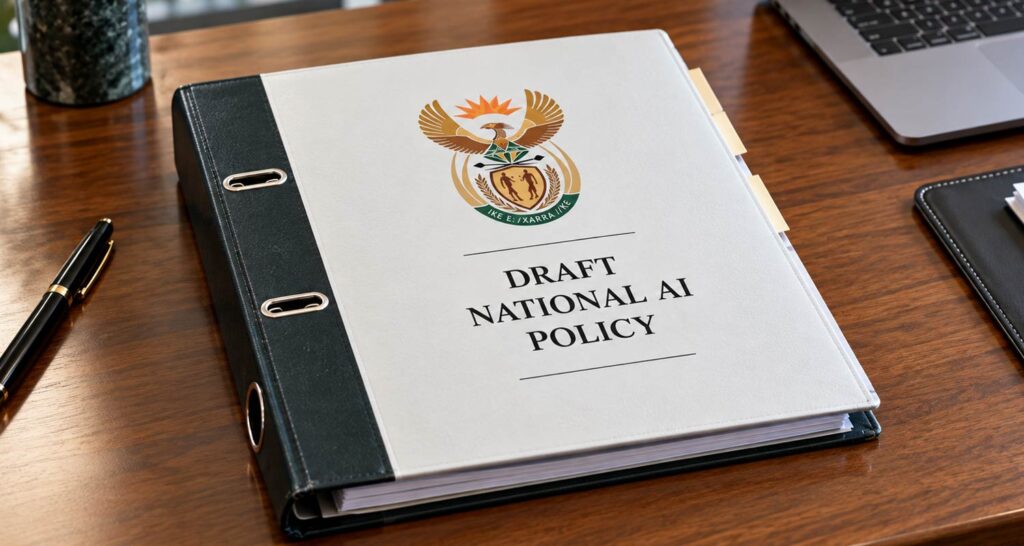
Officials from the department rewriting South Africa’s national AI policy told parliament’s communications committee they had no mandate to brief MPs on it, prompting the committee’s chair to ask who was actually running the department.
The department of communications & digital technologies was due on 17 November to update the committee on its redraft of the policy, which communications minister Solly Malatsi withdrew in April after fictitious references were found in it, according to a Parliamentary Monitoring Group report of the meeting.
But the acting director-general, Gcobisa Soci, was at the Africa Tech Festival, where she was assisting the deputy minister. Jeanette Morwane, the deputy director-general responsible for the policy, told MPs she faced the same problem as a colleague who had said he was not mandated to lead the delegation. The committee deferred the item, along with an update on Icasa’s performance management system.
The DA’s Tsholofelo Bodlani called the department’s handling of the meeting unacceptable and disrespectful. Committee chair Khusela Sangoni Diko said MPs often found the director-general travelling abroad when they expected the DG at meetings, and that members were asking who was running the department. The committee will write to the department for an explanation.
The drafting team has until 30 November to submit the revised policy to the minister, and the department aims to take it to cabinet by March 2027, months later than first promised.
An AI Act for South Africa
The same meeting heard a proposal from committee researcher Khanyisani Xulu for a dedicated South African AI Act. His position paper sets out five pillars:
- Prohibiting AI practices that threaten constitutional rights;
- Regulating AI according to risk;
- Requiring organisations that build or deploy AI to put governance and compliance measures in place;
- Keeping humans “in command” of significant decisions; and
- Making high-impact AI systems able to show how they reached an output, with independent audits.
That last requirement is what the paper presents as South Africa’s possible contribution to global AI governance. Xulu argued that existing frameworks, including the EU’s, regulate AI outputs and risk levels but don’t adequately address how systems reach their decisions.
The paper does not propose a new regulator. Instead, an AI Regulators Forum would coordinate Icasa, the Information Regulator, the Competition Commission, the National Consumer Commission and sector regulators, with parliament overseeing it through a joint committee on AI.
MPs welcomed the research but raised concerns about overlapping regulators, whether complex AI systems can realistically be audited and the risk that heavy regulation would stifle innovation. The DA’s Adrian Roos questioned a proposed technical reproducibility requirement that he said no other jurisdiction imposes. The paper is a starting point for the committee’s thinking, not its agreed position.
Icasa council seats
The committee also agreed to widen the search for candidates to fill four vacancies on Icasa’s council, after five of the 23 shortlisted candidates withdrew and one was disqualified for failing to provide copies of the qualifications listed on their CV. Fifteen have been interviewed.
Parliament said on 19 November that six additional candidates would be considered alongside two who had been unavailable for interviews, with public comment open until Thursday, 26 November. The appointments must be completed by the end of February 2027. – (c) 2026 NewsCentral Media