Close Menu
TechCentralTechCentral

    Subscribe to the newsletter

    Get the best South African technology news and analysis delivered to your e-mail inbox every morning.

    Facebook X (Twitter) YouTube LinkedIn
    WhatsApp Facebook X (Twitter) LinkedIn YouTube
    TechCentralTechCentral
    • News
      Truecaller cooperating with Info Regulator's Popia probe

      Truecaller cooperating with Info Regulator’s Popia probe

      25 March 2026
      Why Namibia slammed the door on Starlink

      Why Namibia slammed the door on Starlink

      25 March 2026
      Podcasters push back against regulatory overreach

      Podcasters push back against regulatory overreach

      25 March 2026
      Maziv plots fibre expansion blitz - Dietlof Mare

      Maziv plots fibre expansion blitz

      25 March 2026
      Jury finds Meta enabled child exploitation

      Jury finds Meta enabled child exploitation

      25 March 2026
    • World
      It's official: ads are coming to ChatGPT

      It’s official: ads are coming to ChatGPT

      23 March 2026
      Mystery Chinese AI model revealed to be Xiaomi's

      Mystery Chinese AI model revealed to be Xiaomi’s

      19 March 2026
      A mystery AI model has developers buzzing

      A mystery AI model has developers buzzing

      18 March 2026
      Samsung's trifold gamble ends in retreat

      Samsung’s trifold gamble ends in retreat

      17 March 2026
      Nvidia targets $1-trillion in AI chip sales as inference demand surges - Jensen Huang

      Nvidia targets $1-trillion in AI chip sales as inference demand surges

      17 March 2026
    • In-depth
      The last generation of coders

      The last generation of coders

      18 February 2026
      Sentech is in dire straits

      Sentech is in dire straits

      10 February 2026
      How liberalisation is rewiring South Africa's power sector

      How liberalisation is rewiring South Africa’s power sector

      21 January 2026
      The top-performing South African tech shares of 2025

      The top-performing South African tech shares of 2025

      12 January 2026
      Digital authoritarianism grows as African states normalise internet blackouts

      Digital authoritarianism grows as African states normalise internet blackouts

      19 December 2025
    • TCS
      Meet the CIO | HealthBridge CTO Anton Fatti on the future of digital health

      Meet the CIO | Healthbridge CTO Anton Fatti on the future of digital health

      23 March 2026
      TCS+ | Arctic Wolf unpacks the evolving threat landscape for SA businesses - Clare Loveridge and Jason Oehley

      TCS+ | Arctic Wolf unpacks the evolving threat landscape for SA businesses

      19 March 2026
      TCS+ | Vox Kiwi: a wireless solution promising a fibre-like experience - Theo van Zyl

      TCS+ | Vox Kiwi: a wireless solution promising a fibre-like experience

      13 March 2026
      TCS+ | Flipping the narrative on AI in the Global South - Josefin Rosén

      TCS+ | Flipping the narrative on AI in the Global South

      13 March 2026
      TCS | Sink or swim? Antony Makins on how AI is rewriting the rules of work

      TCS | Sink or swim? Antony Makins on how AI is rewriting the rules of work

      5 March 2026
    • Opinion
      South Africa's energy future hinges on getting wheeling right - Aishah Gire

      South Africa’s energy future hinges on getting wheeling right

      10 March 2026
      Hold the doom: the case for a South African comeback - Duncan McLeod

      Apple just dropped a bomb on the Windows world

      5 March 2026
      VC's centre of gravity is shifting - and South Africa is in the frame - Alison Collier

      VC’s centre of gravity is shifting – and South Africa is in the frame

      3 March 2026
      Hold the doom: the case for a South African comeback - Duncan McLeod

      Hold the doom: the case for a South African comeback

      26 February 2026
      The AI fraud crisis your bank is not ready for - Andries Maritz

      The AI fraud crisis your bank is not ready for

      18 February 2026
    • Company Hubs
      • 1Stream
      • Africa Data Centres
      • AfriGIS
      • Altron Digital Business
      • Altron Document Solutions
      • Altron Group
      • Arctic Wolf
      • Ascent Technology
      • AvertITD
      • Braintree
      • CallMiner
      • CambriLearn
      • CYBER1 Solutions
      • Digicloud Africa
      • Digimune
      • Domains.co.za
      • ESET
      • Euphoria Telecom
      • HOSTAFRICA
      • Incredible Business
      • iONLINE
      • IQbusiness
      • Iris Network Systems
      • LSD Open
      • Mitel
      • NEC XON
      • Netstar
      • Network Platforms
      • Next DLP
      • Ovations
      • Paracon
      • Paratus
      • Q-KON
      • SevenC
      • SkyWire
      • Solid8 Technologies
      • Telit Cinterion
      • Tenable
      • Vertiv
      • Videri Digital
      • Vodacom Business
      • Wipro
      • Workday
      • XLink
    • Sections
      • AI and machine learning
      • Banking
      • Broadcasting and Media
      • Cloud services
      • Contact centres and CX
      • Cryptocurrencies
      • Education and skills
      • Electronics and hardware
      • Energy and sustainability
      • Enterprise software
      • Financial services
      • HealthTech
      • Information security
      • Internet and connectivity
      • Internet of Things
      • Investment
      • IT services
      • Lifestyle
      • Motoring
      • Policy and regulation
      • Public sector
      • Retail and e-commerce
      • Satellite communications
      • Science
      • SMEs and start-ups
      • Social media
      • Talent and leadership
      • Telecoms
    • Events
    • Advertise
    TechCentralTechCentral
    Home » In-depth » SA makes astronomical advances

    SA makes astronomical advances

    By Editor23 December 2011
    Twitter LinkedIn Facebook WhatsApp Email Telegram Copy Link
    News Alerts
    WhatsApp
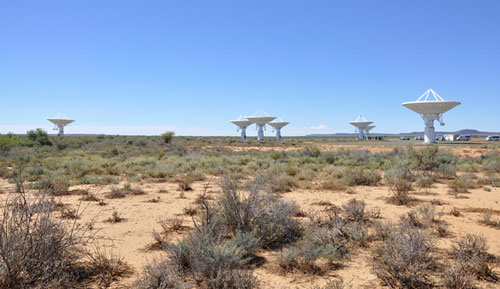
    KAT-7 in the Karoo

    In a bus jouncing through arid Karoo hills, Prof Justin Jonas patiently tried to explain some of the theories and tenets of our universe — the Big Bang, the expansion of our universe and what we know of other things such as dark energy. “The latest Nobel prize in physics was basically for confirming that there is something that we call dark energy,” Jonas said. He summed it up later as the force that drives not just the expansion of our universe but also its acceleration.

    Difficult as these concepts may be for the layman to grasp, they are among the things the massive Square Kilometre Array (SKA) radio tele­scope could help us to understand — along with how the stars were formed, the nature of black holes and whether there is any other life out there.

    Jonas, a radio astronomer from Rhodes University, has been intimately involved in SA’s bid to host the telescope. He is the associate director for science and engineering on the project. Since 2006, SA has been in a punishing race against Australia and New Zealand to host the SKA, with the final specifications for the bid submitted in September.

    Until recently, the project was run by an international steering committee but in early November it was replaced by the non-profit SKA Organisation, which is housed in Manchester, in the UK. It is comprised of seven partner countries, namely SA, Australia, China, Italy, New Zealand, the Netherlands and the UK.

    There are several points in Australia’s favour. It is a developed nation and, as deputy science & technology minister Derek Hanekom told journalists, “Afro-pessimism” may work against SA. Australia also has a laudable academic base in radio astronomy.

    But Jonas argued with a quiet determination, as have many of his colleagues and political principals, that the work SA had done just to bid for the telescope had advanced our country’s expertise, skill and capability by the leaps and bounds necessary to make us more than a worthy contender.
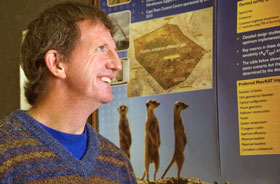
    Prof Justin Jonas

    Part of this preparation has been the building of the Karoo Array Telescope (KAT-7). That is where our dusty bus trip took us. The KAT-7 is in a radio-quiet zone an hour out of the tiny hamlet of Carnavon — devoid of the noise made by cellphones, televisions and other modern conveniences ubiquitous to modern cities or towns. Even the power lines to this part of the world have been specially developed to avoid creating radio-frequency interference.

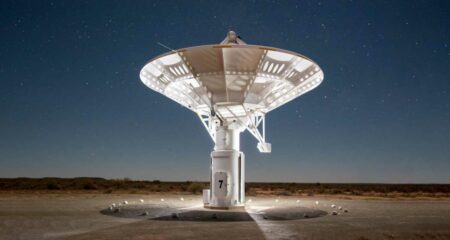
    Sheltered by surrounding hills, the region is further protected by the Astronomy Geographic Advantage Act, which places the value of the radio astronomy work being done here above that of all other developments or potential developments. The KAT-7 (seven radio telescopes, all designed and built by SA endeavour) are trained on the quiet sky, rising out of the dust like strange white blooms.

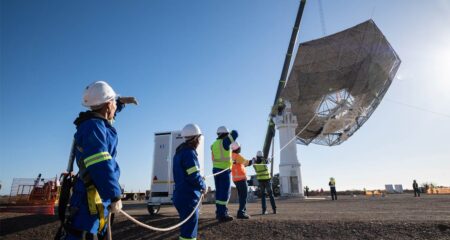
    The KAT-7 is the prototype for MeerKAT (“more KAT”), SA’s version of the SKA pathfinder. The antennae will listen for radio waves travelling from so far away that they would provide a look back in time. The MeerKAT will consist of 64 telescopes and is due to come online for scientific observations by 2016.

    Should SA win the SKA bid, more than 2 000 similar receivers will form a pinwheel across this landscape and stretch to Botswana, Namibia, Ghana, Kenya, Madagascar, Mauritius, Mozambique and Zambia. The site, despite its remoteness, is accessible by plane and car. It has significant infrastructure in the form of computer hardware and fibre-optic networks, all carefully buried or sealed off to maintain a radio quiet zone.

    Enormous amounts of data will be generated by the SKA and both the computer processing technology and human capacity to harness it is being beefed up. “It’s going to be a challenge. To have that computer power is one thing, to harness it is another,” said Jonas. “Even for MeerKAT, we are developing new techniques and algorithms to handle the data.”

    But there are tougher questions than deciding between SA and Australia as a site for the SKA. For the project to go ahead, it will cost at least €1,5bn. The participating countries in the SKA Organisation have committed to an initial outlay of €69m, but where the rest of the money will come from is still to be determined.

    Meanwhile, MeerKAT, already budgeted for by the department of science & technology, will become the largest radio telescope in the southern hemisphere. Together, KAT-7, MeerKAT and the work done in preparation for the SKA, from upgrading roads to the site to bursaries, will cost SA R2bn.

    Already, five years of observing time have been booked by radio astronomers from around the world applying to do research on the instrument, many with similarly quirky acronyms that house wordy scientific titles. There is Laduma (Looking at the Distant Universe with the MeerKAT Array), Mhongoose (MeerKAT HI Observations of Nearby Galactic Objects: Observing Southern Emitters), Mightee (MeerKAT International Gigahertz Tiered Extragalactic Exploration Survey) and finally ThunderKAT (The Hunt for Dynamic and Explo­sive Radio Transients with MeerKAT).

    Artist's impression of MeerKAT

    The bid for the SKA has also boosted SA’s scientific expertise. More than 300 postgraduate bursaries have been granted through SKA SA and five research chairs have been established at local universities to aid the research and development of the telescope.

    The engineering and scientific work done to develop KAT-7 and MeerKat is already being applied in other scientific arenas. The work leading up to MeerKAT has seen the development of the reconfigurable open architecture computing hardware (Roach) board, which enables specialised, super-fast computing.

    According to Jonas, the Roach board is being developed for genome sequencing at the University of Cape Town. The infrastructure and conditions in the Karoo are so ideal that they have attracted other experiments such as the US-led Paper (precision array to probe the epoch of reionisation) research, which is searching for the moment the first stars formed about 13bn years ago.

    Arguably, this could be seen as competition to the SKA, said Jonas. But, far from seeing it as a threat, Jonas was philosophical about it. It was, he said, “the risk you run in science”. But it was also evidence that the country was conducive to institutions doing cutting-edge work.

    He said SA was providing digital signal processing work to Paper and the Karoo site team was providing infrastructural and technical support. The adage “build it and they will come” had worked, said Jonas, given the amount of international interest the MeerKAT alone had generated. “It comes all the way from government policy and it works,” Jonas said. It had been important to set realistic goals and not to oversell the programme. “Do not overrun schedules and budgets and, as long as you see success, money will be made available,” said Jonas.  — Lynley Donnelly, Mail & Guardian

    • Visit the Mail & Guardian Online, the smart news source
    • Subscribe to our free daily newsletter
    • Follow us on Twitter or on Google+ or on Facebook
    • Visit our sister website, SportsCentral (still in beta)

    Follow TechCentral on Google News Add TechCentral as your preferred source on Google


    Derek Hanekom Justin Jonas Kat-7 MeerKAT SKA Square Kilometre Array
    WhatsApp YouTube
    Share. Facebook Twitter LinkedIn WhatsApp Telegram Email Copy Link
    Previous ArticleIcasa key to cheaper broadband
    Next Article Epson EB-1775W review: lightweight but loud projector

    Related Posts

    UCT astronomers uncover vast hidden supercluster behind the Milky Way

    UCT astronomers uncover vast hidden supercluster behind the Milky Way

    12 March 2026
    A MeerKAT antenna

    MeerKAT detects most powerful natural radio laser ever observed

    19 February 2026
    South Africa's giant SKA telescope clears major technical hurdle

    South Africa’s giant SKA telescope clears major technical hurdle

    8 January 2026
    Company News
    Why South Africa's technology leaders choose TechCentral

    Why South Africa’s technology leaders choose TechCentral

    25 March 2026
    Why most Cisco partners leave money on the table at renewal time - Westcon-Comstor

    Why most Cisco partners leave money on the table at renewal time

    25 March 2026
    The MSP stack is collapsing under its own weight. AI is forcing a reset - Acronis

    The MSP stack is collapsing under its own weight. AI is forcing a reset

    25 March 2026
    Opinion
    South Africa's energy future hinges on getting wheeling right - Aishah Gire

    South Africa’s energy future hinges on getting wheeling right

    10 March 2026
    Hold the doom: the case for a South African comeback - Duncan McLeod

    Apple just dropped a bomb on the Windows world

    5 March 2026
    VC's centre of gravity is shifting - and South Africa is in the frame - Alison Collier

    VC’s centre of gravity is shifting – and South Africa is in the frame

    3 March 2026

    Subscribe to Updates

    Get the best South African technology news and analysis delivered to your e-mail inbox every morning.

    Latest Posts
    Truecaller cooperating with Info Regulator's Popia probe

    Truecaller cooperating with Info Regulator’s Popia probe

    25 March 2026
    Why South Africa's technology leaders choose TechCentral

    Why South Africa’s technology leaders choose TechCentral

    25 March 2026
    Why Namibia slammed the door on Starlink

    Why Namibia slammed the door on Starlink

    25 March 2026
    Why most Cisco partners leave money on the table at renewal time - Westcon-Comstor

    Why most Cisco partners leave money on the table at renewal time

    25 March 2026
    © 2009 - 2026 NewsCentral Media
    • Cookie policy (ZA)
    • TechCentral – privacy and Popia

    Type above and press Enter to search. Press Esc to cancel.

    Manage consent

    TechCentral uses cookies to enhance its offerings. Consenting to these technologies allows us to serve you better. Not consenting or withdrawing consent may adversely affect certain features and functions of the website.

    Functional Always active
    The technical storage or access is strictly necessary for the legitimate purpose of enabling the use of a specific service explicitly requested by the subscriber or user, or for the sole purpose of carrying out the transmission of a communication over an electronic communications network.
    Preferences
    The technical storage or access is necessary for the legitimate purpose of storing preferences that are not requested by the subscriber or user.
    Statistics
    The technical storage or access that is used exclusively for statistical purposes. The technical storage or access that is used exclusively for anonymous statistical purposes. Without a subpoena, voluntary compliance on the part of your Internet Service Provider, or additional records from a third party, information stored or retrieved for this purpose alone cannot usually be used to identify you.
    Marketing
    The technical storage or access is required to create user profiles to send advertising, or to track the user on a website or across several websites for similar marketing purposes.
    • Manage options
    • Manage services
    • Manage {vendor_count} vendors
    • Read more about these purposes
    View preferences
    • {title}
    • {title}
    • {title}