Close Menu
TechCentralTechCentral

    Subscribe to the newsletter

    Get the best South African technology news and analysis delivered to your e-mail inbox every morning.

    Facebook X (Twitter) YouTube LinkedIn
    WhatsApp Facebook X (Twitter) LinkedIn YouTube
    TechCentralTechCentral
    • News
      MultiChoice scraps annual DStv price hikes for 2026 - David Mignot

      MultiChoice scraps annual DStv price hike

      20 February 2026
      What Gen Z really thinks about the tech world it inherited - Tinashe Mazodze

      What Gen Z really thinks about the tech world it inherited

      20 February 2026
      Showmax 'can't continue' in its current form

      Showmax ‘can’t continue’ in its current form

      20 February 2026
      Free Market Foundation slams treasury's proposed gambling tax

      Free Market Foundation slams treasury’s proposed gambling tax

      20 February 2026
      South Africa's dynamic spectrum breakthrough - Paul Colmer

      South Africa’s dynamic spectrum breakthrough

      20 February 2026
    • World
      Prominent Southern African journalist targeted with Predator spyware

      Prominent Southern African journalist targeted with Predator spyware

      18 February 2026
      More drama in Warner Bros tug of war

      More drama in Warner Bros tug of war

      17 February 2026
      Russia bans WhatsApp

      Russia bans WhatsApp

      12 February 2026
      EU regulators take aim at WhatsApp

      EU regulators take aim at WhatsApp

      9 February 2026
      Musk hits brakes on Mars mission

      Musk hits brakes on Mars mission

      9 February 2026
    • In-depth
      How liberalisation is rewiring South Africa's power sector

      How liberalisation is rewiring South Africa’s power sector

      21 January 2026
      The top-performing South African tech shares of 2025

      The top-performing South African tech shares of 2025

      12 January 2026
      Digital authoritarianism grows as African states normalise internet blackouts

      Digital authoritarianism grows as African states normalise internet blackouts

      19 December 2025
      TechCentral's South African Newsmakers of 2025

      TechCentral’s South African Newsmakers of 2025

      18 December 2025
      Black Friday goes digital in South Africa as online spending surges to record high

      Black Friday goes digital in South Africa as online spending surges to record high

      4 December 2025
    • TCS
      Watts & Wheels S1E4: 'We drive an electric Uber'

      Watts & Wheels S1E4: ‘We drive an electric Uber’

      10 February 2026
      TCS+ | How Cloud On Demand is helping SA businesses succeed in the cloud - Xhenia Rhode, Dion Kalicharan

      TCS+ | Cloud On Demand and Consnet: inside a real-world AWS partner success story

      30 January 2026
      Watts & Wheels S1E4: 'We drive an electric Uber'

      Watts & Wheels S1E3: ‘BYD’s Corolla Cross challenger’

      30 January 2026
      Watts & Wheels S1E4: 'We drive an electric Uber'

      Watts & Wheels S1E2: ‘China attacks, BMW digs in, Toyota’s sublime supercar’

      23 January 2026

      TCS+ | Why cybersecurity is becoming a competitive advantage for SA businesses

      20 January 2026
    • Opinion
      A million reasons monopolies don't work - Duncan McLeod

      A million reasons monopolies don’t work

      10 February 2026
      The author, Business Leadership South Africa CEO Busi Mavuso

      Eskom unbundling U-turn threatens to undo hard-won electricity gains

      9 February 2026
      South Africa's skills advantage is being overlooked at home - Richard Firth

      South Africa’s skills advantage is being overlooked at home

      29 January 2026
      Why Elon Musk's Starlink is a 'hard no' for me - Songezo Zibi

      Why Elon Musk’s Starlink is a ‘hard no’ for me

      26 January 2026
      A million reasons monopolies don't work - Duncan McLeod

      South Africa’s new fibre broadband battle

      20 January 2026
    • Company Hubs
      • Africa Data Centres
      • AfriGIS
      • Altron Digital Business
      • Altron Document Solutions
      • Altron Group
      • Arctic Wolf
      • AvertITD
      • Braintree
      • CallMiner
      • CambriLearn
      • CYBER1 Solutions
      • Digicloud Africa
      • Digimune
      • Domains.co.za
      • ESET
      • Euphoria Telecom
      • Incredible Business
      • iONLINE
      • IQbusiness
      • Iris Network Systems
      • LSD Open
      • Mitel
      • NEC XON
      • Netstar
      • Network Platforms
      • Next DLP
      • Ovations
      • Paracon
      • Paratus
      • Q-KON
      • SevenC
      • SkyWire
      • Solid8 Technologies
      • Telit Cinterion
      • Tenable
      • Vertiv
      • Videri Digital
      • Vodacom Business
      • Wipro
      • Workday
      • XLink
    • Sections
      • AI and machine learning
      • Banking
      • Broadcasting and Media
      • Cloud services
      • Contact centres and CX
      • Cryptocurrencies
      • Education and skills
      • Electronics and hardware
      • Energy and sustainability
      • Enterprise software
      • Financial services
      • Information security
      • Internet and connectivity
      • Internet of Things
      • Investment
      • IT services
      • Lifestyle
      • Motoring
      • Public sector
      • Retail and e-commerce
      • Satellite communications
      • Science
      • SMEs and start-ups
      • Social media
      • Talent and leadership
      • Telecoms
    • Events
    • Advertise
    TechCentralTechCentral
    Home » Sections » Energy and sustainability » Two mammoth power plants are sinking Eskom and South Africa

    Two mammoth power plants are sinking Eskom and South Africa

    By Agency Staff9 October 2019
    Twitter LinkedIn Facebook WhatsApp Email Telegram Copy Link
    News Alerts
    WhatsApp

    South Africa’s economy was roaring along in 2007 on the back of the global commodities boom when power shortages struck, bringing mines and smelters to a halt.

    Then-President Thabo Mbeki publicly apologised for prevaricating about adding generation capacity despite repeated warnings that supply was constrained, and state power utility Eskom swiftly opened the spending taps. The botched implementation of the expansion plan has haunted the country ever since.

    Eskom in 2007 alone approved 13 projects worth more than R200-billion that it said would boost electricity output 56% by 2017. The flagships were two mammoth coal-fired power stations, Medupi and Project Bravo, that were both expected to be finished by 2015 at a total cost of R163.2-billion.

    Instead of resolving the energy shortfall, the plants have been textbook studies on how not to execute large infrastructure projects

    Instead of resolving the energy shortfall, the plants have been textbook studies on how not to execute large infrastructure projects. Medupi’s completion date has been pushed out until next year or 2021 and Kusile, as Bravo is now called, is scheduled for 2023. The delays have given South Africa months of rolling blackouts, an economy in deep trouble and a huge headache for its president, Cyril Ramaphosa.

    While Eskom’s current management and Ramaphosa’s government have sought to come to grips with the problems at Medupi and Kusile, there’s no guarantee the plants will ever perform optimally.

    “They needed to basically call a halt to the whole project and do a reset — to go back into the contracts and the design and engineering,” said Mike Rossouw, who was appointed as an independent consultant to Eskom in 2014 and advised it on how to address its construction challenges. “They never did that and haven’t at any stage and the consequences are there for all to see.”

    Costs ballooned

    Meanwhile, the anticipated price tag has ballooned to R451-billion, including the costs of interest during construction and fitting the plants with equipment needed to meet environmental standards. That equates to Eskom’s entire current debt, a burden that’s left it unsustainable and reliant on a three-year, R128-billion government bailout to remain solvent.

    The utility now concedes multiple failings that led to cost overruns and delays, including inadequate planning and front-end engineering development, plus ineffective contracting strategy, execution and oversight. Contractors also performed poorly and incurred limited penalties, while strikes and demonstrations compounded the implementation woes. Turnover at the top — the company has had 11 permanent and acting chief executives since construction began — didn’t help.

    Steve Lennon, Eskom’s former group executive for sustainability, recalled how Medupi’s construction went awry when the utility was ordered to fast-track the process.
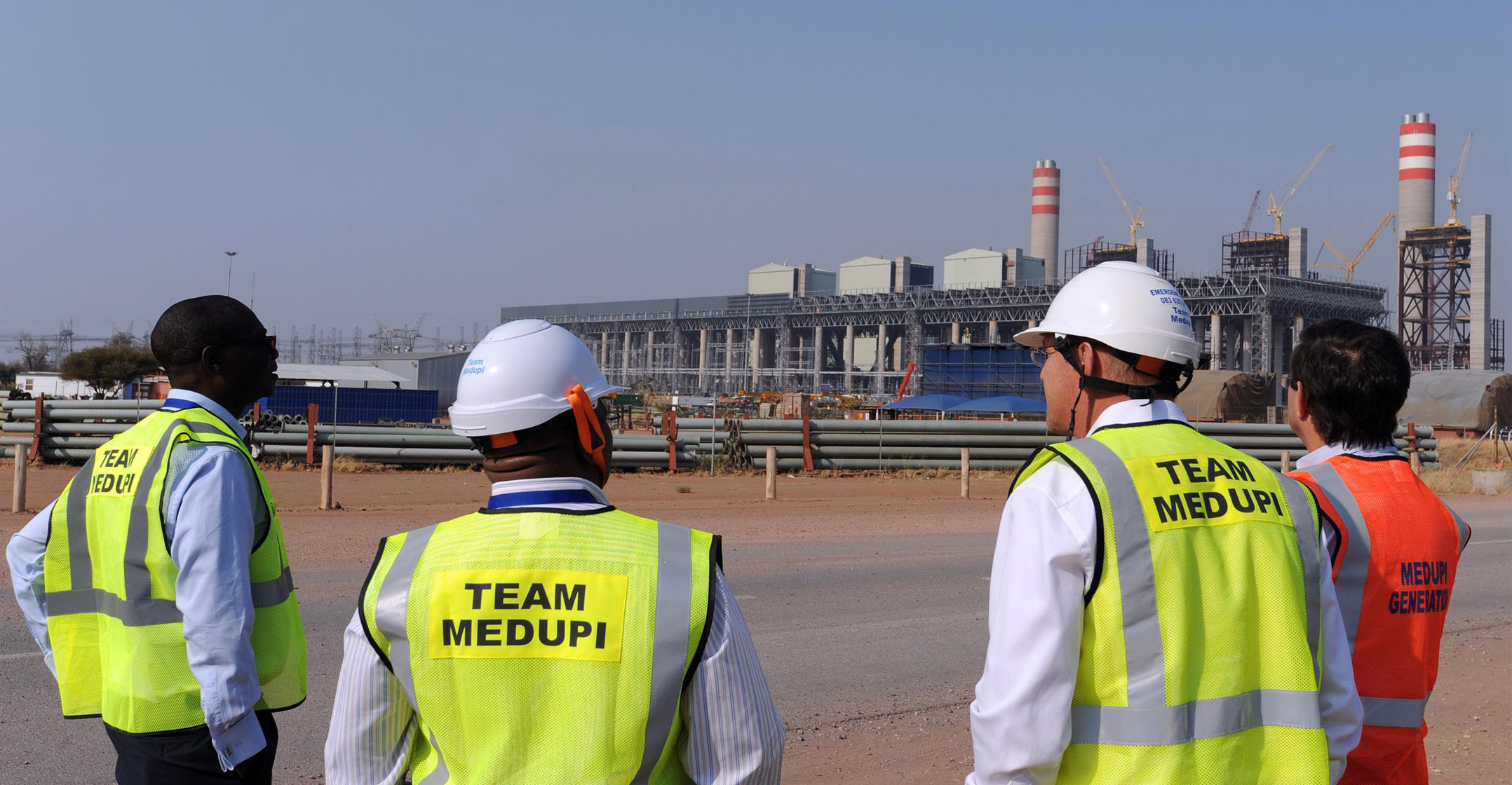
    Image: GCIS

    “The project was under development and implementation at the same time, which is clearly a recipe for disaster in terms of any good practice for major project execution,” he said by e-mail. “There was a shortage of contractor capacity given the worldwide demand for large-scale generation plant at the time. That meant that the main contractors could virtually name their price and conditions.”

    Eskom also assumed much of the risk of developing Medupi and Kusile when it decided to coordinate the projects, rather than appointing an outsider to oversee engineering, procurement and construction — a common practice in plant development.

    “The South African market at the time was not ready for a single contractor to handle the onerous risk of executing a project of this complexity and magnitude,” Eskom said in an e-mailed reply to questions. The company also wanted to develop skills and create jobs by bringing in small and medium-sized contractors, it said.

    While Eskom initially denied that the projects had gone off track, it was forced two years later to adjust the time lines and anticipated price

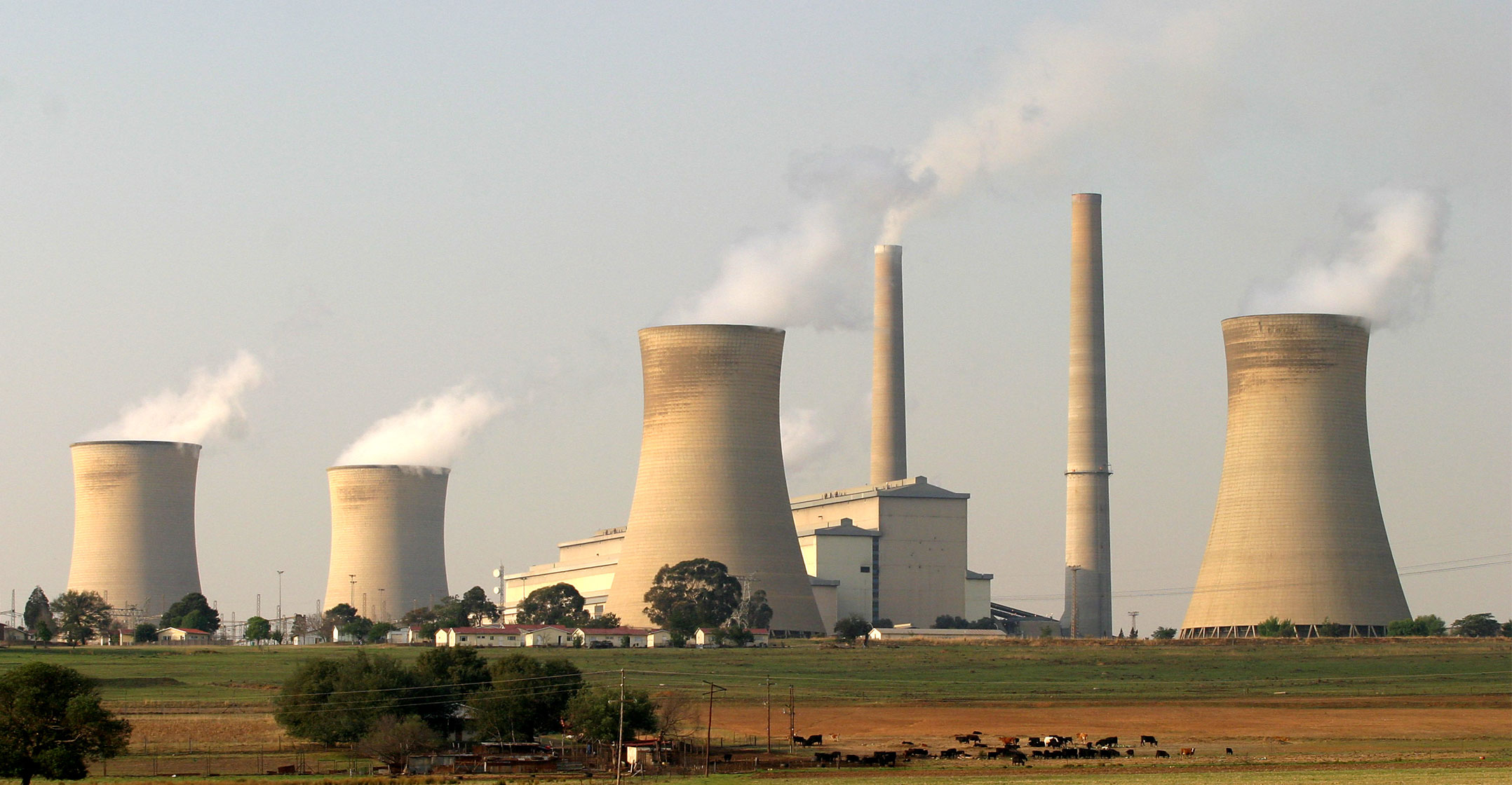
    Medupi and Kusile, expected to be among the world’s biggest coal-fired stations, share the same configuration. The latter’s two towering smokestacks and six enormous boilers are visible from the main highway that runs between Johannesburg and the east coast.

    Speculation that the plants could be delayed first surfaced in 2008. While Eskom initially denied that the projects had gone off track, it was forced two years later to adjust the time lines and anticipated price.

    Eskom Rotek Industries, a wholly owned Eskom subsidiary, was appointed to establish the Kusile site — a process that entailed digging drains, laying pipes and doing the earthworks and terracing. Its contract was terminated early on because it was unable to deliver. That created a bottleneck for other contractors, which filed for damages.

    Claims and counter-claims

    Eskom said it has paid out R14.8-billion to settle the claims, which totalled R252.9-billion, and it filed claims of its own worth R2.6-billion against companies that failed to meet their contracts.

    The delays and design changes reverberated throughout the programme. While the manufacture of equipment continued as planned, it was left sitting in warehouses or on site with the clock ticking on warranties, according to Makgopa Tshehla, a professor at the University of South Africa and an expert on large construction project management.

    The biggest construction headaches were caused by the installation of deficient boilers supplied by Mitsubishi Hitachi Power Systems Africa, according to Eskom. Talks on how to resolve the problems are ongoing, according to Jan Oberholzer, the utility’s chief operating officer.

    Mitsubishi Hitachi didn’t respond to questions about the defaults or the discussion of plans. In 2014, Hitachi Power Africa, an earlier iteration of the company, blamed local subcontractors for faulty welds on the Medupi boilers, but Eskom’s former finance director, Paul O’Flaherty, said the main contractors were at fault.

    Tshehla says Eskom’s board should ultimately bear most of the blame for failing to properly assess the projects and the related risks, and for not holding management accountable for poor performance.

    Oversight deficiencies were compounded by the repeated changes to Eskom’s top management and demands by politicians for them to get a move-on with the projects.

    Eskom was already under the whip for lack of capacity so they were chasing like mad dogs to get those power plants done

    “Eskom was already under the whip for lack of capacity so they were chasing like mad dogs to get those power plants done,” Rossouw said. The management “took on responsibility and risk which I don’t think the board ever understood properly. They were hardly capable of conveying a concise, understandable picture to the board.”

    In 2012, Eskom invited then-President Jacob Zuma to attend a pressure test on Medupi’s first boiler to show that the project was running according to plan. Rossouw recounted that management ignored engineers’ advice that the plant wasn’t ready and, when steam was pumped into pipes connected to the boilers, tools and other debris were blown out.

    Zuma gave no indication that he was aware anything was wrong. He said in a prepared speech that he was “delighted” with the progress being made on the project and congratulated his minister, Eskom and its workers “for a job well done”. Zuma returned to the plant in 2015 when it delivered its first power to the grid — two years later than anticipated at the time of his previous visit.  — Reported by Paul Burkhardt and Michael Cohen, (c) 2019 Bloomberg LP

    Follow TechCentral on Google News Add TechCentral as your preferred source on Google


    Cyril Ramaphosa Eskom Jacob Zuma Paul O'Flaherty Steve Lennon top
    WhatsApp YouTube
    Share. Facebook Twitter LinkedIn WhatsApp Telegram Email Copy Link
    Previous ArticleEthiopia could sell most of state telco as Vodacom, MTN eye entry
    Next Article Naspers committed to libra despite global controversy

    Related Posts

    Not enough: Eskom unions spurn above-inflation wage offer

    Not enough: Eskom unions spurn above-inflation wage offer

    17 February 2026
    Blu Label lands energy trading licence from Nersa - Mark Levy

    Blu Label lands electricity trading licence from Nersa

    17 February 2026
    The biggest thing missing from the state of the nation address - Cyril Ramaphosa

    The biggest thing missing from the state of the nation address

    16 February 2026
    Company News
    Service is everyone's problem now - and that's exactly why the Atlassian Service Collection matters

    Service is everyone’s problem now – why the Atlassian Service Collection matters

    20 February 2026
    Customers have new expectations. Is your CX ready? 1Stream

    Customers have new expectations. Is your CX ready?

    19 February 2026
    South Africa's cybersecurity challenge is not a tool problem - Nicholas Applewhite, Trinexia South Africa

    South Africa’s cybersecurity challenge is not a tool problem

    19 February 2026
    Opinion
    A million reasons monopolies don't work - Duncan McLeod

    A million reasons monopolies don’t work

    10 February 2026
    The author, Business Leadership South Africa CEO Busi Mavuso

    Eskom unbundling U-turn threatens to undo hard-won electricity gains

    9 February 2026
    South Africa's skills advantage is being overlooked at home - Richard Firth

    South Africa’s skills advantage is being overlooked at home

    29 January 2026

    Subscribe to Updates

    Get the best South African technology news and analysis delivered to your e-mail inbox every morning.

    Latest Posts
    MultiChoice scraps annual DStv price hikes for 2026 - David Mignot

    MultiChoice scraps annual DStv price hike

    20 February 2026
    What Gen Z really thinks about the tech world it inherited - Tinashe Mazodze

    What Gen Z really thinks about the tech world it inherited

    20 February 2026
    Showmax 'can't continue' in its current form

    Showmax ‘can’t continue’ in its current form

    20 February 2026
    Free Market Foundation slams treasury's proposed gambling tax

    Free Market Foundation slams treasury’s proposed gambling tax

    20 February 2026
    © 2009 - 2026 NewsCentral Media
    • Cookie policy (ZA)
    • TechCentral – privacy and Popia

    Type above and press Enter to search. Press Esc to cancel.

    Manage consent

    TechCentral uses cookies to enhance its offerings. Consenting to these technologies allows us to serve you better. Not consenting or withdrawing consent may adversely affect certain features and functions of the website.

    Functional Always active
    The technical storage or access is strictly necessary for the legitimate purpose of enabling the use of a specific service explicitly requested by the subscriber or user, or for the sole purpose of carrying out the transmission of a communication over an electronic communications network.
    Preferences
    The technical storage or access is necessary for the legitimate purpose of storing preferences that are not requested by the subscriber or user.
    Statistics
    The technical storage or access that is used exclusively for statistical purposes. The technical storage or access that is used exclusively for anonymous statistical purposes. Without a subpoena, voluntary compliance on the part of your Internet Service Provider, or additional records from a third party, information stored or retrieved for this purpose alone cannot usually be used to identify you.
    Marketing
    The technical storage or access is required to create user profiles to send advertising, or to track the user on a website or across several websites for similar marketing purposes.
    • Manage options
    • Manage services
    • Manage {vendor_count} vendors
    • Read more about these purposes
    View preferences
    • {title}
    • {title}
    • {title}