Close Menu
TechCentralTechCentral

    Subscribe to the newsletter

    Get the best South African technology news and analysis delivered to your e-mail inbox every morning.

    Facebook X (Twitter) YouTube LinkedIn
    WhatsApp Facebook X (Twitter) LinkedIn YouTube
    TechCentralTechCentral
    • News
      Chinese car makers flood South Africa while factories lag - Mikel Mabasa

      Chinese car makers flood South Africa while factories lag

      28 January 2026
      Reports of the smartphone's impending death are greatly exaggerated

      Reports of the smartphone’s impending death are greatly exaggerated

      28 January 2026
      Popia is strong, Paia needs reform, says Information Regulator - Mukelani Dimba

      Popia is strong, Paia needs reform, says Information Regulator

      28 January 2026
      AI replaces people as Amazon cuts 16 000 corporate jobs

      AI replaces people as Amazon cuts 16 000 corporate jobs

      28 January 2026
      iCAUR to launch in South Africa with 20-dealer network - iCAUR V23

      iCAUR to launch in South Africa with 20-dealer network

      28 January 2026
    • World
      SpaceX IPO may be largest in history

      SpaceX IPO may be largest in history

      28 January 2026
      Nvidia throws AI at the weather

      Nvidia throws AI at weather forecasting

      27 January 2026
      Debate erupts over value of in-flight Wi-Fi

      Debate erupts over value of in-flight Wi-Fi

      26 January 2026
      Intel takes another hit - Intel CEO Lip-Bu Tan. Laure Andrillon/Reuters

      Intel takes another hit

      23 January 2026
      ByteDance clinches US TikTok deal

      ByteDance clinches US TikTok deal

      23 January 2026
    • In-depth
      How liberalisation is rewiring South Africa's power sector

      How liberalisation is rewiring South Africa’s power sector

      21 January 2026
      The top-performing South African tech shares of 2025

      The top-performing South African tech shares of 2025

      12 January 2026
      Digital authoritarianism grows as African states normalise internet blackouts

      Digital authoritarianism grows as African states normalise internet blackouts

      19 December 2025
      TechCentral's South African Newsmakers of 2025

      TechCentral’s South African Newsmakers of 2025

      18 December 2025
      Black Friday goes digital in South Africa as online spending surges to record high

      Black Friday goes digital in South Africa as online spending surges to record high

      4 December 2025
    • TCS
      Watts & Wheels S1E2: 'China attacks, BMW digs in, Toyota's sublime supercar'

      Watts & Wheels S1E2: ‘China attacks, BMW digs in, Toyota’s sublime supercar’

      23 January 2026

      TCS+ | Why cybersecurity is becoming a competitive advantage for SA businesses

      20 January 2026
      Watts & Wheels S1E2: 'China attacks, BMW digs in, Toyota's sublime supercar'

      Watts & Wheels: S1E1 – ‘William, Prince of Wheels’

      8 January 2026
      TCS+ | Africa's digital transformation - unlocking AI through cloud and culture - Cliff de Wit Accelera Digital Group

      TCS+ | Cloud without culture won’t deliver AI: Accelera’s Cliff de Wit

      12 December 2025
      TCS+ | How Cloud on Demand helps partners thrive in the AWS ecosystem - Odwa Ndyaluvane and Xenia Rhode

      TCS+ | How Cloud On Demand helps partners thrive in the AWS ecosystem

      4 December 2025
    • Opinion
      Why Elon Musk's Starlink is a 'hard no' for me - Songezo Zibi

      Why Elon Musk’s Starlink is a ‘hard no’ for me

      26 January 2026
      South Africa's new fibre broadband battle - Duncan McLeod

      South Africa’s new fibre broadband battle

      20 January 2026
      AI moves from pilots to production in South African companies - Nazia Pillay SAP

      AI moves from pilots to production in South African companies

      20 January 2026
      South Africa's new fibre broadband battle - Duncan McLeod

      ANC’s attack on Solly Malatsi shows how BEE dogma trumps economic reality

      14 December 2025
      South Africa's new fibre broadband battle - Duncan McLeod

      Netflix, Warner Bros deal raises fresh headaches for MultiChoice

      5 December 2025
    • Company Hubs
      • Africa Data Centres
      • AfriGIS
      • Altron Digital Business
      • Altron Document Solutions
      • Altron Group
      • Arctic Wolf
      • AvertITD
      • Braintree
      • CallMiner
      • CambriLearn
      • CYBER1 Solutions
      • Digicloud Africa
      • Digimune
      • Domains.co.za
      • ESET
      • Euphoria Telecom
      • Incredible Business
      • iONLINE
      • IQbusiness
      • Iris Network Systems
      • LSD Open
      • NEC XON
      • Netstar
      • Network Platforms
      • Next DLP
      • Ovations
      • Paracon
      • Paratus
      • Q-KON
      • SevenC
      • SkyWire
      • Solid8 Technologies
      • Telit Cinterion
      • Tenable
      • Vertiv
      • Videri Digital
      • Vodacom Business
      • Wipro
      • Workday
      • XLink
    • Sections
      • AI and machine learning
      • Banking
      • Broadcasting and Media
      • Cloud services
      • Contact centres and CX
      • Cryptocurrencies
      • Education and skills
      • Electronics and hardware
      • Energy and sustainability
      • Enterprise software
      • Financial services
      • Information security
      • Internet and connectivity
      • Internet of Things
      • Investment
      • IT services
      • Lifestyle
      • Motoring
      • Public sector
      • Retail and e-commerce
      • Satellite communications
      • Science
      • SMEs and start-ups
      • Social media
      • Talent and leadership
      • Telecoms
    • Events
    • Advertise
    TechCentralTechCentral
    Home » Sections » Science » Voyager 2 has lost track of Earth. This antenna could help it ‘phone home’

    Voyager 2 has lost track of Earth. This antenna could help it ‘phone home’

    Almost 46 years after launch, Voyager 2 has lost contact with Earth. There's only one way to fix the problem.
    By The Conversation3 August 2023
    Twitter LinkedIn Facebook WhatsApp Email Telegram Copy Link
    News Alerts
    WhatsApp
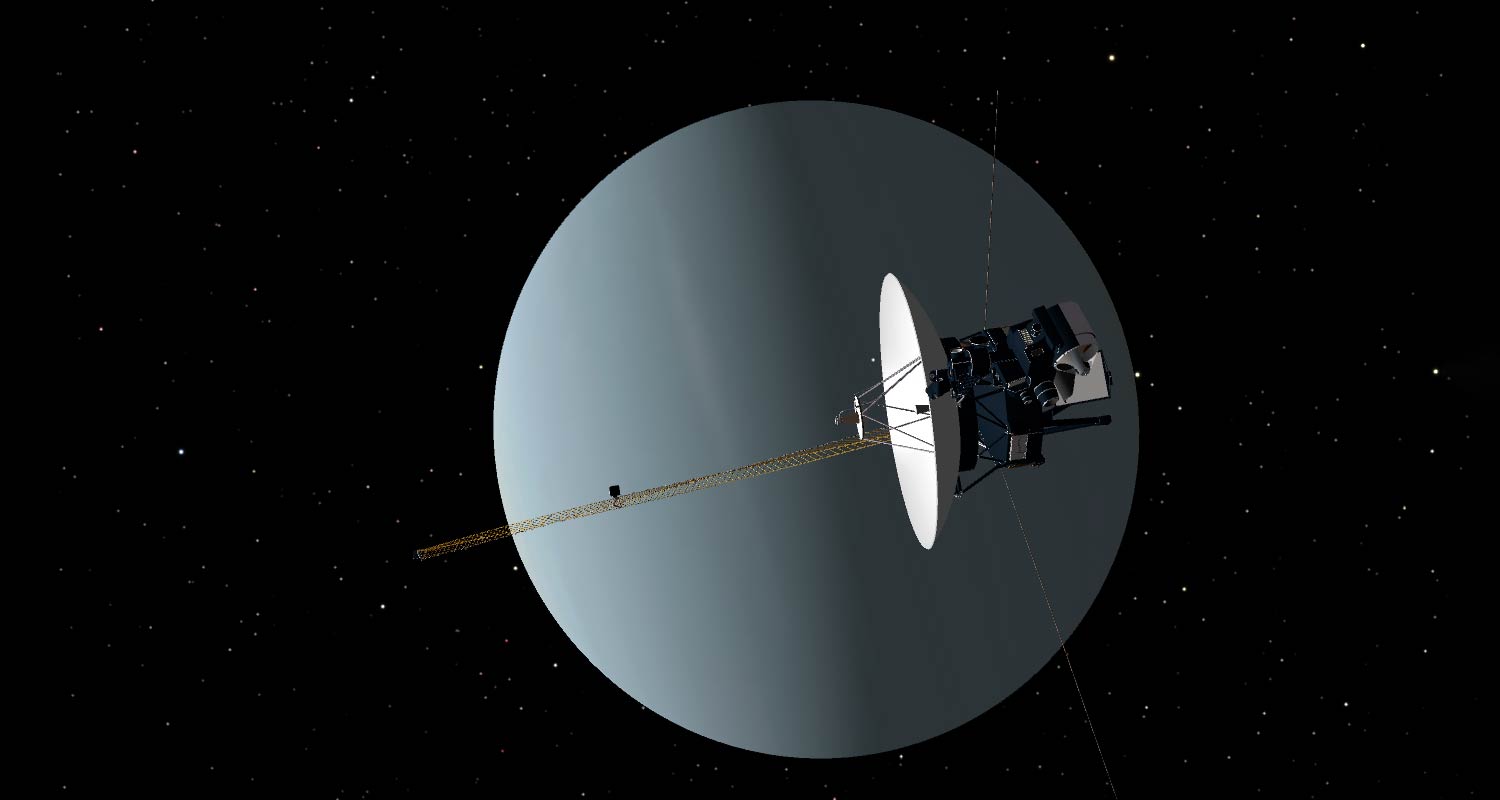
    Artist’s impression of the Voyager 2 spacecraft in front of Uranus

    In 1977, five years before ET asked to “phone home”, two robotic spacecraft began their own journey into space.

    Almost 46 years later, after exploring the solar system and beyond, one of those spacecraft – Voyager 2 – has lost contact with Earth.

    All communication with Voyager 2 goes through Nasa’s Deep Space Station 43, a 70m radio dish at the Canberra Deep Space Communication Complex operated by CSIRO.

    After intense efforts at Nasa and in Canberra, we have detected a faint “heartbeat” signal from the craft

    Contact was lost more than a week ago. After intense efforts at Nasa and in Canberra, we have detected a faint “heartbeat” signal from the craft – and we’re confident of re-establishing full contact.

    Nasa’s twin Voyager spacecraft – Voyager 1 and Voyager 2 – were designed to complete a “grand tour” of the solar system, visiting the giant planets Jupiter, Saturn, Uranus and Neptune.

    Throughout the billions of kilometres of their journeys, the Voyagers stayed in touch with Earth through the three antennas of the Deep Space Network. One is in Madrid, Spain; a second in Goldstone, California; and the third in Canberra, Australia.

    Having completed their tasks in 1989, both Voyager 1 and 2 have long since left our solar system behind. They are now exploring interstellar space – the space between the stars.

    20 billion kilometres

    Voyager 1 is currently 24 billion kilometres from home, with Voyager 2 not far behind at 20 billion kilometres.

    On 21 July, a series of planned commands sent to Voyager 2 inadvertently caused the spacecraft’s antenna to point two degrees away from Earth. As a result, the spacecraft is unable to receive commands or transmit any data back to Earth.

    Mishaps like this are not uncommon in space exploration. The Nasa team is expert at problem solving, and has a good track record of keeping spacecraft flying long after their prime mission has ended.

    Nasa’s science and engineering teams have dealt with communication drop-outs before, with both Voyagers. Their efforts have already quadrupled the planned 12-year life of the craft, so they don’t think we’ve heard the last from Voyager 2.

    It’s an enormous achievement that we still have contact with these spacecraft at all, given their enormous distance from Earth and the relative weakness of the signal received through the big antenna dishes in Canberra. Even when Voyager 2 is pointing at Earth, its signal is already a whisper from space, billions of times weaker than the power generated by a tiny watch battery.
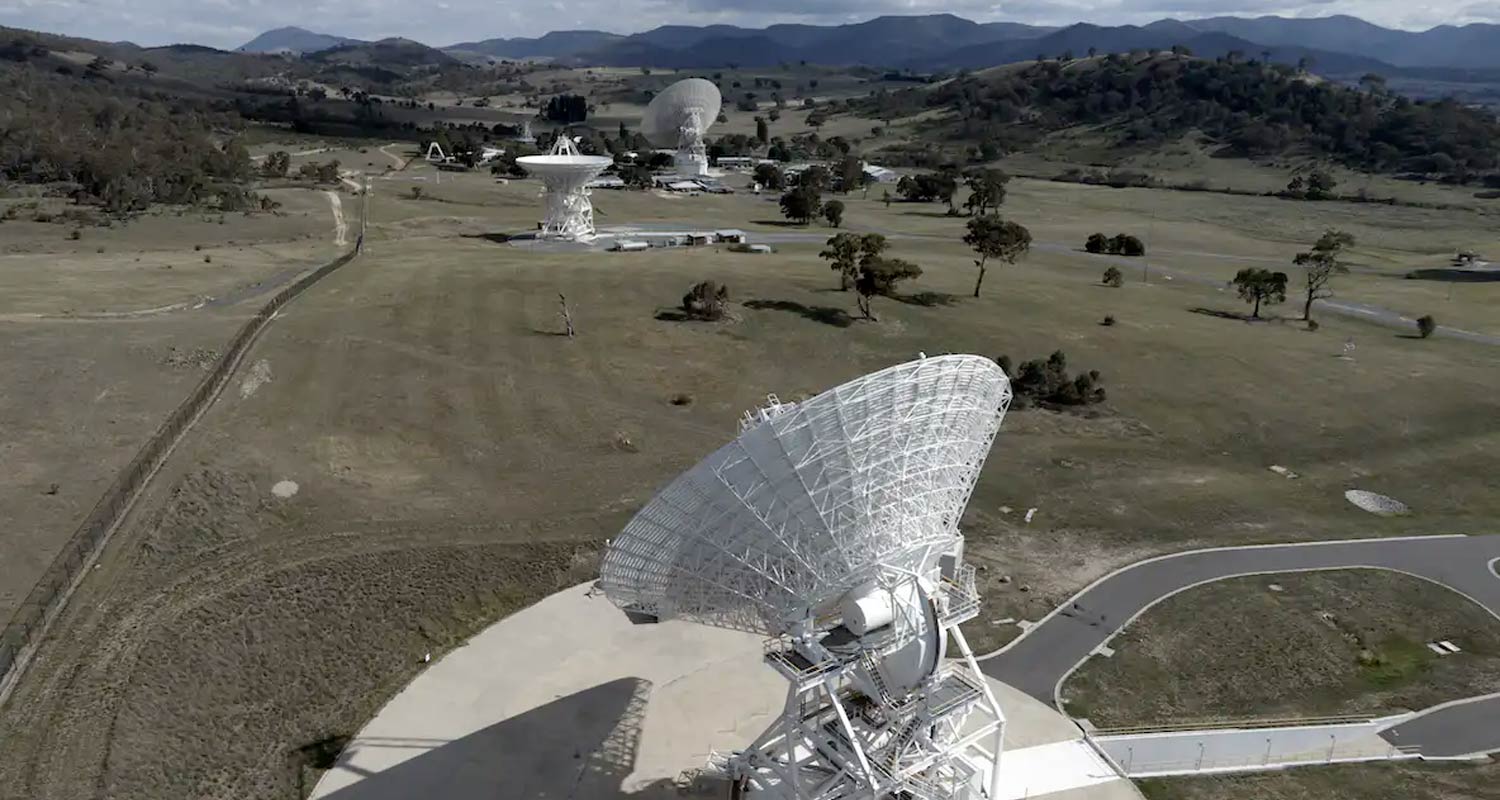
    The Canberra Deep Space Communication Complex has the only antenna that maintains contact with Voyager 2. AAP/CSIRO

    The last time Voyager 2 was out of contact was in March 2020, when the dish at the Canberra Deep Space Communication Complex was shut down for a scheduled 11-month upgrade project. Ahead of the shutdown, commands were sent to Voyager 2 to program the spacecraft to maintain operations without needing to hear from Earth for an extended period.

    Canberra’s Deep Space Station 43 is the only antenna in the world that can communicate directly with both Voyagers. Its sister stations in the northern hemisphere are unable to “see” Voyager 2, because Earth is in the way.

    Since Voyager 2’s antenna was tweaked off target, we have been using Deep Space Station 43 to listen intently for any signal. Eventually this effort paid off, with the detection of the craft’s carrier tone – a “heartbeat” indicating Voyager 2 is still transmitting.

    Now attempts will be made to relay commands to Voyager 2 and tell it to reorientate its antenna towards Earth.

    If those attempts fail, Voyager 2 is already programmed to use the sun and the bright star Canopus to reorientate itself several times each year. The next scheduled reset will occur on 15 October, which should automatically enable communications to resume.

    Voyager 2, into interstellar space

    The Canberra team feels a very close connection to this distant traveller. We have been with it on every step of its journey so far, and plan to continue to provide mission support for however long the mission lasts.

    Voyager 2 was launched on 20 August 1977 and reached Jupiter in July 1979, a few months after Voyager 1. It proceeded to Saturn for a flyby of the ringed planet in 1981, and then had encounters with Uranus in 1986 and Neptune in August 1989, ending the so-called “grand tour”.

    As both spacecraft were in good health, they were given an extended mission to reach the edge of our solar system, where the influence of the sun’s energy ends. The Voyagers are now in the “clear air” of interstellar space and can, for the first time, make direct measurements of this environment.

    The data they have returned is changing our understanding of the universe. The teams at Nasa and here in Canberra are confident there is more science and discoveries to come, when Voyager 2 once again phones home.The Conversation

    • The author, Glen Nagle, is outreach manager, Canberra Deep Space Communication Complex, CSIRO
    • This article is republished from The Conversation under a Creative Commons licence
    Get TechCentral’s daily newsletter


    Nasa Voyager 1 Voyager 2
    WhatsApp YouTube Follow on Google News Add as preferred source on Google
    Share. Facebook Twitter LinkedIn WhatsApp Telegram Email Copy Link
    Previous ArticleSA must protect critical infrastructure from cyberattack
    Next Article Criminals exploiting smartphone tap to pay in South Africa

    Related Posts

    Breaking free from legacy thinking in banks: AI, automation and the agentic operating model - Steve Burke iqbusiness

    Breaking free from legacy thinking in banks: AI, automation and the agentic operating model

    15 January 2026
    Starlink satellite anomaly creates debris in rare orbital mishap

    Starlink satellite anomaly creates debris in rare orbital mishap

    19 December 2025
    Trump space order puts the moon back at centre of US, China rivalry - US President Donald Trump

    Trump space order puts the moon back at centre of US, China rivalry

    19 December 2025
    Company News
    WeBuyCars expands national footprint with two landmark supermarkets

    WeBuyCars expands national footprint with two landmark supermarkets

    28 January 2026
    The changing state of fintech - from disruption to infrastructure - BBD Software

    The changing state of fintech – from disruption to infrastructure

    27 January 2026
    Human behaviour, not AI will determine who wins in 2026

    Human behaviour, not AI, will determine who wins in 2026

    27 January 2026
    Opinion
    Why Elon Musk's Starlink is a 'hard no' for me - Songezo Zibi

    Why Elon Musk’s Starlink is a ‘hard no’ for me

    26 January 2026
    South Africa's new fibre broadband battle - Duncan McLeod

    South Africa’s new fibre broadband battle

    20 January 2026
    AI moves from pilots to production in South African companies - Nazia Pillay SAP

    AI moves from pilots to production in South African companies

    20 January 2026

    Subscribe to Updates

    Get the best South African technology news and analysis delivered to your e-mail inbox every morning.

    Latest Posts
    Chinese car makers flood South Africa while factories lag - Mikel Mabasa

    Chinese car makers flood South Africa while factories lag

    28 January 2026
    Reports of the smartphone's impending death are greatly exaggerated

    Reports of the smartphone’s impending death are greatly exaggerated

    28 January 2026
    Popia is strong, Paia needs reform, says Information Regulator - Mukelani Dimba

    Popia is strong, Paia needs reform, says Information Regulator

    28 January 2026
    AI replaces people as Amazon cuts 16 000 corporate jobs

    AI replaces people as Amazon cuts 16 000 corporate jobs

    28 January 2026
    © 2009 - 2026 NewsCentral Media
    • Cookie policy (ZA)
    • TechCentral – privacy and Popia

    Type above and press Enter to search. Press Esc to cancel.

    Manage consent

    TechCentral uses cookies to enhance its offerings. Consenting to these technologies allows us to serve you better. Not consenting or withdrawing consent may adversely affect certain features and functions of the website.

    Functional Always active
    The technical storage or access is strictly necessary for the legitimate purpose of enabling the use of a specific service explicitly requested by the subscriber or user, or for the sole purpose of carrying out the transmission of a communication over an electronic communications network.
    Preferences
    The technical storage or access is necessary for the legitimate purpose of storing preferences that are not requested by the subscriber or user.
    Statistics
    The technical storage or access that is used exclusively for statistical purposes. The technical storage or access that is used exclusively for anonymous statistical purposes. Without a subpoena, voluntary compliance on the part of your Internet Service Provider, or additional records from a third party, information stored or retrieved for this purpose alone cannot usually be used to identify you.
    Marketing
    The technical storage or access is required to create user profiles to send advertising, or to track the user on a website or across several websites for similar marketing purposes.
    • Manage options
    • Manage services
    • Manage {vendor_count} vendors
    • Read more about these purposes
    View preferences
    • {title}
    • {title}
    • {title}