
Close Menu
TechCentralTechCentral

    Subscribe to the newsletter

    Get the best South African technology news and analysis delivered to your e-mail inbox every morning.

    Facebook X (Twitter) YouTube LinkedIn
    WhatsApp Facebook X (Twitter) LinkedIn YouTube
    TechCentralTechCentral
    • News
      Big Microsoft 365 price increases coming next year

      Big Microsoft price increases coming next year

      5 December 2025
      Vodacom to take control of Safaricom in R36-billion deal - Shameel Joosub

      Vodacom to take control of Safaricom in R36-billion deal

      4 December 2025
      Black Friday goes digital in South Africa as online spending surges to record high

      Black Friday goes digital in South Africa as online spending surges to record high

      4 December 2025
      BYD takes direct aim at Toyota with launch of sub-R500 000 Sealion 5 PHEV

      BYD takes direct aim at Toyota with launch of sub-R500 000 Sealion 5 PHEV

      4 December 2025
      'Get it now': Takealot in new instant deliveries pilot

      ‘Get it now’: Takealot in new instant deliveries pilot

      4 December 2025
    • World
      Amazon and Google launch multi-cloud service for faster connectivity

      Amazon and Google launch multi-cloud service for faster connectivity

      1 December 2025
      Google makes final court plea to stop US breakup

      Google makes final court plea to stop US breakup

      21 November 2025
      Bezos unveils monster rocket: New Glenn 9x4 set to dwarf Saturn V

      Bezos unveils monster rocket: New Glenn 9×4 set to dwarf Saturn V

      21 November 2025
      Tech shares turbocharged by Nvidia's stellar earnings

      Tech shares turbocharged by stellar Nvidia earnings

      20 November 2025
      Config file blamed for Cloudflare meltdown that disrupted the web

      Config file blamed for Cloudflare meltdown that disrupted the web

      19 November 2025
    • In-depth
      Jensen Huang Nvidia

      So, will China really win the AI race?

      14 November 2025
      Valve's Linux console takes aim at Microsoft's gaming empire

      Valve’s Linux console takes aim at Microsoft’s gaming empire

      13 November 2025
      iOCO's extraordinary comeback plan - Rhys Summerton

      iOCO’s extraordinary comeback plan

      28 October 2025
      Why smart glasses keep failing - no, it's not the tech - Mark Zuckerberg

      Why smart glasses keep failing – it’s not the tech

      19 October 2025
      BYD to blanket South Africa with megawatt-scale EV charging network - Stella Li

      BYD to blanket South Africa with megawatt-scale EV charging network

      16 October 2025
    • TCS
      TCS+ | How Cloud on Demand helps partners thrive in the AWS ecosystem - Odwa Ndyaluvane and Xenia Rhode

      TCS+ | How Cloud On Demand helps partners thrive in the AWS ecosystem

      4 December 2025
      TCS | MTN Group CEO Ralph Mupita on competition, AI and the future of mobile

      TCS | Ralph Mupita on competition, AI and the future of mobile

      28 November 2025
      TCS | Dominic Cull on fixing South Africa's ICT policy bottlenecks

      TCS | Dominic Cull on fixing South Africa’s ICT policy bottlenecks

      21 November 2025
      TCS | BMW CEO Peter van Binsbergen on the future of South Africa's automotive industry

      TCS | BMW CEO Peter van Binsbergen on the future of South Africa’s automotive industry

      6 November 2025
      TCS | Why Altron is building an AI factory - Bongani Andy Mabaso

      TCS | Why Altron is building an AI factory in Johannesburg

      28 October 2025
    • Opinion
      Your data, your hardware: the DIY AI revolution is coming - Duncan McLeod

      Your data, your hardware: the DIY AI revolution is coming

      20 November 2025
      Zero Carbon Charge founder Joubert Roux

      The energy revolution South Africa can’t afford to miss

      20 November 2025
      It's time for a new approach to government IT spend in South Africa - Richard Firth

      It’s time for a new approach to government IT spend in South Africa

      19 November 2025
      How South Africa's broken Rica system fuels murder and mayhem - Farhad Khan

      How South Africa’s broken Rica system fuels murder and mayhem

      10 November 2025
      South Africa's AI data centre boom risks overloading a fragile grid - Paul Colmer

      South Africa’s AI data centre boom risks overloading a fragile grid

      30 October 2025
    • Company Hubs
      • Africa Data Centres
      • AfriGIS
      • Altron Digital Business
      • Altron Document Solutions
      • Altron Group
      • Arctic Wolf
      • AvertITD
      • Braintree
      • CallMiner
      • CambriLearn
      • CYBER1 Solutions
      • Digicloud Africa
      • Digimune
      • Domains.co.za
      • ESET
      • Euphoria Telecom
      • Incredible Business
      • iONLINE
      • IQbusiness
      • Iris Network Systems
      • LSD Open
      • NEC XON
      • Netstar
      • Network Platforms
      • Next DLP
      • Ovations
      • Paracon
      • Paratus
      • Q-KON
      • SevenC
      • SkyWire
      • Solid8 Technologies
      • Telit Cinterion
      • Tenable
      • Vertiv
      • Videri Digital
      • Vodacom Business
      • Wipro
      • Workday
      • XLink
    • Sections
      • AI and machine learning
      • Banking
      • Broadcasting and Media
      • Cloud services
      • Contact centres and CX
      • Cryptocurrencies
      • Education and skills
      • Electronics and hardware
      • Energy and sustainability
      • Enterprise software
      • Financial services
      • Information security
      • Internet and connectivity
      • Internet of Things
      • Investment
      • IT services
      • Lifestyle
      • Motoring
      • Public sector
      • Retail and e-commerce
      • Satellite communications
      • Science
      • SMEs and start-ups
      • Social media
      • Talent and leadership
      • Telecoms
    • Events
    • Advertise
    TechCentralTechCentral
    Home » Top » VR hype has lost touch with reality

    VR hype has lost touch with reality

    By Editor8 August 2014
    Twitter LinkedIn Facebook WhatsApp Email Telegram Copy Link
    News Alerts
    WhatsApp
    A user wears the Oculus Rift VR headset
    A man wears the Oculus Rift VR headset (image: Sergey Galyonkin)

    Anyone who reads the technology news can’t have failed to notice a certain preoccupation in the past couple of years on the part of developers to bring viewers close to the action of TV, films and computer games through virtual reality. Every other day, it seems, we hear of yet another allegedly ground-breaking solution in the quest for “immersion”. The next person to claim to have invented a Star-Trek-like Holodeck is going to get a Vulcan neck pinch from me.

    Frustratingly, this marketing hype actually seems to be working so well that VR headsets, be they binocular, biocular or monocular (such as Google’s Glass), have become a “must have” item. Even in traditionally sceptical and risk-averse sectors such as defence, aerospace, energy and education, they are fast becoming de rigeur in training exercises.

    Many other technology observers, from swooning journalists to corporate futurologists — a good too many of whom appear to believe everything they read or see online — are also fuelling the rush to invest in a holodeck.

    It seems inevitable that large investments will be made with little return, giving some of us a distinct sense of déjà vu.

    We were first exposed to the “wonders” of head-mounted displays in the late 1980s and throughout the 1990s, when we were told that they would revolutionise VR and telepresence. Even then, head-mounted displays were by no means a new concept. A patent filed as long ago as 1960 described the Telesphere Mask, a stereoscopic “television apparatus for individual use” developed by the late, great Mort Heilig — best known for his later Sensorama “kiosk” with its canned stereoscopic films, artificially generated smells and vibrating seat experience.

    A year later, Philco, the US electronics company famous for providing US space agency Nasa with its early Mission Control consoles, announced Headsight, a single cathode ray tube “telepresence” head-mounted display and in 1968, Ivan Sutherland’s Sword of Damocles, a ceiling-linked, mechanically head-tracked stereoscopic device, enabled users to look around a simple 3D graphic as if it were “floating” in the room in front of them.

    But it wasn’t until the late 1980s that commercially available products such as VPL’s EyePhone, LEEP’s CyberFace, Virtual Research’s Flight Helmet and the unbelievably unwearable Virtuality Visette, with its patented “Ergolock” head restrainer, captured the attention of the press, thus heralding a decade of false promise, high expenditure and end user disappointment.

    Big names like Nintendo, Olympus, Phillips and Sony all came, experimented and retreated, either disgruntled at the poor domestic market uptake or concerned about the possibility of litigations over so-called cybersickness.

    Sony’s withdrawal of its early Glasstron product range came about, allegedly, as a result of health and safety worries yet it is heavily involved in this latest hypefest with the rather expensive HMZ “Personal Viewer” series and, more recently, the Morpheus for the PS4 games system.

    A woman wearing Google Glass
    A woman wearing Google Glass

    I’ve used most of the devices produced since the 1980s and, indeed, have even been involved in the sale of many since the 1990s. Today, my own “Headset Hall of Shame” lecture now consists of four PowerPoint slides with thumbnail images of most (but certainly not all) HMD devices ever to reach existence.

    And that’s why I think the cult status given to the latest generation of VR headsets simply beggars belief. We’ve had decades of developments with no real breakthroughs made. And with the possible exception of the defence sector, there has been little evidence that the actual needs and limitations of the end user have been taken into consideration when these devices are being designed.

    Since it took the world by storm by achieving a $2,4m cash injection on Kickstarter, the Oculus Rift has become the leading example of how over-hyped marketing and inflated statements by celebrity gaming personalities can influence a generation of potential adopters. We managed to obtain three Rifts for student projects and academic research and it soon became obvious that we, too, had inherited cult status, simply by the gasps and stares that greeted their every appearance at open days. Yet, almost without exception (the exception being a very small handful of hard-line gamers), those who donned the Rift were either unwilling or unable to continue with its use after two minutes or, in many cases, far less.

    The Rift is certainly more comfortable than its 1990s ancestors but its image resolution is still limited, it still blurs pixels and it still offers an inadequate field of view.

    Users continue to report disorientation and eyestrain, making it hard to imagine how the device can possibly be recommended as an “essential” interface for gamers or anyone else.

    In March, Oculus was acquired by Facebook for a staggering US$2bn. Many of the people involved in the development of head-mounted devices believe this to be a step in the wrong direction for a variety of reasons — some moral, some technical — but the floodgates have been opened, whichever way you look at it. The frenetic race to beat Oculus at its own game, even with the features of its promised DK2 and consumer editions, is now on.

    Technologies come and go, but the human user remains the one constant factor. No matter how good the specifications become, it will be some time before a display technology is developed that satisfies the majority of the end-user population and it may never happen at all.

    Research (summarised in an MoD-sponsored human factors document) has shown that as many as 56% of individuals between the ages of 18 and 38 have one or more problems which can compromise their binocular vision. Individuals with stereoscopic or binocular vision defects cope by exploiting monocular depth and distance cues, such as motion parallax, light and shadows, focus, geometric overlap (interposition), aerial perspective, relative size and size/shape constancies. Even if it becomes possible to screen out users with binocular deficits, this may still not be sufficient to prevent usability and “cyber sickness” problems with head-mounted displays.
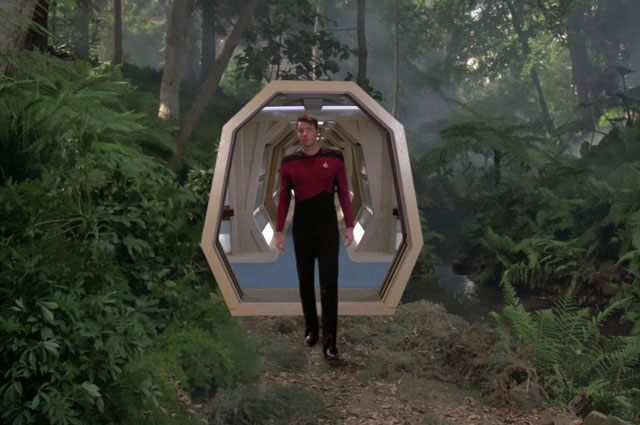
    We are nowhere near the day when we can walk into the equivalent of Star Trek's Holodeck, says the writer
    We are nowhere near the day when we can walk into the equivalent of Star Trek’s Holodeck, says the writer

    One of the well-known human factors issues with 3D displays is the mismatch between visual accommodation and convergence. When observing a real-world scene, your eyes will both converge on objects in the scene and re-focus to keep the imagery sharply registered on the retinas as your view changes. But when viewing 3D virtual environments via a display, your eyes begin to behave asynchronously. They converge on the virtual object, but the focus remains more or less constant as a result of the fixed position of the plane of the screen (or, indeed, the structure onto which the screen is mounted).

    This mismatch can rapidly promote visual fatigue, discomfort and disorientation — three of the key precursors to cyber sickness.

    The concepts of virtual reality and total immersion are, without doubt, as powerful today as they were when they first appeared in the late 1980s. Of that I have little doubt, and the interactive visualisation and training domains have much to benefit from the real-time interactive quality of today’s VR software toolkits.The Conversation

    But meaningful content design really needs to happen before VR headsets can come anywhere near meeting the high bar being set for them at the moment. Despite ridiculous claims to the contrary, we are nowhere near the day when we can walk into the equivalent of Star Trek’s Holodeck and experience a truly multisensory computer-generated reality without having to endure the cumbersome and often malaise-causing technologies we are being encouraged to buy today.

    • Robert Stone is chair in interactive multimedia systems at the University of Birmingham
    • This article was originally published on The Conversation


    Facebook Holodeck Oculus Rift Robert Stone Star Trek
    Subscribe to TechCentral Subscribe to TechCentral
    Share. Facebook Twitter LinkedIn WhatsApp Telegram Email Copy Link
    Previous ArticleConvergeSA to explore zero-cost calling
    Next Article Pinnacle warns of fall in earnings

    Related Posts

    Why smart glasses keep failing - no, it's not the tech - Mark Zuckerberg

    Why smart glasses keep failing – it’s not the tech

    19 October 2025

    EU kills ‘Fair Share’ plan favoured by South African operators

    31 July 2025
    Shrimp Jesus and the AI ad invasion - Meta Platforms CEO Mark Zuckerberg

    Shrimp Jesus and the AI ad invasion

    4 June 2025
    Company News
    AI is not a technology problem - iqbusiness

    AI is not a technology problem – iqbusiness

    5 December 2025
    Telcos are sitting on a data gold mine - but few know what do with it - Phillip du Plessis

    Telcos are sitting on a data gold mine – but few know what do with it

    4 December 2025
    Unlock smarter computing with your surface Copilot+ PC

    Unlock smarter computing with your Surface Copilot+ PC

    4 December 2025
    Opinion
    Your data, your hardware: the DIY AI revolution is coming - Duncan McLeod

    Your data, your hardware: the DIY AI revolution is coming

    20 November 2025
    Zero Carbon Charge founder Joubert Roux

    The energy revolution South Africa can’t afford to miss

    20 November 2025
    It's time for a new approach to government IT spend in South Africa - Richard Firth

    It’s time for a new approach to government IT spend in South Africa

    19 November 2025

    Subscribe to Updates

    Get the best South African technology news and analysis delivered to your e-mail inbox every morning.

    Latest Posts
    Big Microsoft 365 price increases coming next year

    Big Microsoft price increases coming next year

    5 December 2025
    AI is not a technology problem - iqbusiness

    AI is not a technology problem – iqbusiness

    5 December 2025
    Vodacom to take control of Safaricom in R36-billion deal - Shameel Joosub

    Vodacom to take control of Safaricom in R36-billion deal

    4 December 2025
    Black Friday goes digital in South Africa as online spending surges to record high

    Black Friday goes digital in South Africa as online spending surges to record high

    4 December 2025
    © 2009 - 2025 NewsCentral Media
    • Cookie policy (ZA)
    • TechCentral – privacy and Popia

    Type above and press Enter to search. Press Esc to cancel.

    Manage consent

    TechCentral uses cookies to enhance its offerings. Consenting to these technologies allows us to serve you better. Not consenting or withdrawing consent may adversely affect certain features and functions of the website.

    Functional Always active
    The technical storage or access is strictly necessary for the legitimate purpose of enabling the use of a specific service explicitly requested by the subscriber or user, or for the sole purpose of carrying out the transmission of a communication over an electronic communications network.
    Preferences
    The technical storage or access is necessary for the legitimate purpose of storing preferences that are not requested by the subscriber or user.
    Statistics
    The technical storage or access that is used exclusively for statistical purposes. The technical storage or access that is used exclusively for anonymous statistical purposes. Without a subpoena, voluntary compliance on the part of your Internet Service Provider, or additional records from a third party, information stored or retrieved for this purpose alone cannot usually be used to identify you.
    Marketing
    The technical storage or access is required to create user profiles to send advertising, or to track the user on a website or across several websites for similar marketing purposes.
    • Manage options
    • Manage services
    • Manage {vendor_count} vendors
    • Read more about these purposes
    View preferences
    • {title}
    • {title}
    • {title}