Close Menu
TechCentralTechCentral

    Subscribe to the newsletter

    Get the best South African technology news and analysis delivered to your e-mail inbox every morning.

    Facebook X (Twitter) YouTube LinkedIn
    WhatsApp Facebook X (Twitter) LinkedIn YouTube
    TechCentralTechCentral
    • News
      Home affairs opens visa fast lane - with tech talent a top priority

      Home affairs opens visa fast lane – with tech talent a top priority

      21 July 2026
      Skills authority to probe MICT Seta leadership crisis - Buti Manamela

      Skills authority to probe MICT Seta leadership crisis

      21 July 2026
      Mastercard bets billions on the tech that could eat its lunch - Prakriti Singh

      Mastercard bets billions on the tech that could eat its lunch

      21 July 2026
      From care homes to production lines, the robots are coming

      From care homes to production lines, the robots are coming

      21 July 2026
      Remote work in South Africa hits record high

      Remote work in South Africa hits record high

      21 July 2026
    • World
      Meta AI will now tell parents if their teen is in crisis

      Meta AI will now tell parents if their teen is in crisis

      17 July 2026
      IBM shares crash 25% as AI upends software spending - Arvind Krishna

      IBM shares crash 25% as AI upends software spending

      15 July 2026
      Jony Ive's first OpenAI device: an AI smart speaker - Jony Ive and Sam Altman

      Jony Ive’s first OpenAI device: an AI smart speaker

      15 July 2026
      Stripe, Advent in talks to buy PayPal for $53-billion

      Stripe, Advent in talks to buy PayPal for $53-billion

      15 July 2026
      Memory crisis sends smartphone market into steep decline

      Memory crisis sends smartphone market into steep decline

      13 July 2026
    • In-depth
      The plan to stop AI from breaking the world - Google DeepMind CEO Demis Hassabis. Image: John Sears

      The plan to stop AI from breaking the world

      16 July 2026
      The internet has a Strait of Hormuz problem

      The internet has a Strait of Hormuz problem

      15 July 2026
      AI boom sparks rally, frenzy and fear

      AI boom sparks rally, frenzy and fear

      11 June 2026
      Every plug-in hybrid on sale in South Africa, ranked by price - Lamborghini Temerario

      Every plug-in hybrid on sale in South Africa, ranked by price

      7 June 2026
      What Wi-Fi 8 will mean for wireless networks

      What Wi-Fi 8 will mean for wireless networks

      1 June 2026
    • TCS
      Watts & Wheels S1E7: 'Ferrari's EV breaks the internet'

      Watts & Wheels S1E7: ‘Ferrari’s EV breaks the internet’

      8 July 2026
      TCS+ | How Tracker is turning vehicle data into business strategy - Silvia Schollenberger

      TCS+ | How Tracker is turning vehicle data into business strategy

      1 July 2026
      TCS+ | IBM Bob: an AI-powered 'development partner' for the enterprise - David Spurway

      TCS+ | IBM Bob: an AI-powered development partner for the enterprise

      30 June 2026
      Watts & Wheels S1E6: 'A flawless Alfa and a bakkie that divides'

      Watts & Wheels S1E6: ‘A flawless Alfa and a bakkie that divides’

      17 June 2026
      Watts & Wheels S1E6: 'A flawless Alfa and a bakkie that divides'

      Watts & Wheels S1E5: ‘A Bentley of the bush and a car that swims’

      8 June 2026
    • Opinion
      Selling vapour is corporate suicide in slow motion - Jannie van Zyl

      Selling vapour is corporate suicide in slow motion

      16 July 2026
      Brazil's online gambling crackdown is a lesson for South Africa

      How Amazon outmanoeuvred Starlink in South Africa

      15 July 2026
      The Popia problem with agentic AI - Herman Haasbroek

      The Popia problem with agentic AI

      14 July 2026
      The author, Fanie van Rooyen

      South Africa can still catch the AI wave – here’s how

      7 July 2026
      The author, Fanie van Rooyen

      The AI utopia South Africa can’t afford

      1 July 2026
    • Company Hubs
      • 1Stream
      • Africa Data Centres
      • AfriGIS
      • Altron Digital Business
      • Altron Document Solutions
      • Altron Group
      • Arctic Wolf
      • Ascent Technology
      • AvertITD
      • BBD
      • Braintree
      • CallMiner
      • CambriLearn
      • CM Telecom
      • Contactable
      • CYBER1 Solutions
      • Digicloud Africa
      • Digimune
      • Domains.co.za
      • ESET
      • Euphoria Telecom
      • HOSTAFRICA
      • Incredible Business
      • iONLINE
      • IQbusiness
      • Iris Network Systems
      • Kaspersky
      • LSD Open
      • Mitel
      • NEC XON
      • Netstar
      • Network Platforms
      • Next DLP
      • Ovations
      • Paracon
      • Paratus
      • Q-KON
      • SevenC
      • SkyWire
      • Solid8 Technologies
      • Telit Cinterion
      • Telviva
      • Tenable
      • Vertiv
      • Videri Digital
      • Vodacom Business
      • Wipro
      • Workday
      • XLink
    • Sections
      • AI and machine learning
      • Banking
      • Broadcasting and Media
      • Cloud services
      • Contact centres and CX
      • Cryptocurrencies
      • Education and skills
      • Electronics and hardware
      • Energy and sustainability
      • Enterprise software
      • Financial services
      • HealthTech
      • Information security
      • Internet and connectivity
      • Internet of Things
      • Investment
      • IT services
      • Lifestyle
      • Policy and regulation
      • Public sector
      • Retail and e-commerce
      • Satellite communications
      • Science
      • SMEs and start-ups
      • Social media
      • Talent and leadership
      • Telecoms
      • Watts & Wheels
    • Events
    • Advertise
    TechCentralTechCentral
    Home » News » Want it? Print it

    Want it? Print it

    By Editor4 January 2013
    Twitter LinkedIn Facebook WhatsApp Email Telegram Copy Link
    News Alerts
    WhatsApp
    3d-print-640
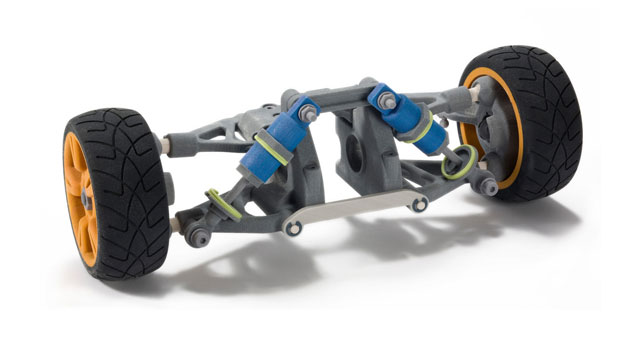
    A front wheel assembly printed on a 3D printer

    It is the stuff of science-fiction — implants for the human body, matching a recipient’s dimensions exactly and printed from titanium powder, much like the way an inkjet printer reels off a document. This is the world that 3D printing, also known as additive manufacturing, is making possible — and it is no longer the stuff of B-grade cult films.

    In the Netherlands last year, an 83-year-old woman received a jaw implant created with 3D print­ing. At the Nemours/Alfred I duPont Hospital for Children in the American state of Delaware, it has been used to make robotic exoskeletons for children with a rare disorder that affects joint and muscle development. In other places in the US and Europe, the technology is being used to tailor-make hearing aids and dental implants, and the global scientific community is exploring the possibility that it will be able to print viable human tissue one day.

    Although we’re still decades away from printing human organs on demand, additive manufacturing is revolutionising the way we build and design everything from aircraft to cars, and it has serious implications for the amount of resources we use, as well as for entire production cycles.

    Additive manufacturing is different from conventional or subtractive manufacturing, according to Hardus Greyling, operations manager of the National Laser Centre at the Council for Scientific and Industrial Research (CSIR), where he works on laser materials processing.

    Conventional manufacturing begins with a billet of material that is then milled into a product or component. Additive manufacturing uses a 3D model of a product, developed with the use of computer-aided design (CAD) software. The design is fed into a 3D printer, which prints the object, layer by layer. Each sliver is fused together, using a heat source such as a laser, until the component is fully formed.

    Greyling said there was a wide range of technologies that supported additive manufacturing, the most common involving a plastic material but others, such as metal and rubber, could also be used.

    Off-the-shelf 3D printers can be bought for between R10 000 and R15 000 that people can use to make things at home. It’s a simple matter of getting the hang of the software.

    Hobbyists have blossomed the world over, using websites such as thingiverse.com to share 3D designs and ideas. Need an iPhone holder for your car? Print it out. With the right software, such as OpenSCAD, and a little know-how, you can print your own Christmas decorations, a clutch purse, a new lampshade, a roll-top toolbox or a skull-shaped ashtray.

    In South Africa, companies such as CAD House supply the equipment from the US-based 3D-Systems, one of the world’s largest firms in this field, for both hobbyists and local industry. Other large global companies include Stratasys, recently formed by the merger of US-based Stratasys and Israeli-based Objet.

    In the commercial realm, additive manufacturing has revolutionised how prototypes for many industries are designed and made. It uses far less material and allows for design variations and advancements that ordinary manufacturing does not.

    The CSIR is concentrating on applications of this technology in the aerospace industry and, in partnership with South African aerospace company Aerosud and Airbus, the organisation is developing the world’s largest and fastest 3D-printer to manufacture aircraft components using titanium. The project will enable the 3D printing of components up to two metres in length.

    As the world’s second largest titanium supplier, work such as this represents a major beneficiation opportunity for the country. The additive manufacturing process might be more expensive but, in the long term, it can result in large savings. Conventional manufacturing can result in the loss of 90% of the material to make one product. But additive manufacturing uses the exact amount of material needed and, given the design modifications that are possible, stronger and lighter components can be made.

    The process also has implications for manufacturing logistics and supply chains. Instead of storing warehouses full of parts for different vehicle makes and models, Greyling said that vehicle manufacturers could one day store all the designs electronically — car manufacturers would only need to “print” the spares when they were needed.

    Forbes magazine reported earlier this year how TV star Jay Leno uses a 3D printer to make rare parts for his classic car collection. One enterprising New Zealand academic, Olaf Diegel, has created 3D-printed electric guitars.

    It looks as if a world where everything from hearts to cars can be made at the touch of a button may not be so far away.  Beam us up, Scotty! Or is that print me up a Starship Enterprise?  — (c) 2013 Mail & Guardian

    • Visit the Mail & Guardian Online, the smart news source
    • Image courtesy of Creative Tools
    Follow TechCentral on Google News Add TechCentral as your preferred source on Google


    3D-Systems CAD House CSIR Hardus Greyling Objet Olaf Diegel Stratasys
    WhatsApp YouTube
    Share. Facebook Twitter LinkedIn WhatsApp Telegram Email Copy Link
    Previous ArticleKenya Sim switch-off hits snag
    Next Article Telkom kills hard-capped broadband

    Related Posts

    Battlefield tech could save lives on South Africa's roads - Dithoto Modungwa

    Battlefield tech could save lives on South Africa’s roads

    10 July 2026
    South Africa's leap to modern Wi-Fi has barely begun

    Mobile operators locked out as Icasa opens 900MHz of spectrum

    27 May 2026
    Wapa's Paul Colmer said publication of the regulations is hugely significant

    South Africa’s dynamic spectrum breakthrough

    20 February 2026
    Company News
    Cloud adoption is done. Execution is the new frontier - Cloud on Demand

    Cloud adoption is done. Execution is the new frontier

    21 July 2026
    Data poisoning in AI models: what businesses need to know - Domains.co.za

    Data poisoning in AI models: what businesses need to know

    21 July 2026
    The AI-led industrial revolution has begun - CallMiner Bruce McMahon

    The AI-led industrial revolution has begun

    20 July 2026
    Opinion
    Selling vapour is corporate suicide in slow motion - Jannie van Zyl

    Selling vapour is corporate suicide in slow motion

    16 July 2026
    Brazil's online gambling crackdown is a lesson for South Africa

    How Amazon outmanoeuvred Starlink in South Africa

    15 July 2026
    The Popia problem with agentic AI - Herman Haasbroek

    The Popia problem with agentic AI

    14 July 2026

    Subscribe to Updates

    Get the best South African technology news and analysis delivered to your e-mail inbox every morning.

    Latest Posts
    Home affairs opens visa fast lane - with tech talent a top priority

    Home affairs opens visa fast lane – with tech talent a top priority

    21 July 2026
    Skills authority to probe MICT Seta leadership crisis - Buti Manamela

    Skills authority to probe MICT Seta leadership crisis

    21 July 2026
    Mastercard bets billions on the tech that could eat its lunch - Prakriti Singh

    Mastercard bets billions on the tech that could eat its lunch

    21 July 2026
    From care homes to production lines, the robots are coming

    From care homes to production lines, the robots are coming

    21 July 2026
    © 2009 - 2026 NewsCentral Media
    Built and maintained by Chronon
    • Cookie policy (ZA)
    • TechCentral – privacy and Popia

    Type above and press Enter to search. Press Esc to cancel.

    Manage consent

    TechCentral uses cookies to enhance its offerings. Consenting to these technologies allows us to serve you better. Not consenting or withdrawing consent may adversely affect certain features and functions of the website.

    Functional Always active
    The technical storage or access is strictly necessary for the legitimate purpose of enabling the use of a specific service explicitly requested by the subscriber or user, or for the sole purpose of carrying out the transmission of a communication over an electronic communications network.
    Preferences
    The technical storage or access is necessary for the legitimate purpose of storing preferences that are not requested by the subscriber or user.
    Statistics
    The technical storage or access that is used exclusively for statistical purposes. The technical storage or access that is used exclusively for anonymous statistical purposes. Without a subpoena, voluntary compliance on the part of your Internet Service Provider, or additional records from a third party, information stored or retrieved for this purpose alone cannot usually be used to identify you.
    Marketing
    The technical storage or access is required to create user profiles to send advertising, or to track the user on a website or across several websites for similar marketing purposes.
    • Manage options
    • Manage services
    • Manage {vendor_count} vendors
    • Read more about these purposes
    View preferences
    • {title}
    • {title}
    • {title}