
Close Menu
TechCentralTechCentral

    Subscribe to the newsletter

    Get the best South African technology news and analysis delivered to your e-mail inbox every morning.

    Facebook X (Twitter) YouTube LinkedIn
    WhatsApp Facebook X (Twitter) LinkedIn YouTube
    TechCentralTechCentral
    • News
      MultiChoice scraps annual DStv price hikes for 2026 - David Mignot

      MultiChoice scraps annual DStv price hike

      20 February 2026
      What Gen Z really thinks about the tech world it inherited - Tinashe Mazodze

      What Gen Z really thinks about the tech world it inherited

      20 February 2026
      Showmax 'can't continue' in its current form

      Showmax ‘can’t continue’ in its current form

      20 February 2026
      Free Market Foundation slams treasury's proposed gambling tax

      Free Market Foundation slams treasury’s proposed gambling tax

      20 February 2026
      South Africa's dynamic spectrum breakthrough - Paul Colmer

      South Africa’s dynamic spectrum breakthrough

      20 February 2026
    • World
      Prominent Southern African journalist targeted with Predator spyware

      Prominent Southern African journalist targeted with Predator spyware

      18 February 2026
      More drama in Warner Bros tug of war

      More drama in Warner Bros tug of war

      17 February 2026
      Russia bans WhatsApp

      Russia bans WhatsApp

      12 February 2026
      EU regulators take aim at WhatsApp

      EU regulators take aim at WhatsApp

      9 February 2026
      Musk hits brakes on Mars mission

      Musk hits brakes on Mars mission

      9 February 2026
    • In-depth
      How liberalisation is rewiring South Africa's power sector

      How liberalisation is rewiring South Africa’s power sector

      21 January 2026
      The top-performing South African tech shares of 2025

      The top-performing South African tech shares of 2025

      12 January 2026
      Digital authoritarianism grows as African states normalise internet blackouts

      Digital authoritarianism grows as African states normalise internet blackouts

      19 December 2025
      TechCentral's South African Newsmakers of 2025

      TechCentral’s South African Newsmakers of 2025

      18 December 2025
      Black Friday goes digital in South Africa as online spending surges to record high

      Black Friday goes digital in South Africa as online spending surges to record high

      4 December 2025
    • TCS
      Watts & Wheels S1E4: 'We drive an electric Uber'

      Watts & Wheels S1E4: ‘We drive an electric Uber’

      10 February 2026
      TCS+ | How Cloud On Demand is helping SA businesses succeed in the cloud - Xhenia Rhode, Dion Kalicharan

      TCS+ | Cloud On Demand and Consnet: inside a real-world AWS partner success story

      30 January 2026
      Watts & Wheels S1E4: 'We drive an electric Uber'

      Watts & Wheels S1E3: ‘BYD’s Corolla Cross challenger’

      30 January 2026
      Watts & Wheels S1E4: 'We drive an electric Uber'

      Watts & Wheels S1E2: ‘China attacks, BMW digs in, Toyota’s sublime supercar’

      23 January 2026

      TCS+ | Why cybersecurity is becoming a competitive advantage for SA businesses

      20 January 2026
    • Opinion
      A million reasons monopolies don't work - Duncan McLeod

      A million reasons monopolies don’t work

      10 February 2026
      The author, Business Leadership South Africa CEO Busi Mavuso

      Eskom unbundling U-turn threatens to undo hard-won electricity gains

      9 February 2026
      South Africa's skills advantage is being overlooked at home - Richard Firth

      South Africa’s skills advantage is being overlooked at home

      29 January 2026
      Why Elon Musk's Starlink is a 'hard no' for me - Songezo Zibi

      Why Elon Musk’s Starlink is a ‘hard no’ for me

      26 January 2026
      A million reasons monopolies don't work - Duncan McLeod

      South Africa’s new fibre broadband battle

      20 January 2026
    • Company Hubs
      • Africa Data Centres
      • AfriGIS
      • Altron Digital Business
      • Altron Document Solutions
      • Altron Group
      • Arctic Wolf
      • AvertITD
      • Braintree
      • CallMiner
      • CambriLearn
      • CYBER1 Solutions
      • Digicloud Africa
      • Digimune
      • Domains.co.za
      • ESET
      • Euphoria Telecom
      • Incredible Business
      • iONLINE
      • IQbusiness
      • Iris Network Systems
      • LSD Open
      • Mitel
      • NEC XON
      • Netstar
      • Network Platforms
      • Next DLP
      • Ovations
      • Paracon
      • Paratus
      • Q-KON
      • SevenC
      • SkyWire
      • Solid8 Technologies
      • Telit Cinterion
      • Tenable
      • Vertiv
      • Videri Digital
      • Vodacom Business
      • Wipro
      • Workday
      • XLink
    • Sections
      • AI and machine learning
      • Banking
      • Broadcasting and Media
      • Cloud services
      • Contact centres and CX
      • Cryptocurrencies
      • Education and skills
      • Electronics and hardware
      • Energy and sustainability
      • Enterprise software
      • Financial services
      • Information security
      • Internet and connectivity
      • Internet of Things
      • Investment
      • IT services
      • Lifestyle
      • Motoring
      • Public sector
      • Retail and e-commerce
      • Satellite communications
      • Science
      • SMEs and start-ups
      • Social media
      • Talent and leadership
      • Telecoms
    • Events
    • Advertise
    TechCentralTechCentral
    Home » Sections » Science » Webb space telescope reveals rapid growth of primordial black hole
    Webb space telescope reveals rapid growth of primordial black hole

    Webb space telescope reveals rapid growth of primordial black hole

    By Agency Staff6 November 2024

    At the heart of our Milky Way galaxy lurks a supermassive black hole about four million times the mass of the sun, called Sagittarius A*. In fact, these objects, which increase in mass over time by eating material that wanders too close, reside at the centre of most galaxies.

    But since Nasa’s James Webb Space Telescope came online in 2022, astronomers have been surprised to find supermassive black holes inhabiting the early universe — earlier than they had thought possible considering the time needed to gather such great mass. New observations of one such primordial black hole is offering insight into how this may have occurred — through episodes of supercharged growth.

    Black holes are extremely dense objects with gravity so strong that not even light can escape. With their immense gravitational pull, they grow in mass by sucking in material such as gas, dust and stars unfortunate enough to stray nearby.

    The existence of supermassive black holes in the early universe challenges our current models

    “The existence of supermassive black holes in the early universe challenges our current models of black hole formation and growth,” said astronomer Hyewon Suh of the International Gemini Observatory in Hawaii and the US National Science Foundation’s NOIRLab, lead author of the study published in the journal Nature Astronomy.

    The new Webb observations involve a supermassive black hole called LID-568 that existed when the cosmos was about 11% its current age — about 1.5 billion years after the Big Bang event 13.8 billion years ago that initiated the universe. LID-568 has a mass about 10 million times greater than the sun, so 2-1/2 times that of Sagittarius A*. The researchers have not yet determined the mass of its home galaxy.

    LID-568 was observed gaining mass at a pace faster than previously thought possible. Webb showed that, based on its observed energetic output, LID-568 appeared to be consuming infalling material — known as accretion — at more than 40 times the hypothesised maximum, called the Eddington limit, for such activity.

    Eddington limit

    “The Eddington limit is a theoretical limit for the maximum energy output the black hole can produce through the accretion process. This theoretical limit assumes that the outward force from the radiation produced during the accretion process balances the gravity of the infalling material,” said astronomer and study co-author Julia Scharwächter of the Gemini Observatory and NOIRLab.

    These primordial black holes are thought to have originated in one of two ways, either following the explosive death of the universe’s first generation of stars or through the collapse of large clouds of gas present in the early universe.

    Read: Black hole image marks ‘breakthrough for humanity’

    “The discovery of LID-568 suggests that a significant portion of mass growth can occur during a single episode of rapid accretion. This could help explain how supermassive black holes formed so early in the universe, regardless of how they originated,” Suh said.

    “Until now, we have lacked observational confirmation of how these black holes could grow so quickly in the early universe,” Suh added.
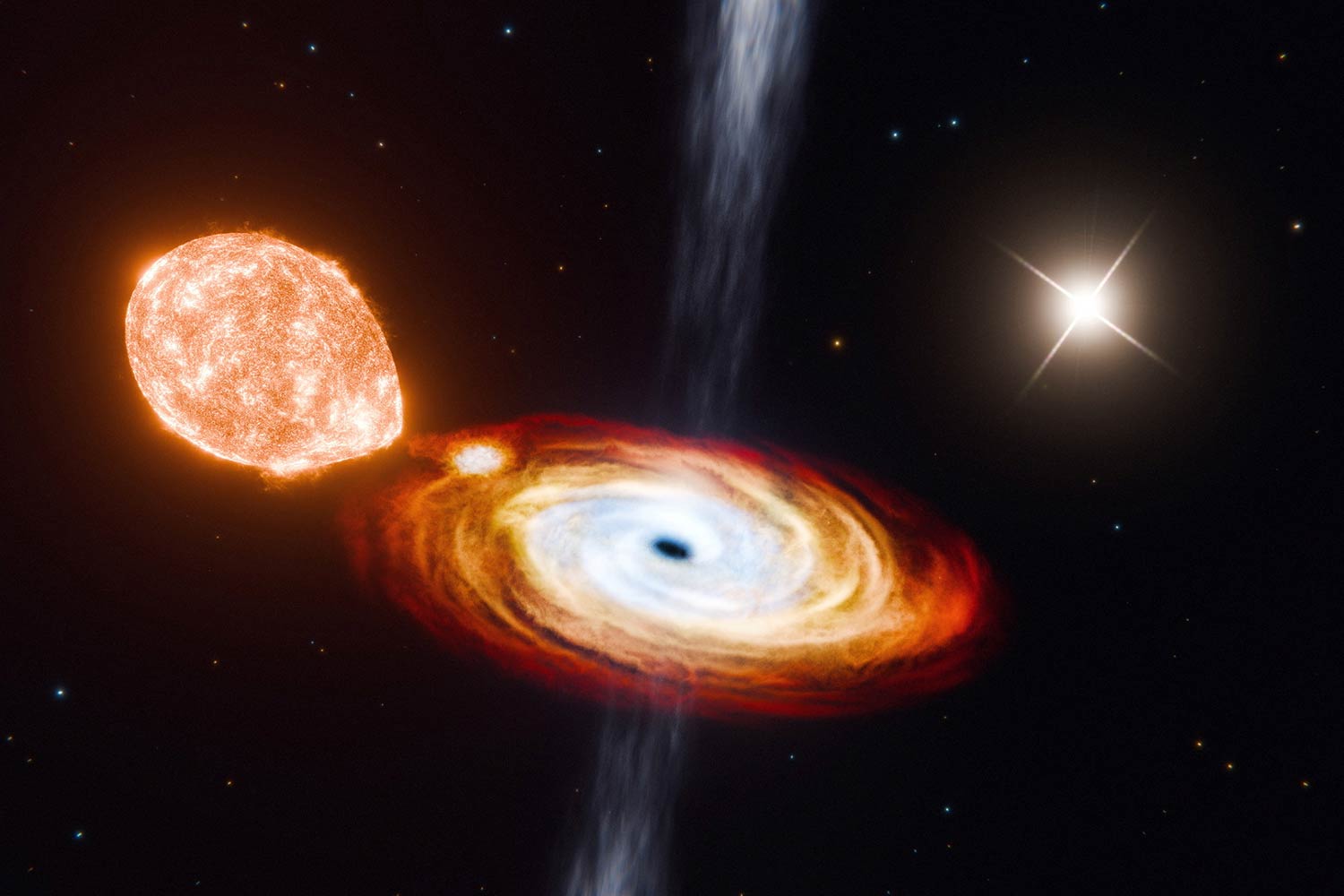
    An artist’s impression shows a triple star system called V404 Cygni with a black hole and two ordinary stars. Material siphoned from the deformed nearby star, left, is pictured swirling around the black hole, right, as the third star, top right, shines in the distance. Jorge Lugo

    A key sign of a growing supermassive black hole is emission of X-rays, high-energy electromagnetic radiation with very short wavelengths. Material swirling around a supermassive black hole before it is consumed is superheated and glows strongly in X-ray wavelengths. The researchers first spotted LID-568 using Nasa’s Chandra X-ray Observatory and then studied it more closely using Webb’s infrared observational capabilities.

    The Webb observations suggest the existence of some sort of mechanism through which a black hole can gobble up material at a faster pace than previously believed possible.

    Read: World’s first wooden satellite heads to space

    “LID-568 is remarkable due to its extreme growth rate and the fact that it exists so early in the universe,” Suh said. “We don’t know yet how LID-568 is able to exceed the Eddington limit. To investigate further, we need more data, so we are planning to conduct follow-up observations with Webb.”  — Will Dunham, (c) 2024 Reuters

    • Main image is an artist’s illustration shows a rapidly feeding black hole that is emitting powerful gas outflows. Using data from NASA’s JWST and Chandra X-ray Observatory, a team of US National Science Foundation NOIRLab astronomers have discovered this low-mass black hole at the centre of a galaxy just 1.5 billion years after the Big Bang. It is accreting matter at a phenomenal rate — over 40 times the theoretical limit. While short lived, this black hole’s “feast” could help astronomers explain how supermassive black holes grew so quickly in the early universe. NOIRLab/NSF/Aura/J da Silva/M Zamani

    Don’t miss:

    Scientists unveil first image of black hole at centre of Milky Way

    Follow TechCentral on Google News Add TechCentral as your preferred source on Google


    James Webb Space Telescope JWST Nasa NOIRLab
    WhatsApp YouTube
    Share. Facebook Twitter LinkedIn WhatsApp Telegram Email Copy Link
    Previous ArticleBitcoin leaps to record high on early Trump gains
    Next Article China is better prepared for Trump 2.0

    Related Posts

    Musk hits brakes on Mars mission

    Musk hits brakes on Mars mission

    9 February 2026
    Breaking free from legacy thinking in banks: AI, automation and the agentic operating model - Steve Burke iqbusiness

    Breaking free from legacy thinking in banks: AI, automation and the agentic operating model

    15 January 2026
    Starlink satellite anomaly creates debris in rare orbital mishap

    Starlink satellite anomaly creates debris in rare orbital mishap

    19 December 2025
    Company News
    Service is everyone's problem now - and that's exactly why the Atlassian Service Collection matters

    Service is everyone’s problem now – why the Atlassian Service Collection matters

    20 February 2026
    Customers have new expectations. Is your CX ready? 1Stream

    Customers have new expectations. Is your CX ready?

    19 February 2026
    South Africa's cybersecurity challenge is not a tool problem - Nicholas Applewhite, Trinexia South Africa

    South Africa’s cybersecurity challenge is not a tool problem

    19 February 2026
    Opinion
    A million reasons monopolies don't work - Duncan McLeod

    A million reasons monopolies don’t work

    10 February 2026
    The author, Business Leadership South Africa CEO Busi Mavuso

    Eskom unbundling U-turn threatens to undo hard-won electricity gains

    9 February 2026
    South Africa's skills advantage is being overlooked at home - Richard Firth

    South Africa’s skills advantage is being overlooked at home

    29 January 2026

    Subscribe to Updates

    Get the best South African technology news and analysis delivered to your e-mail inbox every morning.

    Latest Posts
    MultiChoice scraps annual DStv price hikes for 2026 - David Mignot

    MultiChoice scraps annual DStv price hike

    20 February 2026
    What Gen Z really thinks about the tech world it inherited - Tinashe Mazodze

    What Gen Z really thinks about the tech world it inherited

    20 February 2026
    Showmax 'can't continue' in its current form

    Showmax ‘can’t continue’ in its current form

    20 February 2026
    Free Market Foundation slams treasury's proposed gambling tax

    Free Market Foundation slams treasury’s proposed gambling tax

    20 February 2026
    © 2009 - 2026 NewsCentral Media
    • Cookie policy (ZA)
    • TechCentral – privacy and Popia

    Type above and press Enter to search. Press Esc to cancel.

    Manage consent

    TechCentral uses cookies to enhance its offerings. Consenting to these technologies allows us to serve you better. Not consenting or withdrawing consent may adversely affect certain features and functions of the website.

    Functional Always active
    The technical storage or access is strictly necessary for the legitimate purpose of enabling the use of a specific service explicitly requested by the subscriber or user, or for the sole purpose of carrying out the transmission of a communication over an electronic communications network.
    Preferences
    The technical storage or access is necessary for the legitimate purpose of storing preferences that are not requested by the subscriber or user.
    Statistics
    The technical storage or access that is used exclusively for statistical purposes. The technical storage or access that is used exclusively for anonymous statistical purposes. Without a subpoena, voluntary compliance on the part of your Internet Service Provider, or additional records from a third party, information stored or retrieved for this purpose alone cannot usually be used to identify you.
    Marketing
    The technical storage or access is required to create user profiles to send advertising, or to track the user on a website or across several websites for similar marketing purposes.
    • Manage options
    • Manage services
    • Manage {vendor_count} vendors
    • Read more about these purposes
    View preferences
    • {title}
    • {title}
    • {title}