
Close Menu
TechCentralTechCentral

    Subscribe to the newsletter

    Get the best South African technology news and analysis delivered to your e-mail inbox every morning.

    Facebook X (Twitter) YouTube LinkedIn
    WhatsApp Facebook X (Twitter) LinkedIn YouTube
    TechCentralTechCentral
    • News
      SA experts split on whether the singularity has begun

      SA experts split on whether the singularity has begun

      3 August 2026
      South Africa's hybrid boom is masking a flat electric car market

      South Africa’s hybrid boom is masking a flat electric car market

      3 August 2026
      SABC+ scales up

      SABC+ scales up

      3 August 2026
      The Post Office has fixed its books but not its business

      The Post Office has fixed its books but not its business

      3 August 2026
      SA companies could face cross-border crypto ban

      SA companies could face cross-border crypto ban

      3 August 2026
    • World
      Meta AI will now tell parents if their teen is in crisis

      Meta AI will now tell parents if their teen is in crisis

      17 July 2026
      IBM shares crash 25% as AI upends software spending - Arvind Krishna

      IBM shares crash 25% as AI upends software spending

      15 July 2026
      Jony Ive's first OpenAI device: an AI smart speaker - Jony Ive and Sam Altman

      Jony Ive’s first OpenAI device: an AI smart speaker

      15 July 2026
      Stripe, Advent in talks to buy PayPal for $53-billion

      Stripe, Advent in talks to buy PayPal for $53-billion

      15 July 2026
      Memory crisis sends smartphone market into steep decline

      Memory crisis sends smartphone market into steep decline

      13 July 2026
    • In-depth
      The plan to stop AI from breaking the world - Google DeepMind CEO Demis Hassabis. Image: John Sears

      The plan to stop AI from breaking the world

      16 July 2026
      The internet has a Strait of Hormuz problem

      The internet has a Strait of Hormuz problem

      15 July 2026
      AI boom sparks rally, frenzy and fear

      AI boom sparks rally, frenzy and fear

      11 June 2026
      Every plug-in hybrid on sale in South Africa, ranked by price - Lamborghini Temerario

      Every plug-in hybrid on sale in South Africa, ranked by price

      7 June 2026
      What Wi-Fi 8 will mean for wireless networks

      What Wi-Fi 8 will mean for wireless networks

      1 June 2026
    • TCS
      TCS+ | Why South African workers must become supervisors of digital labour - Accelera Digital Group Cliff de Wit

      TCS+ | Why South African workers must become supervisors of digital labour

      31 July 2026
      TCS | Rapid deployment rules can't work without municipalities: ACT - Nomvuyiso Batyi

      TCS | Icasa’s rules skip the real bottleneck: ACT

      30 July 2026
      TCS+ | iStore Business on why Apple makes sense for SMEs - Sudesh Pillay and Tamia Nontsikelelo

      TCS+ | iStore Business on why Apple makes sense for SMEs

      30 July 2026
      TCS+ | A smarter approach to cloud for South African businesses - Joel Chacko and Jonathan Oaker

      TCS+ | A smarter approach to cloud for South African businesses

      28 July 2026
      TCS | How Optasia lends billions to people banks can't see - Salvador Anglada

      TCS | How Optasia lends billions to people banks can’t see

      23 July 2026
    • Opinion
      The author, Jannie van Zyl

      Selling vapour is corporate suicide in slow motion

      16 July 2026
      Brazil's online gambling crackdown is a lesson for South Africa

      How Amazon outmanoeuvred Starlink in South Africa

      15 July 2026
      The Popia problem with agentic AI - Herman Haasbroek

      The Popia problem with agentic AI

      14 July 2026
      The author, Fanie van Rooyen

      South Africa can still catch the AI wave – here’s how

      7 July 2026
      The author, Fanie van Rooyen

      The AI utopia South Africa can’t afford

      1 July 2026
    • Company Hubs
      • 1Stream
      • Africa Data Centres
      • AfriGIS
      • Altron Digital Business
      • Altron Document Solutions
      • Altron Group
      • Arctic Wolf
      • Ascent Technology
      • AvertITD
      • BBD
      • Braintree
      • CallMiner
      • CambriLearn
      • CM Telecom
      • Contactable
      • CYBER1 Solutions
      • Digicloud Africa
      • Digimune
      • Domains.co.za
      • ESET
      • Euphoria Telecom
      • HOSTAFRICA
      • Incredible Business
      • iONLINE
      • IQbusiness
      • Iris Network Systems
      • Kaspersky
      • LSD Open
      • Mitel
      • NEC XON
      • Netstar
      • Network Platforms
      • Next DLP
      • Ovations
      • Paracon
      • Paratus
      • Q-KON
      • SevenC
      • SkyWire
      • Solid8 Technologies
      • Telit Cinterion
      • Telviva
      • Tenable
      • Vertiv
      • Videri Digital
      • Vodacom Business
      • Vox
      • Wipro
      • Workday
      • XLink
    • Sections
      • AI and machine learning
      • Banking
      • Broadcasting and Media
      • Cloud services
      • Contact centres and CX
      • Cryptocurrencies
      • Education and skills
      • Electronics and hardware
      • Energy and sustainability
      • Enterprise software
      • Financial services
      • HealthTech
      • Information security
      • Internet and connectivity
      • Internet of Things
      • Investment
      • IT services
      • Lifestyle
      • Policy and regulation
      • Public sector
      • Retail and e-commerce
      • Satellite communications
      • Science
      • SMEs and start-ups
      • Social media
      • Talent and leadership
      • Telecoms
      • Watts & Wheels
    • Events
    • Advertise
    TechCentralTechCentral
    Home » News » Why the time might be right to get back into global tech stocks

    Why the time might be right to get back into global tech stocks

    By James Bennett18 July 2022
    Twitter LinkedIn Facebook WhatsApp Email Telegram Copy Link
    News Alerts
    WhatsApp

    After the selloff in technology shares in recent months, investors are debating whether the sector is investable. It would be a mistake to avoid tech as a whole. These types of selloffs typically create excellent buying opportunities in individual stocks, and the current pullback is unlikely to be any different.

    At some point in our investing journeys, we have probably all declared a sector to be unsuitable for investment – for reasons that include high valuations, a poor secular outlook for that industry, or unusually large regulatory risk. There are undoubtably points in time where simply avoiding a sector would have served our overall performance very well, even if only for a short while. Avoiding the high-revenue-growth, no-earnings software sector from the second half of 2021 seems like a smart call with hindsight (and maybe even to some at the time).

    Tech is the biggest sector by market capitalisation in the US, accounting for 27% of the S&P 500 Index. It is a large sector that offers a wide range of investment opportunities.
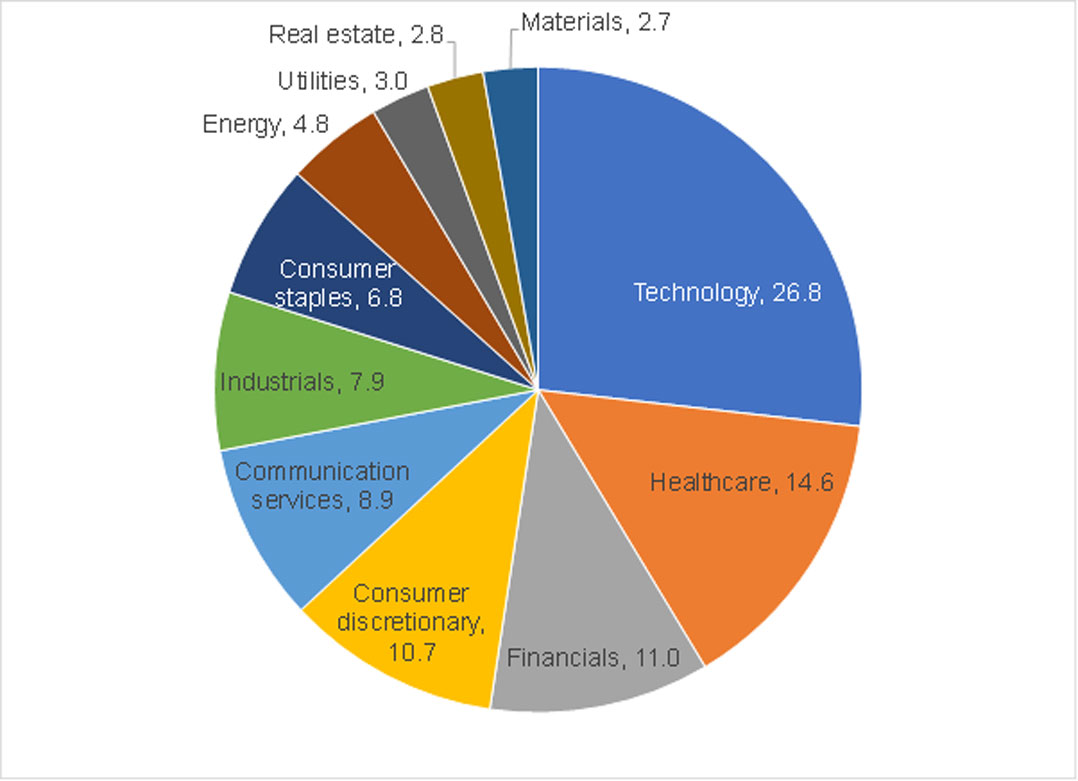
    Figure 1: S&P 500 sector weightings by market cap, %. Source: Bloomberg, Anchor

    The tech sector’s weighting in the S&P 500 Index has steadily increased over the past 20 years but remains below the peaks achieved at the height of the 2000 tech bubble. The current increase has seen a steady climb over many years compared with the sharp, sudden increases of the late 1990s. This points to a longer-term secular trend compared to the tech bubble of the late 1990s.
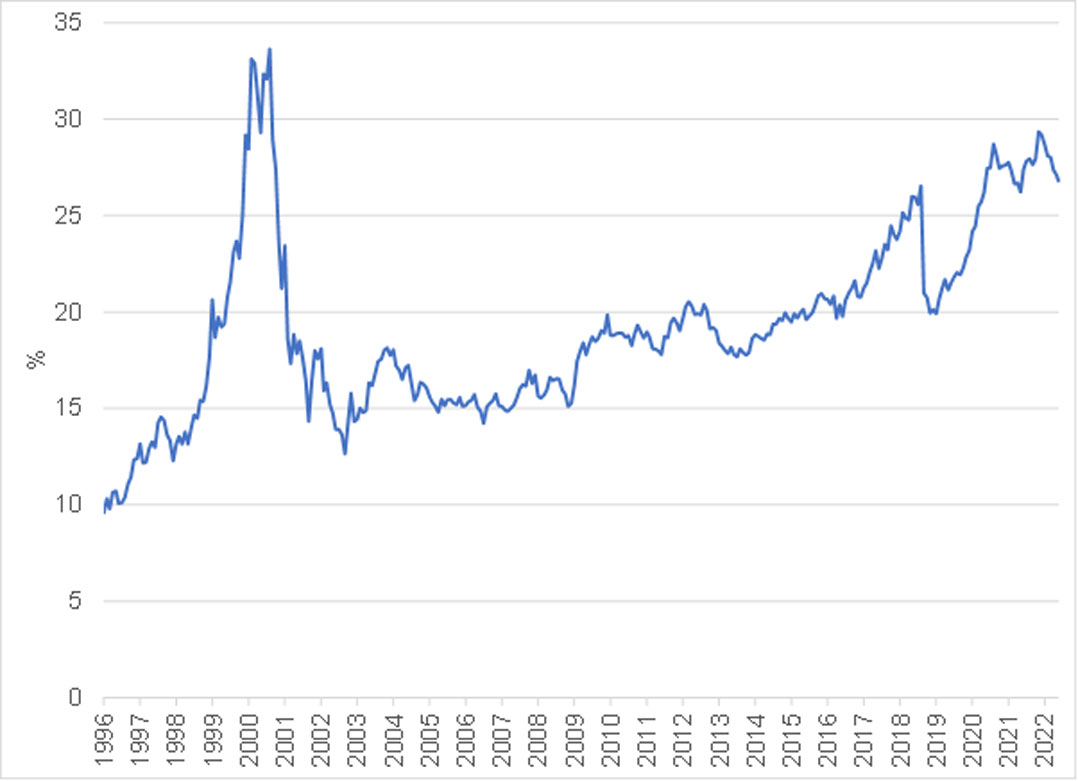
    Figure 2: The technology sector as a percentage of the S&P 500 market cap. Source: Bloomberg, Anchor

    The S&P 500 Information Technology sector’s price-to-earnings (p:e) multiple has retraced sharply but it is not yet in long-term, deep-value territory.
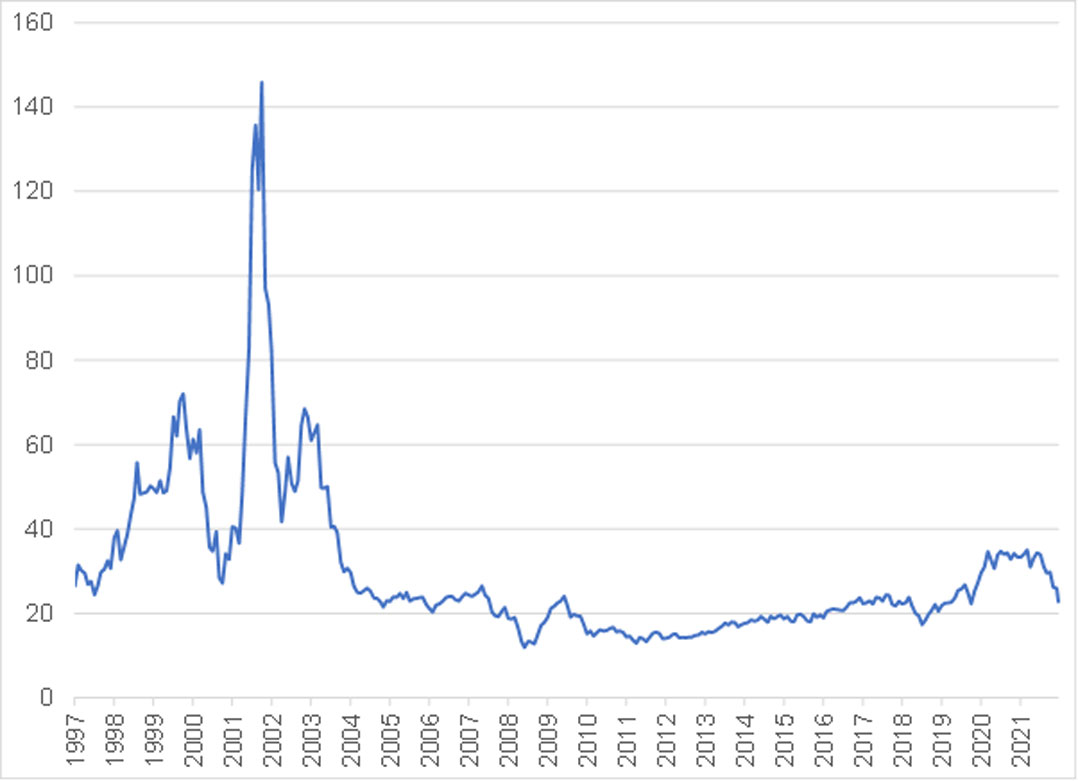
    Figure 3: The S&P 500 Information Technology sector p:e ratio. Source: Bloomberg, Anchor

    The sharp sell-off of 2022 has seen the price-to-sales (p:s) multiple of the S&P 500 Information Technology sector retrace sharply but it is not yet in value territory for the sector as a whole. The p:s multiple has some severe shortcomings as a valuation metric. However, it can be useful in the tech sector given the tendency of higher-growth companies to deliberately reinvest a large proportion of current profits into driving future revenue growth.
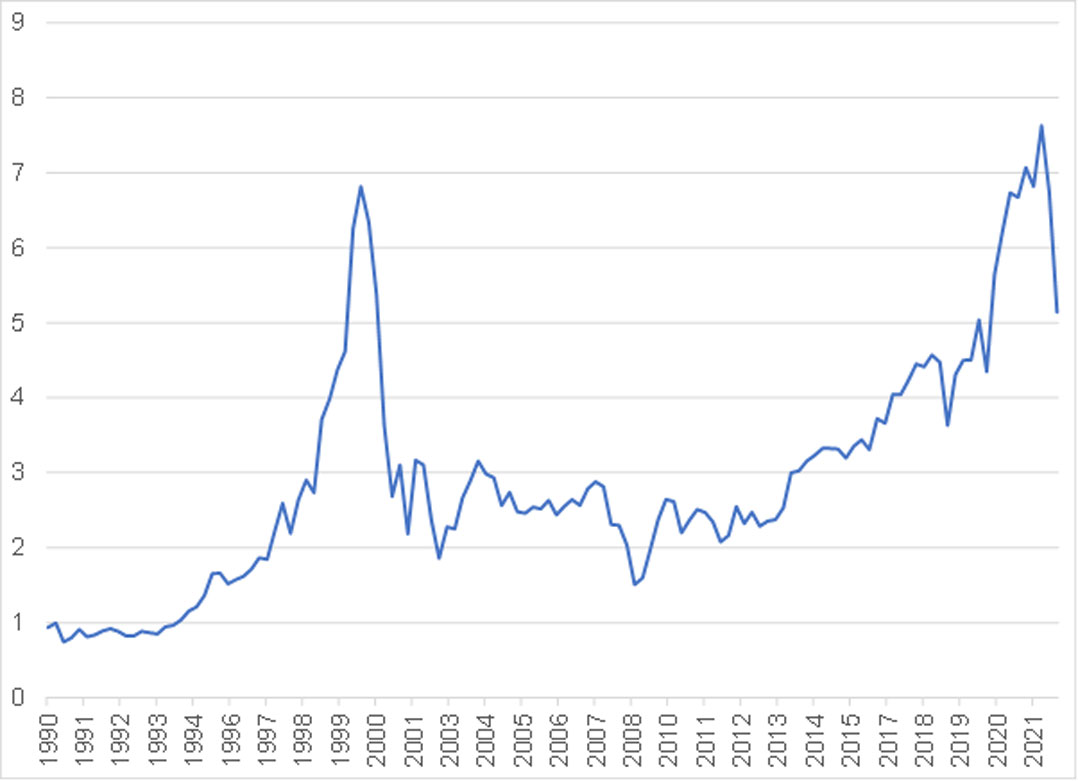
    Figure 4: The S&P 500 Information Technology sector p:s ratio. Source: Bloomberg, Anchor

    It is worth discussing how one defines a tech company. Is Apple a tech company or a consumer electronics company with phenomenal products? Is Alphabet/Google a tech company or is it an advertising company that serves its customers in a highly efficient and cost-effective way? Is Amazon a tech company or is it a retailer (ignoring Amazon Web Services) that uses technology to deliver an outstanding consumer experience for its customers?

    Sometimes, what we classify as a tech company is a traditional business that is using modern technology to enhance the way it serves its customers. Surely this is what most/all companies should be doing? If an older, traditional company embraces technology to improve its service, does it then become a tech company to be avoided, even though this newer approach might be enhancing its investor returns?

    There is no doubt that the successful application of modern technology is enabling companies to scale much faster than in previous eras of slowly grinding out an expansion in brick-and-mortar businesses.

    Many businesses that are now classified as tech companies would have been classified as something else in a bygone era

    The increasingly wide definition of what constitutes a tech company is likely contributing to the steady rise of tech as a percentage of the overall market. Many businesses that are now classified as tech companies would have been classified as something else in a bygone era. It is worth noting that some of the companies that are commonly referred to as Big Tech (such as Alphabet and Amazon) are not actually included in the S&P 500 Information Technology Index.

    Previously, tech spending was considered a cost centre for many large corporations. Increasingly, it is considered mission-critical spending to enhance business efficiencies and therefore profits. In the face of slowing global economic growth, no sector is truly immune to this slowdown. However, large parts of corporate tech spending could still prove very resilient. A mission-critical sector such as cybersecurity is a good example of this.

    Ironically, over the years, some have suggested avoiding consumer electronics businesses as they make for poor investments. Well, maybe not in the case of companies like Apple that make truly world-class products. These top-down views can lead to poor investment outcomes. Rather assess each company on a case-by-case basis.

    Vulnerable

    Some tech companies have shown a remarkable ability to grow into what seemed like stretched valuations at the time. This is not without risks as equity markets have recognised the ability of technology to scale a business faster than was the case previously and valued many of them accordingly. It does, however, leave investors vulnerable if the high-growth investment thesis does not pan out.

    Several successful private investors have observed that some of their most rewarding long-term “tech” investments were in companies that were universally decried as being “too expensive” at the time of investment. The so-called FAANGMs (Facebook/Meta Platforms, Amazon, Apple, Netflix, Alphabet/Google and Microsoft) were avoided by many value-based investors for years as being too expensive, thereby completely missing these market-beating returns. Every day is a new day in markets and maybe the time will come when the FAANGMs do become too expensive relative to their prospects.

    Ultimately, the truth to investing lies in a bottom-up, case-by-case analysis. Accurate bottom-up analysis should lead you to the correct top-down view rather than the other way around. Undoubtedly, there will be some pandemic winners that lack a sustainable business model in a more normalised world. These companies will continue to fade away.

    The author, Anchor Capital’s James Bennett

    Possibly there will be fewer tech failures than was the case in 2000. Many of the 2000 failures were in companies that had no real business model and were selling a future concept to the market. A lot of today’s tech companies seem to have more proven business models, albeit that their share prices were materially overvalued in 2021. Many current high-revenue-growth tech companies have taken an active decision to forgo profits to scale their business for the longer term. These companies have some scope to dial back on rapid revenue growth in exchange for higher current profits. Cutting back on large sales and marketing expense lines is one example of this.

    Taking top-down decisions to avoid a particular sector can exclude the investor from potential opportunities to generate significant personal wealth. Given the increasingly wide definition of what constitutes a tech company, it seems a mistake to take a top-down view to avoid investment in these companies completely. The valuation pullback in recent months is likely to create some excellent buying opportunities in individual tech companies.

    • The author, James Bennett, is global equity analyst at Anchor Capital

    Follow TechCentral on Google News Add TechCentral as your preferred source on Google


    Anchor Capital James Bennett
    WhatsApp YouTube
    Share. Facebook Twitter LinkedIn WhatsApp Telegram Email Copy Link
    Previous ArticleVodafone sells towers in New Zealand for $1.1-billion
    Next Article Cisco study: South Africans love hybrid work – and it’s good for us

    Related Posts

    The story of AI and two brilliant Englishmen

    18 July 2023

    Tech investment in 2021: A tale of two countries

    17 January 2022

    Where to invest right now in global tech

    15 October 2021
    Company News
    Google Cloud, AI adoption gain momentum in Africa - Digicloud Africa

    Google Cloud, AI adoption gain momentum in Africa

    3 August 2026
    Domains.co.za launches self-hosted n8n VPS hosting

    Domains.co.za launches self-hosted n8n VPS hosting

    31 July 2026
    Smarter.tech '26 shows why smarter technology begins with context - Obsidian Systems

    Context is the missing piece in enterprise AI: Obsidian

    31 July 2026
    Opinion
    The author, Jannie van Zyl

    Selling vapour is corporate suicide in slow motion

    16 July 2026
    Brazil's online gambling crackdown is a lesson for South Africa

    How Amazon outmanoeuvred Starlink in South Africa

    15 July 2026
    The Popia problem with agentic AI - Herman Haasbroek

    The Popia problem with agentic AI

    14 July 2026

    Subscribe to Updates

    Get the best South African technology news and analysis delivered to your e-mail inbox every morning.

    Latest Posts
    SA experts split on whether the singularity has begun

    SA experts split on whether the singularity has begun

    3 August 2026
    South Africa's hybrid boom is masking a flat electric car market

    South Africa’s hybrid boom is masking a flat electric car market

    3 August 2026
    SABC+ scales up

    SABC+ scales up

    3 August 2026
    The Post Office has fixed its books but not its business

    The Post Office has fixed its books but not its business

    3 August 2026
    © 2009 - 2026 NewsCentral Media
    Built and maintained by Chronon
    • Cookie policy (ZA)
    • TechCentral – privacy and Popia

    Type above and press Enter to search. Press Esc to cancel.

    Manage consent

    TechCentral uses cookies to enhance its offerings. Consenting to these technologies allows us to serve you better. Not consenting or withdrawing consent may adversely affect certain features and functions of the website.

    Functional Always active
    The technical storage or access is strictly necessary for the legitimate purpose of enabling the use of a specific service explicitly requested by the subscriber or user, or for the sole purpose of carrying out the transmission of a communication over an electronic communications network.
    Preferences
    The technical storage or access is necessary for the legitimate purpose of storing preferences that are not requested by the subscriber or user.
    Statistics
    The technical storage or access that is used exclusively for statistical purposes. The technical storage or access that is used exclusively for anonymous statistical purposes. Without a subpoena, voluntary compliance on the part of your Internet Service Provider, or additional records from a third party, information stored or retrieved for this purpose alone cannot usually be used to identify you.
    Marketing
    The technical storage or access is required to create user profiles to send advertising, or to track the user on a website or across several websites for similar marketing purposes.
    • Manage options
    • Manage services
    • Manage {vendor_count} vendors
    • Read more about these purposes
    View preferences
    • {title}
    • {title}
    • {title}