


Close Menu
TechCentralTechCentral

    Subscribe to the newsletter

    Get the best South African technology news and analysis delivered to your e-mail inbox every morning.

    Facebook X (Twitter) YouTube LinkedIn
    WhatsApp Facebook X (Twitter) LinkedIn YouTube
    TechCentralTechCentral
    • News
      Andrew Baker is new CIO of Capitec

      Andrew Baker is new CIO of Capitec

      16 February 2026
      Global network rankings put just one SA operator on the map

      Global network rankings put just one SA operator on the map

      16 February 2026
      South African CISOs are facing a burnout epidemic

      South African CISOs are facing a burnout epidemic

      16 February 2026
      Telkom tops 25 million mobile subscribers as data growth surges - Serame Taukobong

      Telkom tops 25 million mobile subscribers as data growth surges

      16 February 2026
      BCX CEO Jonas Bogoshi to retire after seven years at the helm

      BCX CEO Jonas Bogoshi to retire after seven years at the helm

      16 February 2026
    • World
      Russia bans WhatsApp

      Russia bans WhatsApp

      12 February 2026
      EU regulators take aim at WhatsApp

      EU regulators take aim at WhatsApp

      9 February 2026
      Musk hits brakes on Mars mission

      Musk hits brakes on Mars mission

      9 February 2026
      Crypto firm accidentally sends R700-billion in bitcoin to its users

      Crypto firm accidentally sends R700-billion in bitcoin to its users

      8 February 2026
      AI won't replace software, says Nvidia CEO amid market rout - Jensen Huang

      AI won’t replace software, says Nvidia CEO amid market rout

      4 February 2026
    • In-depth
      How liberalisation is rewiring South Africa's power sector

      How liberalisation is rewiring South Africa’s power sector

      21 January 2026
      The top-performing South African tech shares of 2025

      The top-performing South African tech shares of 2025

      12 January 2026
      Digital authoritarianism grows as African states normalise internet blackouts

      Digital authoritarianism grows as African states normalise internet blackouts

      19 December 2025
      TechCentral's South African Newsmakers of 2025

      TechCentral’s South African Newsmakers of 2025

      18 December 2025
      Black Friday goes digital in South Africa as online spending surges to record high

      Black Friday goes digital in South Africa as online spending surges to record high

      4 December 2025
    • TCS
      Watts & Wheels S1E4: 'We drive an electric Uber'

      Watts & Wheels S1E4: ‘We drive an electric Uber’

      10 February 2026
      TCS+ | How Cloud On Demand is helping SA businesses succeed in the cloud - Xhenia Rhode, Dion Kalicharan

      TCS+ | Cloud On Demand and Consnet: inside a real-world AWS partner success story

      30 January 2026
      Watts & Wheels S1E4: 'We drive an electric Uber'

      Watts & Wheels S1E3: ‘BYD’s Corolla Cross challenger’

      30 January 2026
      Watts & Wheels S1E4: 'We drive an electric Uber'

      Watts & Wheels S1E2: ‘China attacks, BMW digs in, Toyota’s sublime supercar’

      23 January 2026

      TCS+ | Why cybersecurity is becoming a competitive advantage for SA businesses

      20 January 2026
    • Opinion
      A million reasons monopolies don't work - Duncan McLeod

      A million reasons monopolies don’t work

      10 February 2026
      The author, Business Leadership South Africa CEO Busi Mavuso

      Eskom unbundling U-turn threatens to undo hard-won electricity gains

      9 February 2026
      South Africa's skills advantage is being overlooked at home - Richard Firth

      South Africa’s skills advantage is being overlooked at home

      29 January 2026
      Why Elon Musk's Starlink is a 'hard no' for me - Songezo Zibi

      Why Elon Musk’s Starlink is a ‘hard no’ for me

      26 January 2026
      A million reasons monopolies don't work - Duncan McLeod

      South Africa’s new fibre broadband battle

      20 January 2026
    • Company Hubs
      • Africa Data Centres
      • AfriGIS
      • Altron Digital Business
      • Altron Document Solutions
      • Altron Group
      • Arctic Wolf
      • AvertITD
      • Braintree
      • CallMiner
      • CambriLearn
      • CYBER1 Solutions
      • Digicloud Africa
      • Digimune
      • Domains.co.za
      • ESET
      • Euphoria Telecom
      • Incredible Business
      • iONLINE
      • IQbusiness
      • Iris Network Systems
      • LSD Open
      • Mitel
      • NEC XON
      • Netstar
      • Network Platforms
      • Next DLP
      • Ovations
      • Paracon
      • Paratus
      • Q-KON
      • SevenC
      • SkyWire
      • Solid8 Technologies
      • Telit Cinterion
      • Tenable
      • Vertiv
      • Videri Digital
      • Vodacom Business
      • Wipro
      • Workday
      • XLink
    • Sections
      • AI and machine learning
      • Banking
      • Broadcasting and Media
      • Cloud services
      • Contact centres and CX
      • Cryptocurrencies
      • Education and skills
      • Electronics and hardware
      • Energy and sustainability
      • Enterprise software
      • Financial services
      • Information security
      • Internet and connectivity
      • Internet of Things
      • Investment
      • IT services
      • Lifestyle
      • Motoring
      • Public sector
      • Retail and e-commerce
      • Satellite communications
      • Science
      • SMEs and start-ups
      • Social media
      • Talent and leadership
      • Telecoms
    • Events
    • Advertise
    TechCentralTechCentral
    Home » In-depth » World’s deadliest inventor: Mikhail Kalashnikov and his AK-47

    World’s deadliest inventor: Mikhail Kalashnikov and his AK-47

    By The Conversation10 November 2019
    Twitter LinkedIn Facebook WhatsApp Email Telegram Copy Link
    News Alerts
    WhatsApp

    What is the deadliest weapon of the 20th century?

    Perhaps you think first of the atomic bomb, estimated to have killed as many as 200 000 people when the US dropped two on the Japanese cities of Hiroshima and Nagasaki in 1945.

    But another weapon is responsible for far more deaths — numbering up into the millions. It’s the Kalashnikov assault rifle, commonly known as the AK-47.

    Originally developed in secret for the Soviet military, an estimated 100 million AK-47s and its variants have been produced to date. This gun is now found throughout the world, including in the hands of many American civilians, who in 2012 bought as many AK-47s as the Russian police and military.

    The name of Kalashnikov’s greatest invention stands for Automat Kalashnikova 1947, the year it was first produced

    Russian Mikhail Kalashnikov invented the weapon that bears his name in the middle of the 20th century. Born on 10 November 1919, Kalashnikov was a tank mechanic in the Soviet military during the second World War. He was wounded during the German invasion of the USSR in 1941.

    Having seen first-hand the combat advantage conferred by Germany’s superior firearms, Kalashnikov resolved to develop a better weapon. While still in the military, he produced several designs that lost out to competitors before eventually producing the first AK-47.

    The name of Kalashnikov’s greatest invention stands for Automat Kalashnikova 1947, the year it was first produced.

    Quickly spread

    In 1949, the AK-47 became the assault rifle of the Soviet Army. Later adopted by other nations in the Warsaw Pact, the weapon quickly spread around the world, becoming a symbol of revolution in such far-flung lands as Vietnam, Afghanistan, Colombia and Mozambique, on whose flag it figures prominently.

    Over the course of his long life, Kalashnikov continued to tweak his classic design. In 1959, production began on his AKM, which replaced the AK-47’s milled receiver with one made of stamped metal, making it both lighter and less expensive to produce. He also developed the cartridge-fed PK machine gun. Modified AK-47s are still in production in countries around the world.

    Why was the AK-47 such a revolutionary rifle?

    It is relatively inexpensive to produce, short and light to carry, and easy to use, with little recoil. It also boasts legendary reliability under harsh conditions ranging from waterlogged jungles to Middle Eastern sandstorms, in both extreme cold and heat.
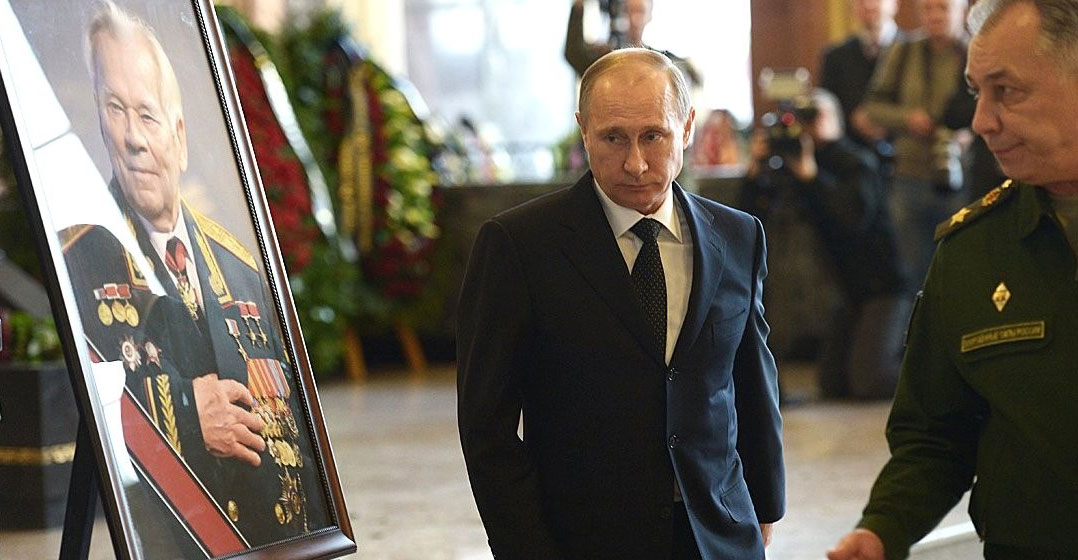
    Vladimir Putin at Mikhail Kalashnikov’s funeral in 2013

    It also requires relatively little maintenance. This stems from its large gas piston and wide clearances between moving parts, which help to prevent it from jamming.

    Kalashnikov liked to boast about the rifle’s superiority to the American military’s M-16 rifle. “During the Vietnam War,” he said in a 2007 interview, “American soldiers would throw away their M-16s to grab AK-47s and bullets for it from dead Vietnamese soldiers. And I hear American soldiers in Iraq use it quite often.”

    The world’s most abundant firearm is also well suited to crime and terrorism. The hostage-takers who stormed the Olympic Village in Munich in 1972 were armed with Kalashnikovs, and mass shooters in the US have used semi-automatic versions of the weapon in killings in Stockton, California and Dallas.

    Today, global prices often run in the hundreds of dollars, but some AK-47s can be had for as little as $50

    The US military has acted as a distributor of the weapon in conflicts in Afghanistan and Iraq. With a service life of 20 to 40 years, AKs are easily relocated and repurposed.

    Today, global prices often run in the hundreds of dollars, but some AK-47s can be had for as little as US$50. The huge worldwide production of the weapon, particularly in countries with low labour costs, has driven prices downward.

    For his labours, the Soviet Union awarded Kalashnikov the Stalin Prize, the Red Star and the Order of Lenin. In 2007, President Vladimir Putin singled out the Kalashnikov rifle as “a symbol of the creative genius of our people”.

    Kalashnikov died a national hero in 2013 at the age of 94.

    Rebuffed

    Throughout most of his life, Kalashnikov rebuffed attempts to saddle him with guilt over the vast number of killings and injuries inflicted with his invention. He insisted that he had developed it for defence, not offence.

    When a reporter asked in 2007 how he could sleep at night, he replied: “I sleep well. It is the politicians who are to blame for failing to come to an agreement and resorting to violence.”

    Yet in the final year of his life, Kalashnikov may have experienced a change of heart. He wrote a letter to the head of the Russian Orthdox Church, saying: “The pain in my soul is unbearable. I keep asking myself the same unsolvable question. If my assault rifle took people’s lives, that means that I am responsible for their deaths.”

    It’s a perennial debate: What kills? Guns, or those who carry them? At the bottom of the letter, he signed it: “A slave of God, the designer Mikhail Kalashnikov.”The Conversation

    • Written by Richard Gunderman, chancellor’s professor of medicine, liberal arts, and philanthropy, Indiana University
    • This article is republished from The Conversation under a Creative Commons licence


    Mikhail Kalashnikov
    WhatsApp YouTube Follow on Google News Add as preferred source on Google
    Share. Facebook Twitter LinkedIn WhatsApp Telegram Email Copy Link
    Previous ArticleFake rhino horn ‘could help conservation efforts’
    Next Article Bitcoin plunge risks erasing Xi-inspired rally
    Company News
    Vox Weather viewer numbers continue to climb across multiple technology platforms

    Vox Weather viewer numbers continue to climb across tech platforms

    16 February 2026
    Vivo launches X300 flagship series in SA with 200MP Zeiss cameras

    Vivo launches X300 flagship series in SA with 200MP Zeiss cameras

    16 February 2026
    Cell C delivers maiden results with growth momentum, financial flexibility - Jorges Mendes

    Cell C delivers maiden results with growth momentum, financial flexibility

    13 February 2026
    Opinion
    A million reasons monopolies don't work - Duncan McLeod

    A million reasons monopolies don’t work

    10 February 2026
    The author, Business Leadership South Africa CEO Busi Mavuso

    Eskom unbundling U-turn threatens to undo hard-won electricity gains

    9 February 2026
    South Africa's skills advantage is being overlooked at home - Richard Firth

    South Africa’s skills advantage is being overlooked at home

    29 January 2026

    Subscribe to Updates

    Get the best South African technology news and analysis delivered to your e-mail inbox every morning.

    Latest Posts
    Andrew Baker is new CIO of Capitec

    Andrew Baker is new CIO of Capitec

    16 February 2026
    Global network rankings put just one SA operator on the map

    Global network rankings put just one SA operator on the map

    16 February 2026
    Vox Weather viewer numbers continue to climb across multiple technology platforms

    Vox Weather viewer numbers continue to climb across tech platforms

    16 February 2026
    South African CISOs are facing a burnout epidemic

    South African CISOs are facing a burnout epidemic

    16 February 2026
    © 2009 - 2026 NewsCentral Media
    • Cookie policy (ZA)
    • TechCentral – privacy and Popia

    Type above and press Enter to search. Press Esc to cancel.

    Manage consent

    TechCentral uses cookies to enhance its offerings. Consenting to these technologies allows us to serve you better. Not consenting or withdrawing consent may adversely affect certain features and functions of the website.

    Functional Always active
    The technical storage or access is strictly necessary for the legitimate purpose of enabling the use of a specific service explicitly requested by the subscriber or user, or for the sole purpose of carrying out the transmission of a communication over an electronic communications network.
    Preferences
    The technical storage or access is necessary for the legitimate purpose of storing preferences that are not requested by the subscriber or user.
    Statistics
    The technical storage or access that is used exclusively for statistical purposes. The technical storage or access that is used exclusively for anonymous statistical purposes. Without a subpoena, voluntary compliance on the part of your Internet Service Provider, or additional records from a third party, information stored or retrieved for this purpose alone cannot usually be used to identify you.
    Marketing
    The technical storage or access is required to create user profiles to send advertising, or to track the user on a website or across several websites for similar marketing purposes.
    • Manage options
    • Manage services
    • Manage {vendor_count} vendors
    • Read more about these purposes
    View preferences
    • {title}
    • {title}
    • {title}