Close Menu
TechCentralTechCentral

    Subscribe to the newsletter

    Get the best South African technology news and analysis delivered to your e-mail inbox every morning.

    Facebook X (Twitter) YouTube LinkedIn
    WhatsApp Facebook X (Twitter) LinkedIn YouTube
    TechCentralTechCentral
    • News
      SABC Plus to flight Microsoft AI training videos

      SABC Plus to flight Microsoft AI training videos

      30 January 2026
      Fibre industry consolidation in KZN

      Fibre industry consolidation in KZN

      30 January 2026
      Watts & Wheels S1E3: 'BYD's Corolla Cross challenger'

      Watts & Wheels S1E3: ‘BYD’s Corolla Cross challenger’

      30 January 2026
      What ordinary South Africans really think of AI

      What ordinary South Africans really think of AI

      30 January 2026
      Tim Cook flags memory crunch as AI chips starve smartphones

      Tim Cook flags memory crunch as AI chips starve smartphones

      30 January 2026
    • World
      Apple acquires audio AI start-up Q.ai

      Apple acquires audio AI start-up Q.ai

      30 January 2026
      SpaceX IPO may be largest in history

      SpaceX IPO may be largest in history

      28 January 2026
      Nvidia throws AI at the weather

      Nvidia throws AI at weather forecasting

      27 January 2026
      Debate erupts over value of in-flight Wi-Fi

      Debate erupts over value of in-flight Wi-Fi

      26 January 2026
      Intel takes another hit - Intel CEO Lip-Bu Tan. Laure Andrillon/Reuters

      Intel takes another hit

      23 January 2026
    • In-depth
      How liberalisation is rewiring South Africa's power sector

      How liberalisation is rewiring South Africa’s power sector

      21 January 2026
      The top-performing South African tech shares of 2025

      The top-performing South African tech shares of 2025

      12 January 2026
      Digital authoritarianism grows as African states normalise internet blackouts

      Digital authoritarianism grows as African states normalise internet blackouts

      19 December 2025
      TechCentral's South African Newsmakers of 2025

      TechCentral’s South African Newsmakers of 2025

      18 December 2025
      Black Friday goes digital in South Africa as online spending surges to record high

      Black Friday goes digital in South Africa as online spending surges to record high

      4 December 2025
    • TCS
      TCS+ | How Cloud On Demand is helping SA businesses succeed in the cloud - Xhenia Rhode, Dion Kalicharan

      TCS+ | Cloud On Demand and Consnet: inside a real-world AWS partner success story

      30 January 2026
      Watts & Wheels S1E3: 'BYD's Corolla Cross challenger'

      Watts & Wheels S1E2: ‘China attacks, BMW digs in, Toyota’s sublime supercar’

      23 January 2026

      TCS+ | Why cybersecurity is becoming a competitive advantage for SA businesses

      20 January 2026
      Watts & Wheels S1E3: 'BYD's Corolla Cross challenger'

      Watts & Wheels: S1E1 – ‘William, Prince of Wheels’

      8 January 2026
      TCS+ | Africa's digital transformation - unlocking AI through cloud and culture - Cliff de Wit Accelera Digital Group

      TCS+ | Cloud without culture won’t deliver AI: Accelera’s Cliff de Wit

      12 December 2025
    • Opinion
      South Africa's skills advantage is being overlooked at home - Richard Firth

      South Africa’s skills advantage is being overlooked at home

      29 January 2026
      Why Elon Musk's Starlink is a 'hard no' for me - Songezo Zibi

      Why Elon Musk’s Starlink is a ‘hard no’ for me

      26 January 2026
      South Africa's new fibre broadband battle - Duncan McLeod

      South Africa’s new fibre broadband battle

      20 January 2026
      AI moves from pilots to production in South African companies - Nazia Pillay SAP

      AI moves from pilots to production in South African companies

      20 January 2026
      South Africa's new fibre broadband battle - Duncan McLeod

      ANC’s attack on Solly Malatsi shows how BEE dogma trumps economic reality

      14 December 2025
    • Company Hubs
      • Africa Data Centres
      • AfriGIS
      • Altron Digital Business
      • Altron Document Solutions
      • Altron Group
      • Arctic Wolf
      • AvertITD
      • Braintree
      • CallMiner
      • CambriLearn
      • CYBER1 Solutions
      • Digicloud Africa
      • Digimune
      • Domains.co.za
      • ESET
      • Euphoria Telecom
      • Incredible Business
      • iONLINE
      • IQbusiness
      • Iris Network Systems
      • LSD Open
      • NEC XON
      • Netstar
      • Network Platforms
      • Next DLP
      • Ovations
      • Paracon
      • Paratus
      • Q-KON
      • SevenC
      • SkyWire
      • Solid8 Technologies
      • Telit Cinterion
      • Tenable
      • Vertiv
      • Videri Digital
      • Vodacom Business
      • Wipro
      • Workday
      • XLink
    • Sections
      • AI and machine learning
      • Banking
      • Broadcasting and Media
      • Cloud services
      • Contact centres and CX
      • Cryptocurrencies
      • Education and skills
      • Electronics and hardware
      • Energy and sustainability
      • Enterprise software
      • Financial services
      • Information security
      • Internet and connectivity
      • Internet of Things
      • Investment
      • IT services
      • Lifestyle
      • Motoring
      • Public sector
      • Retail and e-commerce
      • Satellite communications
      • Science
      • SMEs and start-ups
      • Social media
      • Talent and leadership
      • Telecoms
    • Events
    • Advertise
    TechCentralTechCentral
    Home » Sections » Science » 10 incredible images taken by the James Webb Space Telescope in 2022

    10 incredible images taken by the James Webb Space Telescope in 2022

    These 10 images demonstrate the staggering power of humanity's new window to the universe.
    By The Conversation23 December 2022
    Twitter LinkedIn Facebook WhatsApp Email Telegram Copy Link
    News Alerts
    WhatsApp

    It is no exaggeration to say the James Webb Space Telescope (JWST) represents a new era for modern astronomy.

    Launched on 25 December last year and fully operational since July, the telescope offers glimpses of the universe that were inaccessible to us before. Like the Hubble Space Telescope, the JWST is in space, so it can take pictures with stunning detail free from the distortions of Earth’s atmosphere.

    However, while Hubble is in orbit around Earth at an altitude of 540km, the JWST is 1.5 million kilometres distant, far beyond the moon. From this position, away from the interference of our planet’s reflected heat, it can collect light from across the universe far into the infrared portion of the electromagnetic spectrum.

    The Webb telescope can see much further into the infrared than Hubble, with greater sensitivity and sharpness

    This ability, when combined with the JWST’s larger mirror, state-of-the-art detectors and many other technological advances, allows astronomers to look back to the universe’s earliest epochs.

    As the universe expands, it stretches the wavelength of light travelling towards us, making more distant objects appear redder. At great enough distances, the light from a galaxy is shifted entirely out of the visible part of the electromagnetic spectrum to the infrared. The JWST is able to probe such sources of light right back to the earliest times, nearly 14 billion years ago.

    The Hubble telescope continues to be a great scientific instrument and can see at optical wavelengths where the JWST cannot. But the Webb telescope can see much further into the infrared with greater sensitivity and sharpness.

    As the year draws to a close, let’s have a look at 10 images that have demonstrated the staggering power of this new window to the universe.

    1. Mirror alignment complete
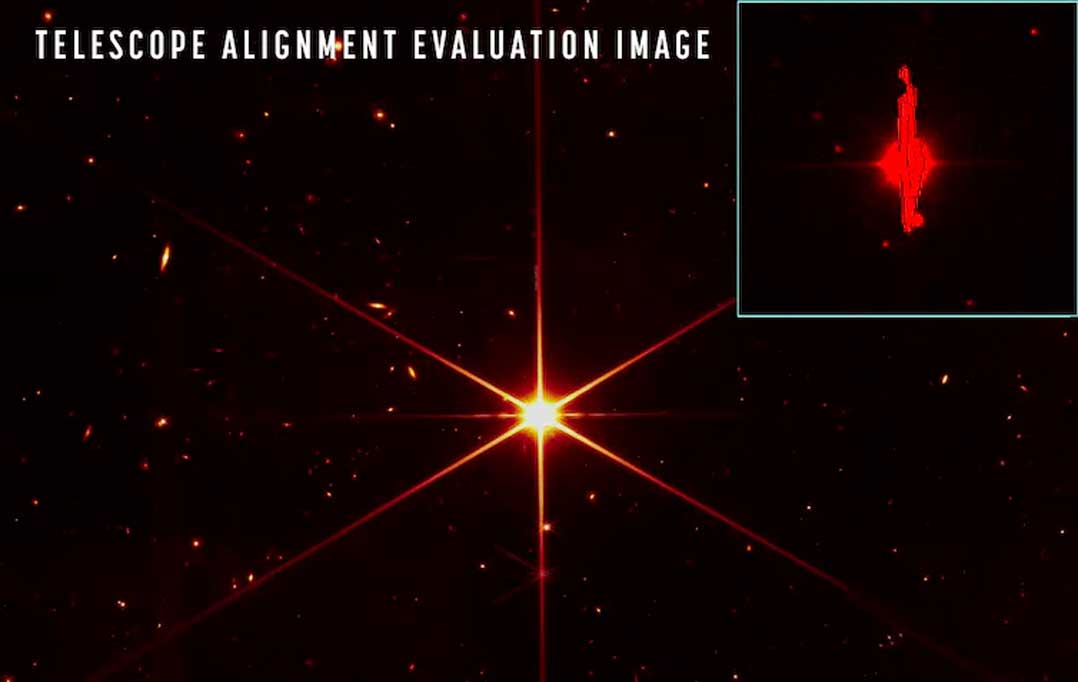
    Left: The first publicly released alignment image from the JWST. Astronomers jumped on this image to compare it to previous images of the same part of sky like that on the right from the Dark Energy Camera on Earth. Nasa/STScI/LegacySurvey/C Jacobs

    Despite years of testing on the ground, an observatory as complex as the JWST required extensive configuration and testing once deployed in the cold and dark of space.

    One of the biggest tasks was getting the 18 hexagonal mirror segments unfolded and aligned to within a fraction of a wavelength of light. In March, Nasa released the first image (centred on a star) from the fully aligned mirror. Although it was just a calibration image, astronomers immediately compared it to existing images of that patch of sky – with considerable excitement.

    2. Spitzer vs MIRI
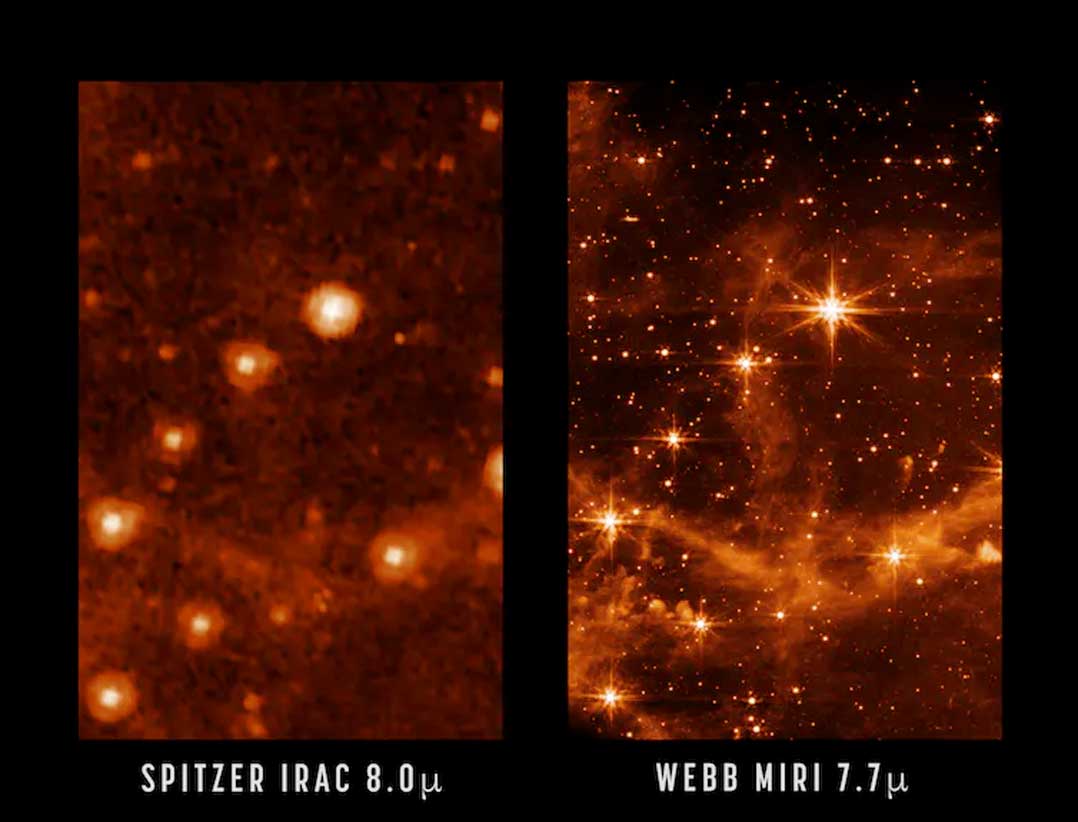
    This image shows a portion of the ‘Pillars of Creation’ in the infrared (see below); on the left taken with the Spitzer Space Telescope, and JWST on the right. The contrast in depth and resolution is dramatic. Nasa/JPL-Caltech (left), Nasa/ESA/CSA/STScI (right)

    This early image, taken while all the cameras were being focused, clearly demonstrates the step change in data quality that JWST brings over its predecessors.

    On the left is an image from the Spitzer telescope, a space-based infrared observatory with an 85cm mirror; the right, the same field from JWST’s mid-infrared MIRI camera and 6.5m mirror. The resolution and ability to detect much fainter sources is on show here, with hundreds of galaxies visible that were lost in the noise of the Spitzer image. This is what a bigger mirror situated out in the deepest, coldest dark can do.

    3. The first galaxy cluster image
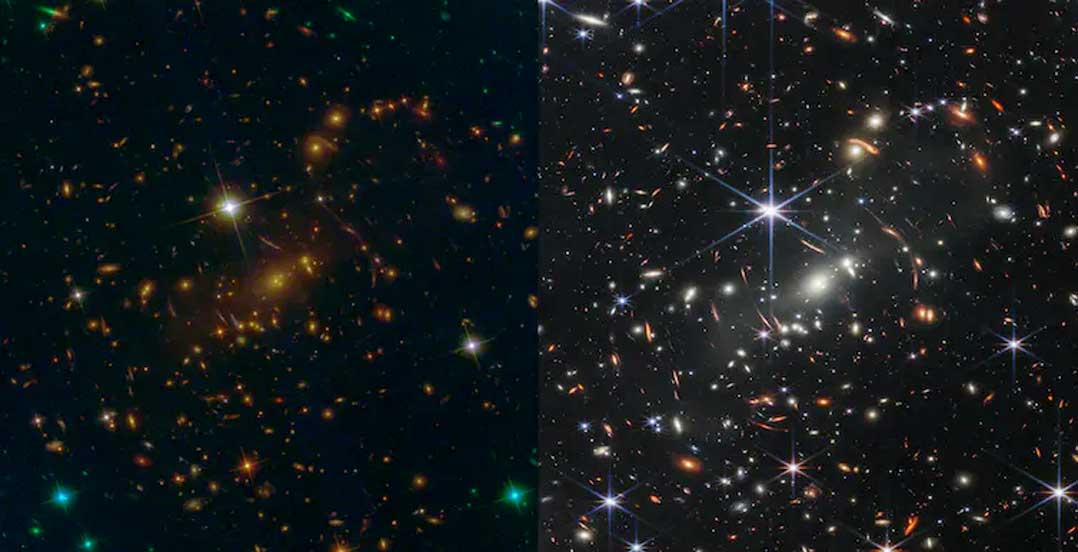
    Smacs 0723 galaxy cluster – from Hubble on the left, and JWST on the right. Hundreds more galaxies are visible in JWST’s infrared image. Nasa/STSci

    The galaxy cluster with the prosaic name of Smacs J0723.3–7327 was a good choice for the first colour images released to the public from the JWST.

    The field is crowded with galaxies of all shapes and colours. The combined mass of this enormous galaxy cluster, over four billion light years away, bends space in such a way that light from distant sources in the background is stretched and magnified, an effect known as gravitational lensing.

    These distorted background galaxies can be clearly seen as lines and arcs throughout this image. The field is already spectacular in Hubble images (left), but the JWST near-infrared image (right) reveals a wealth of extra detail, including hundreds of distant galaxies too faint or too red to be detected by its predecessor.

    4. Stephan’s Quintet
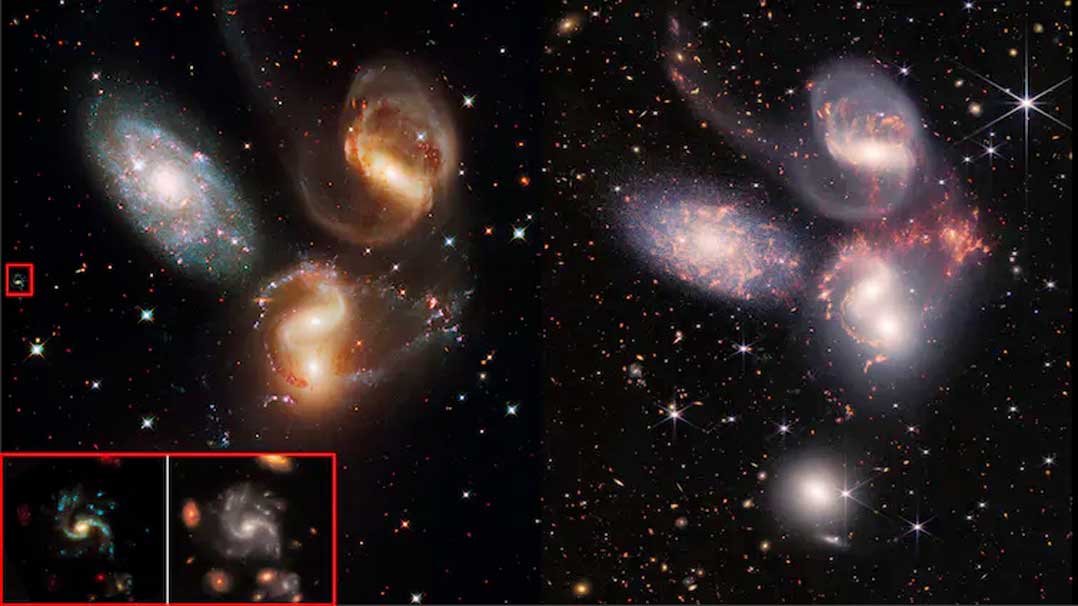
    Hubble (left) and JWST (right) images of the group of galaxies known as ‘Stephan’s Quintet’. The inset shows a zoom-in on a distant background galaxy. Nasa/STScI

    These images depict a spectacular group of galaxies known as Stephan’s Quintet, a group that has long been of interest to astronomers studying the way colliding galaxies interact with one another gravitationally.

    On the left we see the Hubble view, and the right the JWST mid-infrared view. The inset shows the power of the new telescope, with a zoom in on a small background galaxy. In the Hubble image we see some bright star-forming regions, but only with the JWST does the full structure of this and surrounding galaxies reveal itself.

    5. The Pillars of Creation
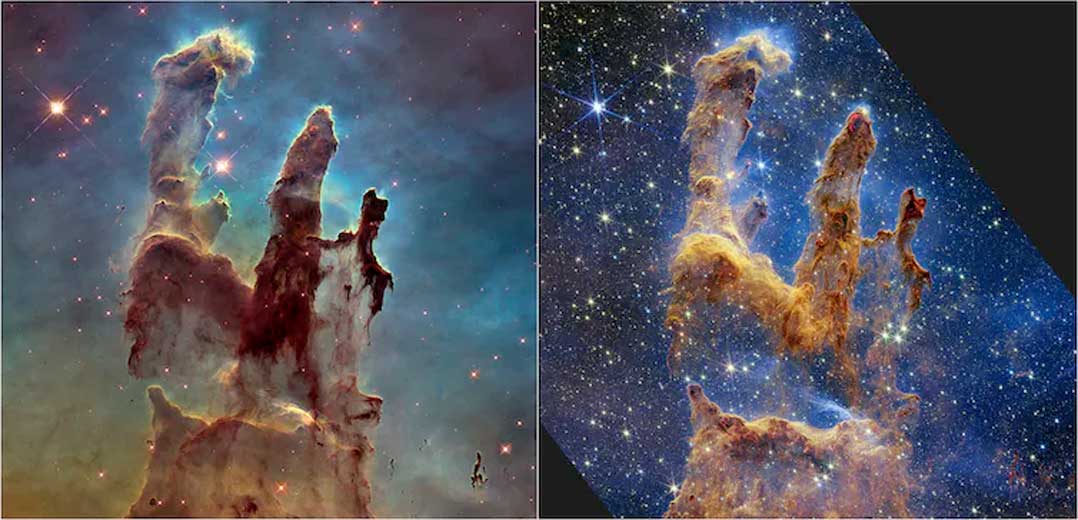
    The ‘Pillars of Creation’, a star-forming region of our galaxy, as captured by Hubble (left) and JWST (right). Nasa, ESA, CSA, STScI; Joseph DePasquale (STScI), Anton M Koekemoer (STScI), Alyssa Pagan (STScI)

    The so-called Pillars of Creation is one of the most famous images in all of astronomy, taken by Hubble in 1995. It demonstrated the extraordinary reach of a space-based telescope.

    It depicts a star-forming region in the Eagle Nebula, where interstellar gas and dust provide the backdrop to a stellar nursery teeming with new stars. The image on the right, taken with the JWST’s near-infrared camera (NIRCam), demonstrates a further advantage of infrared astronomy: the ability to peer through the shroud of dust and see what lies within and behind.

    6. The ‘Hourglass’ Protostar
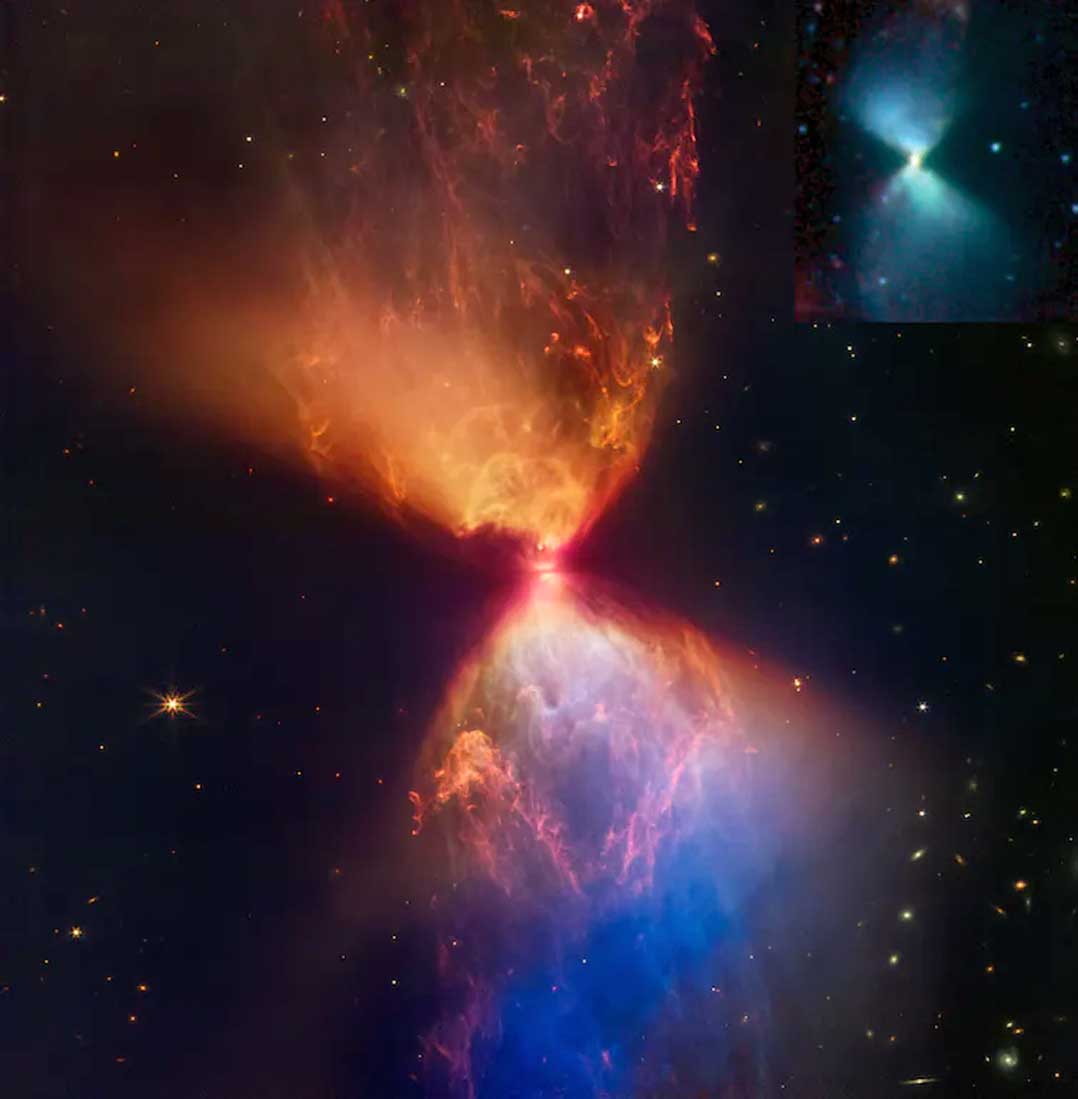
    The ‘hourglass protostar’, a star still in the process of accreting enough gas to begin fusing hydrogen. Inset: A much lower resolution view from Spitzer. Nasa/STScI/JPL-Caltech/A Tobin

    This image depicts another act of galactic creation within the Milky Way. This hourglass-shaped structure is a cloud of dust and gas surrounding a star in the act of formation – a protostar called L1527.

    Only visible in the infrared, an “accretion disk” of material falling in (the black band in the centre) will eventually enable the protostar to gather enough mass to start fusing hydrogen, and a new star will be born.

    In the meantime, light from the still-forming star illuminates the gas above and below the disk, making the hourglass shape. Our previous view of this came from Spitzer; the amount of detail is once again an enormous leap ahead.

    7. Jupiter in infrared
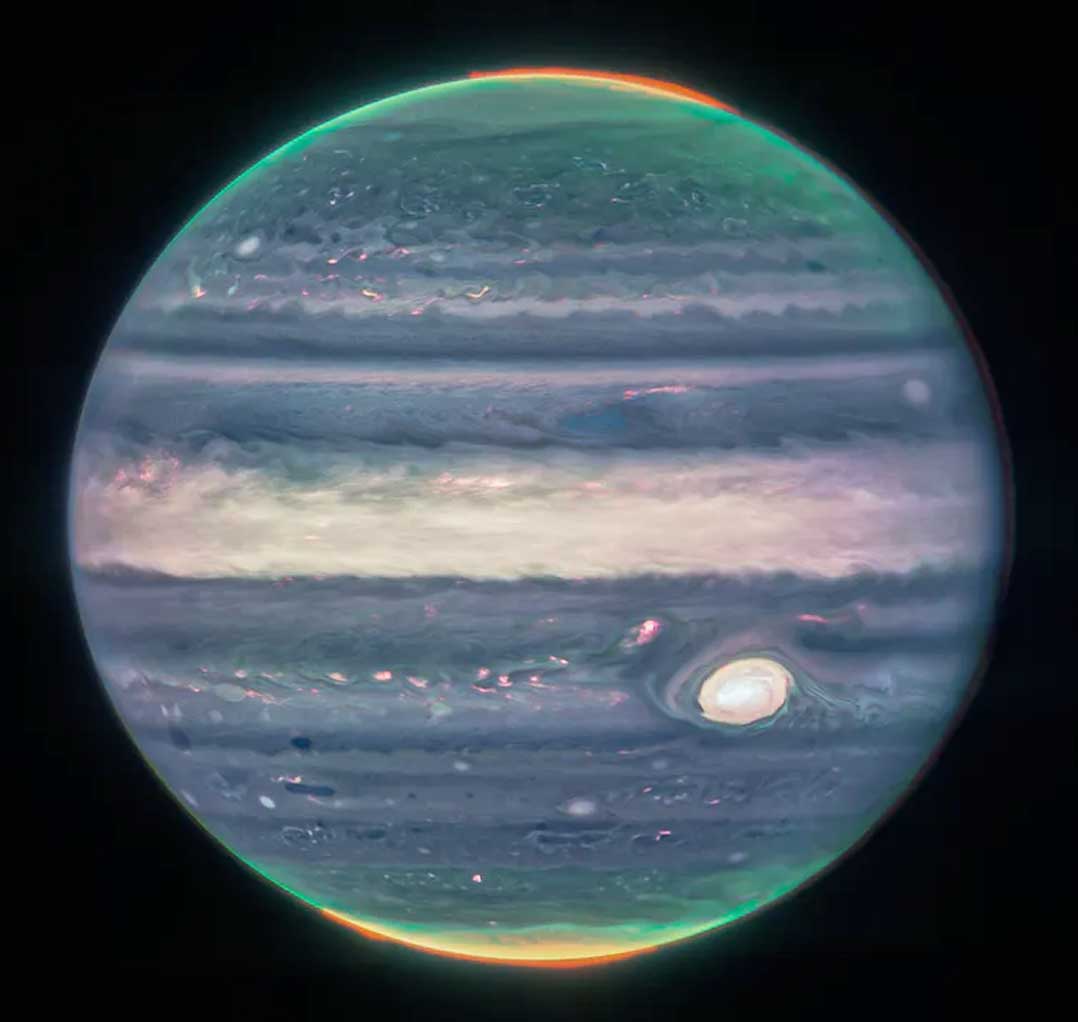
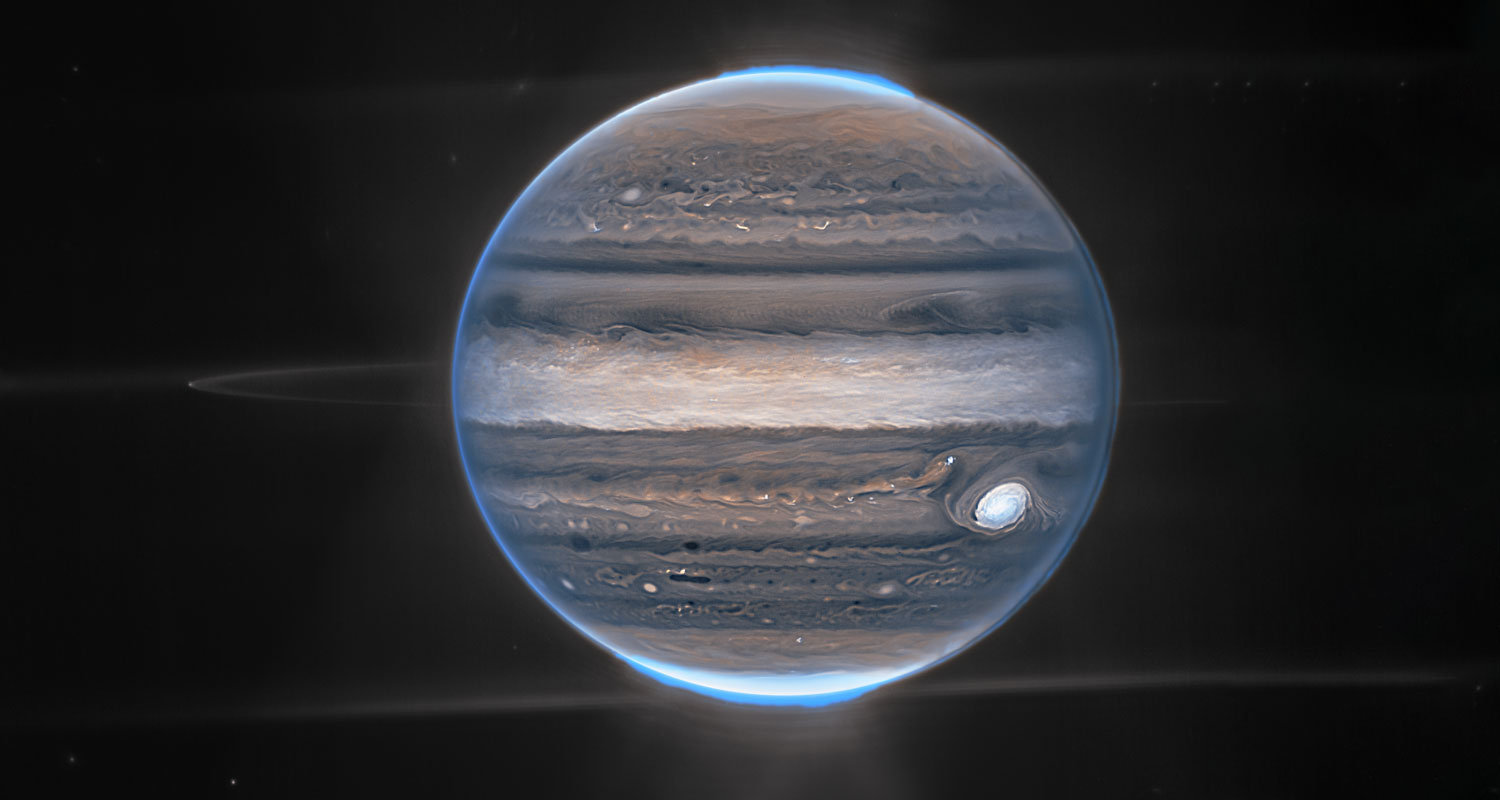
    An infrared view of Jupiter from the JWST. Note the auroral glow at the poles; this is caused by the interaction of charged particles from the sun with Jupiter’s magnetic field. Nasa/STScI

    The Webb telescope’s mission includes imaging the most distant galaxies from the beginning of the universe, but it can look a little closer to home as well.

    Although JWST cannot look at Earth or the inner solar system planets – as it must always face away from the sun – it can look outward at the more distant parts of our solar system. This near-infrared image of Jupiter is a beautiful example, as we gaze deep into the structure of the gas giant’s clouds and storms. The glow of auroras at both the northern and southern poles is haunting.

    This image was extremely difficult to achieve due to the fast motion of Jupiter across the sky relative to the stars and because of its fast rotation. The success proved the Webb telescope’s ability to track difficult astronomical targets extremely well.

    8. The Phantom Galaxy
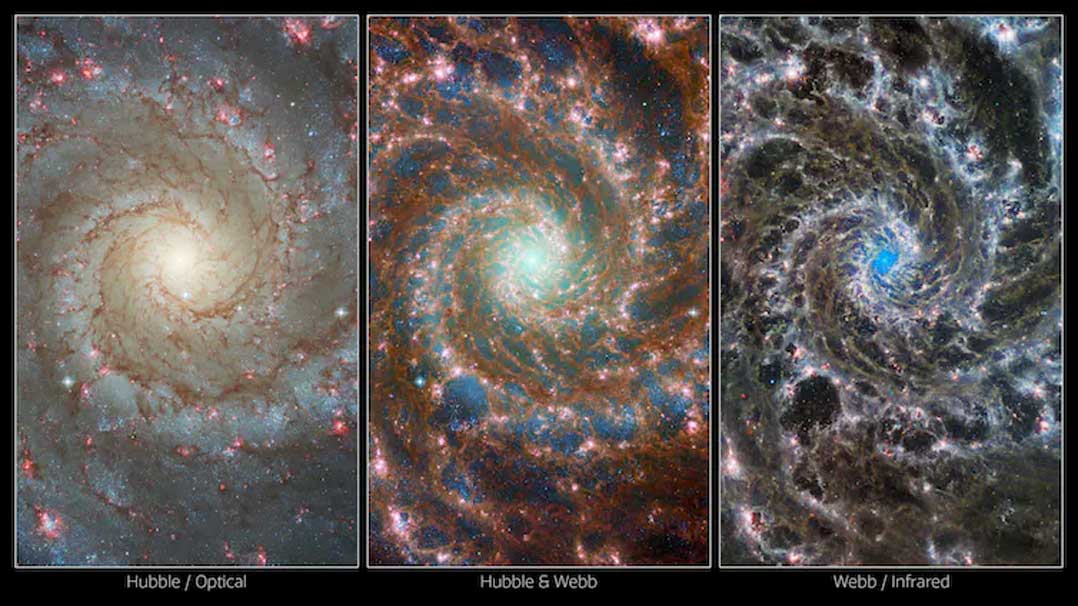
    Hubble visible light (left), JWST infrared (right) and combined (middle) images of the ‘Phantom Galaxy’ M74. The ability to combine visible light information about stars with infrared images of gas and dust allow us to probe such galaxies in exquisite detail. ESA/Nasa

    These images of the so-called Phantom Galaxy or M74 reveal the power of JWST not only as the latest and greatest of astronomical instruments, but as a valuable complement to other great tools. The middle panel here combines visible light from Hubble with infrared from Webb, allowing us to see how starlight (via Hubble) and gas and dust (via JWST) together shape this remarkable galaxy.

    Much JWST science is designed to be combined with Hubble’s optical views and other imaging to leverage this principle.

    9. A super-distant galaxy
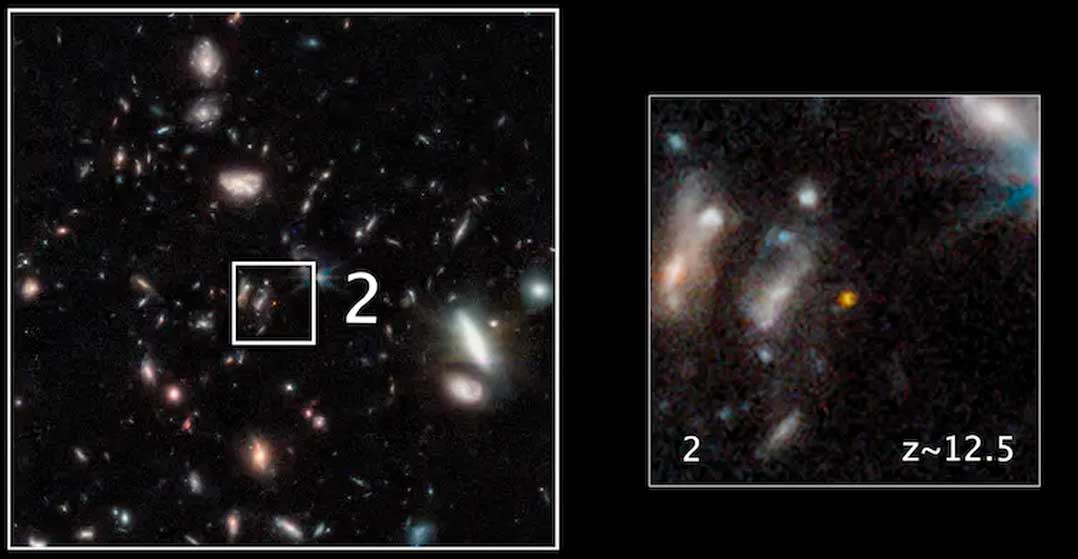
    A ‘zoom in’ on a galaxy from one of the universe’s earliest epochs, when the universe was only about 300 million years old (the small red source visible in the centre of the right panel). Galaxies at this distance are impossible to detect in visible light as their emitted radiation has been ‘redshifted’ far into the infrared. Nasa/STScI/C Jacobs

    Although this galaxy – the small, red blob in the right image – is not among the most spectacularly picturesque our universe has to offer, it is just as interesting scientifically.

    This snapshot is from when the universe was a mere 350 million years old, making this among the very first galaxies ever to have formed. Understanding the details of how such galaxies grow and merge to create galaxies like our own Milky Way 13 billion years later is a key question, and one with many remaining mysteries, making discoveries like this highly sought after.

    It is also a view only the JWST can achieve. Astronomers did not know quite what to expect; an image of this galaxy taken with Hubble would appear blank, as the light of the galaxy is stretched far into the infrared by the expansion of the universe.

    10. This giant mosaic of Abell 2744
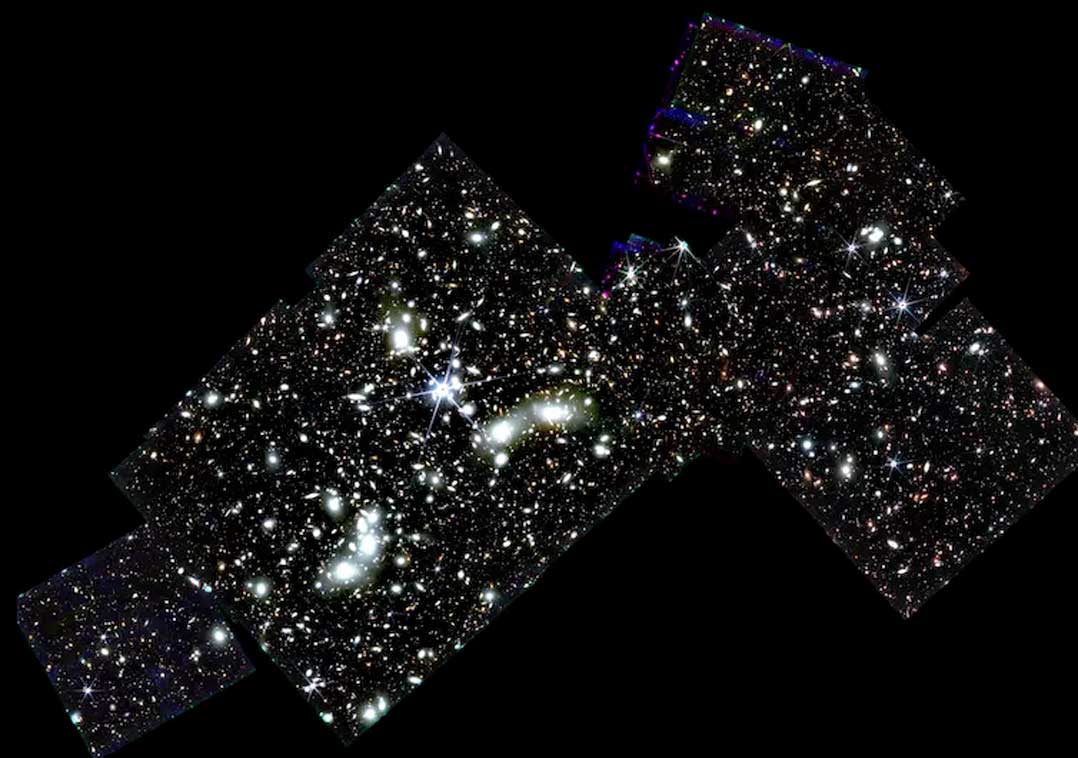
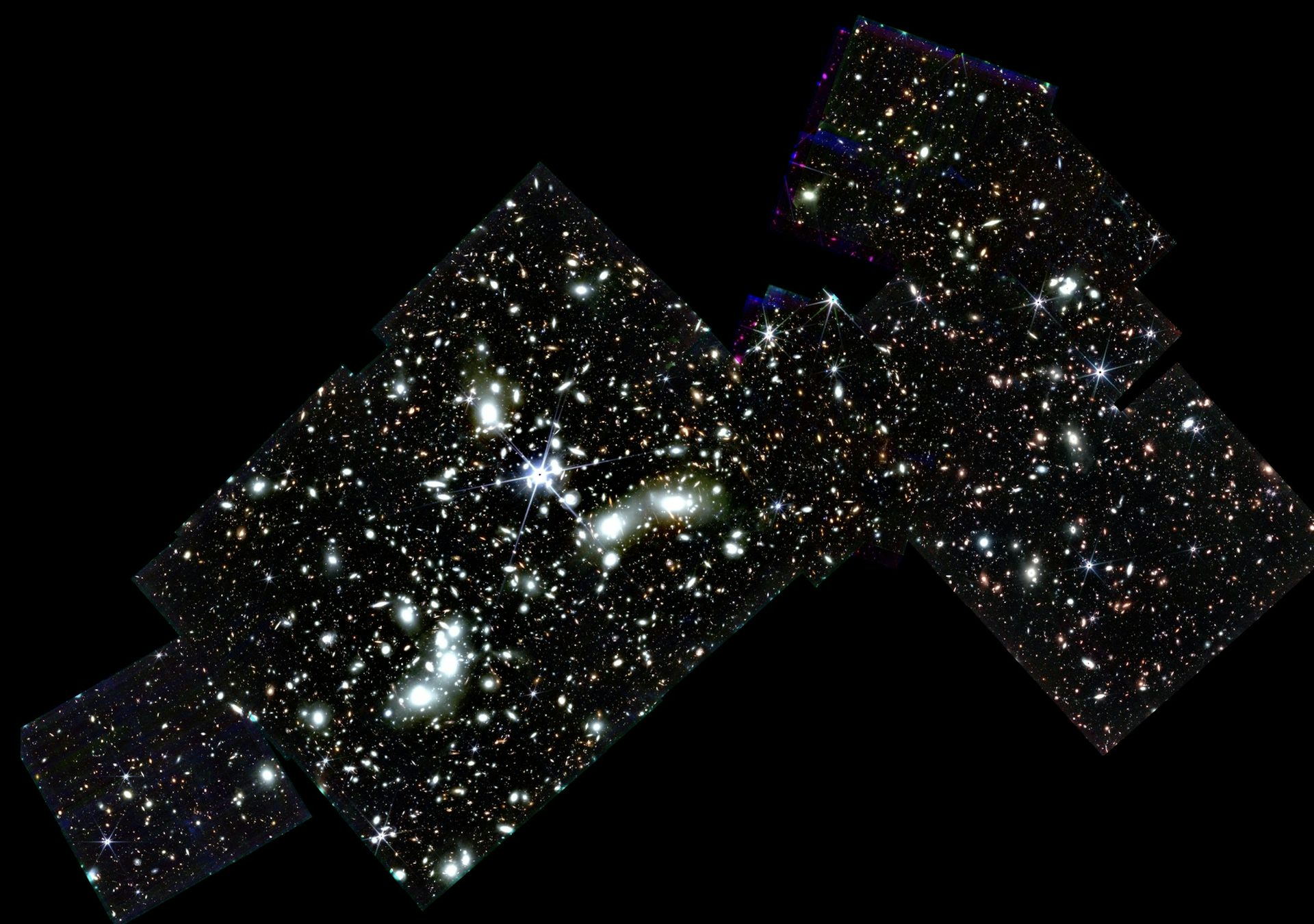
    An image of the galaxy cluster Abell 2744 created by combining many different JWST exposures. In this tiny part of the sky (a fraction of a full moon) almost every one of the thousands of objects shown is a distant galaxy. Lukas Furtak (Ben-Gurion University of the Negev) from images from the Glass/Uncover teams

    This image (click here for full view) is a mosaic (many individual images stitched together) centred on the giant Abell 2744 galaxy cluster, colloquially known as “Pandora’s Cluster”. The sheer number and variety of sources that the JWST can detect is mind boggling; with the exception of a handful of foreground stars, every spot of light represents an entire galaxy.

    In a patch of dark sky no larger than a fraction of the full moon there are umpteen thousands of galaxies, really bringing home the sheer scale of the universe we inhabit. Professional and amateur astronomers alike can spend hours scouring this image for oddities and mysteries.

    Over the coming years, JWST’s ability to look so deep and far back into the universe will allow us to answer many questions about how we came to be. Just as exciting are the discoveries and questions we cannot yet foresee. When you peel back the veil of time as only this new telescope can, these unknown unknowns are certain to be fascinating.The Conversation

    • Written by Colin Jacobs, postdoctoral researcher in astrophysics, Swinburne University of Technology, and by Karl Glazebrook, ARC laureate fellow and distinguished professor, Centre for Astrophysics & Supercomputing, Swinburne University of Technology
    • This article is republished from The Conversation under a Creative Commons licence

    James Webb Space Telescope JWST
    WhatsApp YouTube Follow on Google News Add as preferred source on Google
    Share. Facebook Twitter LinkedIn WhatsApp Telegram Email Copy Link
    Previous ArticleLastPass hacking incident worse than feared
    Next Article Taiwan president says TSMC’s overseas expansion reflects prowess

    Related Posts

    For first time, Webb telescope discovers an alien planet

    For first time, Webb telescope discovers an alien planet

    26 June 2025
    Gases linked to life found in atmosphere of alien planet - K2-18 b

    Gases linked to life found in atmosphere of alien planet

    17 April 2025

    Bookmarks | Big Tech to take arse-kissing to new heights

    7 November 2024
    Company News
    Huawei turns 25 in South Africa, celebrates with major device discounts

    Huawei turns 25 in South Africa, celebrates with major device discounts

    30 January 2026
    Phishing has not disappeared, but it has grown up - KnowBe4

    Phishing has not disappeared, but it has grown up

    30 January 2026
    Smartphone affordability: South Africa's new economic divide - PayJoy

    Smartphone affordability: South Africa’s new economic divide

    29 January 2026
    Opinion
    South Africa's skills advantage is being overlooked at home - Richard Firth

    South Africa’s skills advantage is being overlooked at home

    29 January 2026
    Why Elon Musk's Starlink is a 'hard no' for me - Songezo Zibi

    Why Elon Musk’s Starlink is a ‘hard no’ for me

    26 January 2026
    South Africa's new fibre broadband battle - Duncan McLeod

    South Africa’s new fibre broadband battle

    20 January 2026

    Subscribe to Updates

    Get the best South African technology news and analysis delivered to your e-mail inbox every morning.

    Latest Posts
    TCS+ | How Cloud On Demand is helping SA businesses succeed in the cloud - Xhenia Rhode, Dion Kalicharan

    TCS+ | Cloud On Demand and Consnet: inside a real-world AWS partner success story

    30 January 2026
    Huawei turns 25 in South Africa, celebrates with major device discounts

    Huawei turns 25 in South Africa, celebrates with major device discounts

    30 January 2026
    SABC Plus to flight Microsoft AI training videos

    SABC Plus to flight Microsoft AI training videos

    30 January 2026
    Phishing has not disappeared, but it has grown up - KnowBe4

    Phishing has not disappeared, but it has grown up

    30 January 2026
    © 2009 - 2026 NewsCentral Media
    • Cookie policy (ZA)
    • TechCentral – privacy and Popia

    Type above and press Enter to search. Press Esc to cancel.

    Manage consent

    TechCentral uses cookies to enhance its offerings. Consenting to these technologies allows us to serve you better. Not consenting or withdrawing consent may adversely affect certain features and functions of the website.

    Functional Always active
    The technical storage or access is strictly necessary for the legitimate purpose of enabling the use of a specific service explicitly requested by the subscriber or user, or for the sole purpose of carrying out the transmission of a communication over an electronic communications network.
    Preferences
    The technical storage or access is necessary for the legitimate purpose of storing preferences that are not requested by the subscriber or user.
    Statistics
    The technical storage or access that is used exclusively for statistical purposes. The technical storage or access that is used exclusively for anonymous statistical purposes. Without a subpoena, voluntary compliance on the part of your Internet Service Provider, or additional records from a third party, information stored or retrieved for this purpose alone cannot usually be used to identify you.
    Marketing
    The technical storage or access is required to create user profiles to send advertising, or to track the user on a website or across several websites for similar marketing purposes.
    • Manage options
    • Manage services
    • Manage {vendor_count} vendors
    • Read more about these purposes
    View preferences
    • {title}
    • {title}
    • {title}