
Close Menu
TechCentralTechCentral

    Subscribe to the newsletter

    Get the best South African technology news and analysis delivered to your e-mail inbox every morning.

    Facebook X (Twitter) YouTube LinkedIn
    WhatsApp Facebook X (Twitter) LinkedIn YouTube
    TechCentralTechCentral
    • News
      Nedbank hires MTN's former tech chief as group CIO - Nikos Angelopoulos

      Nedbank hires MTN’s former tech chief as group CIO

      31 July 2026
      Eskom's diesel bill falls 86% as breakdowns hit eight-year low

      Eskom’s diesel bill falls 86% as breakdowns hit eight-year low

      31 July 2026
      Ramaphosa signs off on taking the grid away from Eskom

      Ramaphosa signs off on taking the grid away from Eskom

      31 July 2026
      Microsoft just had the biggest day in stock market history

      Microsoft just had the biggest day in stock market history

      31 July 2026
      MTN Nigeria's growth engine stalled in second quarter - Karl Toriola

      MTN Nigeria’s growth engine stalled in second quarter

      31 July 2026
    • World
      Meta AI will now tell parents if their teen is in crisis

      Meta AI will now tell parents if their teen is in crisis

      17 July 2026
      IBM shares crash 25% as AI upends software spending - Arvind Krishna

      IBM shares crash 25% as AI upends software spending

      15 July 2026
      Jony Ive's first OpenAI device: an AI smart speaker - Jony Ive and Sam Altman

      Jony Ive’s first OpenAI device: an AI smart speaker

      15 July 2026
      Stripe, Advent in talks to buy PayPal for $53-billion

      Stripe, Advent in talks to buy PayPal for $53-billion

      15 July 2026
      Memory crisis sends smartphone market into steep decline

      Memory crisis sends smartphone market into steep decline

      13 July 2026
    • In-depth
      The plan to stop AI from breaking the world - Google DeepMind CEO Demis Hassabis. Image: John Sears

      The plan to stop AI from breaking the world

      16 July 2026
      The internet has a Strait of Hormuz problem

      The internet has a Strait of Hormuz problem

      15 July 2026
      AI boom sparks rally, frenzy and fear

      AI boom sparks rally, frenzy and fear

      11 June 2026
      Every plug-in hybrid on sale in South Africa, ranked by price - Lamborghini Temerario

      Every plug-in hybrid on sale in South Africa, ranked by price

      7 June 2026
      What Wi-Fi 8 will mean for wireless networks

      What Wi-Fi 8 will mean for wireless networks

      1 June 2026
    • TCS
      TCS+ | Why South African workers must become supervisors of digital labour - Accelera Digital Group Cliff de Wit

      TCS+ | Why South African workers must become supervisors of digital labour

      31 July 2026
      TCS | Rapid deployment rules can't work without municipalities: ACT - Nomvuyiso Batyi

      TCS | Icasa’s rules skip the real bottleneck: ACT

      30 July 2026
      TCS+ | iStore Business on why Apple makes sense for SMEs - Sudesh Pillay and Tamia Nontsikelelo

      TCS+ | iStore Business on why Apple makes sense for SMEs

      30 July 2026
      TCS+ | A smarter approach to cloud for South African businesses - Joel Chacko and Jonathan Oaker

      TCS+ | A smarter approach to cloud for South African businesses

      28 July 2026
      TCS | How Optasia lends billions to people banks can't see - Salvador Anglada

      TCS | How Optasia lends billions to people banks can’t see

      23 July 2026
    • Opinion
      The author, Jannie van Zyl

      Selling vapour is corporate suicide in slow motion

      16 July 2026
      Brazil's online gambling crackdown is a lesson for South Africa

      How Amazon outmanoeuvred Starlink in South Africa

      15 July 2026
      The Popia problem with agentic AI - Herman Haasbroek

      The Popia problem with agentic AI

      14 July 2026
      The author, Fanie van Rooyen

      South Africa can still catch the AI wave – here’s how

      7 July 2026
      The author, Fanie van Rooyen

      The AI utopia South Africa can’t afford

      1 July 2026
    • Company Hubs
      • 1Stream
      • Africa Data Centres
      • AfriGIS
      • Altron Digital Business
      • Altron Document Solutions
      • Altron Group
      • Arctic Wolf
      • Ascent Technology
      • AvertITD
      • BBD
      • Braintree
      • CallMiner
      • CambriLearn
      • CM Telecom
      • Contactable
      • CYBER1 Solutions
      • Digicloud Africa
      • Digimune
      • Domains.co.za
      • ESET
      • Euphoria Telecom
      • HOSTAFRICA
      • Incredible Business
      • iONLINE
      • IQbusiness
      • Iris Network Systems
      • Kaspersky
      • LSD Open
      • Mitel
      • NEC XON
      • Netstar
      • Network Platforms
      • Next DLP
      • Ovations
      • Paracon
      • Paratus
      • Q-KON
      • SevenC
      • SkyWire
      • Solid8 Technologies
      • Telit Cinterion
      • Telviva
      • Tenable
      • Vertiv
      • Videri Digital
      • Vodacom Business
      • Vox
      • Wipro
      • Workday
      • XLink
    • Sections
      • AI and machine learning
      • Banking
      • Broadcasting and Media
      • Cloud services
      • Contact centres and CX
      • Cryptocurrencies
      • Education and skills
      • Electronics and hardware
      • Energy and sustainability
      • Enterprise software
      • Financial services
      • HealthTech
      • Information security
      • Internet and connectivity
      • Internet of Things
      • Investment
      • IT services
      • Lifestyle
      • Policy and regulation
      • Public sector
      • Retail and e-commerce
      • Satellite communications
      • Science
      • SMEs and start-ups
      • Social media
      • Talent and leadership
      • Telecoms
      • Watts & Wheels
    • Events
    • Advertise
    TechCentralTechCentral
    Home » In-depth » 5 milestones that created the Internet

    5 milestones that created the Internet

    By The Conversation26 October 2019
    Twitter LinkedIn Facebook WhatsApp Email Telegram Copy Link
    News Alerts
    WhatsApp

    Fifty years ago, a University of California Los Angeles computer science professor and his student sent the first message over the predecessor to the Internet, a network called Arpanet.

    On 29 October 1969, Leonard Kleinrock and Charley Kline sent Stanford University researcher Bill Duval a two-letter message: “lo.” The intended message, the full word “login”, was truncated by a computer crash.

    Much more traffic than that travels through the Internet these days, with billions of e-mails sent and searches conducted daily. As a scholar of how the Internet is governed, I know that today’s vast communications web is a result of governments and regulators making choices that collectively built the Internet as it is today.

    Here are five key moments in this journey.

    1978: Encryption failure

    Early Internet pioneers, in some ways, were remarkably farsighted. In 1973, a group of high school students reportedly gained access to Arpanet, which was supposed to be a closed network managed by the Pentagon.
    Computer scientists Vinton Cerf and Robert Kahn suggested building encryption into the Internet’s core protocols, which would have made it far more difficult for hackers to compromise the system.

    But the US intelligence community objected, though officials didn’t publicly say why. The only reason their intervention is public is because Cerf hinted at it in a 1983 paper he co-authored.

    As a result, basically all of today’s Internet users have to handle complex passwords and multi-factor authentication systems to ensure secure communications. People with more advanced security needs often use virtual private networks or specialised privacy software like Tor to encrypt their online activity.

    However, computers may not have had enough processing power to effectively encrypt Internet communications. That could have slowed the network, making it less attractive to users — delaying, or even preventing, wider use by researchers and the public.
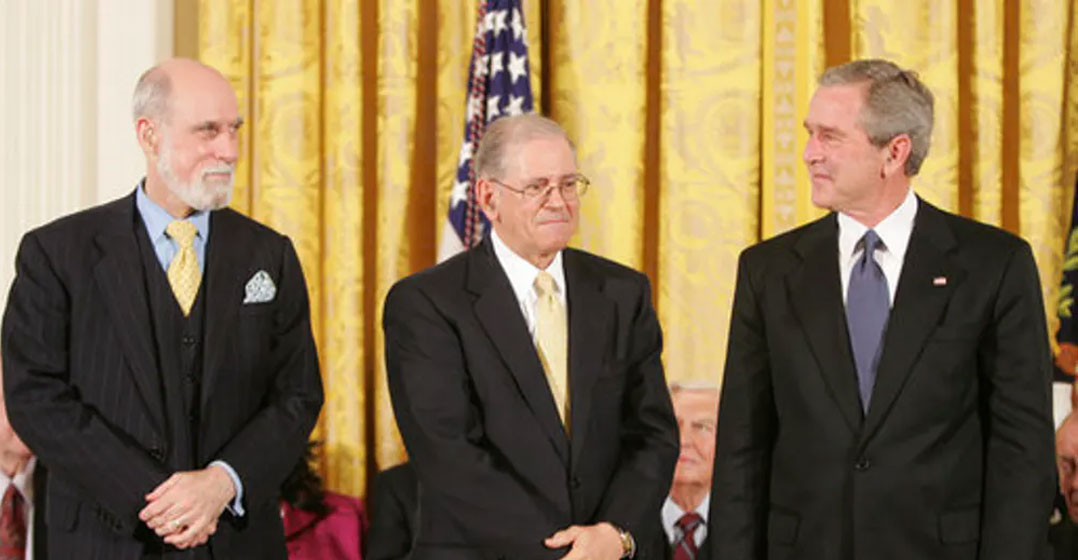
    Vinton Cerf and Robert Kahn with President George W Bush at the ceremony where Cerf and Kahn were given the Presidential Medal of Freedom for their contributions to developing the Internet. Paul Morse/White House/Wikimedia Commons

    1983: ‘The Internet’ is born

    For the Internet to really be a global entity, all kinds of different computers needed to speak the same language to be able to communicate with each other — directly, if possible, rather than slowing things down by using translators.

    Hundreds of scientists from various governments collaborated to devise what they called the Open Systems Interconnection standard. It was a complex method that critics considered inefficient and difficult to scale across existing networks.

    Cerf and Kahn, however, proposed another way, called Transmission Control Protocol/Internet Protocol. TCP/IP worked more like the regular mail — wrapping up messages in packages and putting the address on the outside. All the computers on the network had to do was pass the message to its destination, where the receiving computer would figure out what to do with the information. It was free for anyone to copy and use on their own computers.

    TCP/IP — given that it both worked and was free — enabled the rapid, global scaling of the Internet. A variety of governments, including the US, eventually came out in support of OSI but too late to make a difference. TCP/IP made the Internet cheaper, more innovative and less tied to official government standards.

    1996: Online speech regulated

    By 1996, the Internet boasted more than 73 000 servers, and 22% of surveyed Americans were going online. What they found there, though, worried some members of congress and their constituents — particularly the rapidly growing amount of pornography.

    In response, congress passed the Communications Decency Act, which sought to regulate indecency and obscenity in cyberspace.

    The supreme court struck down portions of the law on free-speech grounds the next year, but it left in place Section 230, which stated: “No provider or user of an interactive computer service shall be treated as the publisher or speaker of any information provided by another information content provider.”

    Those 26 words, as various observers have noted, released Internet service providers and Web-hosting companies from legal responsibility for information their customers posted or shared online. This single sentence provided legal security that allowed the US technology industry to flourish. That protection let companies feel comfortable creating a consumer-focused Internet, filled with grassroots media outlets, bloggers, customer reviews and user-generated content.

    Critics note that section 230 also allows social media sites like Facebook and Twitter to operate largely without regulation.

    1998: US government steps up

    The TCP/IP addressing scheme required that every computer or device connected to the Internet have its own unique address — which, for computational reasons, was a string of numbers like “192.168.2.201”.

    But that’s hard for people to remember — it’s much easier to recall something like “indiana.edu”. There had to be a centralised record of which names went with which addresses, so people didn’t get confused, or end up visiting a site they didn’t intend to.

    Originally, starting in the late 1960s, that record was kept on a floppy disk by a man named Jon Postel. By 1998, though, he and others were pointing out that such a significant amount of power shouldn’t be held by just one person. That year saw the US department of commerce lay out a plan to transition control to a new private non-profit organisation, the Internet Corporation for Assigned Names and Numbers — better known as Icann — that would manage Internet addresses around the world.

    For nearly 20 years, Icann did that work under a contract from the commerce department, though objections over US government control grew steadily. In 2016, the commerce department contract expired, and Icann’s governance shifted to a board of representatives from more than 100 countries.

    Other groups that manage key aspects of Internet communications have different structures. The Internet Engineering Task Force, for instance, is a voluntary technical organisation open to anyone. There are drawbacks to that approach, but it would have lessened both the reality and perception of US control.

    2010: War comes online

    In June 2010, cybersecurity researchers revealed the discovery of a sophisticated cyber weapon called Stuxnet, which was designed specifically to target equipment used by Iran’s effort to develop nuclear weapons. It was among the first known digital attacks that actually caused physical damage.

    Almost a decade later, it’s clear that Stuxnet opened the eyes of governments and other online groups to the possibility of wreaking significant havoc through the Internet. These days, nations use cyberattacks with increasing regularity, attacking a range of military and even civilian targets.

    There’s certainly cause for hope for online peace and community, but these decisions — along with many others — have shaped cyberspace and with it millions of people’s daily lives. Reflecting on those past choices can help inform upcoming decisions — such as how international law should apply to cyberattacks, or whether and how to regulate artificial intelligence.

    Maybe 50 years from now, events in 2019 will be seen as another key turning point in the development of the Internet.The Conversation

    • Written by Scott Shackelford, associate professor of business law and ethics; director, Ostrom Workshop Programme on Cybersecurity and Internet Governance; cybersecurity programme chair, IU-Bloomington, Indiana University
    • This article is republished from The Conversation under a Creative Commons licence

    Follow TechCentral on Google News Add TechCentral as your preferred source on Google


    Bill Duval Charley Kline Icann Jon Postel Leonard Kleinrock Robert Kahn top Vint Cerf
    WhatsApp YouTube
    Share. Facebook Twitter LinkedIn WhatsApp Telegram Email Copy Link
    Previous ArticleStop laughing at the SABC – its video streaming plan makes sense
    Next Article Twitter co-founder Biz Stone envisages ‘new type of media’

    Related Posts

    MTN Group hires Mike Silber in senior regulatory role

    MTN Group hires Mike Silber in senior regulatory role

    28 March 2024
    Price hikes looming for .za internet domains

    Icann wants new internet domains for South Africa

    1 November 2023

    18GW in unplanned breakdowns cripple Eskom

    2 November 2021
    Company News
    Domains.co.za launches self-hosted n8n VPS hosting

    Domains.co.za launches self-hosted n8n VPS hosting

    31 July 2026
    Smarter.tech '26 shows why smarter technology begins with context - Obsidian Systems

    Context is the missing piece in enterprise AI: Obsidian

    31 July 2026
    Huawei launches 12 intelligent transport solutions in South Africa - Sam Tang

    Huawei launches 12 intelligent transport solutions in South Africa

    30 July 2026
    Opinion
    The author, Jannie van Zyl

    Selling vapour is corporate suicide in slow motion

    16 July 2026
    Brazil's online gambling crackdown is a lesson for South Africa

    How Amazon outmanoeuvred Starlink in South Africa

    15 July 2026
    The Popia problem with agentic AI - Herman Haasbroek

    The Popia problem with agentic AI

    14 July 2026

    Subscribe to Updates

    Get the best South African technology news and analysis delivered to your e-mail inbox every morning.

    Latest Posts
    Nedbank hires MTN's former tech chief as group CIO - Nikos Angelopoulos

    Nedbank hires MTN’s former tech chief as group CIO

    31 July 2026
    Eskom's diesel bill falls 86% as breakdowns hit eight-year low

    Eskom’s diesel bill falls 86% as breakdowns hit eight-year low

    31 July 2026
    Ramaphosa signs off on taking the grid away from Eskom

    Ramaphosa signs off on taking the grid away from Eskom

    31 July 2026
    TCS+ | Why South African workers must become supervisors of digital labour - Accelera Digital Group Cliff de Wit

    TCS+ | Why South African workers must become supervisors of digital labour

    31 July 2026
    © 2009 - 2026 NewsCentral Media
    Built and maintained by Chronon
    • Cookie policy (ZA)
    • TechCentral – privacy and Popia

    Type above and press Enter to search. Press Esc to cancel.

    Manage consent

    TechCentral uses cookies to enhance its offerings. Consenting to these technologies allows us to serve you better. Not consenting or withdrawing consent may adversely affect certain features and functions of the website.

    Functional Always active
    The technical storage or access is strictly necessary for the legitimate purpose of enabling the use of a specific service explicitly requested by the subscriber or user, or for the sole purpose of carrying out the transmission of a communication over an electronic communications network.
    Preferences
    The technical storage or access is necessary for the legitimate purpose of storing preferences that are not requested by the subscriber or user.
    Statistics
    The technical storage or access that is used exclusively for statistical purposes. The technical storage or access that is used exclusively for anonymous statistical purposes. Without a subpoena, voluntary compliance on the part of your Internet Service Provider, or additional records from a third party, information stored or retrieved for this purpose alone cannot usually be used to identify you.
    Marketing
    The technical storage or access is required to create user profiles to send advertising, or to track the user on a website or across several websites for similar marketing purposes.
    • Manage options
    • Manage services
    • Manage {vendor_count} vendors
    • Read more about these purposes
    View preferences
    • {title}
    • {title}
    • {title}