Close Menu
TechCentralTechCentral

    Subscribe to the newsletter

    Get the best South African technology news and analysis delivered to your e-mail inbox every morning.

    Facebook X (Twitter) YouTube LinkedIn
    WhatsApp Facebook X (Twitter) LinkedIn YouTube
    TechCentralTechCentral
    • News
      South Africa planning big overhaul of public sector IT - State IT Agency Sita

      South Africa planning big overhaul of public sector IT

      23 April 2026
      Usaasa's 30-year run nears its end - Communications minister Solly Malatsi. Image c/o DCDT

      Usaasa’s 30-year run nears its end

      23 April 2026
      Charge to switch on first N3 off-grid EV stations in May - Joubert Roux

      Charge to switch on first N3 off-grid EV stations in May

      23 April 2026
      Middle-class South Africa is ditching streaming for AI

      Middle-class South Africa is ditching streaming for AI

      23 April 2026
      Mythos forces South African banks onto high alert - Graham Lee

      Mythos forces South African banks onto high alert

      23 April 2026
    • World
      More organic compounds detected on Mars - Nasa Curiosity rover

      More organic compounds detected on Mars

      21 April 2026
      Adobe bets on AI agents to fend off cheaper rivals

      Adobe bets on AI agents to fend off cheaper rivals

      16 April 2026
      Google poised to lose ad crown to Meta

      Google poised to lose ad crown to Meta

      14 April 2026
      Grand Theft Data - hackers hit Rockstar Games - Grand Theft Auto

      Grand Theft Data – hackers hit Rockstar Games

      14 April 2026
      UK PM Keir Starmer declares war on doomscrolling

      UK PM Keir Starmer declares war on doomscrolling

      13 April 2026
    • In-depth
      Africa switches on as Europe dims the lights

      Africa switches on as Europe dims the lights

      9 April 2026
      The biggest untapped EV market on Earth is hiding in plain sight

      The biggest untapped EV market on Earth is hiding in plain sight

      1 April 2026
      The R18-billion tech giant hiding in plain sight - Jens Montanana

      The R16-billion tech giant hiding in plain sight

      26 March 2026
      The last generation of coders

      The last generation of coders

      18 February 2026
      Sentech is in dire straits

      Sentech is in dire straits

      10 February 2026
    • TCS

      TCS+ | ‘The ISP for ISPs’: Vox’s shift to wholesale aggregator

      20 April 2026
      TCS | Werner Lindemann on how AI is rewriting the infosec rulebook

      TCS | Werner Lindemann on how AI is rewriting the infosec rulebook

      15 April 2026
      TCS | Donovan Marsh on AI and the future of filmmaking

      TCS | Donovan Marsh on AI and the future of filmmaking

      7 April 2026
      TCS+ | Vodacom Business moves to crack the SME tech gap - Andrew Fulton, Sannesh Beharie

      TCS+ | Vodacom Business moves to crack the SME tech gap

      7 April 2026
      TCS | MTN's Divysh Joshi on the strategy behind Pi - Divyesh Joshi

      TCS | MTN’s Divyesh Joshi on the strategy behind Pi

      1 April 2026
    • Opinion
      The conflict of interest at the heart of PayShap's slow adoption - Cheslyn Jacobs

      The conflict of interest at the heart of PayShap’s slow adoption

      26 March 2026
      South Africa's energy future hinges on getting wheeling right - Aishah Gire

      South Africa’s energy future hinges on getting wheeling right

      10 March 2026
      Hold the doom: the case for a South African comeback - Duncan McLeod

      Apple just dropped a bomb on the Windows world

      5 March 2026
      R230-million in the bag for Endeavor's third Harvest Fund - Alison Collier

      VC’s centre of gravity is shifting – and South Africa is in the frame

      3 March 2026
      Hold the doom: the case for a South African comeback - Duncan McLeod

      Hold the doom: the case for a South African comeback

      26 February 2026
    • Company Hubs
      • 1Stream
      • Africa Data Centres
      • AfriGIS
      • Altron Digital Business
      • Altron Document Solutions
      • Altron Group
      • Arctic Wolf
      • Ascent Technology
      • AvertITD
      • BBD
      • Braintree
      • CallMiner
      • CambriLearn
      • CYBER1 Solutions
      • Digicloud Africa
      • Digimune
      • Domains.co.za
      • ESET
      • Euphoria Telecom
      • HOSTAFRICA
      • Incredible Business
      • iONLINE
      • IQbusiness
      • Iris Network Systems
      • Kaspersky
      • LSD Open
      • Mitel
      • NEC XON
      • Netstar
      • Network Platforms
      • Next DLP
      • Ovations
      • Paracon
      • Paratus
      • Q-KON
      • SevenC
      • SkyWire
      • Solid8 Technologies
      • Telit Cinterion
      • Telviva
      • Tenable
      • Vertiv
      • Videri Digital
      • Vodacom Business
      • Wipro
      • Workday
      • XLink
    • Sections
      • AI and machine learning
      • Banking
      • Broadcasting and Media
      • Cloud services
      • Contact centres and CX
      • Cryptocurrencies
      • Education and skills
      • Electronics and hardware
      • Energy and sustainability
      • Enterprise software
      • Financial services
      • HealthTech
      • Information security
      • Internet and connectivity
      • Internet of Things
      • Investment
      • IT services
      • Lifestyle
      • Motoring
      • Policy and regulation
      • Public sector
      • Retail and e-commerce
      • Satellite communications
      • Science
      • SMEs and start-ups
      • Social media
      • Talent and leadership
      • Telecoms
    • Events
    • Advertise
    TechCentralTechCentral
    Home » Sections » 5 of the most exciting telescope pictures of the universe

    5 of the most exciting telescope pictures of the universe

    By The Conversation28 December 2021
    Twitter LinkedIn Facebook WhatsApp Email Telegram Copy Link
    News Alerts
    WhatsApp

    The successful launch on Christmas Day of the James Webb Space Telescope offers unprecedented new opportunities for astronomers. It’s also a timely opportunity to reflect on what previous generations of telescopes have shown us.

    Astronomers rarely use their telescopes to simply take pictures. The pictures in astrophysics are usually generated by a process of scientific inference and imagination, sometimes visualised in artist’s impressions of what the data suggests.

    Choosing just a handful of images was not easy. I limited my selection to images produced by publicly funded telescopes, and which reveal some interesting science. I tried to avoid very popular images which have already been viewed widely.

    The selection below is a personal one and I’m sure many readers could advocate for different choices. Feel free to share them in the comments.

    1. Jupiter’s poles
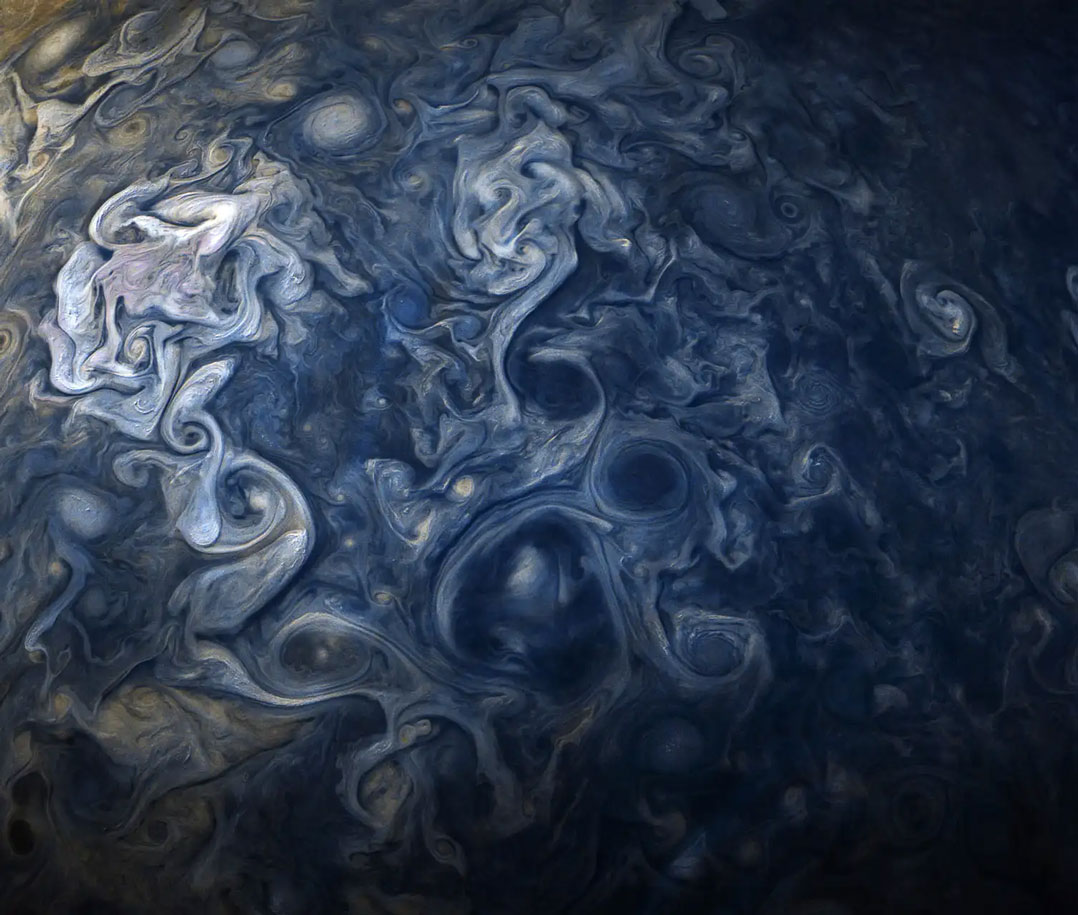
    This image is sometimes called ‘Jupiter Blues’. Enhanced image by Gerald Eichstädt and Sean Doran (CC BY-NC-SA) based on images provided by Nasa/JPL-Caltech/SwRI/MSSS

    The first image I’ve chosen was produced by Nasa’s Juno mission, which is currently orbiting Jupiter. The image was taken in October 2017 when the spacecraft was 18 906km away from the tops of Jupiter’s clouds. It captures a cloud system in the planet’s northern hemisphere, and represents our first view of Jupiter’s poles (the north pole).

    The images this picture is based on reveal complex flow patterns, akin to cyclones in Earth’s atmosphere, and striking effects caused by the variety of clouds at different altitudes, sometimes casting shadows on layers of clouds below.

    I chose this image for its beauty as well as the surprise it produced: the parts of the planet near its north pole look very different to the parts we had previously seen closer to the equator. By looking down on the poles of Jupiter, Juno showed us a different view of a familiar planet.

    2. The Eagle nebula
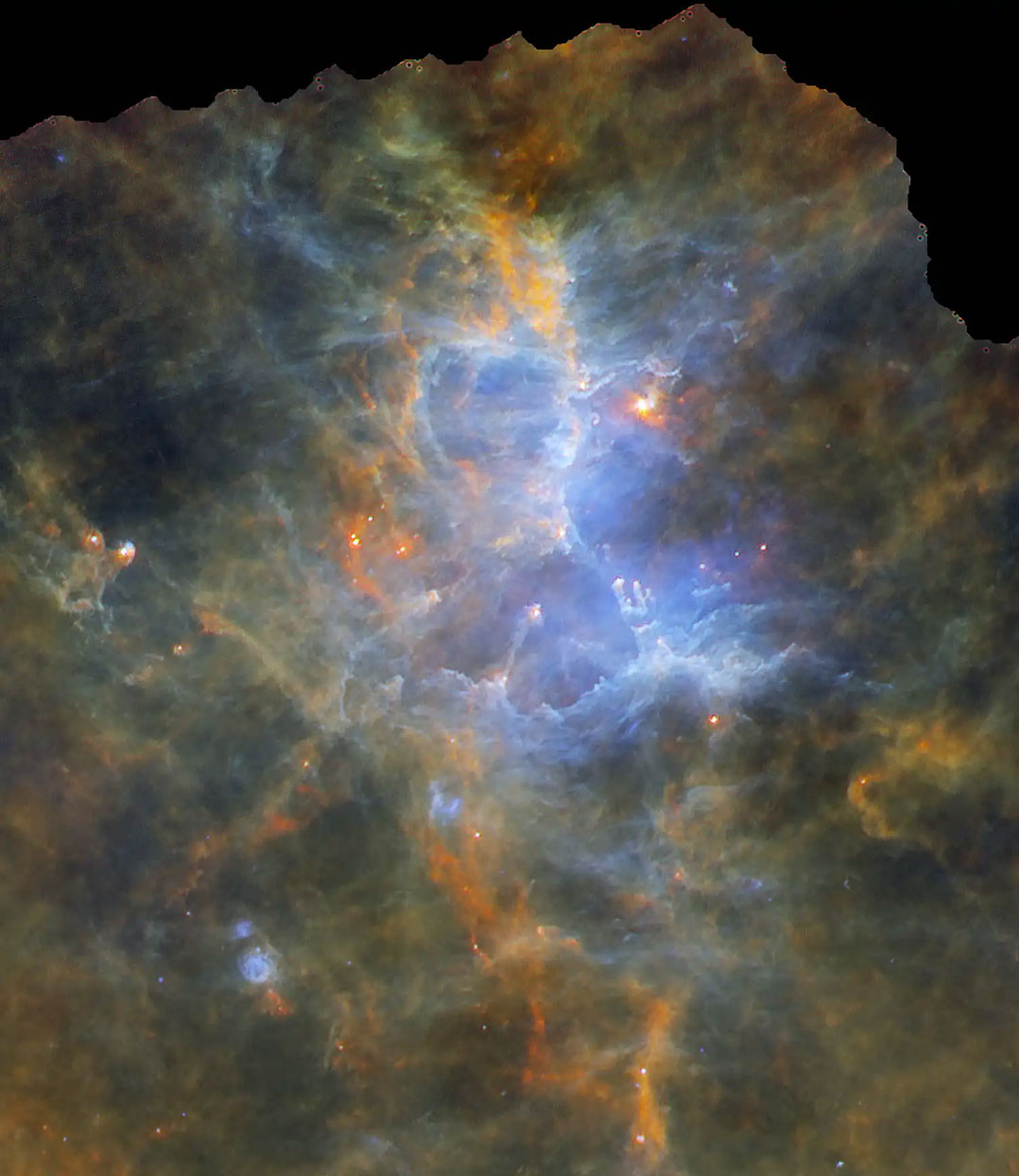
    This image allows us to see into the dense, dusty regions of space where star formation takes place. G Li Causi, IAPS/INAF, Italy, CC BY

    Astronomers can obtain unique information by building telescopes which are sensitive to light of “colours” beyond those our eyes can see. The familiar rainbow of colours is only a tiny fraction of what physicists call the electromagnetic spectrum.

    Beyond red is the infrared, which carries less energy than optical light. An infrared camera can see objects too cool to be detectable by the human eye. In space, it can also see through dust, which otherwise completely obscures our view.

    The James Webb Space Telescope is the largest infrared observatory ever launched. Until its launch, the European Space Agency’s Herschel Space Observatory had been the largest. The next image I’ve chosen is Herschel view of star formation in the Eagle Nebula, also known as M16.

    A nebula is a cloud of gas in space. The Eagle Nebula is 6 500 light years away from Earth, which is quite close by astronomical standards. This nebula is a site of vigorous star formation.

    A close-up view of a feature near the centre of this image has been called the “Pillars of Creation”. Appearing a bit like a thumb and forefinger pointing upwards and slightly to the left, these pillars protrude into a cavity in a giant cloud of molecular gas and dust. The cavity is being swept out by winds emanating from energetic new stars which have recently formed deeper within the cloud.

    3. The galactic centre
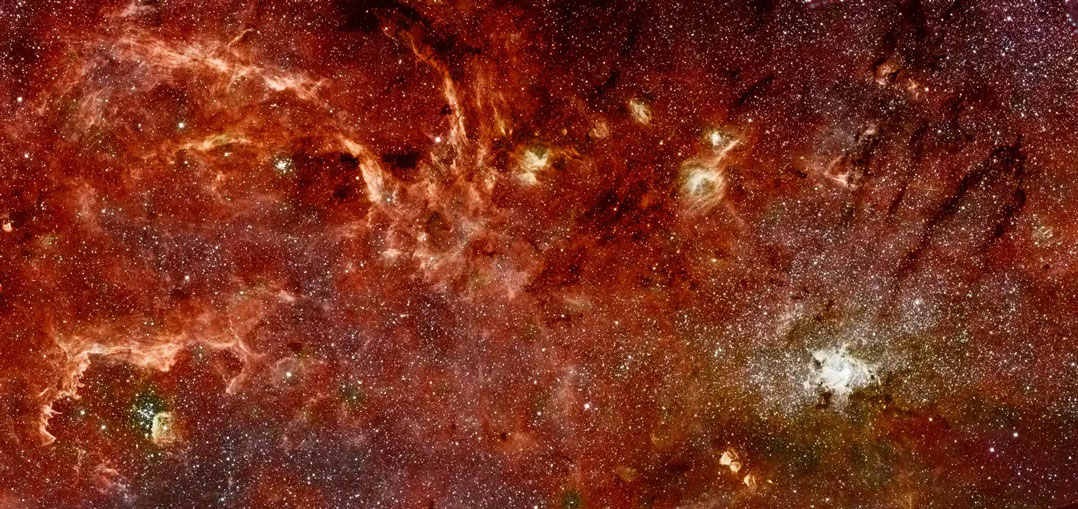
    Can you spot the Quintuplet cluster and the Arches? Hubble: Nasa, ESA, and QD Wang (University of Massachusetts, Amherst); Spitzer: Nasa, Jet Propulsion Laboratory, and S Stolovy (Spitzer Science Center/Caltech)

    This image looks deeper into space to the centre of our Milky Way Galaxy. It also uses infrared light, this time combining data from two Nasa telescopes, Hubble and Spitzer.

    The bright white region in the lower right of the image is the very centre of our galaxy. It contains a massive black hole called Sagittarius A*, a cluster of stars and the remains of a massive star which exploded as a supernova about 10 000 years ago.

    Other star clusters are visible too. There’s the Quintuplet cluster in the lower left of the image within a bubble where the stars’ winds have cleared the local gas and dust. In the upper left there’s a cluster called the Arches, which was named for the illuminated arcs of gas which extend above it and out of the image. These two clusters include some of the most massive stars known.

    4. Abell 370
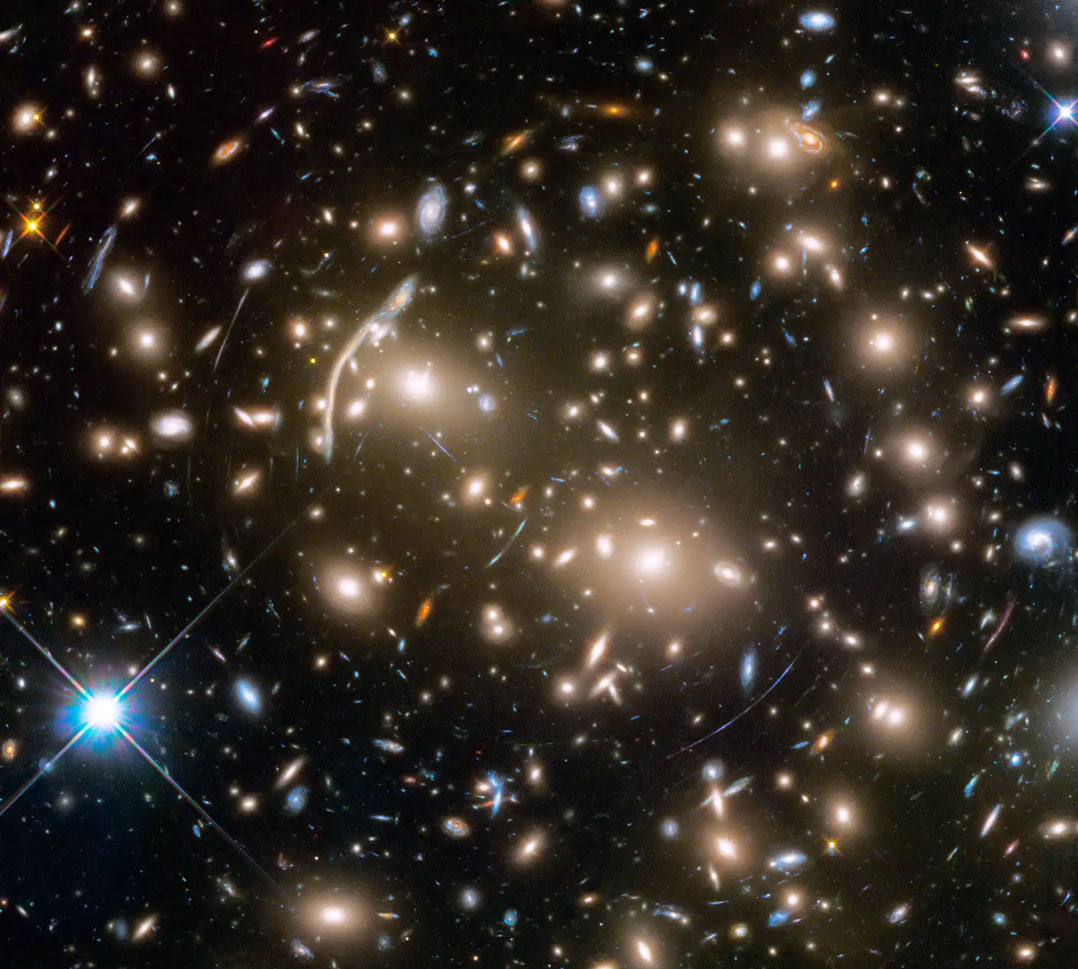
    Abell 370 is a cluster of hundreds of galaxies about five billion light years away from Earth. Nasa, ESA and J Lotz and the HFF Team (STScI)

    On much larger scales than individual galaxies, the universe is structured as a web of filaments (long connected strands) of dark matter. Some of the most dramatic visible objects are clusters of galaxies which form at the intersection of filaments.

    If we look at galaxy clusters nearby (relatively speaking, of course), we can see dramatic proof that Einstein was right when he asserted that mass curves space. One of the prettiest examples which reveals this warping of space can be seen in Hubble’s image of Abell 370, released in 2017.

    Abell 370 is a cluster of hundreds of galaxies about five billion light years away from us. In the picture you can see elongated arcs of light. These are the magnified and distorted images of far more distant galaxies. The mass of the cluster distorts spacetime and bends the light from the more distant objects, magnifying them and in some cases creating multiple images of the same distant galaxy. This phenomenon is called gravitational lensing, because the warped spacetime acts like an optical lens.

    The most prominent of these magnified images is the thickest bright arc above and to the left of the centre of the picture. Called “the Dragon”, this arc consists of two images of the same distant galaxy at its head and tail. Overlapping images of several other distant galaxies comprise the arc of the dragon’s body.

    These gravitationally magnified images are useful to astronomers, because the magnification reveals more detail of the distant lensed object than would otherwise be seen. In this case the lensed galaxy’s population of stars can be examined in detail.

    5. The Hubble Ultra Deep Field
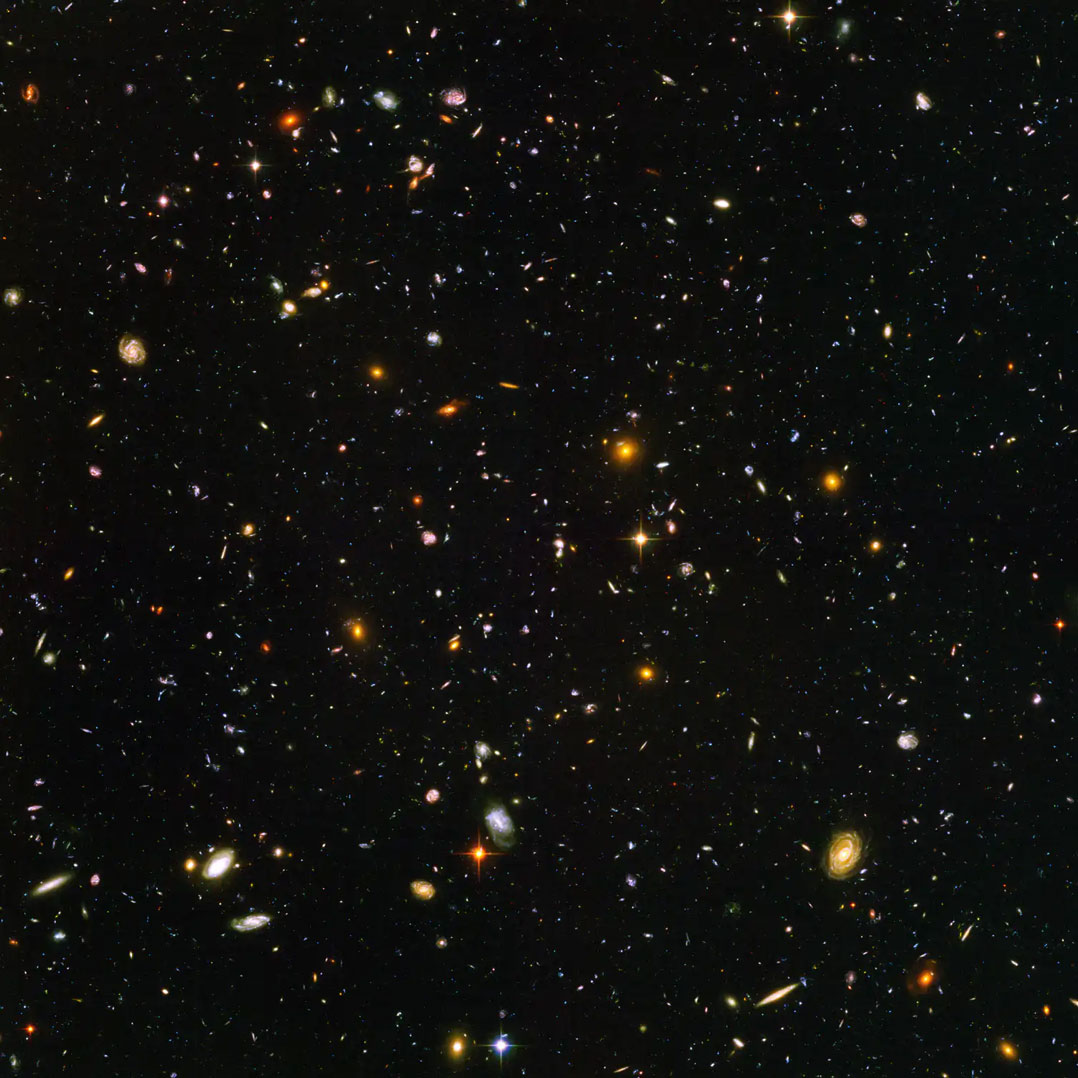
    Sometimes, less is more. Nasa, ESA, and S Beckwith (STScI) and the HUDF Team, CC BY

    In an inspired idea, astronomers decided to point Hubble at a blank patch of sky for several days to discover what extremely distant objects might be seen at the edge of the observable universe.

    The Hubble Ultra Deep Field contains nearly 10 000 objects, almost all of which are very distant galaxies. The light from some of these galaxies has been travelling for over 13 billion years, since the universe was only about half a billion years old.

    Some of these objects are among the oldest and most distant known. Here we’re seeing light from ancient stars whose local contemporaries have long since been extinguished.

    The oldest galaxies formed during the epoch of reionisation, when the tenuous gas in the universe first became bathed in starlight which was capable of separating electrons from hydrogen. This was the last major change in properties of the universe as a whole.

    The fact that light carries so much information, allowing us to piece together the history of the universe, is remarkable. The launch of the James Webb Space Telescope will give us some vastly improved infrared images, and will inevitably raise new questions to challenge future generations of scientists.The Conversation

    • The author, Carole Haswell, is professor of astrophysics, The Open University
    • This article is republished from The Conversation under a Creative Commons licence

    Follow TechCentral on Google News Add TechCentral as your preferred source on Google


    WhatsApp YouTube
    Share. Facebook Twitter LinkedIn WhatsApp Telegram Email Copy Link
    Previous ArticleWhat will crypto do in 2022?
    Next Article China lays complaint at UN over Musk’s Starlink satellites

    Related Posts

    South Africa planning big overhaul of public sector IT - State IT Agency Sita

    South Africa planning big overhaul of public sector IT

    23 April 2026
    Usaasa's 30-year run nears its end - Communications minister Solly Malatsi. Image c/o DCDT

    Usaasa’s 30-year run nears its end

    23 April 2026
    Charge to switch on first N3 off-grid EV stations in May - Joubert Roux

    Charge to switch on first N3 off-grid EV stations in May

    23 April 2026
    Company News
    Security by design is the channel's strongest pitch - Othelo Vieira

    Security by design is the channel’s strongest pitch

    23 April 2026
    Your brand is invisible to the AI that's choosing your competitor - Michelle Losco

    Your brand is invisible to the AI that’s choosing your competitor

    23 April 2026
    How AnyDesk is redefining remote access for African enterprises

    How AnyDesk is redefining remote access for African enterprises

    22 April 2026
    Opinion
    The conflict of interest at the heart of PayShap's slow adoption - Cheslyn Jacobs

    The conflict of interest at the heart of PayShap’s slow adoption

    26 March 2026
    South Africa's energy future hinges on getting wheeling right - Aishah Gire

    South Africa’s energy future hinges on getting wheeling right

    10 March 2026
    Hold the doom: the case for a South African comeback - Duncan McLeod

    Apple just dropped a bomb on the Windows world

    5 March 2026

    Subscribe to Updates

    Get the best South African technology news and analysis delivered to your e-mail inbox every morning.

    Latest Posts
    South Africa planning big overhaul of public sector IT - State IT Agency Sita

    South Africa planning big overhaul of public sector IT

    23 April 2026
    Usaasa's 30-year run nears its end - Communications minister Solly Malatsi. Image c/o DCDT

    Usaasa’s 30-year run nears its end

    23 April 2026
    Charge to switch on first N3 off-grid EV stations in May - Joubert Roux

    Charge to switch on first N3 off-grid EV stations in May

    23 April 2026
    Middle-class South Africa is ditching streaming for AI

    Middle-class South Africa is ditching streaming for AI

    23 April 2026
    © 2009 - 2026 NewsCentral Media
    • Cookie policy (ZA)
    • TechCentral – privacy and Popia

    Type above and press Enter to search. Press Esc to cancel.

    Manage consent

    TechCentral uses cookies to enhance its offerings. Consenting to these technologies allows us to serve you better. Not consenting or withdrawing consent may adversely affect certain features and functions of the website.

    Functional Always active
    The technical storage or access is strictly necessary for the legitimate purpose of enabling the use of a specific service explicitly requested by the subscriber or user, or for the sole purpose of carrying out the transmission of a communication over an electronic communications network.
    Preferences
    The technical storage or access is necessary for the legitimate purpose of storing preferences that are not requested by the subscriber or user.
    Statistics
    The technical storage or access that is used exclusively for statistical purposes. The technical storage or access that is used exclusively for anonymous statistical purposes. Without a subpoena, voluntary compliance on the part of your Internet Service Provider, or additional records from a third party, information stored or retrieved for this purpose alone cannot usually be used to identify you.
    Marketing
    The technical storage or access is required to create user profiles to send advertising, or to track the user on a website or across several websites for similar marketing purposes.
    • Manage options
    • Manage services
    • Manage {vendor_count} vendors
    • Read more about these purposes
    View preferences
    • {title}
    • {title}
    • {title}