Close Menu
TechCentralTechCentral

    Subscribe to the newsletter

    Get the best South African technology news and analysis delivered to your e-mail inbox every morning.

    Facebook X (Twitter) YouTube LinkedIn
    WhatsApp Facebook X (Twitter) LinkedIn YouTube
    TechCentralTechCentral
    • News
      Liquid dodges debt crunch - at a hefty price - Hardy Pemhiwa

      Liquid dodges debt crunch – at a hefty price

      21 April 2026
      Microsoft slashes Xbox Game Pass prices in big strategy shift

      Microsoft slashes Xbox Game Pass prices in big strategy shift

      21 April 2026
      Naspers stalwart Steve Pacak passes away

      Naspers stalwart Steve Pacak passes away

      21 April 2026
      Why AI chatbots are a legal liability waiting to happen - Ahmore Burger-Smidt

      Why AI chatbots are a legal liability waiting to happen

      21 April 2026
      South African tech juniors squeezed as AI reshapes hiring

      South African tech juniors squeezed as AI reshapes hiring

      21 April 2026
    • World
      More organic compounds detected on Mars - Nasa Curiosity rover

      More organic compounds detected on Mars

      21 April 2026
      Adobe bets on AI agents to fend off cheaper rivals

      Adobe bets on AI agents to fend off cheaper rivals

      16 April 2026
      Google poised to lose ad crown to Meta

      Google poised to lose ad crown to Meta

      14 April 2026
      Grand Theft Data - hackers hit Rockstar Games - Grand Theft Auto

      Grand Theft Data – hackers hit Rockstar Games

      14 April 2026
      UK PM Keir Starmer declares war on doomscrolling

      UK PM Keir Starmer declares war on doomscrolling

      13 April 2026
    • In-depth
      Africa switches on as Europe dims the lights

      Africa switches on as Europe dims the lights

      9 April 2026
      The biggest untapped EV market on Earth is hiding in plain sight

      The biggest untapped EV market on Earth is hiding in plain sight

      1 April 2026
      The R18-billion tech giant hiding in plain sight - Jens Montanana

      The R16-billion tech giant hiding in plain sight

      26 March 2026
      The last generation of coders

      The last generation of coders

      18 February 2026
      Sentech is in dire straits

      Sentech is in dire straits

      10 February 2026
    • TCS

      TCS+ | ‘The ISP for ISPs’: Vox’s shift to wholesale aggregator

      20 April 2026
      TCS | Werner Lindemann on how AI is rewriting the infosec rulebook

      TCS | Werner Lindemann on how AI is rewriting the infosec rulebook

      15 April 2026
      TCS | Donovan Marsh on AI and the future of filmmaking

      TCS | Donovan Marsh on AI and the future of filmmaking

      7 April 2026
      TCS+ | Vodacom Business moves to crack the SME tech gap - Andrew Fulton, Sannesh Beharie

      TCS+ | Vodacom Business moves to crack the SME tech gap

      7 April 2026
      TCS | MTN's Divysh Joshi on the strategy behind Pi - Divyesh Joshi

      TCS | MTN’s Divyesh Joshi on the strategy behind Pi

      1 April 2026
    • Opinion
      The conflict of interest at the heart of PayShap's slow adoption - Cheslyn Jacobs

      The conflict of interest at the heart of PayShap’s slow adoption

      26 March 2026
      South Africa's energy future hinges on getting wheeling right - Aishah Gire

      South Africa’s energy future hinges on getting wheeling right

      10 March 2026
      Hold the doom: the case for a South African comeback - Duncan McLeod

      Apple just dropped a bomb on the Windows world

      5 March 2026
      R230-million in the bag for Endeavor's third Harvest Fund - Alison Collier

      VC’s centre of gravity is shifting – and South Africa is in the frame

      3 March 2026
      Hold the doom: the case for a South African comeback - Duncan McLeod

      Hold the doom: the case for a South African comeback

      26 February 2026
    • Company Hubs
      • 1Stream
      • Africa Data Centres
      • AfriGIS
      • Altron Digital Business
      • Altron Document Solutions
      • Altron Group
      • Arctic Wolf
      • Ascent Technology
      • AvertITD
      • BBD
      • Braintree
      • CallMiner
      • CambriLearn
      • CYBER1 Solutions
      • Digicloud Africa
      • Digimune
      • Domains.co.za
      • ESET
      • Euphoria Telecom
      • HOSTAFRICA
      • Incredible Business
      • iONLINE
      • IQbusiness
      • Iris Network Systems
      • Kaspersky
      • LSD Open
      • Mitel
      • NEC XON
      • Netstar
      • Network Platforms
      • Next DLP
      • Ovations
      • Paracon
      • Paratus
      • Q-KON
      • SevenC
      • SkyWire
      • Solid8 Technologies
      • Telit Cinterion
      • Telviva
      • Tenable
      • Vertiv
      • Videri Digital
      • Vodacom Business
      • Wipro
      • Workday
      • XLink
    • Sections
      • AI and machine learning
      • Banking
      • Broadcasting and Media
      • Cloud services
      • Contact centres and CX
      • Cryptocurrencies
      • Education and skills
      • Electronics and hardware
      • Energy and sustainability
      • Enterprise software
      • Financial services
      • HealthTech
      • Information security
      • Internet and connectivity
      • Internet of Things
      • Investment
      • IT services
      • Lifestyle
      • Motoring
      • Policy and regulation
      • Public sector
      • Retail and e-commerce
      • Satellite communications
      • Science
      • SMEs and start-ups
      • Social media
      • Talent and leadership
      • Telecoms
    • Events
    • Advertise
    TechCentralTechCentral
    Home » Sections » Internet and connectivity » The internet revolution happening in Olievenhoutbosch

    The internet revolution happening in Olievenhoutbosch

    A dusty township in Gauteng is the site of a South African-developed mesh network that promises to be a gamechanger.
    By Duncan McLeod20 March 2024
    Twitter LinkedIn Facebook WhatsApp Email Telegram Copy Link
    News Alerts
    WhatsApp

    Mathews Mofokeng was streaming Netflix on his smartphone on the back seat of a battered old car in Ext 27 in Olievenhoutbosch – a sprawling township near Centurion in Gauteng – when TechCentral visited him on a sweltering Sunday afternoon earlier this month.

    Mofokeng, who lives in a tin shack, was doing what he often does nowadays in his downtime: he was streaming online entertainment to his phone, without a care in the world about how much data he was using. He was in the car, windows and doors wide open, because the baking sun on his home’s metal roof had made it unbearably hot to be inside.

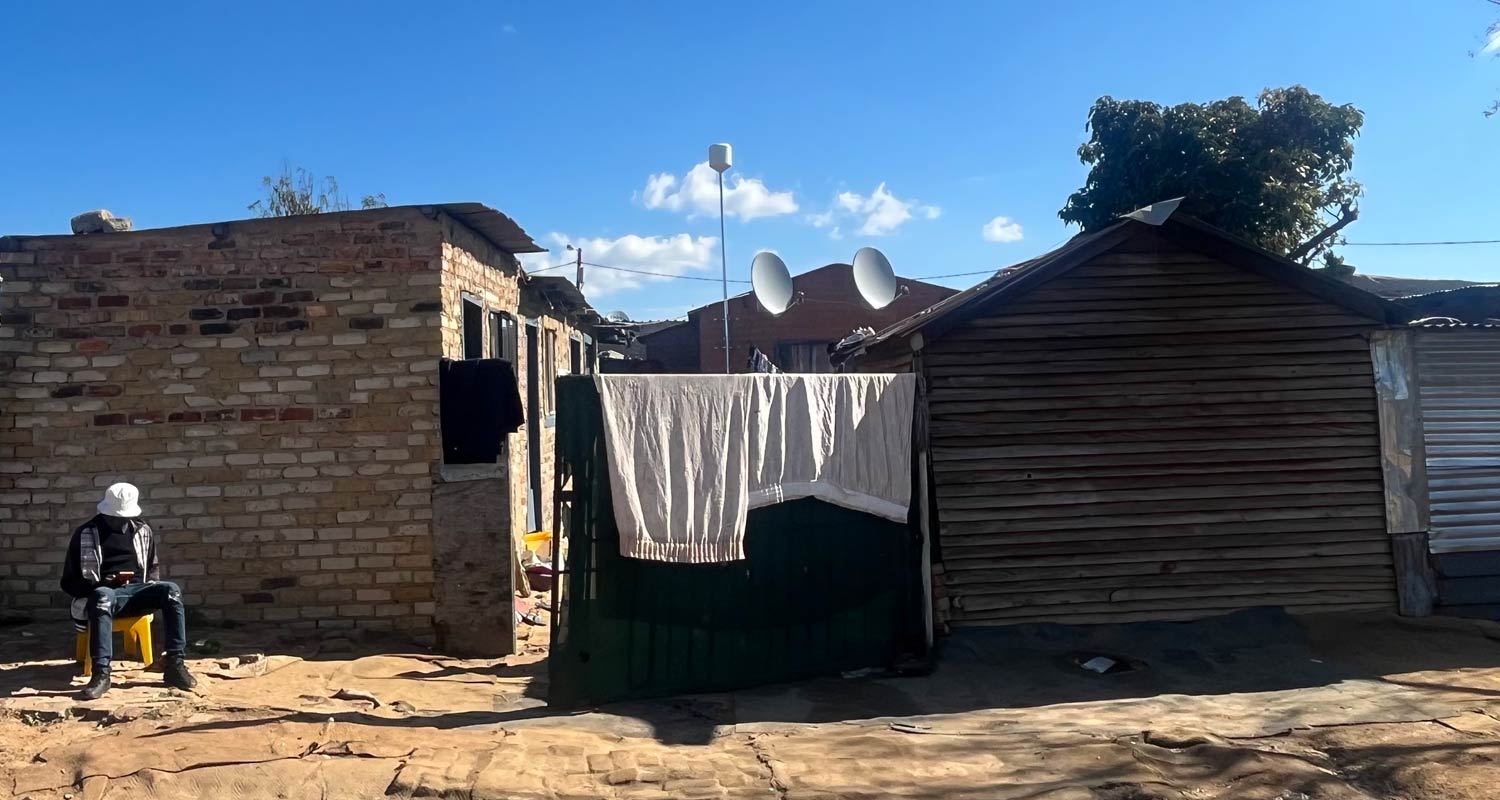
    There was something unusual about Mofokeng’s house, though: this shack had an antenna mounted on the side – a “core node” in a mesh network that already provides completely unlimited broadband internet coverage to about a third of a township that’s home to an estimated 80 000 people. And it costs residents just R99/month.

    Part of Mofokeng’s motivation is that he makes money reselling internet access to the homes around him

    Mofokeng wasn’t meant to have a core node attached his shack (the company behind the technology, Riot Network, doesn’t install them on informal dwellings), but he’d recently moved to Ext 27 from elsewhere in Olievenhoutbosch where he’d had access. And he decided he couldn’t live without uncapped internet, so he put up a core node on his new abode, as basic as his accommodation is.

    Part of Mofokeng’s motivation is that he makes money reselling internet access to the homes around him – he collects 15% of the R99/month that his neighbours pay for a “leaf node” that they’ve installed on their houses so they can also access the mesh network and its uncapped data.

    What many readers may find surprising is that Riot Network, which is deploying the network, is an entirely for-profit commercial venture. And its founders and backers – among them former Dimension Data executive and Sentech CEO Setumo Mohapi – believe that this, along with direct community involvement, has been key in delivering cheap, uncapped broadband into low-income communities. They think the model is replicable countrywide – and even across the African continent.

    Uncapped internet for R99/month

    When TechCentral visited the township on Sunday, 10 March, it quickly became clear to this publication that Riot was onto something big. Across large sections of Olievenhoutbosch, houses – and even informal dwellings like Mofokeng’s – have distinctive core nodes and leaf nodes attached to them, delivering what was previously unheard of to residents: uncapped high-speed internet at low cost. Many have taken to it like proverbial ducks to water, even hooking up their TVs so as to get access to the sort of streaming services like Netflix that in the past they simply haven’t been able to afford because of the cost of mobile data.

    Riot Network, which was founded in 2017, is the brainchild of its three founders, CEO Jarryd Bekker, chief operating officer Moses Mpofu and senior radiofrequency developer Daniel de Kock, who had been tinkering for some time with solutions to reduce the cost of internet access in low-income communities.

    The pair met at an incubation lab overseen by the late Prof Barry Dwolatzky at Wits University’s Joburg Centre for Software Engineering. Initially doing work around the internet of things, they soon pivoted into mesh networks and finding ways of driving down uncapped broadband costs.

    Mathews Mofokeng watching Netflix in Olivienhoutbosch Ext 27

    Here’s how Riot’s system works:

    • The company procures uncontended (business-class) wireless capacity from network providers – currently these are high-frequency 5G fixed-wireless from Comsol and point-to-multipoint fixed-wireless solutions from Wirulink. It hopes fibre backbone providers will soon join the party, too.
    • It then connects these backbone links to “gateway nodes” (often also in people’s homes) in Olievenhoutbosch, from where it is distributed in the community to homes with core nodes.
    • From there, the core nodes provide access to leaf nodes in the same community, sharing in the revenue that is generated, and making them integral to the solution. The leaf nodes can interoperate to connect back to the core nodes, and then back into the core network.

    Bekker told TechCentral that Riot’s founders realised that to drive down the cost of connectivity, it made sense to allow communities to deploy the infrastructure themselves. So, DStv installers are empowered to put up both core nodes and leaf nodes, and to connect them – all using unlicensed spectrum in the 2.4GHz and 5GHz bands, the same frequencies you use to connect to your Wi-Fi router at home.

    TCS | Uncapped fibre for R5/day – Isizwe’s big gambit

    But the really clever aspect of it is that entire communities – of core and leaf nodes – can share a single, high-quality and high-capacity internet pipe, driving down costs while still getting (shared) access to a top-tier package they wouldn’t be able to afford on their own.

    Watch a special TechCentral Show (TCS) interview with Riot Network co-founders Jarryd Bekker and Moses Mpofu, including footage from Olivienhoutbosch and interviews with residents:

    Even at peak times, users will get a minimum of 5Mbit/s, according to Bekker. During off-peak times, it is often far quicker – sometimes up to 100Mbit/s or more. Pricing is R99/month per node, with up to three devices able to be connected per node, and there are no data caps at all.

    If users need to connect more devices or people (many township homes have backyard residents), they can simply install another node. The CPEs – or consumer premises equipment installed inside people’s homes – are built locally, by Microtronix. Much of the intellectual property underpinning the solution was developed in-house.

    Bekker said Riot doesn’t want to be seen as a competitor to established telecommunications operators, but rather as a complementary service. For example, he said, business-focused internet service providers can supply a single link to a gateway node rather than having to service dozens of low-paying clients in a particular area. This improves their margin, and also improves utilisation of their networks during non-peak periods (outside normal business hours). “Our goal is to augment existing networks, presenting new clients to these ISPs and telcos,” he said.

    …article continues below…
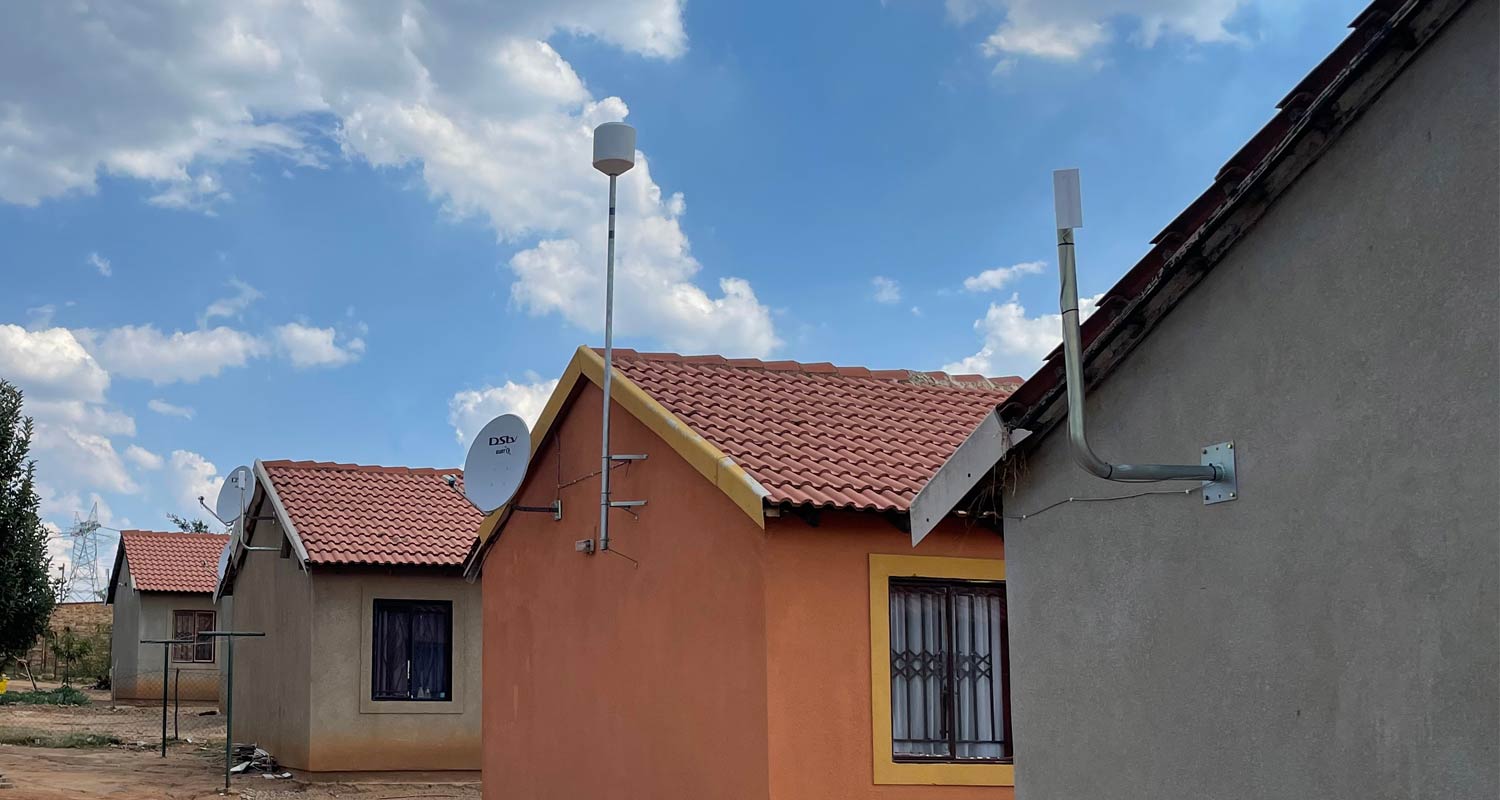
    A core node is visible in the centre of this photo
    Homes in Olivienhoutbosch. The house painted orange is host to a core node, while the house in foreground has a leaf node
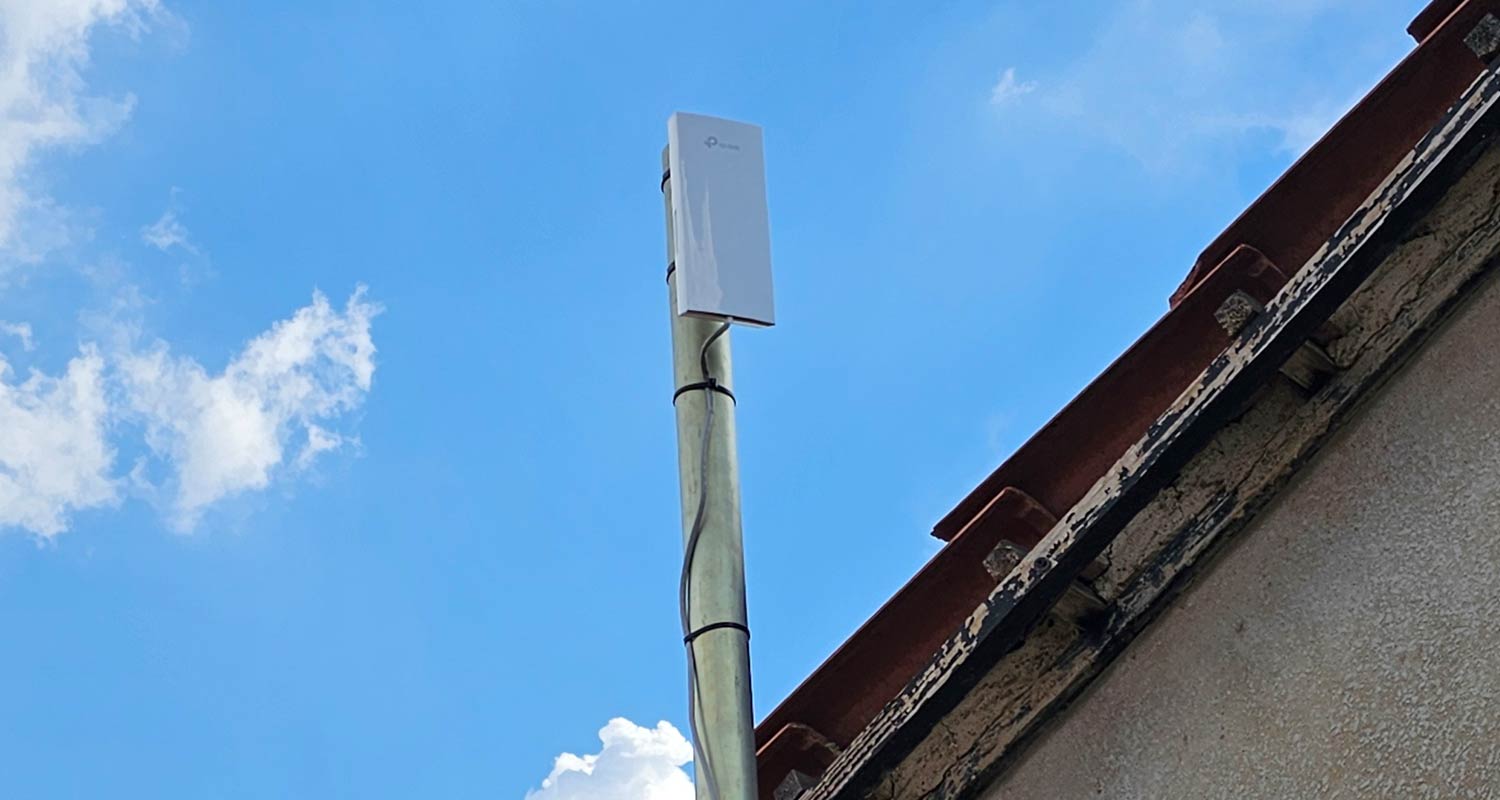
    Close-up of a leaf node

    Core node operators are encouraged to have backup power to keep their nodes operational during load shedding. Both gateway and core nodes consume just 4-7W, so having a backup to keep them online is relatively inexpensive. Riot has provided small backup batteries to some core node operators, but others have taken the initiative to get their own – realising that it keeps the community happy and benefits them because they share in a portion of the revenue.

    Interestingly, despite the high levels of crime in the township, Bekker said none of the equipment has ever been stolen. “It’s on people’s houses – they look after it. There is a status associated with having a node.”

    Watch | A tour of Vumatel’s Alexandra fibre roll-out

    Riot has big plans to expand its solution into other townships around Gauteng – and over time, further afield, too. (Watch the video for more information about the company’s funding, and how it sees the project developing.)

    The founders have big plans, including serving content from the “edge” – directly from the core nodes – and has already run a pilot in this regard with Wikipedia. Bekker said there’s no reason South Africa’s school curriculum can’t be distributed directly from these nodes, empowering youngsters with the educational tools they need.

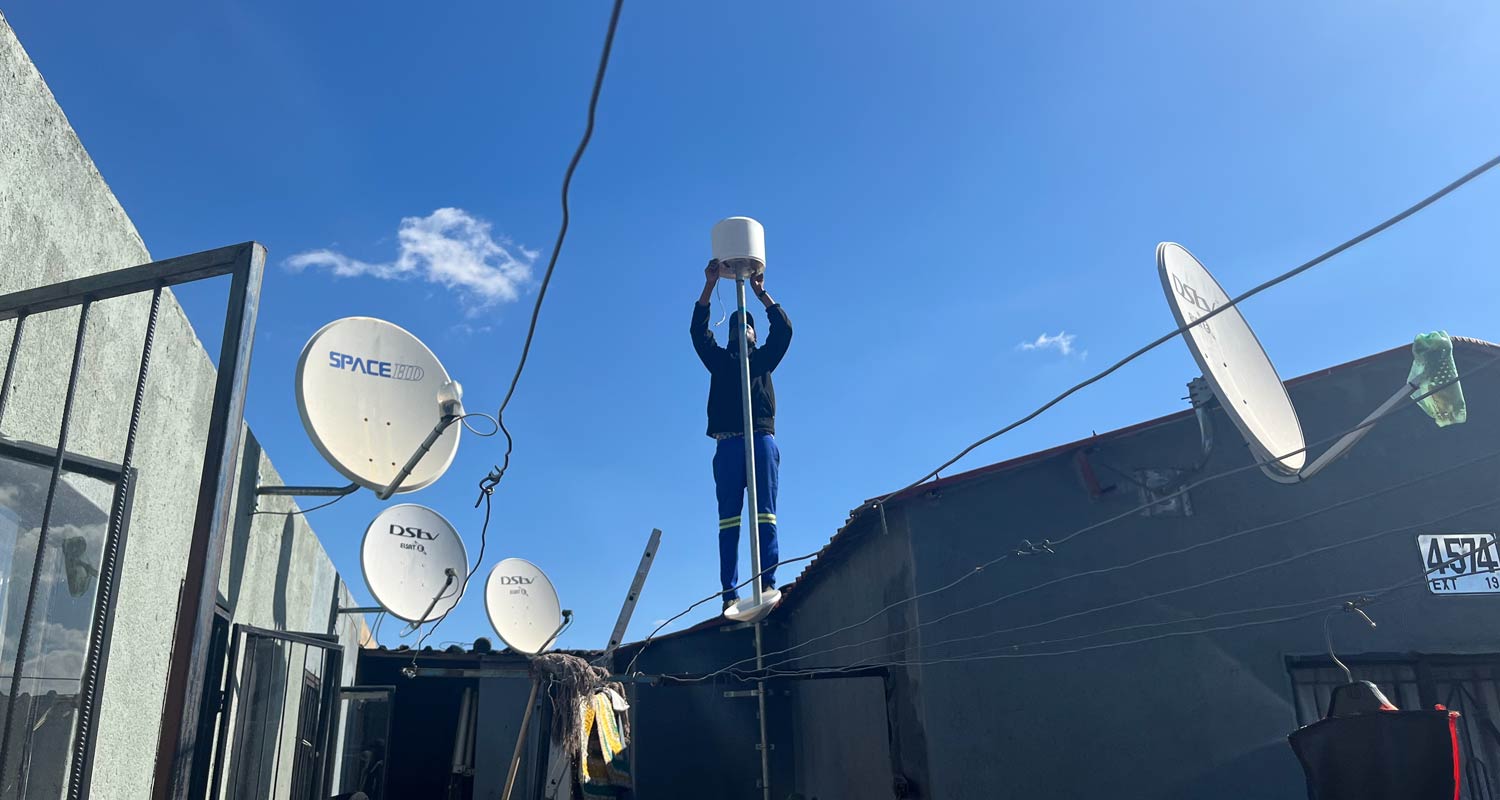
    A member of the Riot team installing a core node

    Backer Setumo Mohapi, who has previously served as CEO of the State IT Agency (Sita) and Sentech, and who serves on Riot’s advisory board, told TechCentral that Riot will succeed where government projects have failed precisely because it’s a commercial venture and involves local communities. He believes the mesh technology developed by Riot will prove transformative for low-income communities.

    “This is not a charity. It’s based on a proper value exchange and is purely commercial,” he said. People with core nodes become “the best salespeople” for connecting others in their communities, and the network effectively builds itself.

    “No one in China would understand this model,” he said. It’s a South African-designed solution that could solve the digital divide.  – © 2024 NewsCentral Media

    Get breaking news alerts from TechCentral on WhatsApp

    Follow TechCentral on Google News Add TechCentral as your preferred source on Google


    Barry Dwolatzky Daniel de Kock DStv Jarryd Bekker Moses Mpofu Netflix Riot Riot Network Setumo Mohapi
    WhatsApp YouTube
    Share. Facebook Twitter LinkedIn WhatsApp Telegram Email Copy Link
    Previous ArticleTelkom in talks to sell its towers to Actis
    Next Article Apple could face US antitrust trial

    Related Posts

    The case for unbundling SuperSport

    The case for unbundling SuperSport

    14 April 2026
    The end of MultiChoice as we know it

    The end of MultiChoice as we know it

    13 April 2026
    Cape Town start-up powers six-month Netflix production with the sun

    Cape Town start-up powers six-month Netflix production with the sun

    7 April 2026
    Company News
    Why retail's future is digital - but still physical - NEC XON

    Why the future of retail is digital – but still physical

    21 April 2026
    Africa's AI dream needs bricks and gigawatts - Gary Galolo, head of technology, media, and telecommunications and digital infrastructure finance at Nedbank CIB

    Africa’s AI dream needs bricks and gigawatts

    21 April 2026
    Fibre: the backbone of South Africa's digital health ecosystem - Mweb

    Fibre: the backbone of South Africa’s digital health ecosystem

    16 April 2026
    Opinion
    The conflict of interest at the heart of PayShap's slow adoption - Cheslyn Jacobs

    The conflict of interest at the heart of PayShap’s slow adoption

    26 March 2026
    South Africa's energy future hinges on getting wheeling right - Aishah Gire

    South Africa’s energy future hinges on getting wheeling right

    10 March 2026
    Hold the doom: the case for a South African comeback - Duncan McLeod

    Apple just dropped a bomb on the Windows world

    5 March 2026

    Subscribe to Updates

    Get the best South African technology news and analysis delivered to your e-mail inbox every morning.

    Latest Posts
    Liquid dodges debt crunch - at a hefty price - Hardy Pemhiwa

    Liquid dodges debt crunch – at a hefty price

    21 April 2026
    Microsoft slashes Xbox Game Pass prices in big strategy shift

    Microsoft slashes Xbox Game Pass prices in big strategy shift

    21 April 2026
    Naspers stalwart Steve Pacak passes away

    Naspers stalwart Steve Pacak passes away

    21 April 2026
    Why AI chatbots are a legal liability waiting to happen - Ahmore Burger-Smidt

    Why AI chatbots are a legal liability waiting to happen

    21 April 2026
    © 2009 - 2026 NewsCentral Media
    • Cookie policy (ZA)
    • TechCentral – privacy and Popia

    Type above and press Enter to search. Press Esc to cancel.

    Manage consent

    TechCentral uses cookies to enhance its offerings. Consenting to these technologies allows us to serve you better. Not consenting or withdrawing consent may adversely affect certain features and functions of the website.

    Functional Always active
    The technical storage or access is strictly necessary for the legitimate purpose of enabling the use of a specific service explicitly requested by the subscriber or user, or for the sole purpose of carrying out the transmission of a communication over an electronic communications network.
    Preferences
    The technical storage or access is necessary for the legitimate purpose of storing preferences that are not requested by the subscriber or user.
    Statistics
    The technical storage or access that is used exclusively for statistical purposes. The technical storage or access that is used exclusively for anonymous statistical purposes. Without a subpoena, voluntary compliance on the part of your Internet Service Provider, or additional records from a third party, information stored or retrieved for this purpose alone cannot usually be used to identify you.
    Marketing
    The technical storage or access is required to create user profiles to send advertising, or to track the user on a website or across several websites for similar marketing purposes.
    • Manage options
    • Manage services
    • Manage {vendor_count} vendors
    • Read more about these purposes
    View preferences
    • {title}
    • {title}
    • {title}