
Terry Pratchett once told me that he didn’t actually recommend beginning your relationship with the Discworld through his first novel in the series, The Colour of Magic (1983).
That’s because hindsight is 20/20. When Terry wrote “The First Discworld Novel” in 1983 he didn’t know how big a phenomenon he was starting.
Over the next 32 years, 40 more novels flowed, first from his keyboard and later from his speech recognition software, up until a year ago this Saturday, when Alzheimer’s stole away one of the greatest contemporary English language writers.
Back in 1983, Terry was working full time and writing in his spare time. When he created the Discworld, Pratchett simply couldn’t have foreseen how things would evolve.
It was a strange, magical, flat world, populated by wizards, dwarfs and trolls, replete with dragons and barbarian heroes. In turn, this world was perched atop four enormous elephants, themselves standing atop a giant star-turtle swimming through the galactic void.
Any reader beginning with “book one” and thinking that they’re embarking on a journey that will take them through 41 variations on that first theme is hugely mistaken. For one thing, the Discworld novels aren’t, strictly speaking, a series. Certainly not in the sense of a story where plot continues to be told across multiple instalments.
Rincewind the Wizzard and the birth of a world
While The Colour of Magic and its 1986 sequel The Light Fantastic serve to introduce the Disc, these early books are, in many ways, really only a prologue to the Discworld series that follows.
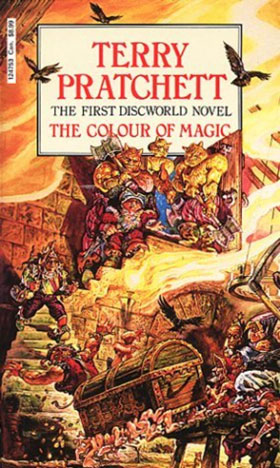
They introduce its idiosyncratic societal peculiarities, geographies and some recurring characters.
All are brought to life and framed by Terry’s wit and irreverence and presented in a uniquely original style: no chapters, many puns, twisted takes on the contemporary presented in less than contemporary environs and frequent forays into footnotes, which meander through humorous observation parallel to the main story.
They’re laced with both overt and sly nods to classical mythology and literary classics. In fact, a “family” of books is probably a more appropriate description to use than series.
Books one and two are predominantly a comical riff on swords and sorcery, dungeons and dragons, Tolkein-like quests and the concept and conceits of using parallel universes as a plot device.
They’re referential and irreverent. Pratchett’s first anti-hero, Rincewind the Wizzard (whose inability to cast a spell is bettered only by his inability to spell) is a misadventure magnet.
He bumbles his way through calamity, much of it caused by him, accompanied by the innocent and all-trusting Twoflower, the Disc’s first tourist.
Together, with Twoflower’s malevolently sentient Luggage in tow, they inadvertently and neatly manage to save the world.
The Colour of Magic and The Light Fantastic chart the protagonists’ chaotic course across the Disc and could stand alone as a single novel. Indeed these two books are the only ones in the “series” that demand sequential reading to convey a story in its entirety.
In later novels, where other recurring characters are introduced, each “episode” is largely self-contained. The reader doesn’t have to have read these books in sequence to appreciate the story being told.
Structurally, the Discworld novels can be grouped into reasonably logical subsets: novels which feature the same characters and which, if read sequentially in their own right, provide both narrative chronology and character (if not plot) development and arc.
Mighty and mundane magic
Pratchett’s first steps on the Discworld left his footprints in magic. One of Terry’s earlier footnotes postulated that the word “wizard” was derived from the archaic word “Wys-ars” — a hypothesis which tees the reader up with all they need to enjoy this series and its characters.
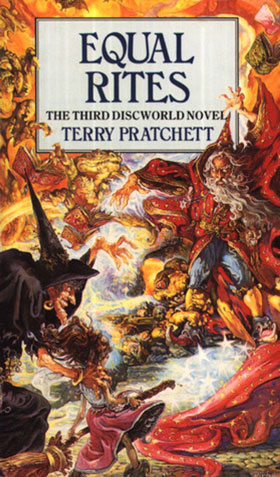
The Unseen University (Discworld’s premier university for the study of magic) features centre stage across half dozen or so novels. It’s chaotic, with professional advancement through wizarding hierarchy secured through assassination of one’s colleagues, while excessive use of magic attracts horrible beasts from the Dungeon Dimensions.
This is all before things settle down with the arrival of Mustrum Ridcully as the Arch-chancellor, who sensibly recognises that the power of magic lies in knowing when not to use it — but at the same making sure that those around you know that you could use it, you know, if you really felt like it.
This group of novels features more slapstick than its cousins in the series, and is a must for anyone who has ever watched Porterhouse Blue, or ever been to or worked in a university (magical or otherwise). Terry never attended university, but he certainly had insight as to how they run, in spite of themselves.
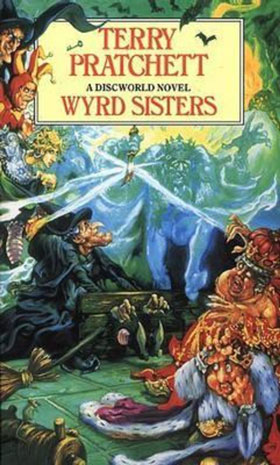
Magic in the Discworld is not restricted to the academy. The next major character created after Rincewind was Mistress Esmerelda Weatherwax, a witch. Granny Weatherwax, as she is more commonly known, is everything Rincewind is not: strong, fearless, stubborn, prim, proud and immensely magical.
She and her wonderful compatriot and partner in adventure, Nanny Ogg, only really get into their stride in the second book recounting their activities — Wyrd Sisters (1988).
Along with the third member of their recurring trio, Magrat Garlick (whose mother liked the name Margaret, but, alas, was unsure of the spelling) they do what witches do best: interfere with what is going on around them.
Wyrd Sisters, which suspiciously resembles a well-known Scottish play by W Shakespeare, allows Pratchett full reign to twist the familiar through a Discworld wringer and humour leaps from the pages right from the beginning:
As the cauldron bubbled an eldritch voice shrieked: ‘When shall we three meet again? There was a pause. Finally another voice said, in far more ordinary tones: ‘Well, I can do next Tuesday’.
Pratchett uses this conceit on other occasions with the Witches of Lancre, notably the Phantom of the Opera-styled Masquerade (1995), and Cinderella in Witches Abroad (1991).
Rather than simply retelling these tales on Discworld, we’re presented with a kernel of the familiar narrative, which is then deftly inverted and gleefully perverted in Pratchett’s alternate rendering.
Death and loss on Discworld
It’s interesting that I Shall Wear Midnight (2010) was written by a man who was, at the time of writing, beginning a more serious struggle with Alzheimer’s disease than his outward persona may have let on. The pacing, complexity and adventure of this story is exceptional, and I rank it among Terry’s very best work.
Reflecting on his own mortality and the role that Alzheimer’s might play in his demise, Terry once told me, riffing on Spike Milligan,
I don’t mind dying, I’d just like to be there when it happens.
Death may not strike the reader as possessing the makings of a great recurring literary character, but on the Discworld he is chaperoned through an exploration of life and humanity by Pratchett.
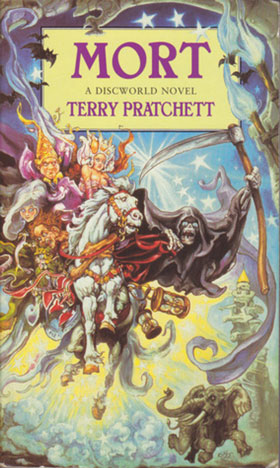
The skeletal, cowl-wearing, bee-keeping, scythe-wielding, soul-stalking harbinger of the end of all things, who talks in all-caps sᴇᴘᴜʟᴄʜʀᴀʟ ғᴏɴᴛ has become a firm fan favourite — and has taken on some more human traits over time.
The Death novels usually relate to world-ending catastrophe, brought about by the naivety and innocence of the ultimate arbiter as he struggles to deal with the personality he feels is missing from his personification. His horse, for example, is called Binky.
Mort (1987), the story of what goes terribly wrong when Death takes on an apprentice, is another book in the canon where new readers can dip their toe safely into the Discworld without prior knowledge being needed to get to grips with the goings-on which unfold.
I fought the law…
In his graduation address to the University of South Australia’s Class of 2014, on receipt of his honorary doctorate from our institution, Terry noted,
There is possibly more of me in Sir Samuel than in any other player on my pages.
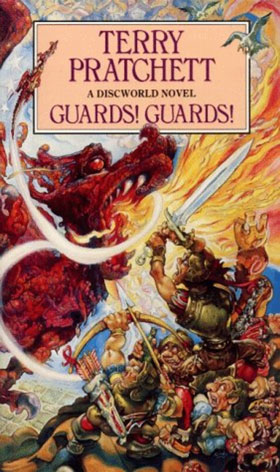
That’s what makes the group of books that deals with the Watchmen of Ankh Morpork a must for anyone interested in Pratchett.
Samuel Vimes, introduced as a drunken night-watchman in Guards! Guards! (1989), develops and grows in the course of our encounters with him across multiple books.
The dedication from Guards! Guards! sums up the genre-bending playfulness of these works:
They may be called the Palace Guard, the City Guard, or the Patrol. Whatever the name, their purpose in any work of heroic fantasy is identical: it is, round about Chapter Three (or ten minutes into the film) to rush into the room, attack the hero one at a time, and be slaughtered. No one ever asks them if they want to.
This book is dedicated to those fine men.
Across ten Guards novels Pratchett explores prejudice and humanity with forays into nationalism, racism, bigotry and genocide.
Big topics, subtly handled and with a thread of passion that leaps from the page. Whenever asked, I generally recommend that anyone stepping onto the Disc for their first time does so with Guards! Guards!
The development of technology
Beyond a handful which deal with gods and religion, many of the remaining novels individually and collectively deal with the industrialisation of the Discworld. Some are standalone, some are linked by recurring characters. Pratchett grew increasingly interested in the impacts of technology on society and he explored this through the introduction of technologies to the Disc.

Moving Pictures (1990) intersects with the wizards of Unseen University and indeed, sees the first appearance of one of that series’ favourites, Ponder Stibbons — who in later life emerges as the one person who actually knows how the Unseen University actually works on a day to day basis.
But in Moving Pictures, our focus is on the invention of (or indeed the rediscovery of the magic behind) the movies. Film buffs will relish spotting subtle and not-so-subtle references to early Hollywood greats.
Much later on in the Discworld series, The Truth (2000) sees the invention of moveable type and the first newspaper, along with journalistic freedom in the context of a City ruled by a sometimes benign dictator.
Pratchett drew deeply on his own journalistic background with ample references to amusingly shaped vegetables and the importance of recording both the name, age and address of everyone quoted in every interest piece.
The Moist Von Lipwig series revolves around an improbably named ex-con anti-hero who is reprieved from the jaws of certain death by the Patrician and set to work to revitalise the official postal service just as commercial modern telecommunications begin to blossom on the Disc in Going Postal (2004).
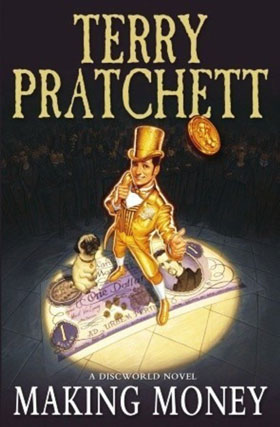
Moist returns a second time to revamp the banking system in Making Money (2007), which came into print coincident with the global financial crisis, and in his last instalment, sets out to lay down the iron highway as the Discworld enters the age of rail in Raising Steam (2013).
In each of these outings, Von Lipwig outshines his con-artistic tendencies and grows in his heroism through the selflessness of his deeds and actions, despite himself. I do know that this particular character, oddly named though he may be, was originally conceived with a different name — but that secret remains one for someone else to tell, in Terry’s biography perhaps.
The body of work that is Discworld extends into companion pieces, guides, maps, plays, folklore and popular science guides. Even the odd (but exciting) short movie exists, set atop that magical world. Like any companion set to a core series, readers can get by with or without these additions, but fans probably can’t.
The moral of this tale is that you can step onto the Discworld anywhere you like. If you enjoy wit, humour and fast-paced plot, you will enjoy yourself immensely. Just don’t feel obliged to begin at the beginning.
The beauty of it is that with 41 books to enjoy, you can always go back around again for more — and such is the depth of Pratchett’s craft, you’ll likely find something you’ve previously missed on every re-read.
- David G Lloyd is vice-chancellor and president, University of South Australia
- This article was originally published on The Conversation