Close Menu
TechCentralTechCentral

    Subscribe to the newsletter

    Get the best South African technology news and analysis delivered to your e-mail inbox every morning.

    Facebook X (Twitter) YouTube LinkedIn
    WhatsApp Facebook X (Twitter) LinkedIn YouTube
    TechCentralTechCentral
    • News
      Big Microsoft 365 price increases coming next year

      Big Microsoft price increases coming next year

      5 December 2025
      Vodacom to take control of Safaricom in R36-billion deal - Shameel Joosub

      Vodacom to take control of Safaricom in R36-billion deal

      4 December 2025
      Black Friday goes digital in South Africa as online spending surges to record high

      Black Friday goes digital in South Africa as online spending surges to record high

      4 December 2025
      BYD takes direct aim at Toyota with launch of sub-R500 000 Sealion 5 PHEV

      BYD takes direct aim at Toyota with launch of sub-R500 000 Sealion 5 PHEV

      4 December 2025
      'Get it now': Takealot in new instant deliveries pilot

      ‘Get it now’: Takealot in new instant deliveries pilot

      4 December 2025
    • World
      Amazon and Google launch multi-cloud service for faster connectivity

      Amazon and Google launch multi-cloud service for faster connectivity

      1 December 2025
      Google makes final court plea to stop US breakup

      Google makes final court plea to stop US breakup

      21 November 2025
      Bezos unveils monster rocket: New Glenn 9x4 set to dwarf Saturn V

      Bezos unveils monster rocket: New Glenn 9×4 set to dwarf Saturn V

      21 November 2025
      Tech shares turbocharged by Nvidia's stellar earnings

      Tech shares turbocharged by stellar Nvidia earnings

      20 November 2025
      Config file blamed for Cloudflare meltdown that disrupted the web

      Config file blamed for Cloudflare meltdown that disrupted the web

      19 November 2025
    • In-depth
      Jensen Huang Nvidia

      So, will China really win the AI race?

      14 November 2025
      Valve's Linux console takes aim at Microsoft's gaming empire

      Valve’s Linux console takes aim at Microsoft’s gaming empire

      13 November 2025
      iOCO's extraordinary comeback plan - Rhys Summerton

      iOCO’s extraordinary comeback plan

      28 October 2025
      Why smart glasses keep failing - no, it's not the tech - Mark Zuckerberg

      Why smart glasses keep failing – it’s not the tech

      19 October 2025
      BYD to blanket South Africa with megawatt-scale EV charging network - Stella Li

      BYD to blanket South Africa with megawatt-scale EV charging network

      16 October 2025
    • TCS
      TCS+ | How Cloud on Demand helps partners thrive in the AWS ecosystem - Odwa Ndyaluvane and Xenia Rhode

      TCS+ | How Cloud On Demand helps partners thrive in the AWS ecosystem

      4 December 2025
      TCS | MTN Group CEO Ralph Mupita on competition, AI and the future of mobile

      TCS | Ralph Mupita on competition, AI and the future of mobile

      28 November 2025
      TCS | Dominic Cull on fixing South Africa's ICT policy bottlenecks

      TCS | Dominic Cull on fixing South Africa’s ICT policy bottlenecks

      21 November 2025
      TCS | BMW CEO Peter van Binsbergen on the future of South Africa's automotive industry

      TCS | BMW CEO Peter van Binsbergen on the future of South Africa’s automotive industry

      6 November 2025
      TCS | Why Altron is building an AI factory - Bongani Andy Mabaso

      TCS | Why Altron is building an AI factory in Johannesburg

      28 October 2025
    • Opinion
      Your data, your hardware: the DIY AI revolution is coming - Duncan McLeod

      Your data, your hardware: the DIY AI revolution is coming

      20 November 2025
      Zero Carbon Charge founder Joubert Roux

      The energy revolution South Africa can’t afford to miss

      20 November 2025
      It's time for a new approach to government IT spend in South Africa - Richard Firth

      It’s time for a new approach to government IT spend in South Africa

      19 November 2025
      How South Africa's broken Rica system fuels murder and mayhem - Farhad Khan

      How South Africa’s broken Rica system fuels murder and mayhem

      10 November 2025
      South Africa's AI data centre boom risks overloading a fragile grid - Paul Colmer

      South Africa’s AI data centre boom risks overloading a fragile grid

      30 October 2025
    • Company Hubs
      • Africa Data Centres
      • AfriGIS
      • Altron Digital Business
      • Altron Document Solutions
      • Altron Group
      • Arctic Wolf
      • AvertITD
      • Braintree
      • CallMiner
      • CambriLearn
      • CYBER1 Solutions
      • Digicloud Africa
      • Digimune
      • Domains.co.za
      • ESET
      • Euphoria Telecom
      • Incredible Business
      • iONLINE
      • IQbusiness
      • Iris Network Systems
      • LSD Open
      • NEC XON
      • Netstar
      • Network Platforms
      • Next DLP
      • Ovations
      • Paracon
      • Paratus
      • Q-KON
      • SevenC
      • SkyWire
      • Solid8 Technologies
      • Telit Cinterion
      • Tenable
      • Vertiv
      • Videri Digital
      • Vodacom Business
      • Wipro
      • Workday
      • XLink
    • Sections
      • AI and machine learning
      • Banking
      • Broadcasting and Media
      • Cloud services
      • Contact centres and CX
      • Cryptocurrencies
      • Education and skills
      • Electronics and hardware
      • Energy and sustainability
      • Enterprise software
      • Financial services
      • Information security
      • Internet and connectivity
      • Internet of Things
      • Investment
      • IT services
      • Lifestyle
      • Motoring
      • Public sector
      • Retail and e-commerce
      • Satellite communications
      • Science
      • SMEs and start-ups
      • Social media
      • Talent and leadership
      • Telecoms
    • Events
    • Advertise
    TechCentralTechCentral
    Home » Science » A giant leap for theoretical physics

    A giant leap for theoretical physics

    By The Conversation12 February 2016
    Twitter LinkedIn Facebook WhatsApp Email Telegram Copy Link
    News Alerts
    WhatsApp
    gravitational-waves-640
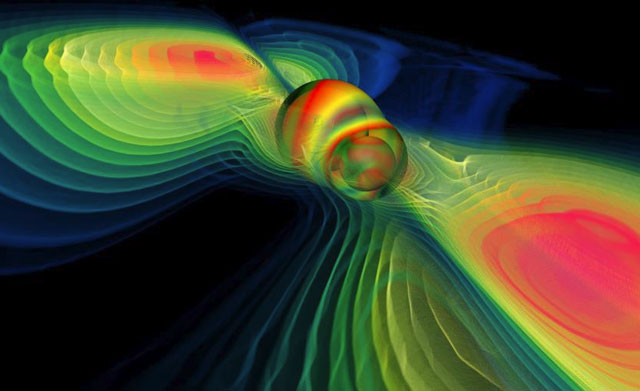
    Computer simulation of two merging black holes producing gravitational waves. Image: Werner Benger

    Scientists working at the LIGO experiment in the US have for the first time detected elusive ripples in the fabric of space and time known as gravitational waves. There is no doubt that the finding is one of the most ground-breaking physics discoveries of the past 100 years. But what are they?

    To best understand the phenomenon, let’s go back in time a few hundred years. In 1687, when Isaac Newton published his Philosophiæ Naturalis Principia Mathematica, he thought of the gravitational force as an attractive force between two masses — be it the Earth and the Moon or two peas on a table top. However, the nature of how this force was transmitted was less well understood at the time. Indeed, the law of gravitation itself was not tested until British scientist Henry Cavendish did so in 1798, while measuring the density of the Earth.

    Fast forward to 1916, when Einstein presented physicists with a new way of thinking about space, time and gravity. Building on work published in 1905, the theory of general relativity tied together that what we commonly consider to be separate entities — space and time — into what is now called “space-time”.

    Space-time can be considered to be the fabric of the universe. That means everything that moves, moves through it. In this model, anything with mass distorts the space-time fabric. The larger the mass, the larger the distortion. And since every moving object moves through space-time, it will also follow the distortions caused by objects with big mass.

    One way of thinking about this is to consider two children, one heavier than the other, playing on a trampoline. If we treat the surface of the trampoline as the fabric, then the more massive child distorts the fabric more than the other. If one child places a ball near the feet of the other then the ball will roll towards, or follow the distortion, towards their feet. Similarly, when the Earth goes around the sun, the huge mass of the sun distorts the space around it, leaving our comparatively tiny planet following as “straight” a path as it can, but in a curved space. This is why it ends up orbiting the sun.

    If we accept this simple analogy, then we have the basics of gravity. Moving on to gravitational waves is a small, but very important, step. Let one of the children on the trampoline pull a heavy object across the surface. This creates a ripple on the surface that can be observed. Another way to visualise it is to consider moving your hand through water. The ripples or waves spread out from their origin but quickly decay.

    Any object moving through the space-time fabric causes waves or ripples in that fabric. Unfortunately, these ripples also disappear fairly quickly and only the most violent events produce distortions big enough to be detected on Earth. To put this into perspective, two colliding black holes each with a mass of 10 times that of our sun would result in a wave causing a distortion of 1% of the diameter of an atom when it reaches the Earth. On this scale, the distortion is of the order of a 0,0000000000001m change in the diameter of the Earth compared to the 1m change due to a tidal bulge.

    What can gravitational waves be used for?

    Given that these ripples are so small and so difficult to detect, why have we made such an effort to find them — and why should we care about spotting them? Two immediate reasons come to mind (I’ll leave aside my own interest in simply wanting to know). One is that they were predicted by Einstein 100 years ago. Confirming the existence of gravitational waves therefore provides further strong observational support for his general theory of relativity.

    In addition, the confirmation could open up new areas of physics such as gravitational-wave astronomy. By studying gravitational waves from the processes that emitted them — in this case two merging black holes — we could see intimate details of violent events in the cosmos.
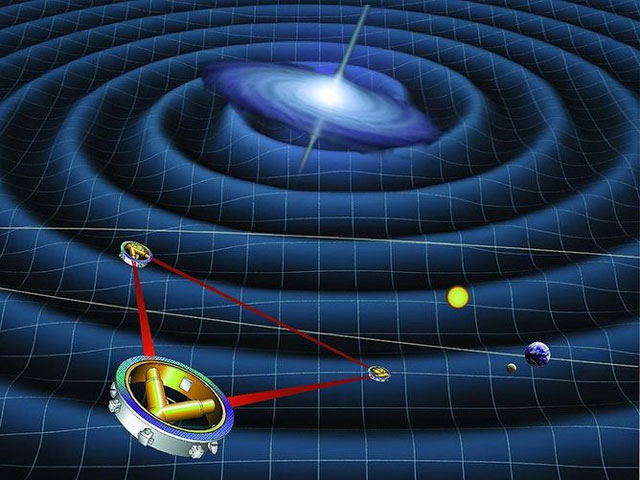
    LISA, a planned space-based laser interferometer, could study astrophysical sources of gravitational waves in detail. Image: Nasa
    Lisa, a planned space-based laser interferometer, could study astrophysical sources of gravitational waves in detail. Image: Nasa

    However, to make the most of such astronomy, it is best to place the detector in space. The Earth-based LIGO managed to catch gravitational waves using laser interferometry. This technique works by splitting a laser beam in two perpendicular directions and sending each down a long vacuum tunnel. The two paths are then reflected back by mirrors to the point they started at, where a detector is placed. If the waves are disturbed by gravitational waves on their way, the recombined beams would be different from the original. However, space-based interferometers planned for the next decade will use laser arms spanning up to a million kilometres.

    Now that we know that they exist, the hope is that gravitational waves could open up the door to answering some of the biggest mysteries in science, such as what the majority of the universe is made of. Only 5% of the universe is ordinary matter, with 27% being dark matter and the remaining 65% being dark energy, with the latter two being called “dark” as we don’t understand what they are. Gravitational waves may now provide a tool with which to probe these mysteries in a similar way that X-rays and MRI have allowed us to probe the human body.The Conversation

    • Gren Ireson professor of science education and research coordinator within the School of Education, Nottingham Trent University
    • This article was originally published on The Conversation

    Albert Einstein Gren Ireson Henry Cavendish Isaac Newton
    Subscribe to TechCentral Subscribe to TechCentral
    Share. Facebook Twitter LinkedIn WhatsApp Telegram Email Copy Link
    Previous ArticleSona 2016 sets social media records
    Next Article Gravitational waves found: the inside story

    Related Posts

    Scientists discover universe is awash in gravitational waves

    29 June 2023

    The standard model of particle physics may be broken

    11 May 2022

    Phenomenon that baffled Einstein is captured in photo for first time

    14 July 2019
    Company News
    AI is not a technology problem - iqbusiness

    AI is not a technology problem – iqbusiness

    5 December 2025
    Telcos are sitting on a data gold mine - but few know what do with it - Phillip du Plessis

    Telcos are sitting on a data gold mine – but few know what do with it

    4 December 2025
    Unlock smarter computing with your surface Copilot+ PC

    Unlock smarter computing with your Surface Copilot+ PC

    4 December 2025
    Opinion
    Your data, your hardware: the DIY AI revolution is coming - Duncan McLeod

    Your data, your hardware: the DIY AI revolution is coming

    20 November 2025
    Zero Carbon Charge founder Joubert Roux

    The energy revolution South Africa can’t afford to miss

    20 November 2025
    It's time for a new approach to government IT spend in South Africa - Richard Firth

    It’s time for a new approach to government IT spend in South Africa

    19 November 2025

    Subscribe to Updates

    Get the best South African technology news and analysis delivered to your e-mail inbox every morning.

    Latest Posts
    Big Microsoft 365 price increases coming next year

    Big Microsoft price increases coming next year

    5 December 2025
    AI is not a technology problem - iqbusiness

    AI is not a technology problem – iqbusiness

    5 December 2025
    Vodacom to take control of Safaricom in R36-billion deal - Shameel Joosub

    Vodacom to take control of Safaricom in R36-billion deal

    4 December 2025
    Black Friday goes digital in South Africa as online spending surges to record high

    Black Friday goes digital in South Africa as online spending surges to record high

    4 December 2025
    © 2009 - 2025 NewsCentral Media
    • Cookie policy (ZA)
    • TechCentral – privacy and Popia

    Type above and press Enter to search. Press Esc to cancel.

    Manage consent

    TechCentral uses cookies to enhance its offerings. Consenting to these technologies allows us to serve you better. Not consenting or withdrawing consent may adversely affect certain features and functions of the website.

    Functional Always active
    The technical storage or access is strictly necessary for the legitimate purpose of enabling the use of a specific service explicitly requested by the subscriber or user, or for the sole purpose of carrying out the transmission of a communication over an electronic communications network.
    Preferences
    The technical storage or access is necessary for the legitimate purpose of storing preferences that are not requested by the subscriber or user.
    Statistics
    The technical storage or access that is used exclusively for statistical purposes. The technical storage or access that is used exclusively for anonymous statistical purposes. Without a subpoena, voluntary compliance on the part of your Internet Service Provider, or additional records from a third party, information stored or retrieved for this purpose alone cannot usually be used to identify you.
    Marketing
    The technical storage or access is required to create user profiles to send advertising, or to track the user on a website or across several websites for similar marketing purposes.
    • Manage options
    • Manage services
    • Manage {vendor_count} vendors
    • Read more about these purposes
    View preferences
    • {title}
    • {title}
    • {title}