Close Menu
TechCentralTechCentral

    Subscribe to the newsletter

    Get the best South African technology news and analysis delivered to your e-mail inbox every morning.

    Facebook X (Twitter) YouTube LinkedIn
    WhatsApp Facebook X (Twitter) LinkedIn YouTube
    TechCentralTechCentral
    • News
      How AI agents are reshaping banking in South Africa - Lindelani Ramukumba, Absa

      How agentic AI is reshaping banking in South Africa

      5 April 2026
      South Africa's 5G boom is bypassing rural areas: Icasa

      South Africa’s 5G boom is bypassing rural areas: Icasa

      5 April 2026
      WhatsApp is eating South African operators' revenue

      WhatsApp is eating South African operators’ revenue

      4 April 2026
      DeepSeek V4 to run on Huawei silicon as China builds its own AI stack

      DeepSeek V4 to run on Huawei silicon as China builds its own AI stack

      4 April 2026
      Gaping holes in South African government cyber defences

      Gaping holes in South African government cyber defences

      2 April 2026
    • World
      Amazon in talks to buy satellite operator Globalstar

      Amazon in talks to buy satellite operator Globalstar

      2 April 2026

      Apple plans to open Siri to rival AI services

      27 March 2026
      It's official: ads are coming to ChatGPT

      It’s official: ads are coming to ChatGPT

      23 March 2026
      Mystery Chinese AI model revealed to be Xiaomi's

      Mystery Chinese AI model revealed to be Xiaomi’s

      19 March 2026
      A mystery AI model has developers buzzing

      A mystery AI model has developers buzzing

      18 March 2026
    • In-depth
      The biggest untapped EV market on Earth is hiding in plain sight

      The biggest untapped EV market on Earth is hiding in plain sight

      1 April 2026
      The R18-billion tech giant hiding in plain sight - Jens Montanana

      The R16-billion tech giant hiding in plain sight

      26 March 2026
      The last generation of coders

      The last generation of coders

      18 February 2026
      Sentech is in dire straits

      Sentech is in dire straits

      10 February 2026
      How liberalisation is rewiring South Africa's power sector

      How liberalisation is rewiring South Africa’s power sector

      21 January 2026
    • TCS
      TCS | MTN's Divysh Joshi on the strategy behind Pi - Divyesh Joshi

      TCS | MTN’s Divyesh Joshi on the strategy behind Pi

      1 April 2026
      Anoosh Rooplal

      TCS | Anoosh Rooplal on the Post Office’s last stand

      27 March 2026
      Meet the CIO | HealthBridge CTO Anton Fatti on the future of digital health

      Meet the CIO | Healthbridge CTO Anton Fatti on the future of digital health

      23 March 2026
      TCS+ | Arctic Wolf unpacks the evolving threat landscape for SA businesses - Clare Loveridge and Jason Oehley

      TCS+ | Arctic Wolf unpacks the evolving threat landscape for SA businesses

      19 March 2026
      TCS+ | Vox Kiwi: a wireless solution promising a fibre-like experience - Theo van Zyl

      TCS+ | Vox Kiwi: a wireless solution promising a fibre-like experience

      13 March 2026
    • Opinion
      The conflict of interest at the heart of PayShap's slow adoption - Cheslyn Jacobs

      The conflict of interest at the heart of PayShap’s slow adoption

      26 March 2026
      South Africa's energy future hinges on getting wheeling right - Aishah Gire

      South Africa’s energy future hinges on getting wheeling right

      10 March 2026
      Hold the doom: the case for a South African comeback - Duncan McLeod

      Apple just dropped a bomb on the Windows world

      5 March 2026
      VC's centre of gravity is shifting - and South Africa is in the frame - Alison Collier

      VC’s centre of gravity is shifting – and South Africa is in the frame

      3 March 2026
      Hold the doom: the case for a South African comeback - Duncan McLeod

      Hold the doom: the case for a South African comeback

      26 February 2026
    • Company Hubs
      • 1Stream
      • Africa Data Centres
      • AfriGIS
      • Altron Digital Business
      • Altron Document Solutions
      • Altron Group
      • Arctic Wolf
      • Ascent Technology
      • AvertITD
      • BBD
      • Braintree
      • CallMiner
      • CambriLearn
      • CYBER1 Solutions
      • Digicloud Africa
      • Digimune
      • Domains.co.za
      • ESET
      • Euphoria Telecom
      • HOSTAFRICA
      • Incredible Business
      • iONLINE
      • IQbusiness
      • Iris Network Systems
      • Kaspersky
      • LSD Open
      • Mitel
      • NEC XON
      • Netstar
      • Network Platforms
      • Next DLP
      • Ovations
      • Paracon
      • Paratus
      • Q-KON
      • SevenC
      • SkyWire
      • Solid8 Technologies
      • Telit Cinterion
      • Telviva
      • Tenable
      • Vertiv
      • Videri Digital
      • Vodacom Business
      • Wipro
      • Workday
      • XLink
    • Sections
      • AI and machine learning
      • Banking
      • Broadcasting and Media
      • Cloud services
      • Contact centres and CX
      • Cryptocurrencies
      • Education and skills
      • Electronics and hardware
      • Energy and sustainability
      • Enterprise software
      • Financial services
      • HealthTech
      • Information security
      • Internet and connectivity
      • Internet of Things
      • Investment
      • IT services
      • Lifestyle
      • Motoring
      • Policy and regulation
      • Public sector
      • Retail and e-commerce
      • Satellite communications
      • Science
      • SMEs and start-ups
      • Social media
      • Talent and leadership
      • Telecoms
    • Events
    • Advertise
    TechCentralTechCentral
    Home » In-depth » What the airport of the future will look like

    What the airport of the future will look like

    By Agency Staff21 July 2017
    Twitter LinkedIn Facebook WhatsApp Email Telegram Copy Link
    News Alerts
    WhatsApp
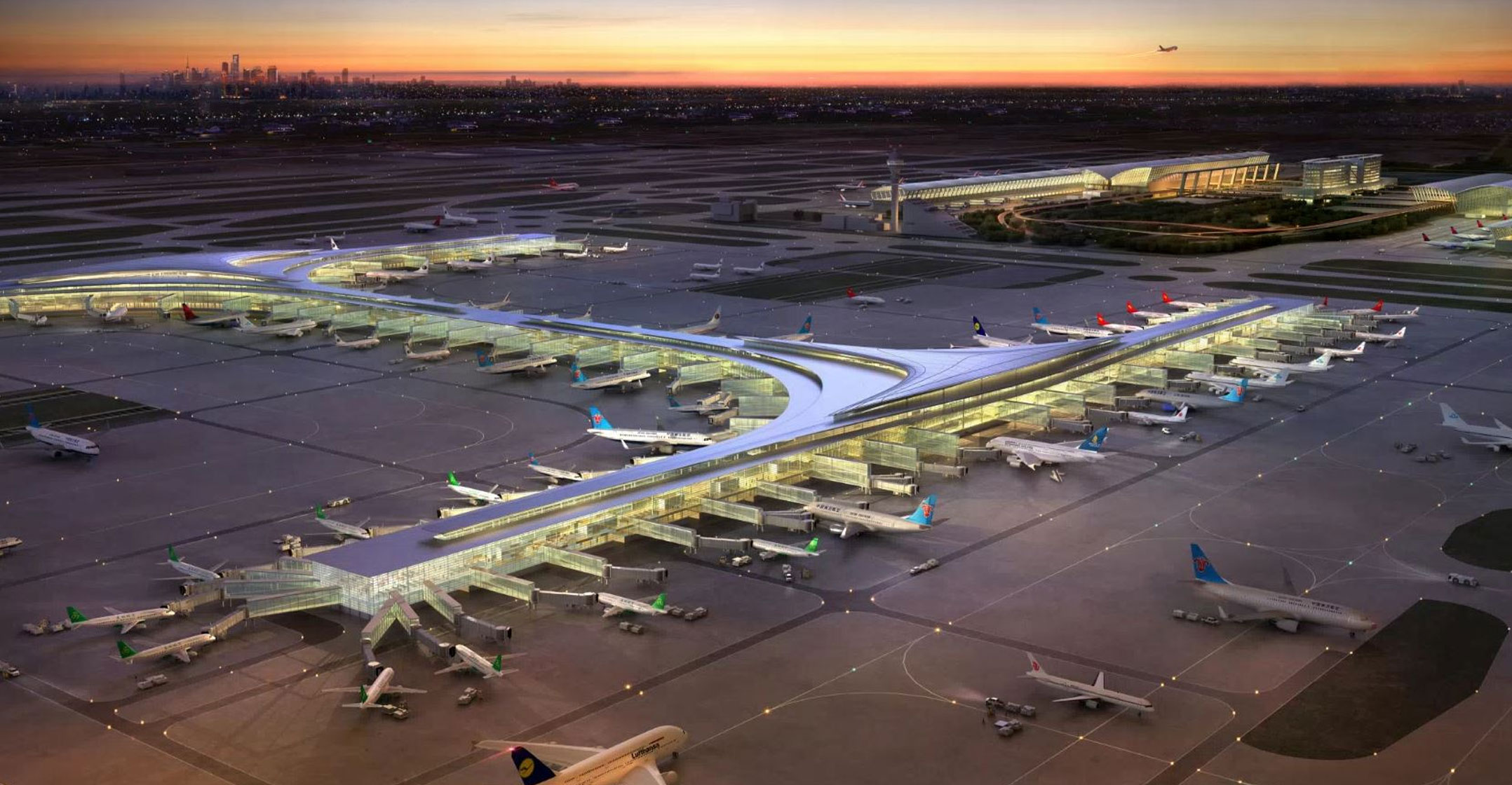
    Shanghai Airport’s proposed redesign. Image: Corgan

    [dropcap]N[/dropcap]o matter how well regarded a particular airport happens to be, the slog from kerb to cabin is pretty much the same wherever you go. A decades-old paradigm of queues, security screens, snack vendors and gate-waiting prevails — the only difference is the level of stress. Transiting a modern hub such as Munich or Seoul is more easily endured than threading your way through the perpetual construction zones that pass for airports around New York.

    The sky portal of the 2040s, however, is likely to be free of such delights. Many of us will be driven to the terminal by autonomous cars; our eyes, faces and fingers will be scanned; and our bags will have a permanent ID that allows them to be whisked from our homes before we even set out. Some of these airports will no longer be relegated to the outskirts of town — they will merge with city centres, becoming new destination “cities” within a city for people without travel plans. Shall we get dinner, watch a movie, see a concert, shop? People will choose to go to the airport. Your employer may even relocate there.

    The goal will be to deploy a security infrastructure that’s constantly screening people from the door to the gate, and not having this toll-booth mentality

    These are the types of infrastructure investments and technologies that will, in theory, allow airports to largely eradicate the dreaded waiting. Travellers will migrate around the terminal faster and see fewer walls and physical barriers thanks to the abundance of sophisticated sensors, predicts Dallas-based architecture and design firm Corgan. The company recently assembled its concepts of how airports will evolve, based on extensive research of passenger experiences at various airports and the greater role technology may play.

    One day, the airport will know “everything about everyone moving in the airport”, said Seth Young, director of the Centre for Aviation Studies at Ohio State University. The goal will be to deploy “a security infrastructure that’s constantly screening people from the door to the gate, and not having this toll-booth mentality”, he said. “We know that 99.9% of the passengers are clean, so why are we wasting time screening all of those?”

    Singapore

    Much of this technology is likely to be seen outside the US first, given the advanced age of most American airports and the more robust infrastructure funding available in Asia, the Middle East and Europe. In the 2017 Skytrax awards, only 14 airports in the US even made the top 100.

    One can look to Singapore for a glimpse of how airports will change over the next 20 years. Changi Airport, a pioneer of the industry, recently opened a “living lab” to pursue further innovation. In March, it was named the world’s best airport for the fifth consecutive year by Skytrax.

    Design for Dalian International Airport in China. Image: Corgan

    One reason airports tend to look and function remarkably alike is that they’re designed to accommodate air travel infrastructure — security, passenger ticketing, baggage, ground transport — with the primary concerns being safety and minimal overhead for their tenant airlines.

    “Today it’s what you call a transient space — it’s not a space to be in, it’s a space for you to move through,” said Jonathan Massey, the aviation leader for Corgan, which has overseen the design of major terminals worldwide, including Atlanta, Dallas, Shanghai, Dalian, China and Los Angeles. “We need to evolve the terminals into being little cities.”

    We’re rapidly moving toward a day when your fingerprint, iris or face will become the only ID you’ll need for any number of transactions throughout a given day

    As part of the research, Corgan designers measured anxiety levels for different passenger types. The greatest offender among all groups was the security checkpoint, that confined space of shoe-doffing, laptop-extraction, and frisky government agents barking orders. “A lot of the stress in an airport is perceived, it’s spatial,” said Samantha Flores, a Corgan associate.

    But when it comes to the biggest infrastructure burden, one aspect of today’s airports stands out. “The big, big issue,” said Dwight Pullen, is luggage.

    Pullen, national director of aviation at Skanska USA, a construction firm with numerous airport projects, including the renovation of New York’s infamous LaGuardia, said: “Think about how much infrastructure and technology and time is spent on bags. It’s a huge issue. It’s not one that has been figured out.”

    ‘Fast and seamless’

    Changi Airport’s new Terminal 4, which will open later this year, will feature an array of “fast and seamless travel” (Fast) technologies to speed people-processing without the need for human supervision, from face-recognition software to automated bag-tagging and checking.

    Two US carriers, Delta Air Lines and JetBlue Airways, recently began trials of biometrics data as a way to speed your way. JetBlue is testing facial recognition equipment in Boston to match travellers with their passports and visa photos, while Delta just began trials of a similar system for bag drops at its Minneapolis-St Paul hub. Delta is also trying out fingerprints as a potential future replacement for boarding passes and ID and, via its mobile app, now offers customers real-time maps showing their checked bags’ location.

    Helsinki Airport redesign

    “We’re rapidly moving toward a day when your fingerprint, iris or face will become the only ID you’ll need for any number of transactions throughout a given day,” said Gil West, Delta’s chief operating officer.

    Amid all this increased efficiency, airports are also keen to have people linger so they’ll buy more stuff — and that means a continuous focus on more upscale retail options. “The number of passengers that flow through airports really rivals any other mechanism out there that can congregate that many customers in one place,” says Ken Buchanan, executive vice president of revenue management for Dallas-Fort Worth International, the fourth largest US airport by passenger numbers. “It’s like having a Super Bowl worth of people every single day.”

    But while technology helps make the airport experience more pleasant, the size of that captive audience may begin shrinking due to, well, technology.

    Our efforts to grow Changi’s commercial business and provide an enjoyable shopping and dining experience is part and parcel of enhancing the overall airport experience

    One thing that may thin out the terminal crowds is cars. Ohio State’s Young and others see a day when autonomous vehicles — and air taxis of the sort Uber envisions — will siphon off a chunk of shorter flights that are 800km or less. For US airports, the ascension of self-driving cars will create a costly conundrum: how to replace parking revenue, which typically represents a quarter of annual airport budgets.

    To find new revenue, airport executives will need to attract dollars in other ways, via dining, shopping and entertainment. Since that may not be enough, new business models will be needed for ground transportation and commercial office space; perhaps new revenue may accrue from baggage delivery service.

    Amenities in an airport — movies, bowling, butterfly gardens and virtual reality golf — are becoming de rigueur for many Asian and Middle Eastern hubs. Singapore’s Jewel Changi extension at Terminal 1, set to open in early 2019, will offer a five-storey garden with thousands of trees and plants, along with a 40m “Rain Vortex” lighted water display. Similar themes are apparent in the designs for Helsinki Airport’s Terminal 2 expansion, set for 2021, which includes an indoor forest.

    At Changi, concession revenues rose 5% last year to a record US$1.6bn, while the world’s busiest airport, Atlanta’s Hartsfield-Jackson International, topped $1bn in concession sales in 2016, also a record.

    “Our efforts to grow Changi’s commercial business and provide an enjoyable shopping and dining experience is part and parcel of enhancing the overall airport experience for our passengers, and will continue in the years to come,” the airport said in an e-mailed statement.

    “No matter what,” Young said, “airports want to make it efficient.” That means getting through quickly — be it arriving, departing or transferring. “But they love it when people are at the airport,” he added, “because of the opportunities to spend money.”  — Reported by Justin Bachman, (c) 2017 Bloomberg LP

    Follow TechCentral on Google News Add TechCentral as your preferred source on Google


    top
    WhatsApp YouTube
    Share. Facebook Twitter LinkedIn WhatsApp Telegram Email Copy Link
    Previous ArticleVodacom thumbs its nose at weak SA economy
    Next Article Bitcoin surges as community embraces SegWit2x

    Related Posts

    18GW in unplanned breakdowns cripple Eskom

    2 November 2021

    Nersa kicks the Karpowership can down the road

    13 September 2021

    If you think South African load shedding is bad, try Zimbabwe’s

    13 September 2021
    Company News
    Synthesis helps financial enterprises transform with new Gemini Enterprise - Digicloud Africa

    Synthesis helps financial enterprises transform with new Gemini Enterprise

    2 April 2026
    The next churn wave is already in your contact centre conversations - CallMiner

    The next churn wave is already in your contact centre conversations

    2 April 2026
    Mining's problem isn't output, it's execution - Workday

    Mining’s problem isn’t output, it’s execution – Workday

    1 April 2026
    Opinion
    The conflict of interest at the heart of PayShap's slow adoption - Cheslyn Jacobs

    The conflict of interest at the heart of PayShap’s slow adoption

    26 March 2026
    South Africa's energy future hinges on getting wheeling right - Aishah Gire

    South Africa’s energy future hinges on getting wheeling right

    10 March 2026
    Hold the doom: the case for a South African comeback - Duncan McLeod

    Apple just dropped a bomb on the Windows world

    5 March 2026

    Subscribe to Updates

    Get the best South African technology news and analysis delivered to your e-mail inbox every morning.

    Latest Posts
    How AI agents are reshaping banking in South Africa - Lindelani Ramukumba, Absa

    How agentic AI is reshaping banking in South Africa

    5 April 2026
    South Africa's 5G boom is bypassing rural areas: Icasa

    South Africa’s 5G boom is bypassing rural areas: Icasa

    5 April 2026
    WhatsApp is eating South African operators' revenue

    WhatsApp is eating South African operators’ revenue

    4 April 2026
    DeepSeek V4 to run on Huawei silicon as China builds its own AI stack

    DeepSeek V4 to run on Huawei silicon as China builds its own AI stack

    4 April 2026
    © 2009 - 2026 NewsCentral Media
    • Cookie policy (ZA)
    • TechCentral – privacy and Popia

    Type above and press Enter to search. Press Esc to cancel.

    Manage consent

    TechCentral uses cookies to enhance its offerings. Consenting to these technologies allows us to serve you better. Not consenting or withdrawing consent may adversely affect certain features and functions of the website.

    Functional Always active
    The technical storage or access is strictly necessary for the legitimate purpose of enabling the use of a specific service explicitly requested by the subscriber or user, or for the sole purpose of carrying out the transmission of a communication over an electronic communications network.
    Preferences
    The technical storage or access is necessary for the legitimate purpose of storing preferences that are not requested by the subscriber or user.
    Statistics
    The technical storage or access that is used exclusively for statistical purposes. The technical storage or access that is used exclusively for anonymous statistical purposes. Without a subpoena, voluntary compliance on the part of your Internet Service Provider, or additional records from a third party, information stored or retrieved for this purpose alone cannot usually be used to identify you.
    Marketing
    The technical storage or access is required to create user profiles to send advertising, or to track the user on a website or across several websites for similar marketing purposes.
    • Manage options
    • Manage services
    • Manage {vendor_count} vendors
    • Read more about these purposes
    View preferences
    • {title}
    • {title}
    • {title}